
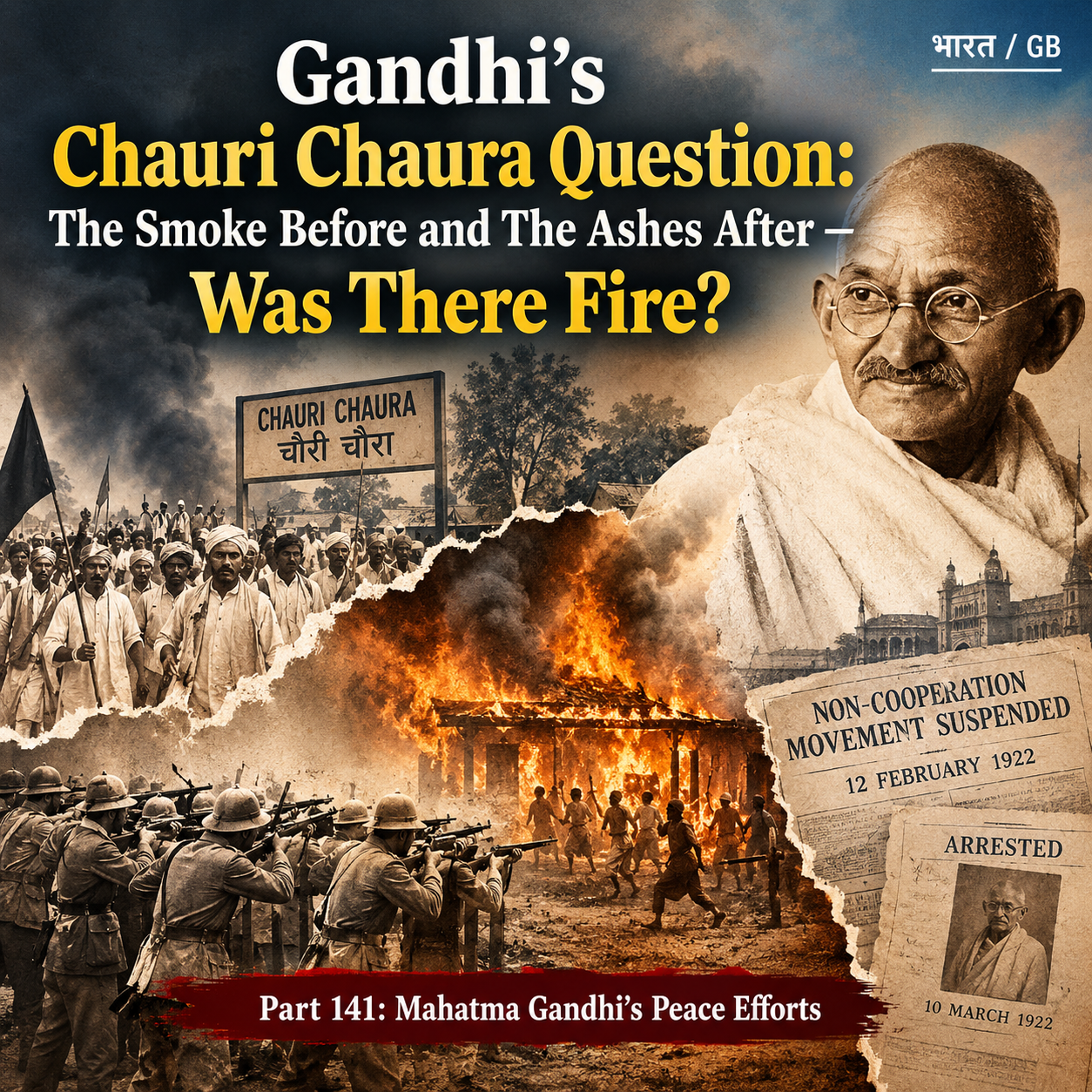
Gandhi’s Chauri Chaura Question: The Smoke Before and The Ashes After — Was There Fire? (141)
भारत / GB
Part 141: Mahatma Gandhi’s Peace Efforts | Series Index
Blog 130 placed the documented events of February 4 1922 before the reader — police fired first, crowd retaliated, 22 policemen dead, Gandhi suspended the national movement eight days later. This post, Gandhi’s Chauri Chaura Question, places something different before the reader: the documented conditions before February 4, the documented outcomes after February 4, and one question the prosecution places before the reader without answering.
Thank you for reading this post, don't forget to subscribe!The Action Taken: Gandhi incorporated specific protective textile tariffs and rupee exchange ratio demands into his 11-point national charter, directly aligning the campaign with the commercial objectives of domestic mill owners.
Who Paid the Price: Domestic consumers of cloth, who faced higher prices for domestic mill production while foreign competition was boycotted.
The Alternative Bypassed: Prioritizing pure peasant relief and general tax reductions without incorporating selective industrial protectionist demands.
Why This Matters: Concrete policy convergence: the national charter integrated specific tariff demands that protected the balance sheets of domestic industrial donors.
The Method — Smoke and Ashes
Gandhi’s Chauri Chaura Question places its method before the reader at the outset. The prosecution does not assert that the British administration planted the Chauri Chaura incident. It does not claim a conspiracy was documented. It does not assert intent beyond what the documented record establishes.
It places the documented smoke before February 4 before the reader. It places the documented ashes after February 4 before the reader. And it places one question before the reader — without answering it.
The Smoke — What Was Documented Before February 4 1922
Gandhi’s Chauri Chaura Question places five documented facts before the reader — all preceding February 4 1922.
November 1921: The British administration’s own documented correspondence — established in Blog 29 of this series — recorded genuine alarm at the Non-Cooperation Movement’s momentum. Viceroy Lord Reading’s despatches to Secretary of State Edwin Montagu documented that the movement had reached a scale threatening the basic operation of government authority across urban and rural centres. The documented alarm was at its highest recorded point.
December 1921 — one month later: The United Provinces Government under Governor Sir Spencer Harcourt Butler declared the Swarajya Sewak Dals — the Non-Cooperation volunteer corps — illegal. District magistrates and police superintendents were directed to physically disperse volunteer gatherings and conduct mass arrests. This directive was issued one month after the documented peak alarm of November 1921.
The documented local conditions at Chauri Chaura: Historian Shahid Amin — whose *Event, Metaphor, Memory: Chauri Chaura 1922-1992* (OUP, 1995) is the definitive historical reconstruction of the incident — documents the local conditions precisely. The Gorakhpur villages around Chauri Chaura had a documented long history of conflict with local police. The Daroga at Chauri Chaura had a documented personal reputation for extorting bribes. The Non-Cooperation volunteer corps had become the only effective check on documented local police excess.
February 1 1922 — three days before: Head constable Gupteshwar Singh beat and humiliated Bhagwan Ahir — a decorated World War I veteran and local volunteer leader — during a documented temperance picket. This documented beating was the immediate trigger for the February 4 gathering.
February 4 1922: As Shahid Amin documents — the February 4 procession was not a random gathering. It was a disciplined volunteer corps demonstration. When the police fired, the crowd interpreted it as continued police brutality, not as the legitimate use of authority.
The Ashes — What Was Documented After February 4 1922
Gandhi’s Chauri Chaura Question places four documented facts before the reader — all following February 4 1922.
February 12 1922: Gandhi suspended the entire Non-Cooperation Movement unilaterally at Bardoli. The documented alarm of November 1921 — the British administration’s own recorded assessment that the movement threatened the basic operation of government authority — was immediately relieved.
The British administration’s documented reaction: Relief. Established in Blog 133 of this series from documented contemporary sources.
March 10 1922: Gandhi was arrested. Tried. Sentenced to six years. The movement’s principal author was removed from active leadership for two years — without the British administration needing to deploy the suppression it had documented as necessary in November 1921.
The documented outcome: The Non-Cooperation Movement — the largest civilian uprising in colonial history, which had brought the British administration to its own documented breaking point — was suspended by Gandhi himself. The British administration did not crush it. Gandhi crushed it.
The Third Documented Exhibit — Shahid Amin’s Critique
Gandhi’s Chauri Chaura Question places one further documented exhibit before the reader — from the definitive historian of the incident.
Shahid Amin’s subaltern critique — documented in *Event, Metaphor, Memory* — places a third reading alongside the standard accounts. Gandhi’s suspension was not solely a moral response to crowd violence. It was also, Amin documents, a class response: elite nationalist leadership reasserting control over a peasant movement that had begun operating autonomously outside the documented framework of Gandhian non-violence. The February 4 procession was disciplined. The volunteer corps was organised. The peasant participants were acting on documented local grievances — police extortion, economic distress, documented Volunteer Corps organisation — within a movement whose leadership had not anticipated the degree of autonomous agency the peasant participants were exercising.
The prosecution places Amin’s documented critique alongside the five smoke exhibits and the four ash exhibits — and asks the reader to examine what the documented conditions before February 4, the documented outcomes after February 4, and the documented class dimension of Gandhi’s response together establish.
The Question
Gandhi’s Chauri Chaura Question places the prosecution’s documented sequence before the reader in full:
November 1921 — documented British alarm at its highest recorded point.
December 1921 — documented directive criminalising volunteer corps, authorising aggressive local policing, issued one month after the documented alarm.
February 1 1922 — documented beating of Bhagwan Ahir by local police.
February 4 1922 — documented disciplined procession, documented police firing, documented crowd retaliation.
February 12 1922 — documented Gandhi suspension. Documented British relief.
The prosecution places one question before the reader — and does not answer it:
Was there fire?
The reader will examine the documented smoke, the documented ashes, and the documented sequence — and complete the sentence.
The Prosecution’s Position
Gandhi’s Chauri Chaura Question places three observations before the reader.
- The prosecution does not assert that the British administration conspired to engineer the Chauri Chaura incident. It places the documented timing — peak alarm November 1921, aggressive coercive directive December 1921, incident February 4 1922 — before the reader without asserting the causal connection between them. The reader examines the timing.
- The prosecution places the documented asymmetric payoff before the reader: if the volunteer corps submitted to Butler’s December 1921 directive, the boycott collapsed; if volunteers retaliated to documented police aggression, Gandhi self-suspended — as he had documented himself doing in April 1919 after Rowlatt. The British administration had observed Gandhi’s documented self-suspension in 1919. The December 1921 directive was issued with that documented observation on the record.
- The prosecution places Shahid Amin’s documented third critique before the reader alongside the smoke and the ashes: Gandhi’s suspension had a documented class dimension — elite reassertion of control over autonomous peasant agency — that the British administration did not need to engineer, but whose documented outcome served the colonial administration’s documented interests precisely.
The series does not answer. Gandhi’s Chauri Chaura Question places the smoke, the ashes, and the question before the reader. The reader will complete the sentence.
Invitation To Defence
The floor belongs to the defense. We now invite them to present their exhibits and challenge the narrative established by the prosecution.
November 1921: documented British alarm at its peak. December 1921: volunteer corps criminalised, aggressive policing authorised — one month after the documented alarm. February 1: Bhagwan Ahir beaten. February 4: disciplined procession, police fired, crowd retaliated. February 12: Gandhi suspended the national movement. British relief documented. British administration did not need to crush the movement. Gandhi crushed it. The prosecution places the smoke before February 4 and the ashes after February 4 before the reader — and asks one question. Was there fire? The reader will complete the sentence.
Feature Image: Click here to view the image.
Videos
Gandhi’s Chauri Chaura Question: Was There Fire? | HinduinfoPedia
गांधी का चौरी चौरा प्रश्न: क्या आग थी? | HinduinfoPedia
Glossary of Terms
- Chauri Chaura: The locality in Gorakhpur associated with the February 4, 1922 confrontation in which police fired on a procession and the crowd retaliated, resulting in the deaths of 22 policemen.
- Non-Cooperation Movement: The nationwide anti-colonial movement led by Gandhi that he suspended on February 12, 1922, following the Chauri Chaura incident.
- Swarajya Sewak Dals: The Non-Cooperation volunteer corps that the United Provinces Government declared illegal in December 1921 and ordered local authorities to disperse and arrest.
- Volunteer Corps: Organized groups of Non-Cooperation volunteers that participated in demonstrations and local campaigns and became an important force in the Chauri Chaura area.
- Subaltern Critique: A historical interpretation focused on the actions and agency of subordinated groups, particularly peasants, rather than viewing events only through elite nationalist leadership.
- Class Response: The blog’s characterization of Gandhi’s suspension as partly a response by elite nationalist leadership to autonomous peasant action within the movement.
- Autonomous Agency: The independent capacity of peasant participants to organize and act beyond the expectations or control of the movement’s central leadership.
- Documented Smoke: A phrase coined in the blog for the documented political and local conditions that existed before February 4, 1922.
- Documented Ashes: A phrase coined in the blog for the documented consequences following February 4, 1922, particularly Gandhi’s suspension and the British administration’s relief.
- Gandhi’s Chauri Chaura Question: The blog’s central analytical phrase for examining the documented conditions before Chauri Chaura and the documented outcomes afterward without asserting a proven conspiracy.
- British Alarm: The documented concern within the British administration over the growing scale and potential impact of the Non-Cooperation Movement, described as reaching its highest recorded point in November 1921.
- Asymmetric Payoff: The blog’s phrase describing the contrasting consequences facing the movement: submission to restrictions would weaken the movement, while retaliation against police aggression would provide the circumstances for Gandhi to suspend it.
- Shahid Amin: The historian whose Event, Metaphor, Memory: Chauri Chaura 1922-1992 is used in the blog as a major historical source and as the basis for its third, subaltern reading.
- Documented Sequence: A phrase used in the blog for the chronological chain from British alarm in November 1921 through the December directive, the February 1 beating, the February 4 confrontation, and Gandhi’s February 12 suspension.
- Invitation to Defence: A series-specific phrase inviting the opposing side to present evidence and challenge the interpretation established by the prosecution.
#ChauriChaura #Gandhi #MahatmaGandhi #NonCooperation #IndianHistory #BritishIndia #FreedomMovement #History #HinduinfoPedia
Gandhi’s Peace Efforts: The Questions Before the Mahatma (0)
Refer to Various Arks Referred to in the Blog