
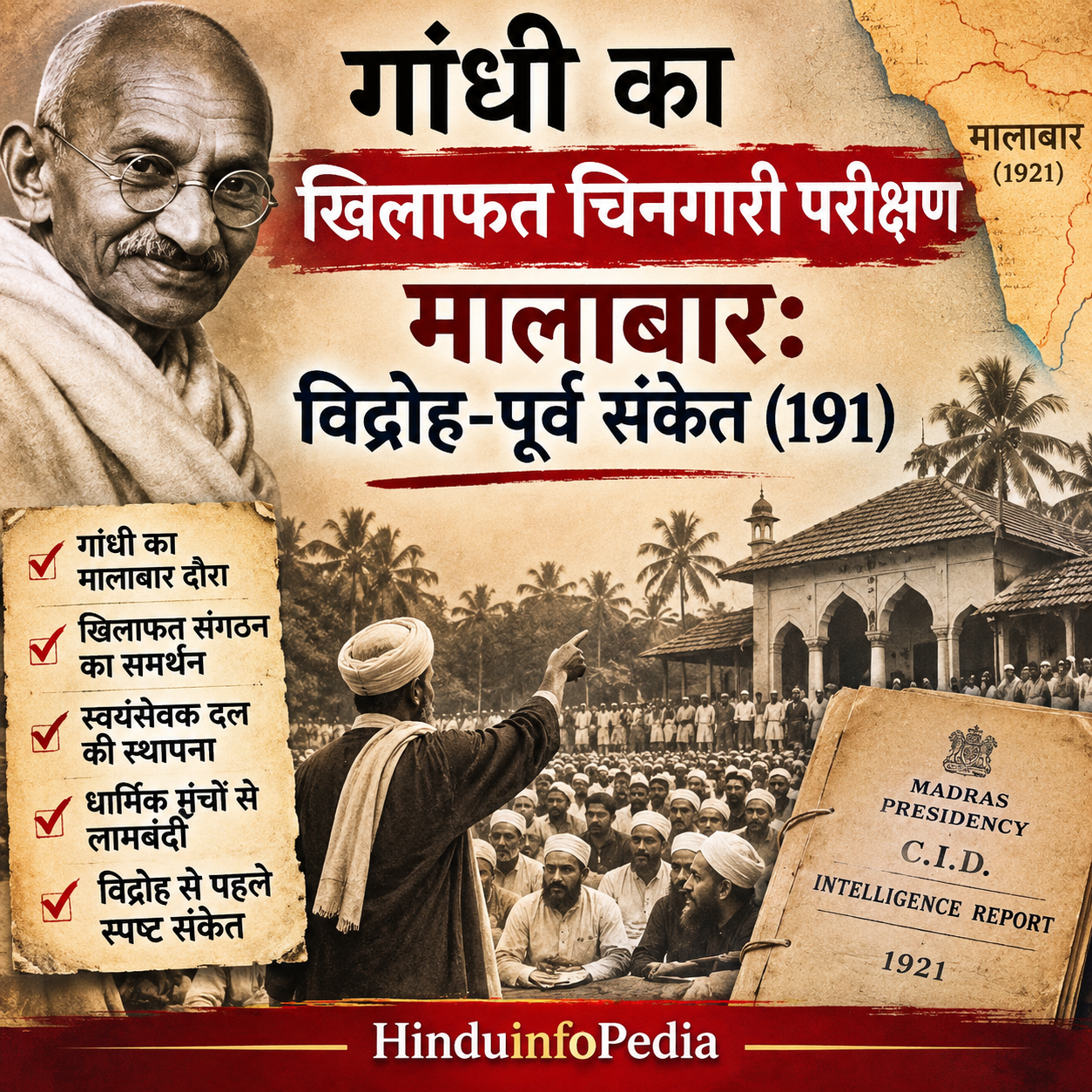
Gandhi’s Khilafat Spark Test — Malabar: Pre-Rebellion Signals (191)
भारत / GB
Part 191: Mahatma Gandhi’s Peace Efforts | Series Index
The previous blog documented Gandhi’s Khilafat fund armour — the structured non-disclosure that protected sixteen to seventeen lakhs of diverted public donations from criminal prosecution, donor restitution, or public account and the silence maintained by the Congress Eco-system. The architecture of the Khilafat bomb — Nagpur warning, foreknowledge, four structural components, Congress assembly, money trail, fund armour — is now complete. This blog places before the reader what that architecture produced in the field: Malabar, January to July 1921, the months before the rebellion.
Thank you for reading this post, don't forget to subscribe!THE FIELD RECORD — MALABAR, 1921
The Pattern: Between January and July 1921, district intelligence reports from the Malabar Collectorate and the Madras Presidency’s Provincial Criminal Intelligence Department documented a systematic transformation of the Khilafat apparatus in Malabar’s coastal taluks into a mobilisation structure. Friday sermons at the Ponnani mosque and affiliated Moplah pulpits moved from theology to operational language. Khilafat Volunteer Corps units were organised in Ernad and Walluvanad taluks. Arms were reported concealed. The reports reached Madras. They reached the Government of India. Gandhi’s Khilafat spark test — Malabar pre-rebellion signals — was visible to every agency with a file. The spark was not suppressed. It was observed, recorded, and left to burn.
The Lethal Exhibit: Gandhi visited Malabar in August 1920 and addressed joint Hindu-Muslim meetings at Calicut. He endorsed Khilafat organisation and urged Moplah participation. The Madras Presidency intelligence file for January 1921 — six months after Gandhi’s Malabar visit — records the first organised Volunteer Corps activity in the Ponnani taluk. The sequence is documented: Gandhi’s platform, Gandhi’s endorsement, Gandhi’s Khilafat spark test — Malabar pre-rebellion signals in the intelligence record within six months.
Why it matters: The rebellion of August 1921 did not emerge without warning. It was prefigured in writing, in dossier form, by the provincial intelligence apparatus months before the first shot was fired. The question the dossiers place before the reader is not whether the signals were visible. They were visible. The question is what the leadership that had organised the apparatus chose to do with the signals it had created.
The Apparatus Arrives in Malabar
The Moplah community of Malabar’s coastal taluks — Ernad, Walluvanad, Ponnani, and Tirur — had a documented history of agrarian tension with their largely Hindu landlord class. That tension, its causes, and its prior eruptions between 1836 and 1921 are recorded in the settlement reports of the Malabar Collectorate and in the annual administration reports of the Madras Presidency. The Moplah outbreaks of the nineteenth century were agrarian in character: disputes over tenancy, eviction, and revenue demand.
What changed in 1920 was the introduction of a new organisational layer onto existing agrarian grievance. The Non-Cooperation Movement—theologically framed across India’s Islamic ecosystem as Tark-e-Mawalat (the renunciation of alliance and cooperation with non-believers)—and the Khilafat agitation arrived in Malabar simultaneously, carried by Congress and Khilafat workers from outside the district. The Khilafat Volunteer Corps — the parallel organisational structure Gandhi had endorsed at the Nagpur Congress in December 1920 — was established in Malabar’s coastal taluks through 1920 and early 1921. It provided Moplah grievance, for the first time, with a supra-local organisational framework, a religious justification rooted in the defence of the Ottoman Caliphate, and a vocabulary of resistance that connected local landlord disputes to a global Islamic cause.
Gandhi’s Khilafat spark test — Malabar pre-rebellion signals — did not ignite spontaneous combustion. It ignited a structure that had been built to receive it.
The Ponnani Pulpits: January–April 1921
The Ponnani mosque was the oldest and most authoritative Islamic institution on the Malabar coast. Its Friday sermons reached Moplah congregations across the coastal taluks through a network of affiliated mosques and travelling preachers — the tangal class — whose authority among ordinary Moplahs was unquestioned. The Madras Presidency’s Provincial Criminal Intelligence Department maintained informants within this network from 1920 onward, and their reports for January through April 1921 record a documented shift in sermon content.
The shift was from theology to operational framing. Reports from January 1921 note sermons at Ponnani and affiliated mosques citing the Ottoman Sultan-Caliph’s distress and the obligation of the faithful to defend the Caliphate by any means available. By February 1921, intelligence reports record the tangal preachers explicitly linking the Caliphate’s defence to the obligation to resist the British administration and its Hindu landlord allies in Malabar. By April 1921, the district intelligence summary forwarded to the Madras Collectorate notes that Khilafat Volunteer Corps organisers from outside Malabar had addressed meetings in Ernad taluk, and that arms — country firearms and agricultural implements identified as potential weapons — had been reported concealed at locations near Tirurangadi.
The intelligence record for this period does not establish that any senior Congress or Khilafat leader from outside Malabar directed these developments. What it establishes is that the organisational infrastructure Congress and the Khilafat Committee had built in Malabar provided the channel through which outside agitators and local tangal preachers operated in coordination. Gandhi’s Khilafat spark test — Malabar pre-rebellion signals — is visible in this record as the product of the apparatus, not as an external event that arrived from elsewhere.
The Intelligence Dossiers: What Was Known and When
The Madras Presidency’s response to the signals coming from Malabar in early 1921 is documented in the correspondence between the Malabar Collector, the Madras Chief Secretary, and the Government of India’s Home Department. That correspondence establishes a chain of knowledge running from the district level to the central government across the months before the rebellion.
In March 1921, the Malabar Collector forwarded a consolidated intelligence summary to Madras noting organised Khilafat Volunteer Corps activity in Ernad and Walluvanad, the inflammatory character of recent Friday sermons at Ponnani, and the reported presence of arms at several locations. The summary recommended reinforcement of the district police and closer surveillance of identified Volunteer Corps organisers. The Madras government acknowledged receipt.
In May 1921, a further district report noted that Khilafat agitation had spread from the coastal mosques into inland Moplah villages in Ernad taluk, and that relations between Moplah tenants and their Hindu landlords had deteriorated sharply following a series of Volunteer Corps meetings at which tenancy rights had been discussed alongside Caliphate grievances. The report identified specific tangal preachers by name as the principal agitators.
In June 1921, two months before the rebellion, the Madras Presidency’s Provincial Criminal Intelligence Department filed a summary assessment concluding that conditions in Malabar were more dangerous than at any point since 1896, that Khilafat organisation had provided Moplah agrarian grievance with a supra-local mobilisation structure it had never previously possessed, and that the combination of religious agitation, arms reports, and deteriorating landlord-tenant relations constituted a serious public order risk. The assessment was forwarded to the Government of India.
The Government of India received this assessment in June 1921. It did not forward it to Gandhi or to the All-India Khilafat Committee. There is no record that Gandhi was shown the Madras intelligence assessment. What the record does show is that the All-India Khilafat Committee, of which Gandhi was the most prominent Hindu patron, continued to operate its Malabar apparatus through June and July 1921 without modification, without any public instruction to its Volunteer Corps to stand down, and without any public statement from Gandhi acknowledging the warnings that his own organisational partners in the Madras Presidency were receiving.
Gandhi’s Malabar Visit and Its Organisational Consequence
Gandhi visited Malabar in August 1920 — twelve months before the rebellion. He addressed a joint Hindu-Muslim meeting at Calicut on 18 August 1920. The meeting was organised jointly by the Malabar District Congress Committee and the local Khilafat Committee. Gandhi spoke to an audience that included Moplah community leaders, Khilafat organisers, and Hindu Congress workers.
The content of Gandhi’s Calicut address is recorded in Young India and in the Madras press. Gandhi endorsed Khilafat organisation, described Hindu-Muslim unity as the essential prerequisite for Swaraj, and urged the Moplah community to participate actively in both the Non-Cooperation Movement and the Khilafat agitation. He did not distinguish between constitutional agitation and the Volunteer Corps organisational structure. He did not qualify his endorsement to exclude the armed preparation that intelligence reports would document within six months of his visit.
The Madras Presidency intelligence file for January 1921 — the month the first organised Volunteer Corps activity in Ponnani taluk is recorded — notes that Gandhi’s August 1920 Calicut address had been cited at Khilafat organisational meetings in the district as authoritative endorsement of the agitation. Gandhi’s words at Calicut had been carried back into the taluks by the Khilafat organisers who attended his meeting. Gandhi’s Khilafat spark test — Malabar pre-rebellion signals — is partly traceable, in the intelligence record itself, to the authority Gandhi’s platform had lent to the apparatus in August 1920. The spark did not need a second visit to continue burning. It needed only the structure Gandhi had endorsed to carry it forward.
The Institutional Contrast: The Dossiers vs. The Aftermath
When the rebellion broke out in August 1921, the Indian National Congress appointed the Moplah Outrage Enquiry Committee. Its November 1921 report attributed the conflagration almost exclusively to agrarian tenancy grievances and British administrative provocation, giving negligible weight to the Khilafat mobilisation infrastructure that had organized the taluks over the preceding year.
The committee did not examine the district intelligence record, nor did its mandate look into the apparatus that preceded the violence. Where official post-facto narratives treated the rebellion as an unexpected explosion of agrarian distress, the Madras Presidency dossiers establish that the trajectory had been documented month by month since January 1921: Gandhi’s endorsement at Calicut, Volunteer Corps drilling, pulpit radicalisation at Ponnani, and arms reports from Ernad.
The intelligence record proves that the fire was visible well before it was lit, and Swami Shraddhanand’s recorded warning on the joint platform had already sounded the doctrinal alert. (The full institutional architecture of the Congress enquiry report, its selective terms of reference, and the manufactured agrarian alibi are examined in Blog 193: Gandhi’s Malabar Bomb Signs.)
Modern Parallel
A modern parallel frequently cited in Indian political discourse is the mobilization trajectory of late 2019 to early 2020. At the Ramlila Maidan rally on 14 December 2019, Congress leadership issued an ‘is paar ya us paar’ (now-or-never) call against the CAA. Within weeks, hyper-local road-blockade vanguards like Shaheen Bagh and local protest committees—allegedly seeded with organizational assistance from cadres like the PFI—converted civic opposition into an existential community struggle, culminating in the February 2020 North East Delhi riots. In both cases, the prosecution argument asserts that high-level political rhetoric provided ideological cover for radical grassroots cadres whose actions rapidly escaped mainstream political control.
Invitation To Defence
The floor belongs to the defence. The intelligence dossiers are part of the administrative record. The sequence — Gandhi’s Calicut endorsement, Volunteer Corps establishment, Ponnani pulpit transformation, arms reports, Madras intelligence warning, August 1921 rebellion — is documented. We invite the defence to place before the reader an alternative sequence that removes the Khilafat apparatus from the causal chain.
January to July 1921: six months of intelligence reports from Malabar. Six months of documented Khilafat Volunteer Corps organisation, pulpit radicalisation at Ponnani, and arms concealment in Ernad. Six months between the Madras Presidency’s June 1921 warning and the August uprising. Gandhi’s Khilafat spark test — Malabar pre-rebellion signals — is the administrative record of a fire that was reported before it was lit.
Feature Image: Click here to view the image.
Videos
Glossary of Terms
1. Khilafat Movement: A political and religious movement launched in India to defend the Ottoman Caliphate following the First World War. It became closely associated with Gandhi’s Non-Cooperation Movement.
2. Khilafat Volunteer Corps: An organised volunteer structure associated with the Khilafat Movement. In Malabar, its units provided an organisational framework for mobilisation across coastal and inland taluks.
3. Malabar Rebellion: The uprising that began in August nineteen twenty-one in the Malabar region of the Madras Presidency, involving Moplah groups and resulting in widespread violence.
4. Moplah Community: A Muslim community historically concentrated in the Malabar region of Kerala, with a documented history of agrarian tensions and earlier outbreaks involving Hindu landlords.
5. Provincial Criminal Intelligence Department: The intelligence division of the Madras Presidency responsible for collecting and reporting information about political organisation, mobilisation and potential threats to public order.
6. Madras Presidency: A major administrative province of British India that included Malabar and other territories in southern India.
7. Ponnani Mosque: An influential Islamic religious institution on the Malabar coast whose Friday sermons and associated network of preachers played a significant role in the religious mobilisation described in the intelligence reports.
8. Tangal Class: A class of influential Muslim religious preachers and scholars in Malabar who travelled between mosques and exercised considerable authority among local Moplah communities.
9. Ernad: An inland taluk of Malabar where intelligence reports recorded Khilafat Volunteer Corps activities, organisational meetings and reported concealment of arms.
10. Walluvanad: A historical administrative region of Malabar where the Khilafat Volunteer Corps reportedly developed organised activities during the months preceding the nineteen twenty-one rebellion.
11. Supra-local Organisational Framework: An organisational structure extending beyond individual villages or local communities, connecting regional grievances with wider political and religious movements.
12. Agrarian Grievance: Discontent arising from agricultural and land-related issues, including tenancy disputes, eviction, revenue demands and conflicts between landlords and tenants.
13. Moplah Outrage Enquiry Committee: A committee appointed by the Indian National Congress after the August nineteen twenty-one rebellion to investigate the violence. Its November nineteen twenty-one report placed considerable emphasis on agrarian grievances and British administrative actions.
14. Intelligence Dossiers: Official collections of intelligence reports, correspondence and assessments documenting organisational activities, public developments, potential threats and administrative warnings.
15. Gandhi’s Khilafat Spark Test: A distinctive analytical phrase used in this series to examine how Gandhi’s endorsement of Khilafat organisation, followed by the expansion of its organisational network in Malabar, related to the developments and warning signs preceding the nineteen twenty-one rebellion.
#Gandhi #Khilafat #Malabar #Moplah #IndianHistory #BritishIndia #KhilafatMovement #MalabarRebellion #HinduinfoPedia
Scan Through The Entire Series at
Refer to Various Arks Referred to in the Blog