
Gandhi’s Bhagat Singh Leverage: Eighteen Days, One Condition Not Made (158)
भारत / GB
Part 158: Mahatma Gandhi’s Peace Efforts | Series Index
Blog 157 placed the Nehru succession before the reader — Gandhi’s preference determining who would govern at independence, with no separate democratic process standing between one man’s word and the premiership. This post places an earlier exhibit before the reader: eighteen days in March 1931, the most concentrated documented window of Gandhi’s leverage over the British, and what Gandhi chose not to do with it.
Thank you for reading this post, don't forget to subscribe!The Action Taken: Gandhi deployed an indefinite fast unto death against the British Communal Award’s grant of separate electorates for the Depressed Classes, coercing Dr. B.R. Ambedkar into signing an agreement that substituted reserved seats in joint electorates.
Who Paid the Price: The political independence of Dalit leadership, whose candidates became structurally dependent on caste-majority party campaign machinery and ballots.
The Alternative Bypassed: Accepting the statutory separate electorates granted to Dalits on the exact same terms already conceded to religious minorities.
Why This Matters: The definitive record of coercive fasting: moral blackmail was used to overturn a legal award, subordinating the political autonomy of the most vulnerable community to majority party discipline.
The Eighteen Days
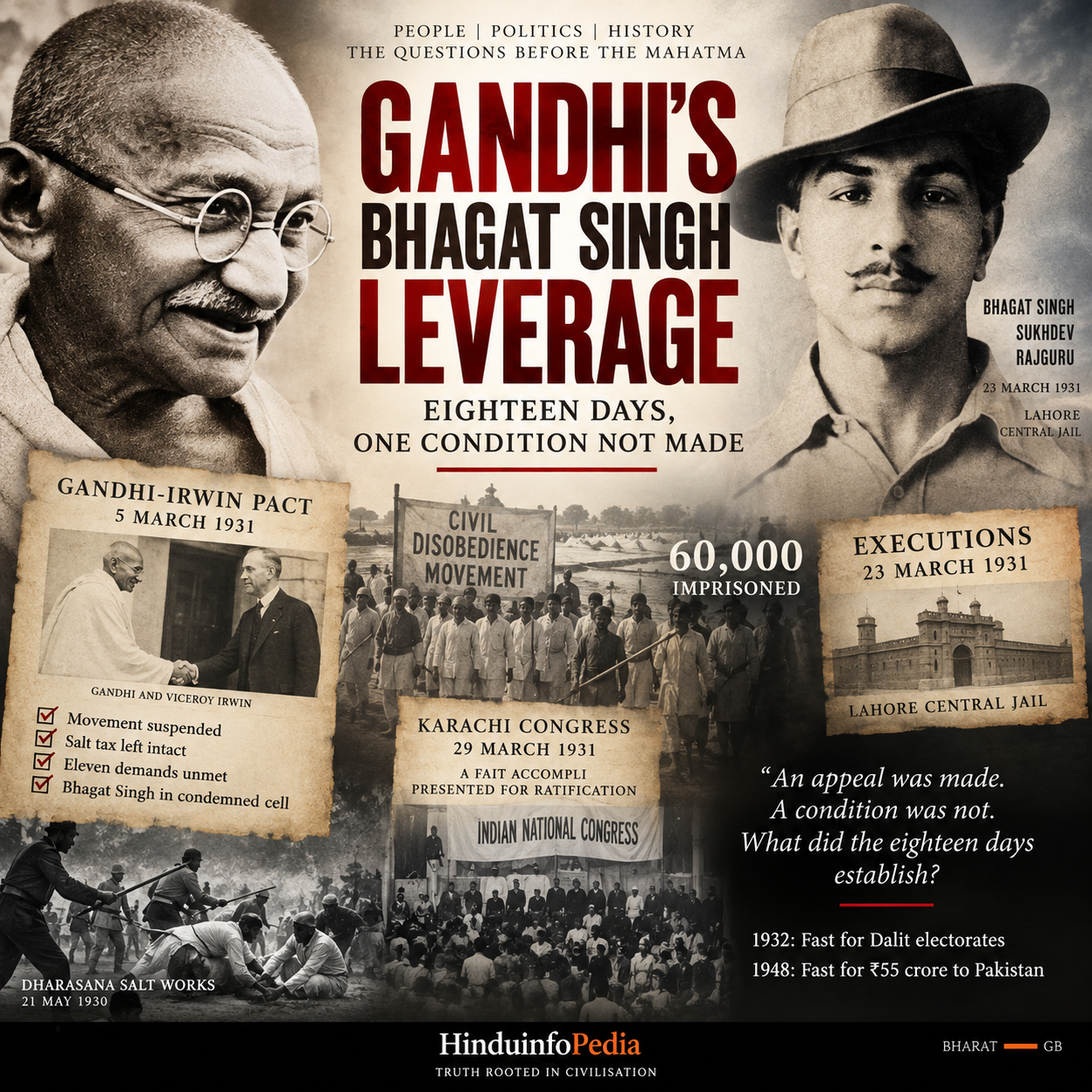
Gandhi’s Bhagat Singh Leverage places the documented timeline before the reader.
March 5 1931: The Gandhi-Irwin Pact was signed. Gandhi had suspended the Civil Disobedience Movement — the largest civilian uprising in colonial history — in exchange for a Round Table Conference seat that produced nothing, the salt tax left intact until 1947, eleven demands unmet, and Bhagat Singh already in the condemned cell. The full balance sheet of that exchange is established across Blogs 17-27 (Group 3, Group 4) of this series.
March 23 1931: Bhagat Singh, Sukhdev, and Rajguru were hanged at Lahore Central Jail.
Eighteen days separated the two dates.
The Fait Accompli Presented to Congress
Gandhi’s Bhagat Singh Leverage places a structural observation before the reader before placing the leverage.
Gandhi’s documented claim: Congress represents all of India. Congress speaks for 300 million Indians. This claim is established across the series — Gandhi’s documented justification for his authority, his negotiations, his instruments.
Gandhi’s documented practice in March 1931: he negotiated the Gandhi-Irwin Pact directly with Viceroy Irwin — without Congress mandate, without Congress deliberation, without Congress approval of the terms. The question of whether to make Bhagat Singh’s commutation a condition was Gandhi’s question to decide — not Congress’s. Gandhi decided alone.
He then brought the completed pact to the Karachi Congress session of March 29 — not for Congress to approve or reject the terms, but for Congress to ratify what Gandhi had already decided. Congress did not negotiate the pact. Congress did not set its conditions. Congress did not determine what would or would not be included. Congress ratified a fait accompli.
If Congress truly represented all of India — as Gandhi claimed — then the Bhagat Singh question was India’s question to decide through Congress. India never got to decide. Gandhi decided. The pact was signed March 5. The executions took place March 23. Congress met March 29. By the time Congress met, the question was irretrievable and the ratification was a formality.
The prosecution places this before the reader: the man who claimed Congress represented all of India negotiated India’s most consequential political agreement of 1931 without asking Congress — and presented Congress a completed fait accompli in which the fate of Bhagat Singh had already been settled by the hangman.
The Substance of the Leverage
Gandhi’s Bhagat Singh Leverage places the human substance of that leverage before the reader. The 60,000 imprisoned were not an abstraction. They were ordinary Indians — farmers, weavers, students, lawyers — who had answered Gandhi’s call to Civil Disobedience and walked into lathi charges at his instruction.
At Dharasana Salt Works on May 21 1930, United Press correspondent Webb Miller documented what one day looked like. Sarojini Naidu led the march. The columns walked forward. The British police advanced with steel-tipped lathis. The first column was beaten to the ground. The next column walked forward. They were beaten to the ground. The next column walked forward. Miller documented that the marchers “simply walked forward until struck down” — not one raised an arm. The injured were dragged away. The next ranks walked forward.
This is what the salt satyagraha required of ordinary Indians — and it was Gandhi’s constituency who paid its price. Not revolutionaries. Ordinary Indians who had trusted Gandhi’s call and offered their bodies to his instrument. Across Bengal, Andhra, Gujarat, and the NWFP, documented violence that press censorship removed from the record produced the undocumented cost behind the 60,000 official figure.
When Gandhi held his leverage in March 1931, the substance of that leverage was the sacrifice of these ordinary Indians. The pact their sacrifice had produced left the salt tax intact until 1947 and eleven demands unmet. The question the prosecution places before the reader: the leverage built on their documented sacrifice — when Gandhi chose not to deploy it as a condition for Bhagat Singh’s life — what does that choice establish about whose cause activated Gandhi’s instrument?
The Condition Not Made
Gandhi’s Bhagat Singh Leverage places what Gandhi did not do before the reader.
Gandhi did not make the commutation of Bhagat Singh’s death sentence a condition of the Gandhi-Irwin Pact. He did not make commutation a prerequisite for presenting the pact for ratification at Karachi. The executions took place on March 23 1931 — six days before the Karachi session of March 29, the only institutional moment at which Congress could formally have challenged the pact. By the time Congress met at Karachi, the question of commutation was already irretrievable. Gandhi presented the pact to Congress as a fait accompli — the hangman had already acted. The prosecution places the documented sequence before the reader: pact signed March 5, Bhagat Singh hanged March 23, Karachi session March 29. The reader will examine what the sequence of those three dates established. He did not make ratification of the pact by Congress a condition for commutation. He did not threaten to resume Civil Disobedience if the hanging proceeded. He did not fast. He did not threaten to resume Civil Disobedience if the hanging proceeded. He did not fast.
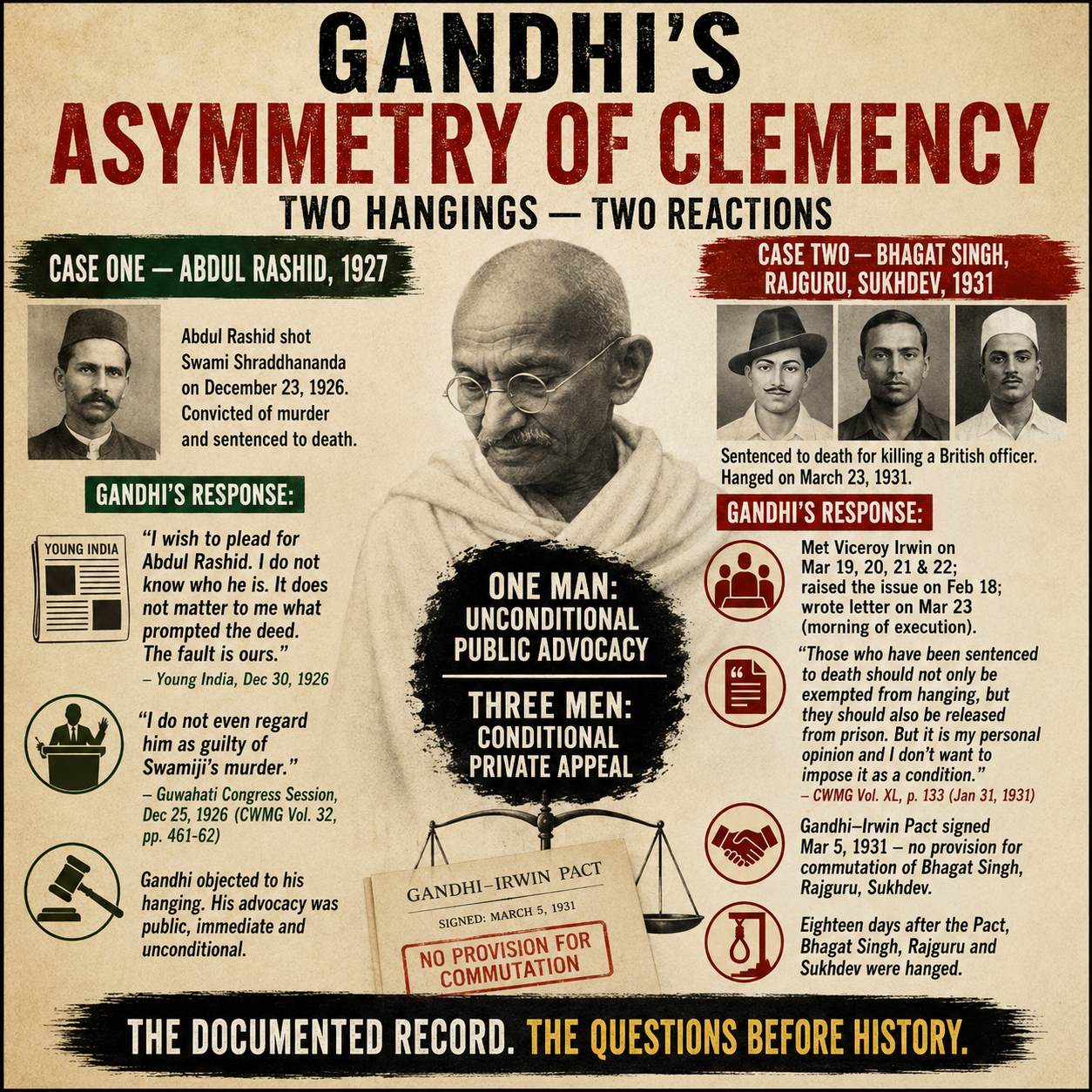
Gandhi personally opposed the death sentence. He stated this publicly. He communicated it to Irwin. He appealed for clemency. He wrote a private letter to Irwin on the morning of the hanging urging a stay of execution.
He did not deploy his instrument — the fast, the condition, the threat of resumed Civil Disobedience. He did not make ratification of the pact by Congress a condition for commutation. He did not give Congress the opportunity to scrutinise the pact terms before the executions and add commutation as a condition.
The prosecution places this before the reader: public sentiment across India demanded commutation. Congress members who would attend the Karachi session had publicly expressed sympathy for Bhagat Singh. The probability that Congress — given the opportunity to deliberate before the executions — would have insisted on commutation was real and present. That probability was never tested. Gandhi presented Congress a fait accompli: the hangman had acted, the question was closed, the pact was before them for ratification only.
The prosecution places this alongside what Gandhi did deploy his instrument for. In 1932 he fasted for six days to block Dalit separate electorates — the constitutional protection the Depressed Classes had negotiated for themselves. In 1948 he fasted to release ₹55 crore to Pakistan during the Kashmir war. The instrument that produced compliance in both cases was not deployed for Bhagat Singh’s life in March 1931 — and Congress was not given the chance to deploy its own authority on the question either.
The prosecution places this alongside what Gandhi did deploy his instrument for. In 1932 he fasted to block Dalit separate electorates. In 1948 he fasted to release ₹55 crore to Pakistan. The documented instrument that produced compliance in both cases was not deployed for Bhagat Singh’s life in March 1931.
The Documented Contrast
Gandhi’s Bhagat Singh Leverage places the documented contrast before the reader.
The documented asymmetry between Gandhi’s public posture for Abdul Rashid — the killer of Swami Shraddhanand — and his posture for Bhagat Singh is placed before the reader in full in Blog 77 of this series and its companion blog. The primary sources carry that contrast with CWMG precision. This blog carries only the eighteen days.
Bhagat Singh was 23 years old. He was hanged on March 23 1931.
What the Eighteen Days Established
Gandhi’s Bhagat Singh Leverage places one observation before the reader. The eighteen days between the pact and the hanging were not eighteen days of helplessness. They were eighteen days of maximum leverage — documented as such by the political conditions of March 1931.
The prosecution does not assert that Gandhi could have saved Bhagat Singh with certainty. It places what Gandhi held alongside the non-deployment of his instrument — and the sequence of three dates that presented Congress with a fait accompli rather than an opportunity to deliberate and act independently — and asks the reader to examine what the choice to appeal rather than condition, in the eighteen days of maximum leverage, established about whose documented cause activated Gandhi’s documented instrument.
The Prosecution’s Position
Gandhi’s Bhagat Singh Leverage places three questions before the reader.
- Does the eighteen-day gap between the Gandhi-Irwin Pact and the hanging of Bhagat Singh, Sukhdev, and Rajguru — placed alongside what Gandhi held in that window — constitute an exhibit the reader places alongside Gandhi’s documented non-deployment of his instrument on their behalf?
- Does the documented contrast between Gandhi’s unconditional advocacy for Abdul Rashid — the murderer of Swami Shraddhanand — and Gandhi’s personal-opinion appeal for Bhagat Singh — the revolutionary freedom fighter — constitute an exhibit the reader places alongside the series’ full record of whose cause activated Gandhi’s documented instrument?
- Does the documented fast for Dalit separate electorates in 1932 and the documented fast for ₹55 crore to Pakistan in 1948 — placed alongside the documented non-fast for Bhagat Singh’s life in 1931 — constitute an exhibit the reader places alongside Gandhi’s documented pattern of instrument deployment?
The series does not answer. Gandhi’s Bhagat Singh Leverage places the eighteen days, the leverage, the condition not made, and the contrast before the reader. The reader will examine what the documented choice established — and complete the sentence.
Invitation To Defence
The floor belongs to the defense. We now invite them to present their exhibits and challenge the narrative established by the prosecution.
March 5 1931: Gandhi-Irwin Pact signed. Pact unsigned at Karachi. Movement resumable. 60,000 imprisoned behind him. March 23 1931: Bhagat Singh, Sukhdev, and Rajguru hanged. Bhagat Singh was 23. Gandhi communicated a personal opinion. He did not make commutation a condition. He did not fast. In 1932 he fasted for Dalit electorates. In 1948 he fasted for Pakistan’s funds. The prosecution places the eighteen days before the reader. The reader will complete the sentence.
Feature Image: Click here to view the image.
Videos
Glossary of Terms
- Bhagat Singh Leverage: The term used in this blog for the political leverage Gandhi held during the eighteen days between the Gandhi-Irwin Pact and the execution of Bhagat Singh, Sukhdev, and Rajguru.
- Gandhi-Irwin Pact: The agreement signed by Mahatma Gandhi and Viceroy Lord Irwin on March 5, 1931, under which Gandhi suspended the Civil Disobedience Movement and agreed to participate in the Round Table Conference.
- Civil Disobedience Movement: The mass movement led by Gandhi against British colonial rule, involving deliberate non-compliance with selected colonial laws and policies.
- Round Table Conference: The constitutional discussions held in London concerning India’s political and constitutional future, in which Gandhi participated following the Gandhi-Irwin Pact.
- Fait Accompli: A situation in which an action or decision has already been completed, leaving others with little or no opportunity to deliberate and independently change it.
- Dharasana Salt Works: The site of a major 1930 salt satyagraha action where protesters were beaten by British police, an event documented by United Press correspondent Webb Miller.
- Webb Miller: The United Press correspondent who documented the violence against satyagrahis at Dharasana Salt Works on May 21, 1930.
- Satyagraha: Gandhi’s method of nonviolent resistance based on civil resistance and the assertion of truth through disciplined action.
- Karachi Congress Session: The Indian National Congress session held at Karachi on March 29, 1931, where Gandhi presented the Gandhi-Irwin Pact for ratification after Bhagat Singh had already been executed.
- Instrument of Leverage: A recurring analytical phrase in this series referring to the political methods Gandhi used to exert pressure or obtain compliance, including fasting, political conditions, and the threat of resuming Civil Disobedience.
- Commutation: The reduction of a death sentence to a lesser punishment, such as imprisonment, without overturning the underlying conviction.
- Abdul Rashid: The man identified in the blog as the killer of Swami Shraddhanand and used as part of the documented comparison concerning Gandhi’s positions on clemency.
- Dalit Separate Electorates: The proposed system of separate electoral representation for the Depressed Classes that Gandhi opposed through his 1932 fast.
- Depressed Classes: The historical term used in the period for communities that were later constitutionally and politically identified as Scheduled Castes.
- CWMG: The Collected Works of Mahatma Gandhi, the documentary collection of Gandhi’s writings, speeches, letters, and other records used as a primary-source reference in this series.
#Gandhi #BhagatSingh #IndianHistory #FreedomMovement #Congress #BritishIndia #GandhiIrwinPact #HinduinfoPedia
Scan Through The Entire Series at
Gandhi’s Peace Efforts: The Questions Before the Mahatma (0)