
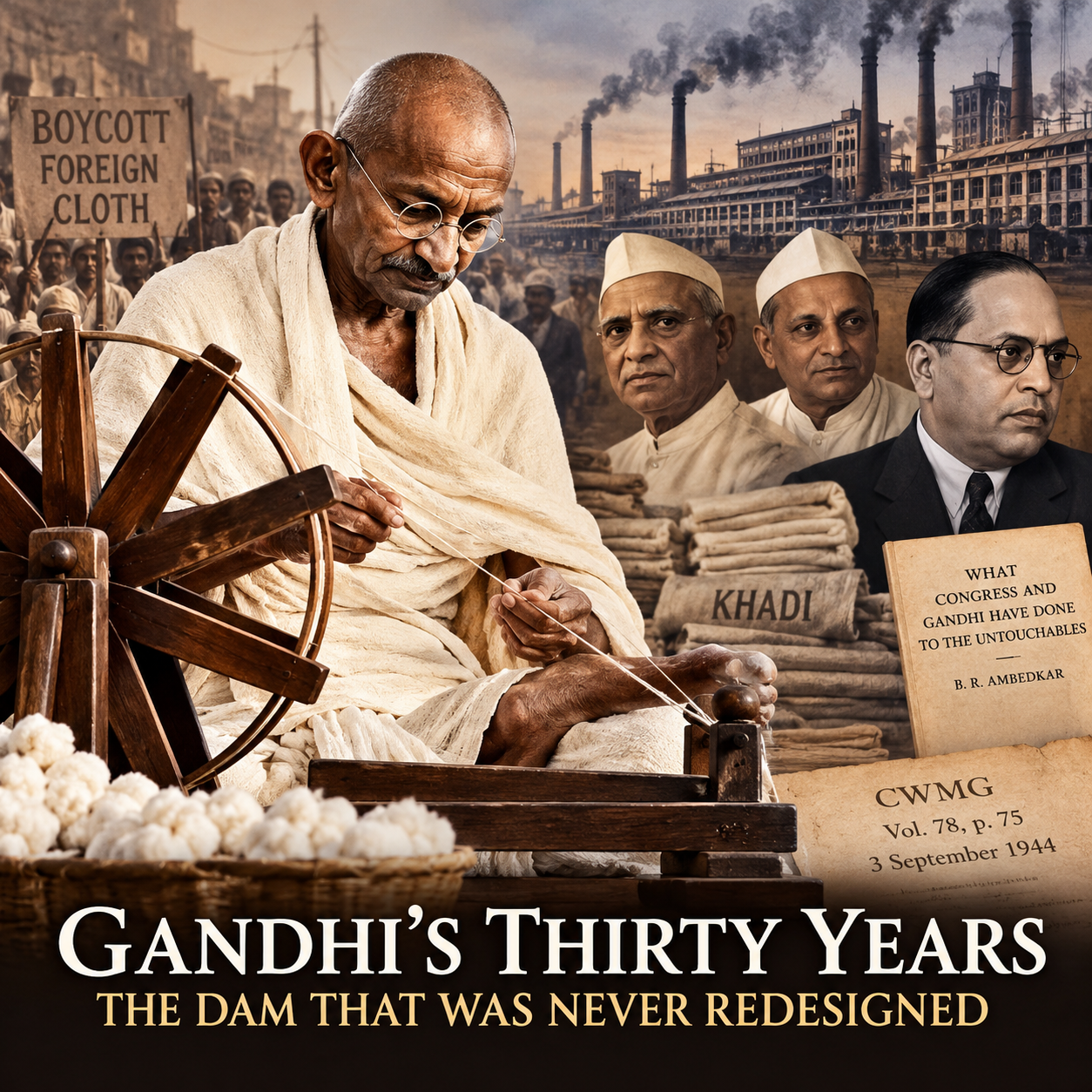
Gandhi’s Thirty Years: The Dam That Was Never Redesigned (167)
भारत / GB
Part 167: Mahatma Gandhi’s Peace Efforts | Series Index
Blog 166 placed before the reader the closed circuit — the four documented nodes running from British Discriminating Protection through Birla and Bajaj capital accumulation to the Gandhian apparatus, anchored by G.D. Birla’s own letter to the Secretary of State for India in March 1932, in which the largest funder of the Indian National Congress told the British Cabinet that Gandhi’s constitutional ceiling was the arrangement both sides had an interest in maintaining. This post places before the reader the instrument at the centre of Gandhi’s Thirty Years — the charkha, the spinning wheel — and the documented record of what happened when the instrument failed: Gandhi watched. The dam was never redesigned.
Thank you for reading this post, don't forget to subscribe!THE HISTORICAL RECORD — THE INSTRUMENT THAT WAS NEVER REVISED
The Pattern: Gandhi’s Thirty Years — 1918 to 1948 — produced one constructive instrument for economic independence: the charkha. The instrument was introduced as the answer to industrial unemployment, colonial drain, and peasant impoverishment. It was never revised when the evidence of failure accumulated. The constructive programme continued; the instrument remained unchanged; the poverty it was designed to address remained unchanged with it.
The Lethal Exhibit: CWMG Vol. 78, p. 75 — Gandhi’s address to the All India Spinners’ Association, 3 September 1944: Congress tolerated the spinning wheel “only for my sake.” The acknowledgment is in the institutional record. Gandhi stated to the very body whose instrument he was describing that the organisation leading the independence movement had adopted the charkha as personal deference to him, not as organisational conviction. It is documented. It is in the record.
Why it matters: The admission closes the distance between Gandhi’s private knowledge and his public position. A leader who believed in the instrument and watched it fail is one kind of figure. A leader who recorded that even his own organisation had adopted the instrument “only for my sake” — and continued to place it at the centre of the constructive programme — is a different kind of figure. The charkha was not a failed experiment. It was a sustained commitment whose failure was documented by its author and not acted upon.
The Instrument
Gandhi’s Thirty Years begins, for the purposes of this exhibit, in 1918 — the year Gandhi took up the charkha in earnest and proposed it as the instrument of India’s economic self-sufficiency. The argument was structural: India’s poverty was produced by the colonial destruction of indigenous weaving, the drain of textile revenue to Lancashire, and the displacement of peasant supplementary income. The charkha would reverse the drain, restore supplementary income, and make the village economically self-sufficient. The constructive programme that followed — khadi production, village industries, the All India Spinners’ Association — was built around this instrument.
The sequencing is itself an exhibit. The salt tax — a direct colonial levy on the most basic dietary necessity, affecting every household without requiring a loom, thread, training, or capital — waited twelve years. Gandhi’s Thirty Years addressed the complex instrument first and the universal one last. When the Salt March of 1930 finally targeted it, the Gandhi-Irwin Pact of March 1931 suspended Civil Disobedience and restored the status quo. The salt tax was not abolished. It remained on the statute books until 1947.
Gandhi’s Thirty Years with the instrument ran to the day of his assassination. The charkha was present at Birla House on January 30, 1948. It had been present for three decades. In those three decades, the instrument did not reverse the drain. It did not restore peasant supplementary income at scale. The poverty it was designed to address remained, documented in the same surveys and reports that Gandhi himself cited when arguing for the instrument’s necessity.
The question this post places before the reader is not whether the charkha was sincere. It is whether the record shows Gandhi revised the instrument when the evidence accumulated. Gandhi’s Thirty Years with the charkha is the answer.
What the Funding Bought
The prosecution places a second question alongside the dam: who funded it, and what did the funding return?
The CWMG record is specific. In a letter to G.D. Birla dated April 27, 1926 (CWMG Vol. 30), Gandhi accounts for Rs. 70,000 directed through the Charkha Sangh into khadi organisations in Bengal, notes the Sangh’s coffers are depleted, and asks Birla to issue direct cheques to affiliated production bodies. In 1927 (CWMG Vol. 35), Gandhi asks Birla for Rs. 2,00,000 earmarked for “khadi, untouchability and education.” Birla’s own memoir, In the Shadow of the Mahatma, documents that between the mid-1920s and the late 1930s he made direct personal contributions to Gandhi’s constructive programmes on more than ten separate occasions, totalling well in excess of Rs. 4,00,000 to Rs. 5,00,000 in liquid cash grants alone — excluding ashram maintenance, institutional underwriting, and land purchases. In today’s value: twelve to eighteen crore rupees.
Birla was not funding a competitor. The Charkha Sangh’s production was never sufficient to meet the demand the boycott of British Lancashire cloth created. The moral campaign against imported textiles drove Indian consumers toward domestic cloth. Khadi could not supply it. The vacuum was filled by Birla’s mechanised composite mills — the same mills whose surplus had funded the Charkha Sangh in the first place. Every rupee Birla placed in the constructive programme returned as mill revenue many times over, because the instrument that could not scale created the market that could only be met by the mills that funded it.
Jamnalal Bajaj served simultaneously as AISA Treasurer and AICC Treasurer. The institutional keeper of the spinning programme and the keeper of the party purse were the same industrial capitalist. The architecture is documented. The reader may examine the circuit.
What the Record Shows
The All India Spinners’ Association was founded in 1925. By the late 1920s, the internal record of the constructive programme showed what independent surveys also showed: khadi production was not reaching the peasant household at the scale required to function as supplementary income. The All India Village Industries Association, founded in 1934, extended the constructive programme to allied village industries — oil-pressing, soap-making, tanning — on the same model. The model’s difficulties were documented in the same period.
Gandhi was not unaware of this. The CWMG records his engagement with the failures of distribution, the problems of quality standardisation, the difficulty of making khadi economically competitive without the subsidy that defeated its purpose. He wrote about the failures. He wrote to Bajaj about them. He wrote to the provincial committees about them.
He did not redesign the instrument.
The dam was built. The dam was watched. The dam was not redesigned.
The Admission
CWMG Vol. 78, p. 75 contains the exhibit the prosecution places before the reader. Gandhi’s Thirty Years produced one sentence that belongs in this record: Congress, Gandhi wrote, had tolerated the charkha “only for my sake.”
The sentence is in the Collected Works. Gandhi wrote it. It records his own understanding of the instrument’s standing within the organisation that was simultaneously claiming, in public, that khadi was the symbol of Indian self-reliance and national regeneration.
The Congress’s public position was that the spinning wheel was the answer to colonial extraction. Gandhi’s documented acknowledgment to the Spinners’ Association was that Congress had adopted it as personal deference to him, not as organisational conviction. Both positions were held simultaneously. The public position was the one that shaped the constructive programme. The documented acknowledgment in the institutional record — CWMG Vol. 78, p. 75, a speech of 3 September 1944 — was the one Gandhi made to the body whose instrument he was describing.
The prosecution does not claim to know which reading the sentence supports. Gandhi may have been pressing the Spinners’ Association to build the case for khadi on its own merits, independent of his personal authority — a moral challenge to an institution he feared would not outlast him. Or he may have been recording, with the candour the institutional setting permitted, what he had observed: that the Congress High Command had adopted the symbol as personal deference, not conviction. Under either reading, the documented outcome is the same. Congress did not sustain the charkha as an economic instrument after independence. The programme that Gandhi’s Thirty Years had built around one man’s authority did not survive the removal of that authority. The prosecution places both readings before the reader alongside the documented outcome — and invites the reader to complete the sentence.
The Three Decades
Gandhi’s Thirty Years with the charkha crossed three distinct phases of Indian political history.
In the Non-Cooperation phase (1920–22), the charkha was the economic complement to political non-cooperation: boycott foreign cloth, spin your own, make the British textile connection economically costly. The instrument had political logic in this phase. It was a weapon as much as a tool.
In the Civil Disobedience phase (1930–34), the instrument had become the symbol of the movement — the salt march’s economics were the same argument: colonial taxation on a peasant necessity, answered by self-sufficiency. The constructive programme continued in parallel with political agitation.
In the final phase (1934–48), Gandhi withdrew from formal Congress politics and placed the constructive programme at the centre of his public work. Gandhi’s Thirty Years in this phase are the years the dam’s inadequacy was most fully documented — and most fully maintained. The village surveys of the 1930s and 1940s show what the instrument was producing. The CWMG of the same years shows Gandhi reading the surveys, writing about the failures, and continuing the programme.
The dam was not redesigned in the Non-Cooperation phase because the instrument was also a weapon and weapons are not redesigned mid-campaign. The dam was not redesigned in the Civil Disobedience phase because the instrument had become the symbol and symbols are not redesigned mid-movement. The dam was not redesigned in the final phase because — the prosecution places the admission before the reader — Congress had adopted the symbol “only for my sake,” and a symbol carried by personal loyalty cannot be revised without confronting the loyalty.
What Ambedkar Placed in the Record
B.R. Ambedkar’s documented position on the charkha belongs in this exhibit. Ambedkar’s What Congress and Gandhi Have Done to the Untouchables (1945) placed before the reader a specific argument: the constructive programme’s instrument served the interests of the caste groups positioned to benefit from village industry — weaving castes, trading castes — and did not address the structural position of Untouchable communities whose occupations were leather-working, scavenging, and agricultural labour. The charkha did not produce supplementary income for those communities. It produced supplementary income for the communities already positioned in the textile chain.
Ambedkar’s argument was structural, not sentimental. It did not ask whether Gandhi was sincere. It asked whose interests the instrument served when deployed at scale — and placed the answer in the documented economic position of different caste communities within the village economy the instrument claimed to serve.
The prosecution places the convergence before the reader: Gandhi’s Thirty Years produced an instrument that, by Gandhi’s own private record, was carried by Congress as personal loyalty rather than organisational conviction, and that, by Ambedkar’s documented structural analysis, served the economic position of the communities already in the textile chain rather than the communities the rhetoric of village regeneration addressed.
The Prosecution’s Position
Gandhi’s Thirty Years places three questions before the reader.
- Does the documented record — CWMG Vol. 78, p. 75, Gandhi’s own words that Congress tolerated the charkha “only for my sake” — constitute an exhibit the reader places alongside the public claim that the spinning wheel was the organisational conviction of the independence movement?
- Does the three-decade record of the constructive programme — the instrument introduced, the failures documented, the instrument maintained unchanged — constitute an exhibit the reader places alongside the claim that Gandhi’s Thirty Years produced a viable economic alternative to colonial extraction?
- Does Ambedkar’s documented structural analysis of whose interests the instrument served at scale — published under his own name in 1945, four years before independence — constitute an exhibit the reader places alongside the claim that the constructive programme addressed the economic position of India’s poorest communities?
The series does not answer. Gandhi’s Thirty Years places the instrument, the admission, and the three decades before the reader. The reader will examine what the documents establish — and complete the sentence.
Invitation To Defence
The floor belongs to the defense. We now invite them to present their exhibits and challenge the narrative established by the prosecution.
Gandhi’s Thirty Years produced one instrument for economic independence. The instrument was not revised when the evidence of failure accumulated. Gandhi recorded in the Collected Works that Congress had adopted the charkha “only for my sake.” The dam was never redesigned. The prosecution places the three decades, the admission, and the structural record before the reader. The reader will complete the sentence.
Feature Image: Click here to view the image.
Videos
Glossary of Terms
- Gandhi’s Thirty Years: The period from 1918 to 1948 examined in the blog, focusing on Gandhi’s continued commitment to the charkha and its economic implications.
- Charkha: A traditional spinning wheel used to turn cotton fibre into yarn. Gandhi promoted it as a symbol and instrument of economic self-sufficiency.
- Khadi: Handspun and handwoven cloth associated with the Swadeshi movement and Gandhi’s effort to encourage Indian production and reduce dependence on imported textiles.
- Swadeshi: An economic and political principle advocating the use of locally produced goods to strengthen domestic production and reduce reliance on foreign products.
- Economic Self-Sufficiency: The ability of individuals, communities or a nation to meet essential economic needs through their own productive resources.
- All India Spinners’ Association (AISA): An organisation established in 1925 to promote spinning, khadi production and related activities within Gandhi’s constructive programme.
- Constructive Programme: Gandhi’s collection of social and economic initiatives, including khadi promotion, education and efforts to remove untouchability, intended to support national regeneration.
- D. Birla: An Indian industrialist and businessman who provided financial support for Gandhi-associated activities, including khadi, education and campaigns against untouchability.
- Jamnalal Bajaj: An industrialist and close associate of Gandhi who supported his initiatives and held organisational responsibilities within the Congress movement.
- Industrial Surplus: The financial resources remaining from industrial and commercial activity that can be used for investment, institutional support or philanthropic contributions.
- Patronage Network: A system of financial and organisational support through which wealthy individuals or institutions fund leaders, movements and programmes.
- Moral Authority: The influence a person derives from public perceptions of personal integrity, ethical commitment or exemplary conduct.
- Institutional Sustainability: The capacity of an organisation or programme to continue functioning through reliable funding, administration, resources and public support.
- Ambedkar’s Critique: B. R. Ambedkar’s examination of Gandhi and Congress, including questions about whether village-centred economic approaches adequately addressed the material conditions of disadvantaged communities.
- The Dam That Was Never Redesigned: A phrase used in the blog’s title to represent the continued use of an established approach without sufficiently reconsidering its limitations or adapting it to changing economic realities.
#Gandhi #India #History #Khadi #Charkha #Economy #Swadeshi #Ambedkar #HinduinfoPedia
Scan Through The Entire Series at
Gandhi’s Peace Efforts: The Questions Before the Mahatma (0)
Refer to Various Arks Referred to in the Blog
ondensed table entries for Blog 167 (~1/3 depth)Simple index row (English)
|
Blog Sl No and Address
|
Pillar
|
Core Factual Claim on Record
|
Primary Source Cited
|
Cross-References Blog Nos
|
|---|---|---|---|---|
|
Gandhi’s Thirty Years (167) — The Dam That Was Never Redesigned
|
Pillar 5: THE PATRONAGE & LOGISTICS FILE
|
From 1918–1948 the charkha was the sole constructive instrument for economic independence. Failures of scale, distribution and income were documented; the instrument was never redesigned. Gandhi recorded (CWMG Vol. 78, p. 75) that Congress tolerated it “only for my sake.” Ambedkar (1945) showed it benefited textile-chain castes, not Untouchable occupations.
|
6, 162, 166
|
THE HISTORICAL RECORD blockTHE HISTORICAL RECORD — THE INSTRUMENT THAT WAS NEVER REVISED (Pillar 5 of 7)
The Pattern: Gandhi’s Thirty Years (1918–1948) produced one economic instrument — the charkha. Introduced against drain and peasant poverty, it was never revised despite documented failure of scale and income.
The Lethal Exhibit: CWMG Vol. 78, p. 75 — Gandhi wrote that Congress tolerated the spinning wheel “only for my sake.”
Why it matters: Private admission that organisational adoption was personal loyalty, not conviction, while the unchanged instrument remained central to the public constructive programme. Failure was known to its author and not acted upon. हिंदी अनुवाद (संक्षिप्त)
|
Blog Sl No and Address
|
Pillar
|
Core Factual Claim on Record
|
Primary Source Cited
|
Cross-References Blog Nos
|
|---|---|---|---|---|
|
गांधी के तीस वर्ष (167) — वह बाँध जो कभी पुनर्निर्मित नहीं हुआ
|
स्तम्भ 5: संरक्षण एवं संभार-तन्त्र अभिलेख
|
1918–1948 तक चरखा आर्थिक स्वतंत्रता का एकमात्र रचनात्मक उपकरण रहा। पैमाने, वितरण और आय की विफलताएँ दस्तावेजित हुईं; उपकरण कभी पुनर्निर्मित नहीं हुआ। गांधी ने दर्ज किया (सीडब्ल्यूएमजी खंड 78, पृष्ठ 75) कि कांग्रेस ने इसे “केवल मेरे लिए” सहन किया। आंबेडकर (1945) ने दिखाया कि इससे वस्त्र-श्रृंखला जातियों को लाभ हुआ, अछूत व्यवसायों को नहीं।
|
6, 162, 166
|
ऐतिहासिक अभिलेख — वह उपकरण जो कभी संशोधित नहीं हुआ (स्तम्भ 7 में से 5)
प्रतिरूप: गांधी के तीस वर्षों (1918–1948) ने एक आर्थिक उपकरण उत्पन्न किया — चरखा। निकासी और किसान गरीबी के विरुद्ध प्रस्तुत, पैमाने और आय की दस्तावेजित विफलता के बावजूद यह कभी संशोधित नहीं हुआ।
घातक प्रदर्श: सीडब्ल्यूएमजी खंड 78, पृष्ठ 75 — गांधी ने लिखा कि कांग्रेस ने चरखा “केवल मेरे लिए” सहन किया।
यह क्यों महत्वपूर्ण है: निजी स्वीकारोक्ति कि संगठनात्मक अपनाया जाना व्यक्तिगत निष्ठा था, न कि दृढ़ विश्वास, जबकि अपरिवर्तित उपकरण सार्वजनिक रचनात्मक कार्यक्रम का केंद्र बना रहा। विफलता इसके लेखक को ज्ञात थी और उस पर कार्रवाई नहीं हुई।