
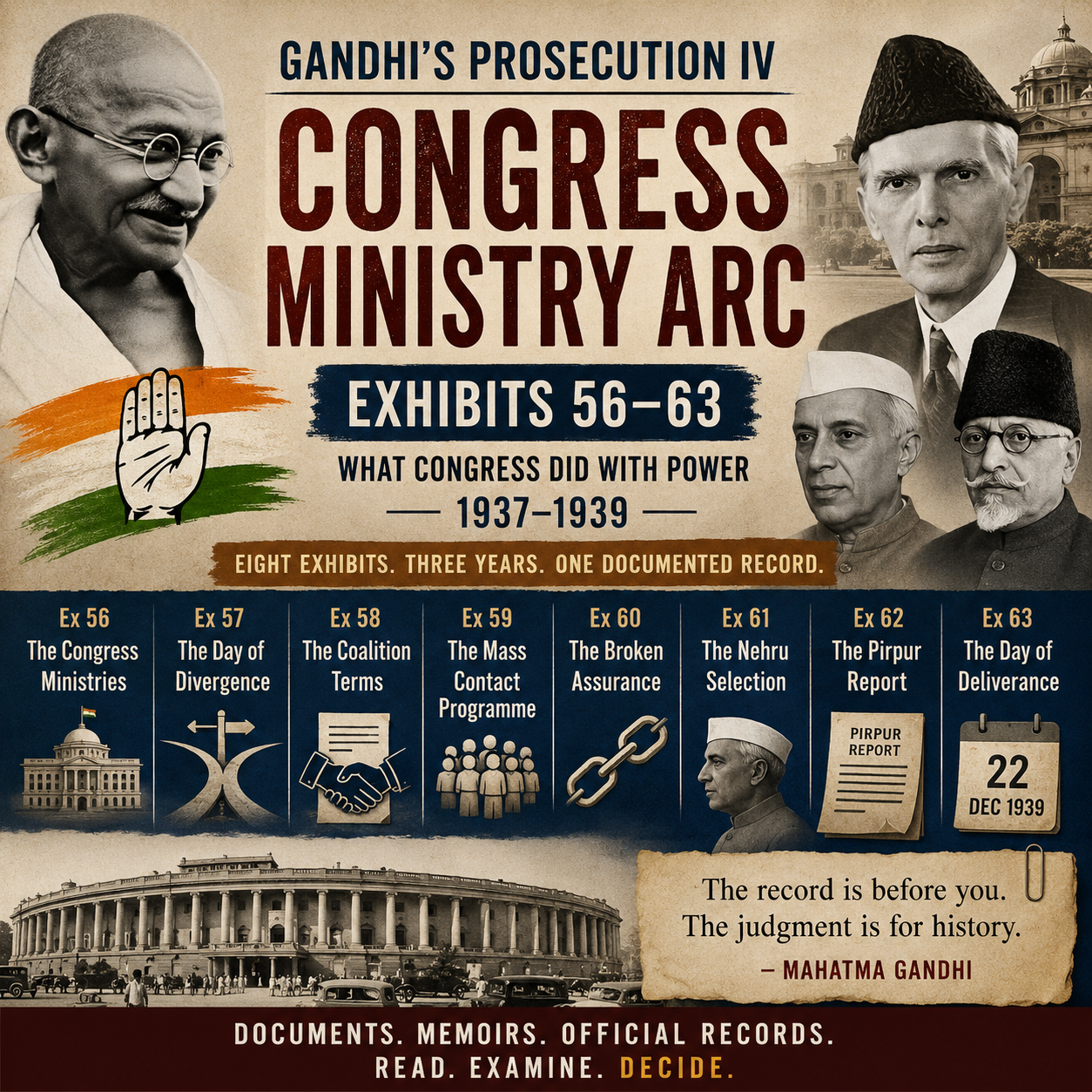
Gandhi’s Prosecution-IV: The Congress Ministry Arc — Exhibits 56-63 (100)
भारत / GB
Part 100: Mahatma Gandhi’s Peace Efforts | Series Index | Exhibits Master Table
Blog 99 compiled the Jinnah Constitutional Arc — Exhibits 51-55, the documented offers, reductions, and rejections of 1928-1929. This post compiles the Congress Ministry Arc — eight exhibits across Blogs 86-93 — documenting what Congress did with power in eight provinces 1937-1939. Structured for direct compatibility with the Gandhi Prosecution Exhibits Master Table.
Thank you for reading this post, don't forget to subscribe!The Action Taken: The prosecution indexed the primary administrative acts, educational decrees, and cultural policies of the 1937–1939 Congress provincial governments that catalyzed Muslim League mobilization.
Who Paid the Price: The historical premise that Congress provincial rule was universally accepted as non-sectarian across all communities.
The Alternative Bypassed: Fragmented defense without administrative documentation.
Why This Matters: Documents the exact administrative exhibits that transformed the Muslim League from an elite debating club into a mass political movement capable of demanding partition.
Congress Ministry Arc — Exhibits 56-63
| Exhibit | Blog No. | Exhibit Name / Key Details | Blog Link / Status |
|---|---|---|---|
| CONGRESS MINISTRY ARC | Exhibits 56-63 | Blogs 86-93 | 1937-1939 | |||
| Ex 56 | 86 | The Congress Ministries — 1937 elections: Congress formed ministries in eight of eleven provinces. Gandhi urged Congress to accept office — his documented intervention was decisive. The League performed poorly in Muslim-majority provinces. Congress governed without League participation, launching the Mass Contact Programme simultaneously. Gandhi’s documented statement on the resignations: needed to drive away the parasites. | Blog 86 — Live |
| Ex 57 | 87 | The Day of Divergence — Two documented Jinnah statements eighteen years apart. December 1928 Calcutta: “Jamshed, this is the parting of the ways” — tears documented. July 30 1946 Bombay: “Today we bid goodbye to constitutional methods. We have forged a pistol.” Gandhi’s “responsible aspirations” declaration placed between them. The eighteen-year arc from constitutional negotiation to declared departure from constitutional methods. | Blog 87 — Live |
| Ex 58 | 88 | The Coalition Terms — Congress required the Muslim League’s parliamentary board to be dissolved as the price of coalition participation in the United Provinces. Azad’s documented assessment: had the offer been accepted, the League would have merged into Congress for all practical purposes. Azad documented Nehru’s specific responsibility. Nehru served as Congress President — placed there by Gandhi. | Blog 88 — Live |
| Ex 59 | 89 | The Mass Contact Programme — Launched simultaneously with coalition refusal. Nehru characterised the League as out of touch with Muslim masses. Documented consequence: Muslim Congress membership tripled — large enough to alarm League leaders — but the League consolidated at its 1937 Lucknow session. The programme strengthened the organisation it was designed to weaken; Muslim premiers of Punjab, Bengal, and Assam were in the League’s camp by 1940. | Blog 89 — Live |
| Ex 60 | 90 | The Broken Assurance — Azad had arranged for Chaudhry Khaliquzzaman and Nawab Ismail Khan — prominent League leaders — to join the UP ministry. Congress went back on the tacit understanding. Azad’s documented assessment: it crushed the pro-Congress elements in the League and forced them into a communal corner. Congress’s own wartime President documented the consequence of his own party’s broken promise. | Blog 90 — Live |
| Ex 61 | 91 | The Nehru Selection — Gandhi placed Nehru in the Congress presidency in 1929, 1936, and 1946, against stronger internal candidates on each occasion. In 1946, twelve of fifteen Pradesh Congress Committees nominated Patel; none nominated Nehru. Gandhi asked Patel to withdraw. The decisions Azad attributed as turning points toward Partition — the 1937 UP coalition failure and the 1946 Cabinet Mission breakdown — were made by the man Gandhi had specifically chosen. | Blog 91 — Live |
| Ex 62 | 92 | The Pirpur Report — November 15 1938. Muslim League committee visited six provinces. 96-page report documented over 100 instances of alleged anti-Muslim discrimination under Congress ministry rule. The Shareef Report followed in 1939, documenting grievances in Bihar. Congress’s own Muslim Mass Contact office corroborated categories of grievance the League was independently compiling. Gandhi’s documented response: called them “unproved allegations.” | Blog 92 — Live |
| Ex 63 | 93 | The Day of Deliverance — Congress ministries resigned October 1939. Gandhi had reservations — he predicted it would strengthen the League. The Wardha CWC vote went against him. Jinnah declared December 22 a Day of Deliverance. Gandhi’s documented December 14 1939 statement: called Pirpur grievances “unproved allegations.” Viceroy and Jinnah both recorded as pleased with the outcome Gandhi had warned against. | Blog 93 — Live |
Gandhi’s Prosecution-IV: What the Ministry Arc Established
Gandhi’s Prosecution places eight documented exhibits before the reader across Blogs 86-93 — its second compilation following the Constitutional Arc compiled in Blog 99. The arc covers the three years in which Congress held governing power in eight provinces — the only period before independence when Gandhi’s organisation controlled administrative machinery. Gandhi’s Prosecution established: coalition terms requiring League dissolution, a Mass Contact Programme that strengthened the League it was designed to weaken, a broken coalition assurance that crushed pro-Congress elements in the League, a Pirpur Report whose categories of grievance were corroborated by Congress’s own outreach office, and Gandhi’s own documented response framing those grievances as unproved allegations.
Gandhi’s Prosecution did not establish that Gandhi designed the outcomes documented here. It placed Gandhi’s documented authority over Congress, his documented choices at specific junctures, and the documented consequences before the reader. The reader draws the conclusions. Gandhi’s Prosecution’s evidentiary foundation: Azad’s *India Wins Freedom*, documented Congress Working Committee proceedings, Gandhi’s own dated December 1939 statement (nehruarchive.in), the Pirpur Report primary document (archive.org), and Rajmohan Gandhi’s *Patel: A Life*.
What the Next Compilation Adds
Gandhi’s Prosecution continues: Blog 101 compiles the Closing Arc — Exhibits 64-68, Blogs 94-98 — the documented 1939-1940 sequence ending with Gandhi’s own self-assessment. The three compilation blogs together place the full Jinnah arc — Exhibits 51-68 across Blogs 81-98 — before the reader as a single documented record.
1937: eight provinces, coalition terms requiring dissolution, Mass Contact launched. 1938: Pirpur Report, 100 documented instances. 1939: Wardha, the resignations Gandhi warned against, the Day of Deliverance, “unproved allegations.” Eight exhibits. The prosecution places the Congress Ministry Arc before the reader. The reader will examine what Congress did with power — and complete the sentence.
Feature Image: Click here to view the image.
Videos
Glossary of Terms
- Congress Ministry Arc: The sequence of eight exhibits (Exhibits 56–63) covering the period from 1937 to 1939, examining the actions and policies of Congress ministries after forming governments in eight provinces.
- Congress Ministries: Provincial governments formed by the Indian National Congress after the 1937 provincial elections under the Government of India Act, 1935.
- Mass Contact Programme: A Congress campaign launched in 1937 to increase its influence among Muslim voters independently of the Muslim League.
- Coalition Terms: The conditions reportedly imposed by Congress during negotiations for a coalition ministry in the United Provinces, including the dissolution of the Muslim League Parliamentary Board.
- League Parliamentary Board: The Muslim League’s provincial legislative organization responsible for coordinating its elected representatives and political strategy.
- Broken Assurance: The term used in this series for the reported failure to honour the understanding regarding inclusion of Muslim League leaders in the United Provinces ministry after the 1937 elections.
- Pirpur Report: A report published by a Muslim League committee in November 1938 documenting alleged grievances and discrimination against Muslims under Congress provincial ministries.
- Shareef Report: A report published in 1939 documenting complaints relating to the functioning of the Congress ministry in Bihar from the perspective of Muslim organisations.
- Day of Deliverance: The observance announced by Muhammad Ali Jinnah on 22 December 1939 following the resignation of Congress ministries from provincial governments.
- Congress Working Committee (CWC): The principal executive body of the Indian National Congress responsible for major policy decisions.
- Wardha Resolution: The Congress Working Committee’s decision at Wardha in 1939 concerning the resignation of Congress provincial ministries following the outbreak of the Second World War.
- United Provinces (UP): A British Indian province, largely corresponding to present-day Uttar Pradesh, where the 1937 Congress–League coalition negotiations took place.
- Pradesh Congress Committee (PCC): A provincial unit of the Indian National Congress responsible for organisation and leadership within a province.
- Gandhi’s Prosecution: A documentary series format presenting dated statements, contemporary records, memoirs and official documents as exhibits, leaving interpretation to the reader rather than advancing judicial conclusions.
- Exhibits Master Table: The master index compiling every exhibit in the Gandhi’s Prosecution series, enabling readers to trace each exhibit to its corresponding blog and primary sources.
#Gandhi #Congress #Jinnah #Partition #IndianHistory #FreedomMovement #MuslimLeague #Politics #History #BritishIndia #CongressMinistries #PirpurReport #Nehru #Patel #HinduinfoPedia
Gandhi’s Peace Efforts: The Questions Before the Mahatma (0)