
Gandhi’s Erasure of Ahimsa: When Individual Accountability Disappeared (76)
भारत / GB
Part 76: Mahatma Gandhi’s Peace Efforts | Series Index
Blog 75 documented Gandhi’s apportionment of guilt for Shraddhananda’s murder — the Guwahati formulation that placed the killer in the brother column and the victim’s work in the guilty column. This post places two further documented quotes before the reader — both from Young India — and asks the reader to examine what they reveal about the principle Gandhi called the cornerstone of his life.
Thank you for reading this post, don't forget to subscribe!The Action Taken: Gandhi singled out the Arya Samaj and Swami Shraddhanand’s Shuddhi movement for public condemnation, calling it provocative, while defending Islamic Tabligh as an established right.
Who Paid the Price: The legal and civic right of indigenous traditions to conduct social reform and peaceful religious reclamation.
The Alternative Bypassed: Upholding complete, symmetric freedom of conscience, proselytization, and reclamation for all faiths equally.
Why This Matters: Subordinated equal civic rights to communal appeasement, establishing the doctrine that Hindu religious assertion was provocative by definition while minority expansionism was legitimate.
The Two Documented Quotes
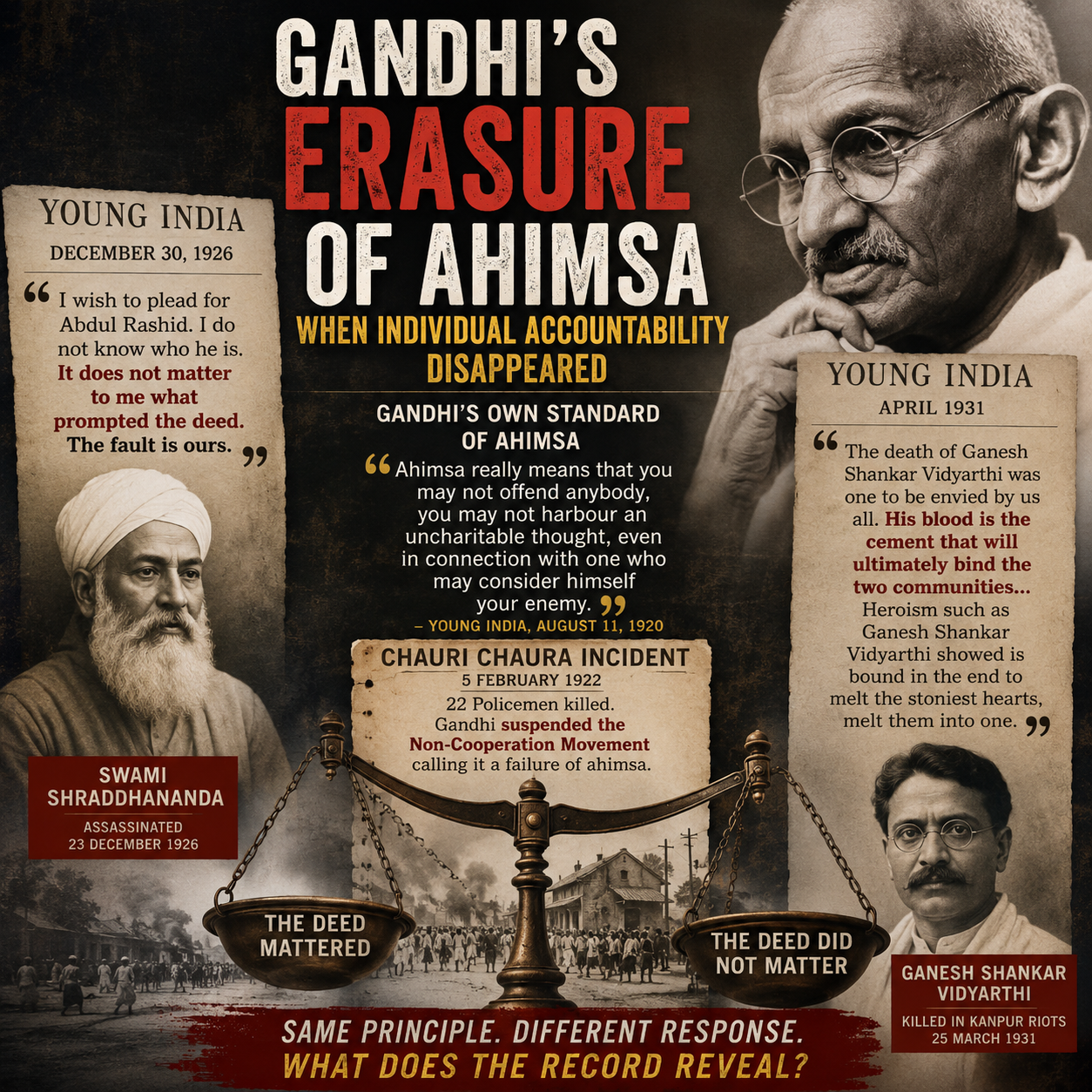
Gandhi’s Erasure of Ahimsa begins with two primary source quotes placed before the reader without characterisation.
Young India, December 30, 1926 — on Shraddhananda’s murder:
“I wish to plead for Abdul Rashid. I do not know who he is. It does not matter to me what prompted the deed. The fault is ours.”
Young India, April 1931 — on Vidyarthi’s death:
“The death of Ganesh Shankar Vidyarthi was one to be envied by us all. His blood is the cement that will ultimately bind the two communities. No pact will bind our hearts. But heroism such as Ganesh Shankar Vidyarthi showed is bound in the end to melt the stoniest hearts, melt them into one.”
Both are Gandhi’s documented published words. Gandhi’s Erasure of Ahimsa places them before the reader as a pair — not as assertion but as primary source record. Both address the violent death of a Hindu figure who had served the independence movement or Hindu social reform. The prosecution places them before the reader as a pair.
What Ahimsa Required — Gandhi’s Own Documented Standard
Gandhi’s Erasure of Ahimsa requires one further documented reference — Gandhi’s own articulation of what ahimsa demanded.
Gandhi consistently described ahimsa not as passive acceptance but as active resistance to evil. He wrote in Young India on August 11 1920: “Ahimsa is not the crude thing it has been made to appear. Not to hurt any living being is no doubt a part of ahimsa. But it is its least expression… Ahimsa really means that you may not offend anybody, you may not harbour an uncharitable thought, even in connection with one who may consider himself your enemy.”
Gandhi suspended the Non-Cooperation Movement over the Chauri Chaura violence — twenty-two policemen killed. He framed that suspension explicitly around ahimsa — the movement had produced violence and he could not continue it. Individual accountability for violent acts was the standard he applied when it served his framework. What prompted the deed at Chauri Chaura mattered enormously. It mattered enough to dissolve a movement that had brought thirty thousand Indians to jail and the British administration to documented alarm. Gandhi’s own documented words on ahimsa established that confronting violence directly — naming it, holding the perpetrator accountable — was the principle’s requirement.
What the December 1926 Quote Does to That Standard
Gandhi’s Erasure of Ahimsa places the December 30 1926 Young India quote alongside Gandhi’s own documented articulation of ahimsa and asks the reader to examine the gap.
“It does not matter to me what prompted the deed.”
Gandhi suspended the Non-Cooperation Movement because the deed at Chauri Chaura mattered. Twenty-two policemen died. What prompted it mattered. The movement was dissolved.
Abdul Rashid walked into a seventy-year-old ill man’s room and shot him twice at point-blank range. What prompted the deed did not matter. The fault was ours.
Gandhi’s Erasure of Ahimsa does not characterise this gap. It places the two documented formulations before the reader — the Chauri Chaura standard and the December 1926 standard — and asks the reader to identify what the difference between them establishes. The documented record is the evidence. No additional characterisation is required.
What the April 1931 Quote Does to That Standard
The Vidyarthi tribute carries the same documented structure. Vidyarthi was stabbed multiple times, dragged, stamped upon, his face disfigured beyond recognition. The documented physical reality of his death is on the record through the Cawnpore Riots Inquiry Committee.
Gandhi’s published response did not address that physical reality. It framed the death as blood that would bind two communities — an asset in the unity project.
Ahimsa as Gandhi documented it required confronting violence directly — naming it, condemning it, holding the perpetrator accountable. Gandhi’s published response to Vidyarthi’s death redirected the violence toward a redemptive political purpose.
Gandhi’s Erasure of Ahimsa places this before the reader as a documented observation — not an assertion about Gandhi’s intent, but a documented description of what his published framing accomplished in each case.
The Prosecution’s Position
Gandhi’s Erasure of Ahimsa places the documented record before the reader as four questions.
- Did Gandhi apply individual accountability when violence served as his basis for dissolving the Non-Cooperation Movement at Chauri Chaura?
- Did Gandhi state — in his own published words in Young India — that what prompted Shraddhananda’s murder did not matter to him?
- Did Gandhi’s published response to Vidyarthi’s brutal documented death address the violence as a violation of ahimsa — or redirect it toward a unity narrative?
- Does the documented pattern across these two cases establish a consistent relationship between ahimsa as principle and its application when Muslim violence against Hindus was involved?
The series does not answer. The two Young India quotes are the evidence. Gandhi’s own documented standard at Chauri Chaura is the comparator. The documented record across three primary sources — Young India August 11 1920, Young India December 30 1926, and Young India April 1931 — is placed before the reader. The reader will examine all three and complete the sentence.
Chauri Chaura — twenty-two policemen killed — Gandhi dissolved the movement. Ahimsa demanded it. Shraddhananda — shot in his sickbed — Gandhi published: it does not matter what prompted the deed. The fault is ours. Vidyarthi — disfigured beyond recognition — Gandhi published: his blood is the cement. The prosecution places the documented standard and the documented departures before the reader. The reader will complete the sentence.
Feature Image: Click here to view the image.
Videos
Glossary of Terms
- Glossary of Terms
- Ahimsa: Gandhi’s principle of nonviolence, presented in this blog as the benchmark against which his responses to various acts of violence are examined.
- Young India: A prominent journal edited by Gandhi in which many of his political, social, and philosophical views were published.
- Swami Shraddhananda: Hindu religious and social reform leader who was assassinated in December 1926 and whose murder forms a central case study in this blog.
- Abdul Rashid: The assassin of Swami Shraddhananda, referenced through Gandhi’s published response to the murder.
- Ganesh Shankar Vidyarthi: Freedom fighter, journalist, and political activist whose death during the Kanpur riots in 1931 is examined in the article.
- Chauri Chaura Incident: Violent 1922 confrontation in which a mob killed twenty-two policemen, leading Gandhi to suspend the Non-Cooperation Movement.
- Non-Cooperation Movement: Major anti-colonial movement led by Gandhi that was halted following the Chauri Chaura violence.
- Individual Accountability: The principle that responsibility for a violent act rests with those who commit or enable it; a central theme explored throughout the blog.
- Communal Unity Narrative: The interpretation that certain deaths or sacrifices could serve the broader goal of Hindu-Muslim reconciliation.
- Cawnpore Riots Inquiry Committee: Official investigative body whose records documented the circumstances surrounding Ganesh Shankar Vidyarthi’s death.
- Gandhi’s Erasure of Ahimsa: A distinctive phrase coined in this series describing the perceived gap between Gandhi’s stated principle of ahimsa and its application in specific cases.
- Documented Standard: A recurring series phrase referring to Gandhi’s own recorded words and actions used as a benchmark for comparison.
- Documented Departure: A series term describing instances where Gandhi’s responses appear to differ from the standard established by his earlier statements or actions.
- Prosecution’s Position: The article’s recurring analytical framework in which evidence is presented as though before a court, leaving readers to draw conclusions.
- Primary Source Record: Contemporary documented material—such as articles, speeches, letters, or official reports—used directly as evidence rather than relying on later interpretations.
#Gandhi #Ahimsa #History #India #FreedomMovement #YoungIndia #Shraddhananda #Vidyarthi #NonCooperation #ChauriChaura #HinduHistory #IndianHistory #Politics #Nationalism #HinduinfoPedia
Gandhi’s Peace Efforts: The Questions Before the Mahatma (0)