
Gandhi’s Two Brothers: The Murderer He Defended — The Martyr He Envied (74)
भारत / GB
Part 74: Mahatma Gandhi’s Peace Efforts | Series Index
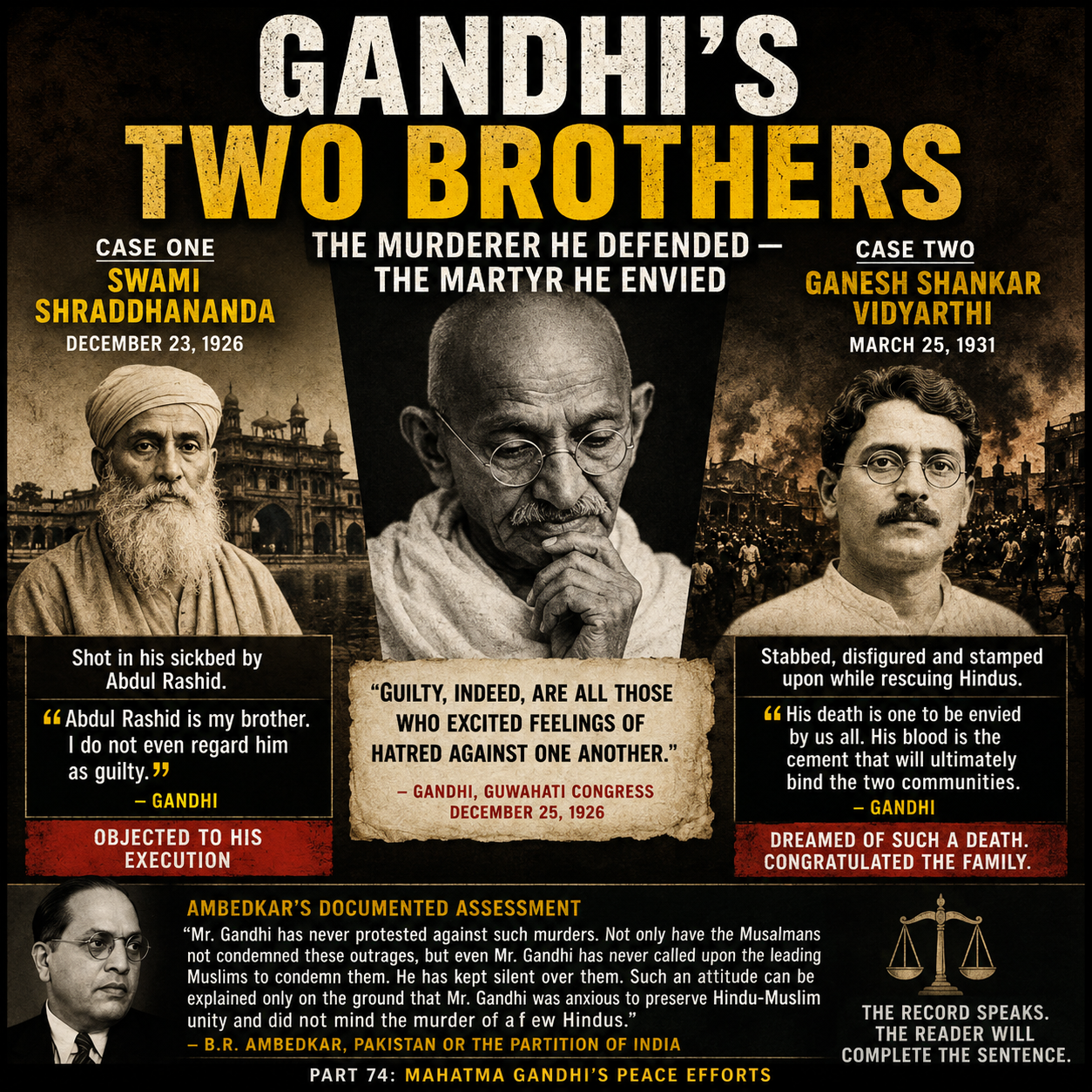
Gandhi’s Two Brothers places two documented murders and Gandhi’s documented responses to each before the reader. Gandhi’s Two Brothers does not characterise the pattern. It places the documented sequence before the reader. The reader will complete the sentence.
Thank you for reading this post, don't forget to subscribe!The Action Taken: Following the assassination of Swami Shraddhanand in his sickbed by Abdul Rashid, Gandhi referred to the assassin as “Brother Abdul Rashid” and urged Hindus to forgive the murder without anger.
Who Paid the Price: Swami Shraddhanand’s legacy and the security of social reformers, whose assassinations were met with spiritualized forgiveness rather than demands for state deterrence.
The Alternative Bypassed: Demanding the full, unsparing prosecution of political and religious assassinations under the Indian Penal Code.
Why This Matters: Confirmed the asymmetrical moral standard: assassins driven by religious fanaticism were publicly embraced as brothers, while the victims were counseled to accept death without grievance.
Case One — Swami Shraddhananda, December 23, 1926
Swami Shraddhananda was seventy years old. He was ill with pneumonia. He was lying in his room at Naya Bazar, Delhi when Abdul Rashid entered on the pretext of discussing religious matters. While his attendant stepped out to fetch water, Abdul Rashid shot Shraddhananda twice at point-blank range. Shraddhananda died instantly.
Shraddhananda had led a documented Shuddhi movement that reconverted over 163,000 Malkana Rajputs to Hinduism — bringing him into direct confrontation with Muslim clerics who had publicly incited violence against him.
Gandhi’s documented response at the Guwahati Congress session, December 25 1926 — CWMG Vol. 32, pp. 461-62:
“Now you will perhaps understand why I have called Abdul Rashid a brother, and I repeat it. I do not even regard him as guilty of Swamiji’s murder. Guilty, indeed, are all those who excited feelings of hatred against one another.”
Gandhi also published in Young India December 30 1926: “I wish to plead for Abdul Rashid. I do not know who he is. It does not matter to me what prompted the deed. The fault is ours.”
Gandhi subsequently objected to the hanging of Abdul Rashid after Rashid was sentenced to death for the murder.
The man who shot a seventy-year-old Hindu religious leader in his sickbed while he lay ill: Gandhi called him brother, pleaded for him, did not regard him as guilty, and objected to his execution.
Case Two — Ganesh Shankar Vidyarthi, March 25, 1931
Ganesh Shankar Vidyarthi was forty years old. He had spent March 25 rescuing both Hindu and Muslim civilians from riot-stricken areas of Kanpur. He had rescued Muslim women. He then went to rescue Hindus trapped in Muslim quarters. He was attacked by a mob with bladed weapons — stabbed multiple times, struck with axe blows, dragged and stamped upon.
His body was not found immediately. When it was found, his face was completely disfigured — unrecognisable. He was identified by his white khadi clothes, the letters in his pockets written that morning, his distinctive hairstyle, and a tattoo on his arm.
Vimla Vidyarthi documented that weapons had been distributed that morning specifically targeting him — the Lion of Kanpur would be killed that day.
Gandhi’s documented response in Young India:
“The death of Ganesh Shankar Vidyarthi was one to be envied by us all. His blood is the cement that will ultimately bind the two communities. No pact will bind our hearts. But heroism such as Ganesh Shankar Vidyarthi showed is bound in the end to melt the stoniest hearts, melt them into one.”
Gandhi subsequently stated he had always dreamed of such a death — axe blows, dagger, kicks — remaining non-violent with a smile. He congratulated the family rather than offering condolences.
Ambedkar’s Documented Assessment
B.R. Ambedkar placed this pattern on the documentary record in Pakistan or the Partition of India — published while Gandhi was alive:
“It is a notorious fact that many prominent Hindus who had offended the religious susceptibilities of the Muslims either by their writings or by their part in the Shudhi movement have been murdered by some fanatic Musalmans. First to suffer was Swami Shraddhanand… What is not understandable is the attitude of Mr. Gandhi. Mr. Gandhi has never protested against such murders. Not only have the Musalmans not condemned these outrages, but even Mr. Gandhi has never called upon the leading Muslims to condemn them. He has kept silent over them. Such an attitude can be explained only on the ground that Mr. Gandhi was anxious to preserve Hindu-Muslim unity and did not mind the murder of a few Hindus.”
The Documented Absence of Parallel Cases
The prosecution is not aware of a widely reported documented case in the same period where a Hindu mob killed a Muslim religious or national leader in comparable circumstances.
What the documented record does show: Gandhi’s own speech at Guwahati placed the guilt not on Abdul Rashid who fired the bullets but on those who had excited feelings of hatred against one another. Shraddhananda had led the Shuddhi movement reconverting Muslims to Hinduism. Gandhi’s documented formulation identified the guilty party in the murder of a Hindu religious leader in his own sickbed — and it was not the man who shot him.
Gandhi’s Two Brothers places this before the reader without characterisation. The reader will identify what the formulation establishes.
The Prosecution’s Position
Gandhi’s Two Brothers places the documented record before the reader as four questions.
- Did Gandhi call the murderer of a seventy-year-old Hindu religious leader shot in his sickbed his brother — and did he not regard him as guilty?
- Did Gandhi object to the execution of that murderer after he was sentenced to death?
- Did Gandhi call the death of a man disfigured beyond recognition while rescuing Hindus enviable — and did he express personal aspiration for a similar death?
- Did Ambedkar document — in a published book, while Gandhi was alive — that Gandhi did not mind the murder of a few Hindus in order to preserve Hindu-Muslim unity?
Gandhi’s Two Brothers is built on four primary sources — CWMG Vol. 32, Young India December 30 1926, Ambedkar’s Pakistan or the Partition of India, and the Cawnpore Riots Inquiry Committee record. The pattern across both cases is placed before the reader without characterisation.
Shraddhananda — shot in his sickbed. Gandhi: Abdul Rashid is my brother. I do not regard him as guilty. Vidyarthi — disfigured beyond recognition rescuing Hindus. Gandhi: his death is to be envied by us all. His blood is the cement. The prosecution places both documented cases and both documented responses before the reader. Ambedkar placed his assessment on the record while Gandhi was alive. The reader will complete the sentence.
Feature Image: Click here to view the image.
Videos
Glossary of Terms
- Gandhi’s Two Brothers: The key phrase of this blog, referring to two contrasting figures in Gandhi’s recorded responses—Abdul Rashid, whom Gandhi called a brother, and Ganesh Shankar Vidyarthi, whose death Gandhi described as enviable.
- Swami Shraddhananda: A prominent Hindu religious leader and social reformer who led the Shuddhi movement and was assassinated in Delhi on December 23, 1926.
- Abdul Rashid: The assassin who shot Swami Shraddhananda while he was ill in his residence in Delhi.
- Shuddhi Movement: A Hindu reconversion campaign aimed at bringing individuals and communities back into the Hindu fold, notably associated with Swami Shraddhananda.
- Malkana Rajputs: A community in northern India whose large-scale reconversion to Hinduism became one of the most notable achievements of the Shuddhi movement.
- Ganesh Shankar Vidyarthi: Freedom fighter, journalist, and social activist who was killed while rescuing civilians during the Kanpur riots of March 1931.
- Kanpur Riots (1931): Communal violence that erupted in Kanpur in March 1931, during which Ganesh Shankar Vidyarthi lost his life while attempting rescue efforts.
- Young India: A publication edited by Mahatma Gandhi in which many of his political, social, and religious views were published.
- Guwahati Congress Session: The December 1926 session of the Indian National Congress where Gandhi publicly commented on the murder of Swami Shraddhananda.
- CWMG (Collected Works of Mahatma Gandhi): The official multi-volume compilation of Gandhi’s speeches, writings, correspondence, and public statements.
- B. R. Ambedkar: Jurist, economist, social reformer, and principal architect of India’s Constitution who critically examined Gandhi’s approach to Hindu-Muslim relations.
- Pakistan or the Partition of India: Ambedkar’s influential book analyzing communal politics, partition, and Gandhi’s responses to Hindu-Muslim conflicts.
- Cawnpore Riots Inquiry Committee: An investigative body that documented facts and evidence relating to the Kanpur riots and the death of Ganesh Shankar Vidyarthi.
- Hindu-Muslim Unity: A major political objective pursued by Gandhi throughout the freedom movement, frequently referenced in discussions of his responses to communal violence.
- The Reader Will Complete the Sentence: A recurring phrase in this series used to present documented facts without explicitly stating a conclusion, leaving interpretation to the reader.
#Gandhi #IndianHistory #Ambedkar #Congress #FreedomMovement #Partition #HinduMuslim #History #Politics #HinduinfoPedia
Gandhi’s Peace Efforts: The Questions Before the Mahatma (0)
Refer to Various Arks Referred to in the Blog