
Gandhi’s Replaced Test: What Friendship Required — and What the Khilafat Leadership Did Instead (69)
भारत / GB
Part 69: Mahatma Gandhi’s Peace Efforts | Series Index
Blog 68 documented Gandhi’s silence of action — no fast, no satyagraha, no demand for condemnation from the Khilafat leadership. This post examines what Gandhi explicitly said about condemnation — that it was not the test of Muslim friendship — and places that documented statement alongside what the Khilafat leadership actually did in the same month, in the same city, in the same Congress session.
Thank you for reading this post, don't forget to subscribe!The Action Taken: Gandhi actively defended the marching uniforms, military-style drill, and organization of the Khilafat Volunteer Corps while condemning Hindu attempts to organize defensive lathi squads.
Who Paid the Price: The physical security of Hindu neighborhoods, which were left disorganized and defenseless in the face of disciplined sectarian cadres.
The Alternative Bypassed: Applying a uniform standard that either disarmed all community volunteer corps or permitted equal, lawful self-defense preparation for all.
Why This Matters: Documents the operational double standard: armed posturing by clerical allies was accommodated as religious expression, while defensive organizing by victim communities was condemned as communal distrust.
The Full Statement — Placed in Its Complete Context
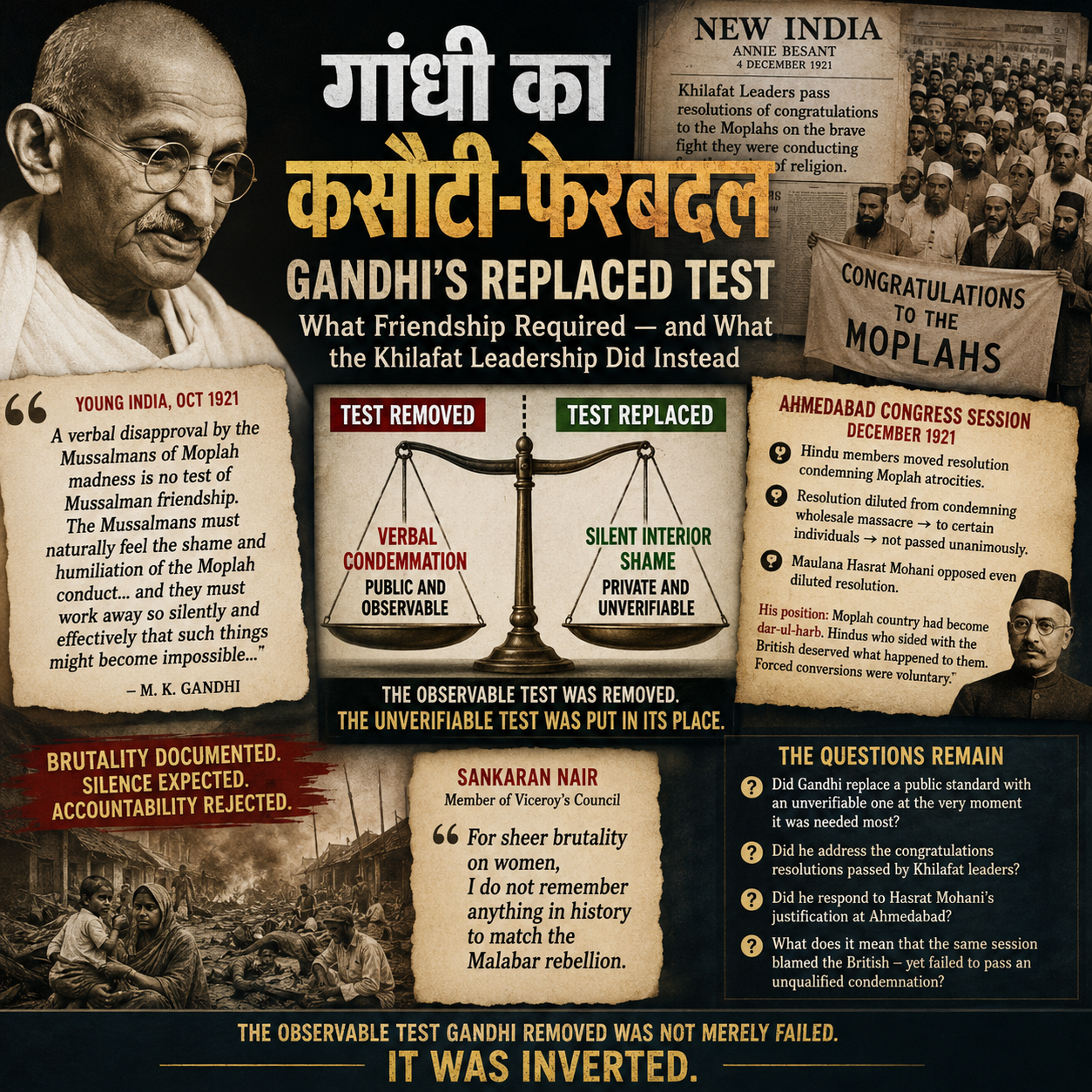
Gandhi’s Replaced Test begins with Gandhi’s October 1921 Young India statement placed in its complete documented form — not the partial quote but the full passage from the Collected Works of Mahatma Gandhi:
“The Moplah revolt is a test for Hindus and Mussulmans. Can Hindus’ friendship survive the strain put upon it? Can Mussulmans in the deepest recesses of their hearts approve of the conduct of the Moplahs? The Hindus must have the courage and the faith to feel that they can protect their religion in spite of such fanatical eruptions. A verbal disapproval by the Mussalmans of Moplah madness is no test of Mussalman friendship. The Mussalmans must naturally feel the shame and humiliation of the Moplah conduct about forcible conversions and looting, and they must work away so silently and effectively that such things might become impossible even on the part of the most fanatical among them. My belief is that the Hindus as a body have received the Moplah madness with equanimity and that the cultured Mussalmans are sincerely sorry for the Moplah’s perversion of the teachings of the Prophet.”
The prosecution places this statement before the reader and notes its precise architecture — and the gap between the standard Gandhi removed and the standard he put in its place.
Gandhi removed one standard — verbal condemnation, a public and observable act — and replaced it with another: Muslims must feel shame internally and work silently and effectively so that such things become impossible. The substitute standard is interior, private, and unverifiable. No one can observe whether a Muslim leader has felt shame in the deepest recesses of his heart. No one can measure whether he has worked silently and effectively. Gandhi removed the test that could be held to account and replaced it with one that could not.
What the Khilafat Leadership Did — Documented
Gandhi’s Replaced Test places alongside his statement the documented conduct of the Khilafat leadership in the same period.
Annie Besant documented in New India — the same publication that carried her Malabar’s Agony — that a wave of horrified feeling had spread among Hindus of every shade of opinion, which was intensified when certain Khilafat leaders were so misguided as to pass resolutions of congratulations to the Moplahs on the brave fight they were conducting for the sake of religion.
The Khilafat leaders did not fail Gandhi’s removed test — verbal condemnation. They went further: they actively congratulated the perpetrators. The substitute standard Gandhi offered — silent interior shame — was inverted into public celebration.
The Ahmedabad Congress Session — December 1921
Gandhi’s Replaced Test reaches its most documented exhibit in the December 1921 Ahmedabad Congress session — the same session where, as Blog 64 documented, the Congress passed a resolution stating the uprising could have been prevented had the British invited Gandhi and the Khilafat leadership to Malabar.
At the same session, Hindu members moved a resolution condemning the Moplah atrocities. What followed is documented in the firsthand account of Swami Shraddhananda, published in The Liberator on August 26, 1926:
The original resolution condemned the Moplahs wholesale for the killing of Hindus and burning of Hindu homes and the forcible conversion to Islam. Hindu members themselves proposed amendments until it was reduced to condemning only certain individuals guilty of those crimes. Then Maulana Hasrat Mohani — described by Shraddhananda as an out-and-out Nationalist — opposed even this reduced resolution. His documented position: the Moplah country had become dar-ul-harb and the Hindus who sided with the British had therefore deserved what happened to them. The forced conversions, in his documented position, were voluntary.
The condemnation resolution was diluted progressively — from condemning the massacre wholesale, to condemning certain individuals, to not passing unanimously even then.
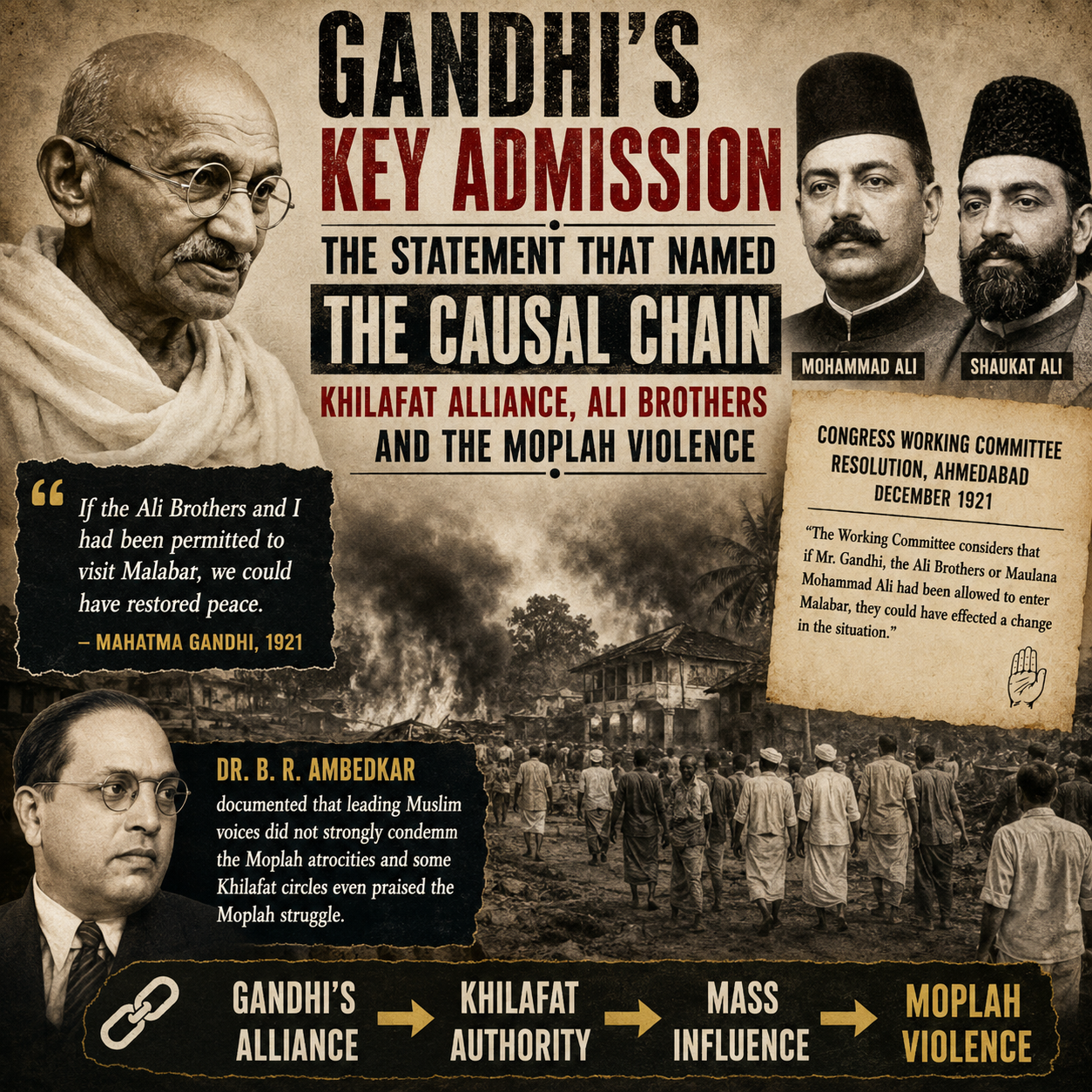
Sankaran Nair’s Documented Testimony
The prosecution places one further documented voice before the reader — Sir Sankaran Nair, member of the Viceroy’s Council, a named contemporary official witness whose documented statement directly contradicts Gandhi’s characterisation of the Moplah conduct.
Sankaran Nair wrote: “For sheer brutality on women, I do not remember anything in history to match the Malabar rebellion.”
Gandhi called the perpetrators brave and God-fearing. Sankaran Nair — writing as a member of the British Indian administration, with direct access to official records — documented that the brutality against women had no historical parallel within his knowledge.
Two contemporaneous characterisations of the same events. The reader will place them side by side.
The Prosecution’s Position
Gandhi’s Replaced Test places the documented sequence before the reader as four exhibits and asks four questions:
- Did Gandhi replace a public observable standard — verbal condemnation — with an interior unverifiable standard — silent private shame — at the precise moment the Khilafat leadership was failing even the removed standard by actively celebrating the massacre?
- Did Gandhi address the congratulations resolutions passed by Khilafat leaders — or did his published writings in Young India decline to name or challenge them?
- Did Gandhi respond to Hasrat Mohani’s documented position at the Ahmedabad session — or did the Congress proceed without placing Mohani’s justification on the record as a position the Congress rejected?
- What does it mean that the same Ahmedabad session that passed a resolution placing responsibility on the British for not inviting Gandhi and the Khilafat leadership to Malabar — also failed to pass an unqualified condemnation of the massacre?
The series does not answer. The four documented exhibits are on the record — Gandhi’s full statement, Besant’s documentation of the congratulations resolutions, Shraddhananda’s account of the Ahmedabad session, Sankaran Nair’s official testimony. The reader will examine the sequence and complete the sentence.
Gandhi removed verbal condemnation as the test of Muslim friendship in October 1921. The congratulations resolutions — documented by Besant as a wave across Khilafat meetings from August onward. The Ahmedabad session — where Mohani justified the massacre and blocked condemnation. These are related but distinct documented events occurring across different months. The same session passed a resolution blaming the British for the massacre. Gandhi’s replaced test — silent interior shame — was not applied. The observable test Gandhi had removed was not merely failed. It was inverted. The prosecution places the documented sequence before the reader.
Feature Image: Click here to view the image.
Videos
Glossary of Terms
- Gandhi’s Replaced Test: A phrase coined in this blog describing Gandhi’s shift from demanding public condemnation of the Moplah violence to emphasizing internal shame and silent reform as the measure of Muslim friendship.
- Moplah Revolt: The 1921 uprising in the Malabar region involving sections of the Moplah Muslim community, marked by attacks, killings, forced conversions, and anti-British violence during the Khilafat and Non-Cooperation period.
- Khilafat Movement: A pan-Islamic political movement in British India launched to defend the Ottoman Caliphate after World War I, strongly supported by Gandhi during the Non-Cooperation movement.
- Young India: Mahatma Gandhi’s English-language journal where he published political commentary, movement guidance, and responses to national events during the freedom struggle.
- Verbal Condemnation: Public denunciation of violence or atrocities. In this blog, it refers to Gandhi’s statement that such condemnation was “no test” of Muslim friendship.
- Silent Interior Shame: The blog’s description of Gandhi’s alternative moral standard, where Muslims were expected to internally feel shame and quietly prevent future violence rather than publicly condemn it.
- Ahmedabad Congress Session: The December 1921 session of the Indian National Congress where resolutions related to Malabar, the Khilafat movement, and the Moplah violence were debated.
- Hasrat Mohani: A nationalist leader and Congress figure who, according to Swami Shraddhananda’s account, opposed even a diluted condemnation of the Moplah atrocities during the Ahmedabad session.
- Dar-ul-Harb: An Islamic juridical term meaning “abode of war,” used historically in some interpretations for territories considered outside Islamic rule.
- Swami Shraddhananda: Arya Samaj leader and social reformer who documented proceedings of the Ahmedabad Congress session and debates surrounding condemnation of the Moplah violence.
- Annie Besant: Theosophist, nationalist leader, and founder of the newspaper New India, who documented reports of Khilafat leaders congratulating Moplah fighters.
- Malabar’s Agony: Annie Besant’s documented writings describing the suffering, killings, forced conversions, and destruction during the Moplah violence in Malabar.
- Sankaran Nair: Indian statesman and member of the Viceroy’s Council who sharply criticized the brutality of the Moplah rebellion in his documented writings.
- Observable Standard: A key phrase in this blog referring to public, measurable actions such as open condemnation of violence.
- Unverifiable Standard: A key phrase in this blog referring to internal feelings or silent intentions that cannot be publicly measured or held accountable.
#Gandhi #Moplah #Khilafat #Congress #Malabar #History #India #Hindus #KhilafatMovement #MahatmaGandhi #HinduinfoPedia
Gandhi’s Peace Efforts: The Questions Before the Mahatma (0)