
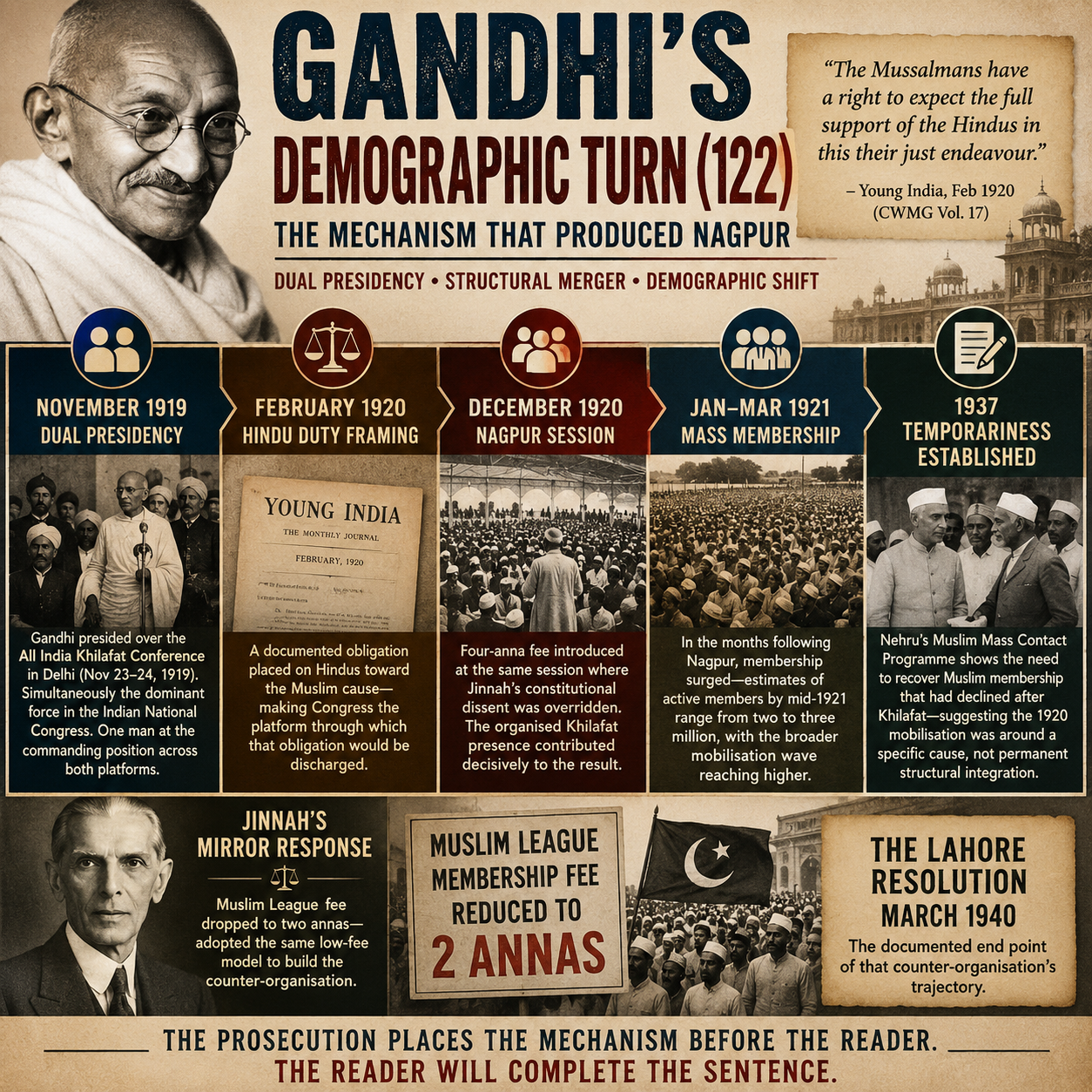
Gandhi’s Demographic Turn: The Muslim Strength That Produced Nagpur Vote (122)
भारत / GB
Part 122: Mahatma Gandhi’s Peace Efforts | Series Index
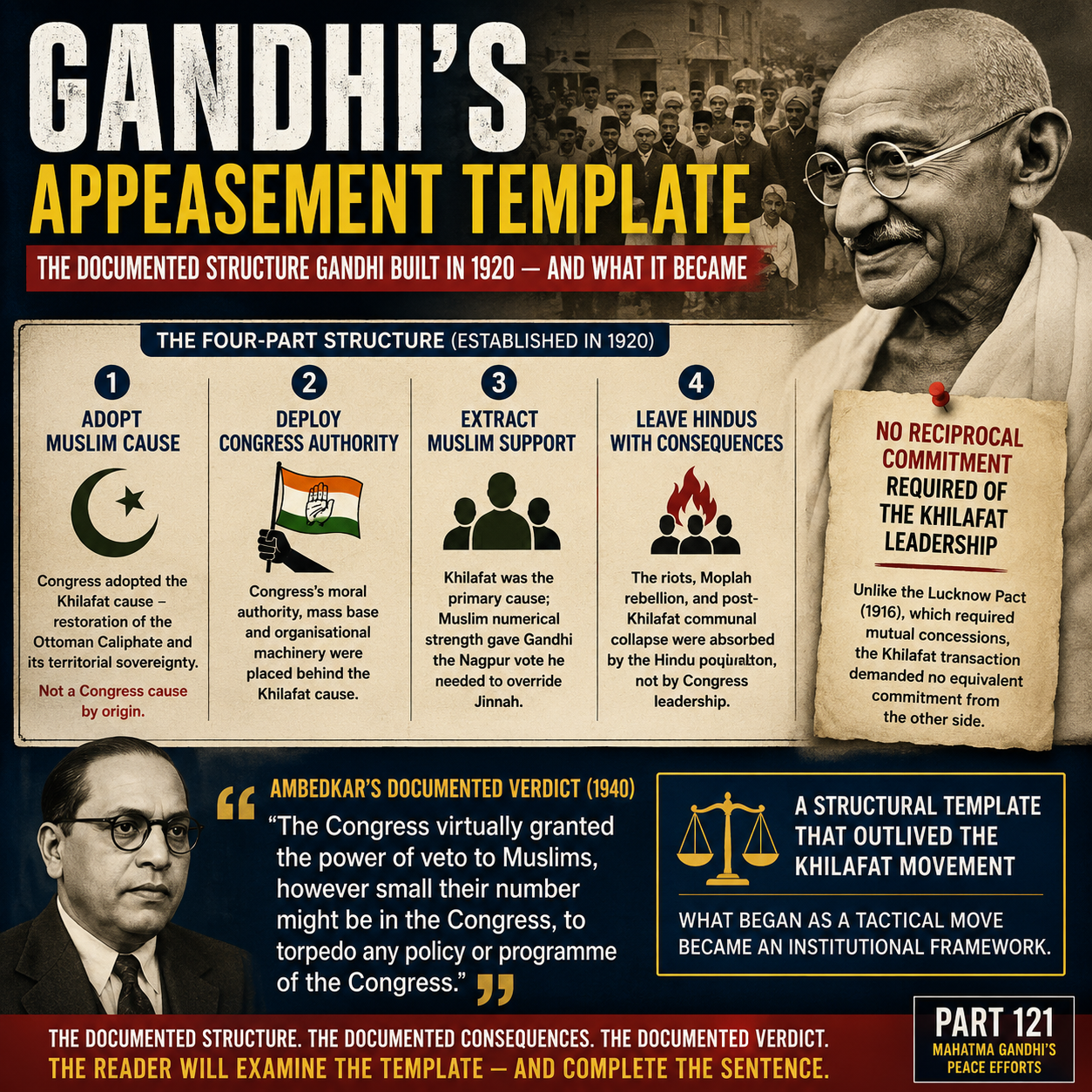
Blog 121 placed the four-part transactional architecture of the Khilafat decision before the reader — the structure Gandhi built in 1920 and what Ambedkar identified as its institutional residue. This post, Gandhi’s Demographic Turn” places the specific mechanism by which that architecture produced the Nagpur result before the reader — the dual presidency, the structural merger, and the demographic shift that overrode Jinnah’s constitutional dissent.
Thank you for reading this post, don't forget to subscribe!The Action Taken: In response to the Kohat massacres, Gandhi undertook a 21-day fast at the residence of Maulana Mohamed Ali in Delhi, framing the violence as an occasion for personal spiritual penance.
Who Paid the Price: The Kohat refugees, whose physical restitution and legal justice were replaced by an inter-faith Unity Conference that yielded no binding guarantees.
The Alternative Bypassed: Leading a national political and legal demand to prosecute the rioters and restore the displaced population under armed state protection.
Why This Matters: Demonstrates the deflection mechanism of the fast: real-world criminal atrocities were internalized as personal spiritual guilt, shifting the national conversation away from legal culpability.
The Dual Presidency — November 1919
Gandhi’s Demographic Turn places the origin of the mechanism before the reader first. In November 1919, Gandhi presided over the All India Khilafat Conference in Delhi (November 23-24 1919). While the Committee’s formal leadership rotated among figures including Seth Chotani and the Ali brothers, Gandhi’s presiding role placed him at the commanding position of the Khilafat movement’s national platform. He was simultaneously the dominant force within the Indian National Congress. One man held the commanding position in both simultaneously — the organisation that mobilised Muslims around the Khilafat issue and the Congress organisation with which Gandhi sought cooperation.
The prosecution places one observation alongside this: Gandhi was not a passive recipient of the Khilafat movement’s support. He was its elected leader. The structural merger of the Khilafat Committee and Congress was not an alliance between two independent organisations with separate leaderships. There was no formal organisational merger — what existed was documented political cooperation, joint programmes, shared mobilisation, and common leadership. Read together, these elements placed Gandhi as the governing authority across both platforms simultaneously.
The Hindu Duty Framing — February 1920
Gandhi’s Demographic Turn places Gandhi’s own documented language from Young India, February 1920 (CWMG Vol. 17) before the reader. Gandhi did not issue a specific call to Muslims to join Congress. What he issued was something structurally more significant: a documented obligation placed on Hindus toward the Muslim cause.
“The Mussalmans have a right to expect the full support of the Hindus in this their just endeavour.”
The prosecution places the documented structure of this statement before the reader. Gandhi placed a Hindu obligation toward the Muslim cause — calling upon Hindus as Congress members to support the Khilafat cause — making Congress the platform through which that obligation would be discharged. The mechanism did not require an explicit call to Muslims. It made Congress the natural institutional home of the Khilafat movement by making Hindu Congress membership a documented obligation to support the Khilafat cause.
Ambedkar placed Gandhi’s intent on the primary source record in Pakistan or the Partition of India: “Mr. Gandhi took up the cause of the Khilafat with a view to bring the Muslims to join the Congress.” The intent is Ambedkar’s documented observation — placed during Gandhi’s lifetime, from the man whose constitutional future Gandhi’s fast would later foreclose.
The Fee Reduction and the Nagpur Session — December 1920
Gandhi’s Demographic Turn places the documented timing before the reader precisely. The four-anna membership fee was introduced at the Nagpur session of December 1920 — the same session at which Jinnah’s constitutional dissent was overridden. The fee reduction and the Nagpur result were simultaneous, not sequential. The Khilafat Committee’s existing organisational infrastructure — mosques, Maulvis, the Ali brothers’ documented mass outreach — was already producing the session’s crowd composition before the fee reduction formalised mass membership.
Kanji Dwarkadas documented the result (India’s Fight for Freedom, pp. 286-287): had there been a standard delegate composition at Nagpur, Jinnah would have prevailed. Gandhi prevailed because of a pro-Khilafat contingent whose organised presence in the pandal overrode Jinnah’s solitary constitutional dissent. The organised Khilafat presence at Nagpur contributed decisively to the result — Kanji Dwarkadas documented that a standard delegate composition would have favoured Jinnah.
What Followed — Five Million in Three Months
Gandhi’s Demographic Turn places the documented post-Nagpur membership surge before the reader. Through 1921, Congress membership surged on a scale unprecedented in its history. The Tilak Swaraj Fund membership drive — launched after the Vijayawada AICC session in March 1921 — produced approximately 50 lakh (five million) enrolled members by mid-1921, against a target of one crore. The mechanism is now on the record: Khilafat conferences explicitly urged those over 21 to join the Indian National Congress — a direct organisational instruction from the Khilafat network to its membership base to enrol in Congress. The fee reduction had formalised what the Khilafat alliance had already demonstrated at Nagpur: organised religious mobilisation could produce mass Congress membership that the existing Hindu educated-class base could not match in numbers alone.
The 1937 Evidence — Temporariness Established
Gandhi’s Demographic Turn places the most precise exhibit in the blog before the reader last. In 1937 — seventeen years after Nagpur — Jawaharlal Nehru launched the formal Muslim Mass Contact Programme. The programme sent Congress workers specifically into Muslim localities to enrol Muslims as four-anna members under the secular banner. The reason: the post-Khilafat years had seen a documented collapse in Muslim participation in Congress.
The prosecution places one observation alongside this: the need for such a programme suggests that the earlier mobilisation had not resulted in durable integration — that Muslim participation in Congress had been tied to the Khilafat cause rather than to Congress as a permanent political home. The Muslim Mass Contact Programme of 1937 is the documented evidence that the demographic shift produced at Nagpur through the Khilafat alliance was temporary — a mobilisation around a specific cause that dissolved when the cause dissolved, not a permanent realignment of Muslim political participation in Congress.
Jinnah’s documented mirror response completes the exhibit: after Nagpur, Jinnah dropped the Muslim League membership fee to two annas — lower than Congress’s four annas. Jinnah adopted the same low-fee membership model to build the Muslim League’s counter-mass base. The Lahore Resolution of March 1940 is the documented end point of that counter-organisation’s trajectory.
The Prosecution’s Position
Gandhi’s Demographic Turn places three questions before the reader.
- Did Gandhi hold the commanding position in both the All India Khilafat Committee (elected President November 1919) and the Indian National Congress simultaneously — making him the governing authority on both sides of the structural merger that produced the Nagpur demographic shift?
- Did Gandhi’s February 1920 Young India statement (CWMG Vol. 17) — “The Mussalmans have a right to expect the full support of the Hindus in this their just endeavour” — frame a Hindu obligation toward the Muslim cause that called upon Hindus as Congress members to discharge that obligation through Congress, as Ambedkar’s primary source observation confirms: “Mr. Gandhi took up the cause of the Khilafat with a view to bring the Muslims to join the Congress”?
- Does the 1937 Nehru Muslim Mass Contact Programme — a formal targeted campaign to recover Muslim membership that had collapsed post-Khilafat — establish that the demographic shift produced at Nagpur was temporary mobilisation around a specific cause rather than permanent structural integration, and does this evidence belong before the reader alongside Jinnah’s documented mirror response of dropping the Muslim League fee to two annas to build the counter-organisation?
The series does not answer. Gandhi’s Demographic Turn places the dual presidency, the Hindu duty framing, the Nagpur mechanism, the five million membership surge, the 1937 evidence of temporariness, and Jinnah’s mirror response before the reader in sequence. The reader will examine the mechanism that produced Nagpur — and complete the sentence.
Invitation To Defence
The floor belongs to the defense. We now invite them to present their exhibits and challenge the narrative established by the prosecution.
November 1919: Gandhi elected President of All India Khilafat Committee. Simultaneously the dominant force in Congress. February 1920, Young India, CWMG Vol. 17: “The Mussalmans have a right to expect the full support of the Hindus in this their just endeavour.” Ambedkar: “Mr. Gandhi took up the cause of the Khilafat with a view to bring the Muslims to join the Congress.” December 1920, Nagpur: pro-Khilafat contingent overrode Jinnah’s solitary constitutional dissent. Five million members in three months. 1937: Nehru’s Muslim Mass Contact Programme — the documented evidence that the demographic shift had dissolved with the cause. Jinnah’s mirror response: Muslim League fee dropped to two annas. The prosecution places the mechanism before the reader. The reader will complete the sentence.
Feature Image: Click here to view the image.
Videos
Glossary of Terms
- Demographic Turn: The central concept of this blog describing the shift in Congress’s organisational composition through Khilafat-linked mass mobilisation.
- Dual Presidency: Gandhi’s simultaneous leadership role in the All India Khilafat Committee and the Indian National Congress during 1919–1920.
- All India Khilafat Committee: The national organisation established to support the Ottoman Caliphate and coordinate the Khilafat Movement in British India.
- Structural Merger: A key phrase in this series referring to the documented political cooperation, shared leadership, and joint mobilisation between the Khilafat Committee and Congress without a formal organisational merger.
- Young India: Gandhi’s English-language weekly journal in which he published political statements, including his February 1920 appeal supporting the Khilafat cause.
- CWMG: Collected Works of Mahatma Gandhi, the official multi-volume compilation of Gandhi’s speeches, writings, and correspondence.
- Four-Anna Membership: The reduced Congress membership fee adopted at the Nagpur Session of 1920 to facilitate mass enrolment.
- Nagpur Session (1920): The December 1920 session of the Indian National Congress where organisational reforms, including the four-anna membership, were adopted and Jinnah’s constitutional position was defeated.
- Tilak Swaraj Fund: A nationwide fundraising and membership campaign launched by Congress in 1921 to expand its organisational base.
- Muslim Mass Contact Programme: Jawaharlal Nehru’s 1937 Congress campaign to recruit Muslims after the decline of Muslim participation following the Khilafat Movement.
- Constitutional Dissent: Jinnah’s documented opposition to Gandhi’s Non-Cooperation and Khilafat strategy through constitutional and parliamentary methods.
- Mirror Response: A term used in this series describing Jinnah’s adoption of a similar low-fee membership strategy for the Muslim League after the Nagpur developments.
- Counter-Organisation: The Muslim League’s expanding organisational structure developed in response to Congress’s mass membership model.
- Lahore Resolution: The March 1940 resolution of the Muslim League that proposed independent Muslim-majority states, marking the culmination of its political trajectory.
- Demographic Shift: The key phrase describing the change in the composition of Congress delegates and membership resulting from Khilafat-linked mass mobilisation.
#Gandhi #Jinnah #Congress #Khilafat #Nagpur #History #India #Politics #Freedom #Partition #Ambedkar #MuslimLeague #HinduinfoPedia
Gandhi’s Peace Efforts: The Questions Before the Mahatma (0)