
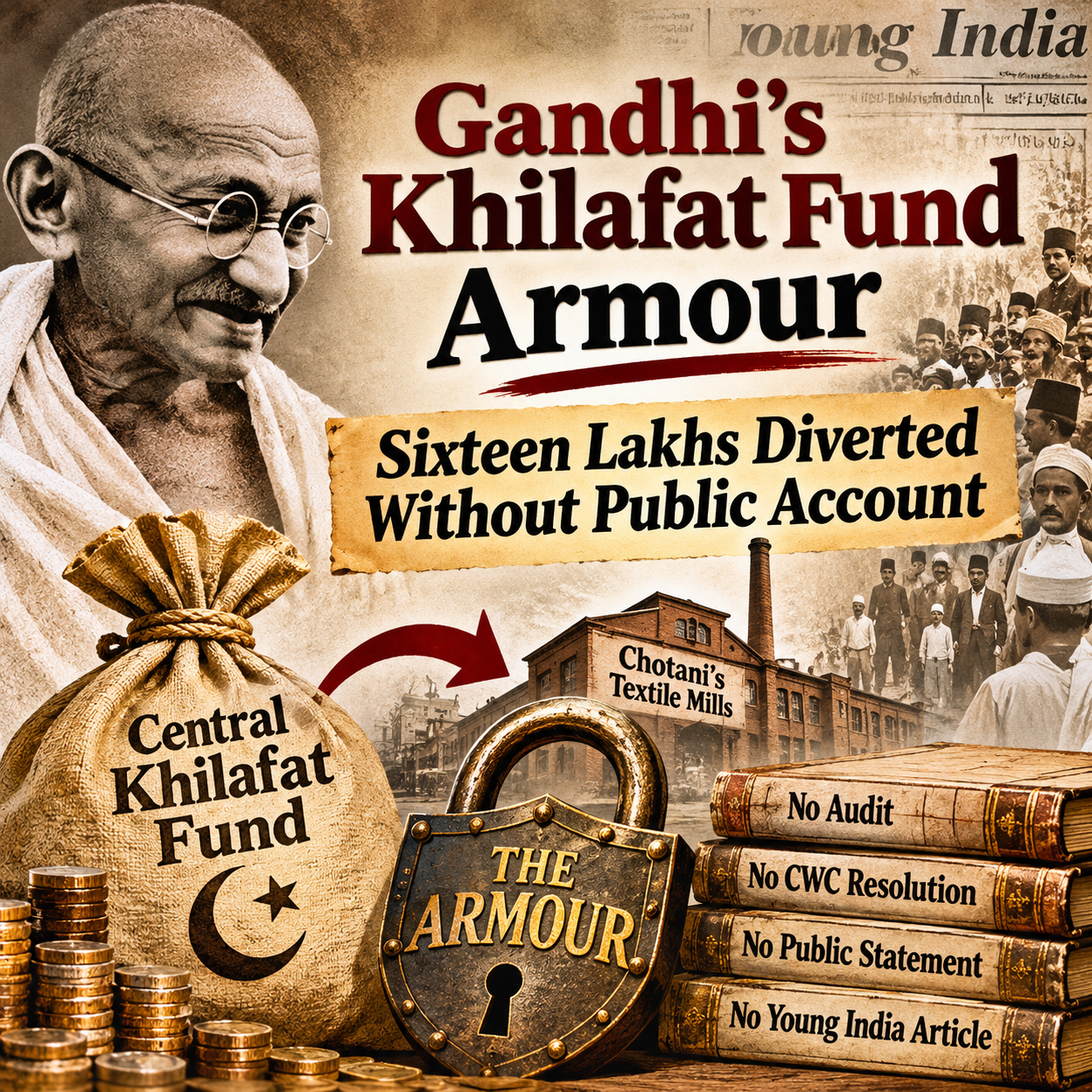
Gandhi’s Khilafat Fund Armour: Sixteen Lakhs Diverted Without Public Account (190)
भारत / GB
Part 190: Mahatma Gandhi’s Peace Efforts | Series Index
The previous blog placed three financial flows before the reader: the Tilak Swaraj Fund deployed into Khilafat organisational infrastructure, the Central Khilafat Fund’s diversion into Seth Jan Muhammad Chotani’s commercial mills — sixteen to seventeen lakhs, no public reckoning — and the İşbank paradox, in which Indian Caliphate donor gold became the founding capital of a secular Turkish bank four months after the Caliphate was abolished. Gandhi’s Khilafat fund armour now places before the reader what the institutional leadership did not do: account.
Thank you for reading this post, don't forget to subscribe!THE INSTITUTIONAL RECORD — THE ARMOUR
The Pattern: Between March 1922 and February 1924, Seth Jan Muhammad Chotani — treasurer of the Central Khilafat Committee — absorbed sixteen to seventeen lakhs of rupees of public donations into his private commercial operations and eventually settled the liability by transferring two textile mills. The Congress Working Committee operated freely throughout this period and produced no resolution, no audit demand, and no public statement. Gandhi was released from Yerwada on 5 February 1924 and produced no Young India article on the diversion thereafter. The fund was shielded on every side.
The Lethal Exhibit: Gandhi’s own Young India published district-by-district Tilak Swaraj Fund receipts — town by town, province by province — under treasurer Jamnalal Bajaj. The identical publication apparatus existed for the Khilafat Fund. It was never deployed for the Khilafat Fund. That differential deployment is Gandhi’s Khilafat fund armour made visible.
Why it matters: Armour does not form by accident. It is constructed, layer by layer, from every platform withheld, every CWC session that produced no resolution, every edition of Young India that carried no audit demand. The diversion needed the armour to survive. The armour held.
The Alibi That Does Not Hold
The standard defence offered for Gandhi’s inaction on the Chotani diversion runs as follows: Gandhi was imprisoned at Yerwada from March 1922 and could not have known or acted. The record, examined chronologically, dismantles this alibi in two phases.
Phase One, March 1922 – February 1924. Gandhi was arrested on 10 March 1922, sentenced before Judge Broomfield on 18 March 1922, and transferred to Yerwada Central Jail shortly thereafter. The Chotani transfer of Khilafat funds into private mill accounts proceeded in the months that followed — the Congress Working Committee was entirely at liberty throughout this period. The CWC met, issued resolutions on political matters across the Gaya Session (1922) and the Cocanada Session (1923), corresponded with provincial Congress committees, and continued to publish. No resolution demanding an audit of Central Khilafat Fund accounts appears in the available CWC record. No CWC statement called for Chotani to account publicly for the disposition of the donations. The CWC had full capacity to act. It did not act. The first layer of Gandhi’s Khilafat fund armour was forged not in Yerwada but in the Congress Working Committee’s own session rooms.
Phase Two, February 1924 onwards. Gandhi was released from Yerwada on 5 February 1924, on medical grounds, having served approximately two years of a six-year sentence. The Chotani matter had not been resolved. The mills had not been transferred. No criminal prosecution had been initiated. Gandhi’s platform — Young India — resumed publication under his editorial direction. Between February 1924 and the end of that year, Gandhi wrote on Hindu-Muslim unity, on untouchability, on the Vaishnava faith, on spinning, on village self-sufficiency. He did not write a single article examining the disposition of sixteen to seventeen lakhs of public donations entrusted to the Central Khilafat Fund. The second layer of armour was laid in every edition of Young India that went to press without a Chotani audit demand.
The prison alibi is further foreclosed by Gandhi’s own subsequent record: in September 1932, from the same Yeravda prison, Gandhi announced a fast unto death on the question of separate electorates for untouchables, negotiated directly with Ambedkar, and produced the Poona Pact within six days — a signed constitutional settlement that reshaped the political map of India. Yeravda’s walls did not prevent decisive national intervention when Gandhi chose to intervene. The choice not to intervene on the Chotani diversion was precisely that — a choice. A choice that armoured the fund from public scrutiny at the moment it was most vulnerable.
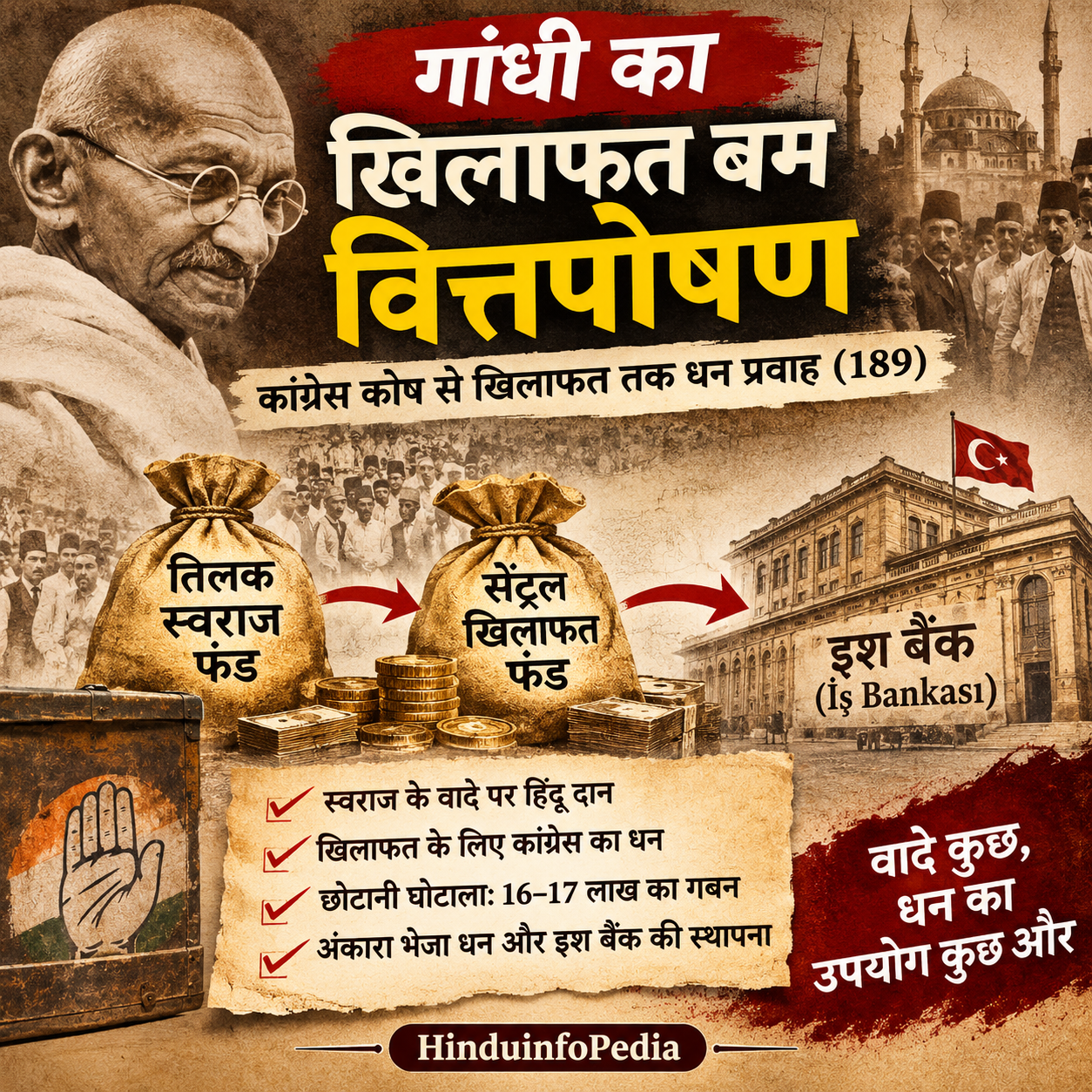
The Forensic Contrast: What Gandhi Did Publish
The most instructive document in this examination is not what Gandhi withheld. It is what Gandhi chose to publish about a different fund managed under the same Congress umbrella.
The Tilak Swaraj Fund — the one-crore rupee fund raised in 1921 in the name of Bal Gangadhar Tilak’s legacy — was subject to regular public accounting in the pages of Young India. Gandhi published district-by-district receipts under treasurer Jamnalal Bajaj. Readers in Madras could see how much Bengal had contributed. Readers in Lahore could verify the Bombay total. The fund’s deployment into Non-Cooperation agitation infrastructure was reported, discussed, and defended publicly. This was Gandhi’s own stated principle: public money raised in public trust required public accounting.
The Central Khilafat Fund occupied an identical structural position. It was raised in public — at Friday mosque collections, at railway station haats, at village gatherings where women surrendered silver anklets and glass bangles. It was raised under Gandhi’s explicit endorsement: he had told Hindu audiences in Young India on 2 June 1920 and 20 October 1920 that it was their duty to contribute to the Khilafat Fund. He was, by his own words, a co-trustee in the moral architecture of that fundraising.
When sixteen to seventeen lakhs of those donations migrated into Seth Chotani’s two textile mills, the Tilak Fund precedent provided Gandhi with an exact template for response: publish the accounts, name the discrepancy, demand an audit. Gandhi’s Khilafat fund armour consisted precisely in the refusal to apply to the Khilafat Fund the same standard of public transparency he had already established for the Tilak Fund. The Tilak Fund was held to account in public. The Khilafat Fund was armoured from it. The contrast is not incidental. It is the proof.
The Private Settlement and What It Foreclosed
The Chotani matter was eventually resolved — not through any public demand, not through a CWC resolution calling for restitution, and not through the criminal law. It was resolved through a private commercial arrangement: Chotani transferred ownership of his two mills as settlement of the debt. The mills, not the cash, changed hands.
This resolution foreclosed several things simultaneously. It foreclosed criminal prosecution: once a civil settlement was reached, the avenue for a charge of criminal breach of trust became procedurally complicated. It foreclosed public accounting: no district-by-district statement of what had been collected and what had been diverted was ever published. It foreclosed donor restitution: the sixteen to seventeen lakhs raised at mosque collections, village haats, and from the jewellery of ordinary Muslim women was not returned to the donors — it was notionally offset against the mill assets, an asset class entirely unfamiliar to those donors and of no direct benefit to them.
One question the private mill settlement foreclosed permanently: whether any portion of the Hindu donations collected on joint Congress–Khilafat platforms entered the physical fund Seth Chotani absorbed into his commercial operations. The formal inquiry identified the missing sum as Angora and Smyrna relief collections booked under Chotani’s Khilafat ledgers, and the Tilak Swaraj Fund’s audited accounts show no corresponding outflow. But the formal ledgers do not reconstruct what happened at the cash stage in the mofussil: at joint rallies across Gujarat, the United Provinces, and Bengal, collections of coin, currency, and ornaments were taken simultaneously from Hindu and Muslim audiences, pooled by local joint committees, and remitted as lump sums before any formal separation into named accounts. A transaction-level audit of that pre-banking physical stage was never conducted. The private mill settlement — a closed commercial arrangement between committee members, with no public disclosure — ensured it never would be.
Gandhi’s Khilafat fund armour made this outcome possible. By withholding the platform of Young India — the platform he had used to solicit the original donations — Gandhi removed the one mechanism through which donors might have learned what had happened to their contributions and demanded a different outcome. The armour did not merely allow the private settlement to happen. It created the conditions under which a private settlement was the only settlement available.
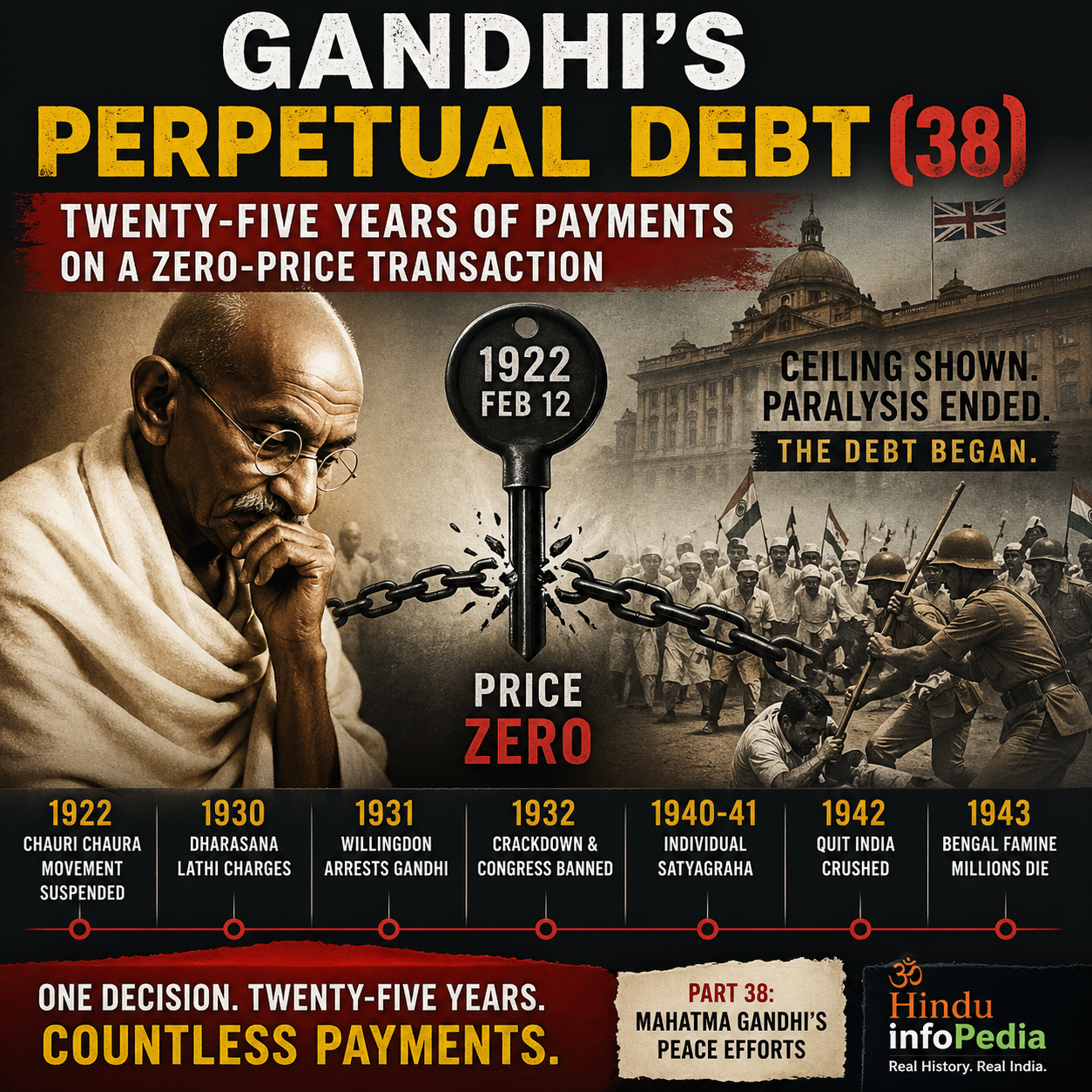
The Verdict: Armour Is Policy
The argument that Gandhi’s inaction was a coincidence of circumstance — imprisonment, illness, the press of other matters — collapses under the weight of the Tilak Fund contrast. Gandhi published detailed financial accountability for the fund he controlled. He published nothing about the fund he had endorsed. The differential treatment is a documented fact, not an inference.
The argument that Gandhi lacked information also collapses. The Chotani diversion was known within the Khilafat Committee’s leadership structure. The CWC, which operated freely throughout 1922–23, had access to committee members who knew. Gandhi’s own correspondents within the movement knew. A man who published monthly district receipts for one fund and maintained total silence about another fund into which he had personally directed public donations is not a man who lacked information. He is a man who constructed armour.
Consider the asymmetry in its sharpest form. In February 1922, at Chauri Chaura in the United Provinces, a crowd killed twenty-two policemen. Gandhi convened the CWC at Bardoli and suspended the entire Non-Cooperation Movement on 12 February 1922, citing the violence as a moral disqualification. His response to Chauri Chaura was swift, public, and came at enormous political cost. His response to the diversion of sixteen to seventeen lakhs of public donations — raised in part from Hindu contributors he had personally solicited — was two years of protected silence, followed by further silence after his release. One act triggered immediate public intervention. The other was armoured from it.
Gandhi’s Khilafat fund armour is the record of a man who calibrated his public moral interventions precisely. He intervened when intervention served his political architecture. He armoured the fund when intervention would have required him to hold a Muslim committee treasurer to the same standard of public accountability he applied without hesitation to Hindu-majority political funds. The armour held the diversion in place. It held the private settlement in place. It held the question of donor restitution permanently off the public record.
Armour is not the absence of an act. Armour, constructed from a platform, in the face of a known diversion, against the interests of identifiable donors, is an act of policy. Gandhi’s Khilafat fund armour is not a gap in the historical record. It is the record. Every edition of Young India that carried no Chotani audit demand is a primary source. Every CWC session that produced no resolution on sixteen to seventeen lakhs of public donations is a primary source. The armour is built from absences, and the absences are documented.
Invitation To Defence
Two years of Congress Working Committee sessions — no resolution on the Chotani diversion. Sixteen to seventeen lakhs of public mosque donations settled as a private commercial mill transfer — no criminal prosecution, no donor restitution, no public disclosure. Gandhi released 5 February 1924 — no Young India article on the fund thereafter. Gandhi’s Khilafat fund armour places the absences before the reader. The absences are the record. The floor belongs to the defence.
Two years of Congress Working Committee sessions — no resolution on the Chotani diversion. Sixteen to seventeen lakhs settled as a private mill transfer — no criminal prosecution, no donor restitution, no public account. Gandhi’s Khilafat fund armour is not what was hidden. It is what was built to hide it.
← Part 189 | Series Index | Exhibits Table | Forensic Archive | Part 191 →
Feature Image: Click here to view the image.
Videos
Glossary of Terms
1. Khilafat Movement: A political and religious movement launched by Indian Muslims to defend the Ottoman Caliphate after the First World War. It became associated with Gandhi’s Non-Cooperation Movement.
2. Central Khilafat Fund: A publicly collected fund intended to support Khilafat-related activities and relief efforts. The blog examines the alleged diversion of sixteen to seventeen lakh rupees from this fund into Seth Jan Muhammad Chotani’s commercial operations.
3. Tilak Swaraj Fund: A fund established in 1921 in memory of Bal Gangadhar Tilak, with a target of one crore rupees. The blog uses its published financial accounts as a comparison with the absence of equivalent public accounting for the Central Khilafat Fund.
4. Congress Working Committee (CWC): The principal executive body of the Indian National Congress. The blog examines its failure to produce a resolution demanding an audit or public accounting of the Chotani diversion during the period under discussion.
5. Young India: An English-language newspaper associated with Mahatma Gandhi, through which he communicated political views, published financial information, and addressed public issues. The blog highlights the absence of articles demanding accountability for the Khilafat Fund.
6. Gandhi’s Khilafat Fund Armour: A distinctive analytical phrase coined in this blog to describe the institutional and editorial silence that allegedly shielded the Central Khilafat Fund diversion from public scrutiny and financial accountability.
7. Public Accounting: The disclosure of financial receipts, expenditures, transfers, and balances to contributors and the general public. The blog treats this as an essential responsibility of institutions managing publicly collected donations.
8. Chotani Diversion: The alleged transfer of sixteen to seventeen lakh rupees from the Central Khilafat Fund into the private commercial operations of Seth Jan Muhammad Chotani, eventually settled through the transfer of two textile mills.
9. Private Commercial Settlement: A financial arrangement in which a disputed liability is resolved through a private agreement rather than public proceedings. In the blog, it refers to Chotani’s transfer of two textile mills to settle the outstanding amount.
10. Criminal Breach of Trust: A legal concept involving the dishonest misuse or misappropriation of property entrusted to someone. The blog raises questions about the absence of criminal prosecution following the private settlement.
11. Mofussil: A historical administrative term referring to districts and towns outside major metropolitan or presidency centres. The blog uses it in discussing the unverified cash collections made at local joint political gatherings.
12. Angora and Smyrna Relief Collections: Funds associated with relief activities connected to Angora and Smyrna, the historical names used for Ankara and İzmir in Turkey. The blog refers to these collections while examining the accounting of missing Khilafat Fund money.
13. Non-Cooperation Movement: A mass political movement led by Gandhi during the early nineteen twenties, encouraging Indians to withdraw cooperation from British colonial institutions.
14. Yerwada Central Jail: The prison in Pune where Gandhi was incarcerated from 1922 until his medical release in February 1924. The blog examines whether his imprisonment adequately explains his silence on the Chotani matter.
15. Poona Pact: The September 1932 agreement between Gandhi and Dr. B. R. Ambedkar concerning political representation for the Depressed Classes. The blog cites Gandhi’s intervention from Yerwada prison as evidence of his capacity to undertake significant political negotiations while incarcerated.
#Gandhi #Khilafat #IndianHistory #Congress #FreedomStruggle #IndianPolitics #History #GandhiHistory #HinduinfoPedia
Scan Through The Entire Series at
Refer to Various Arks Referred to in the Blog