
Gandhi’s Champaran Arithmetic: Who the Settlement Protected — and Who It Left Behind (143)
भारत / GB
Part 143: Mahatma Gandhi’s Peace Efforts | Series Index
Blogs 136-140 placed the DAM ARC’s documented pattern before the reader — the South Africa lesson, the three acts of assembled reservoirs, the empty chair, the structural trap, and the sharpening of the British counter-movement weapon. Blog 141 placed the smoke before February 4 1922 and the ashes after — and the question: was there fire? Blog 142 placed Shahid Amin’s documented finding before the reader: Gandhi’s suspensions as elite nationalist leadership reasserting control over autonomous mass participation. This post, “Gandhi’s Champaran Arithmetic”, places the arithmetic of that pattern before the reader — who the Champaran settlement actually protected, who organised it, who funded it, and who it left behind.
Thank you for reading this post, don't forget to subscribe!The Action Taken: The Champaran settlement refunded 25 percent of documented illegal collections and left the land-tenure frame intact.
Who Paid the Price: Ryots whose full-restitution claim was closed at a quarter refund.
The Alternative Bypassed: Treating the 25 percent as interim pending full accounting and tenure reform.
Why This Matters: This is the 1917 settlement arithmetic, not the tour-diet ledger.
The Settlement Numbers
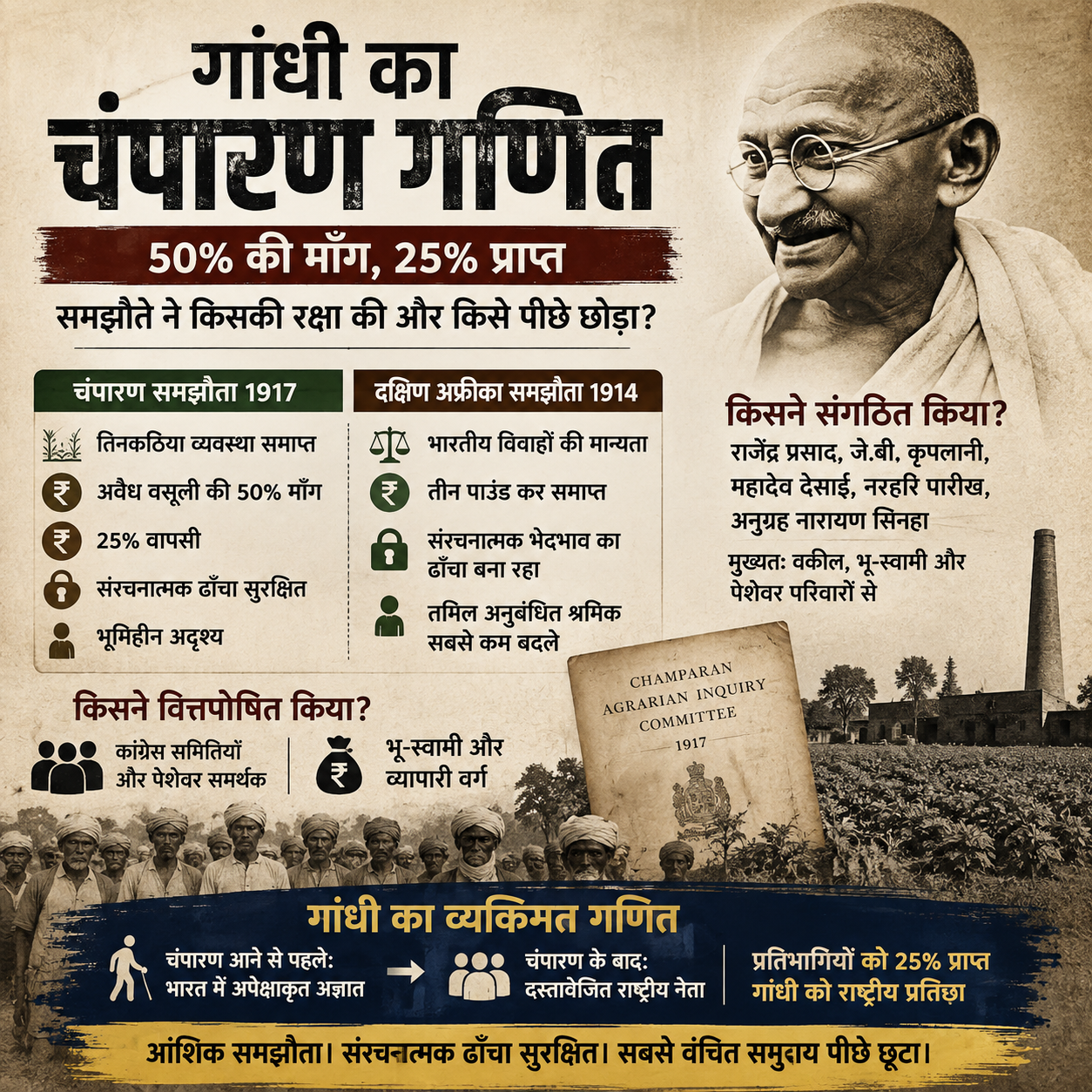
Gandhi’s Champaran Arithmetic places the documented settlement before the reader precisely. 10,000 farmers organised. The demand: abolition of the tinkathia system — requiring indigo cultivation on a fixed portion of land — and the return of illegal exactions extracted by the indigo planters. 25% of the illegal exactions was refunded — the documented settlement of the Champaran Agrarian Inquiry Committee. The tinkathia system was abolished.
The plantation system’s structural framework remained intact — established in Blog 5 of this series. The zamindari land ownership structure was untouched. The landless agricultural labourers — those with no land to have exactions refunded upon — received nothing the documented settlement can be shown to have directly delivered.
The arithmetic: 50% demanded, 25% delivered, structural framework preserved, landless invisible.
Who Organised It
Gandhi’s Champaran Arithmetic places the documented organisation of the Champaran campaign before the reader.
Gandhi arrived in April 1917. He brought with him — and recruited locally — a documented team of legal lieutenants. The documented names include Rajendra Prasad, J.B. Kripalani, Mahadev Desai, Narhari Parikh, and Anugrah Narayan Sinha. Their documented backgrounds: lawyers, drawn predominantly from landowning and professional families. The men who organised, documented, and argued the Champaran case were from the same structural class as the zamindars whose framework the settlement left intact.
The prosecution places this documented fact before the reader without characterisation: the lawyers who organised the Champaran campaign were not from the class of the 10,000 farmers whose grievances they documented. They were from the class whose land ownership structure the settlement did not challenge.
Who Funded It
Gandhi’s Champaran Arithmetic places the documented funding pattern before the reader alongside the South Africa record established in Blog 136 of this series.
In South Africa: the Natal Indian Congress that funded Gandhi’s initial legal work was documented as representing the interests of the Gujarati merchant community — established traders whose documented grievances centred on commercial and property rights. The Tamil indentured labourers, whose documented conditions were structurally more severe, were the secondary beneficiaries of a settlement the Gujarati merchants primarily funded and primarily benefited from.
In Champaran: the documented funding of Gandhi’s campaigns came from the same organisational base — Congress committees and professional supporters drawn from the landowning and merchant classes. The 10,000 farmers provided the documented mass. The funding and organisation were provided by those whose structural position the settlement did not threaten.
The Documented Pattern
Gandhi’s Champaran Arithmetic places the documented pattern across South Africa and Champaran before the reader.
South Africa 1914 documented settlement: Indian marriage recognition and three-pound tax abolition — documented benefits primarily for the Gujarati merchant community who had funded the campaign. Structural discrimination framework intact. Tamil indentured labourers: the most structurally disadvantaged community in the documented South Africa record, left in the most structurally unchanged position after the settlement.
Champaran 1917 documented settlement: 25% refund of exactions — documented benefit for farmers with documented landholdings. Structural zamindari framework intact. Landless agricultural labourers: the most structurally disadvantaged community in the documented Champaran record, invisible in the settlement’s documented terms.
The prosecution places the two documented instances before the reader without characterisation: in each case, the documented settlement delivered partial documented benefits to those with documented standing — landholders, documented community members, those whose grievances could be legally articulated within the colonial framework — while leaving the structural position of the most disadvantaged documented communities unchanged.
Gandhi’s Arithmetic
Gandhi’s Champaran Arithmetic places the documented personal arithmetic before the reader alongside the settlement arithmetic.
Champaran 1917: Gandhi arrived relatively unknown in India — having returned from South Africa in January 1915. He left Champaran as a documented national figure. The Champaran campaign established his documented reputation as a man who would go to the villages, live with the people, and document their grievances with rigorous precision. The documented national fame built on Champaran was real — and it was built on a documented partial settlement that left the structural framework intact.
The prosecution places the documented personal arithmetic alongside the documented settlement arithmetic: the participants received 25% of their documented demand. Gandhi received the documented status of national leader — the documented foundation on which every subsequent movement in this series was built.
The series does not characterise this arithmetic as corrupt or cynical. It places the documented exchange before the reader — partial delivery for participants, national stature for Gandhi — and asks the reader to examine what the arithmetic established about the movement’s documented governing structure.
The Prosecution’s Position
Gandhi’s Champaran Arithmetic places three questions before the reader.
- Does the documented Champaran settlement — 25% of 50% demanded, structural zamindari framework intact, landless agricultural labourers invisible in the settlement’s documented terms — placed alongside the documented South Africa settlement in which Tamil indentured labourers remained in the most structurally unchanged position after a campaign primarily funded by the Gujarati merchant community, constitute a documented pattern the reader places before the series’ full record?
- Does the documented composition of Gandhi’s Champaran legal team — lawyers drawn predominantly from landowning and professional families — placed alongside the documented structural class whose framework the settlement left intact, belong before the reader as a documented exhibit about who organised the campaign and what the settlement protected?
- Does the documented personal arithmetic — participants received 25% of their documented demand, Gandhi received the documented national stature that every subsequent movement in this series was built upon — constitute an exhibit the reader places alongside the series’ documented record of partial settlements and preserved structural frameworks?
The series does not answer. Gandhi’s Champaran Arithmetic places the documented settlement numbers, the documented organisers, the documented funding pattern, and the documented personal arithmetic before the reader. The reader will examine what the Champaran arithmetic established about the movement’s governing structure — and complete the sentence.
Invitation To Defence
The floor belongs to the defense. We now invite them to present their exhibits and challenge the narrative established by the prosecution.
50% demanded. 25% delivered. Structural framework intact. Landless invisible. Legal team: lawyers from landowning families. Funding: same organisational base as South Africa — merchant and professional classes. Tamil indentured labourers in South Africa: most structurally disadvantaged, least changed by settlement. Landless labourers in Champaran: same position. Gandhi: arrived relatively unknown, left as documented national leader. The prosecution places the Champaran arithmetic before the reader. The reader will complete the sentence.
Videos
Glossary of Terms
- Champaran Arithmetic: The analytical framework used in this blog to examine the numerical and structural results of the Champaran settlement, including what was demanded, what was delivered, who benefited, and who remained outside the settlement.
- Tinkathia System: A plantation arrangement in Champaran that required farmers to cultivate indigo on a fixed portion of their land.
- Champaran Agrarian Inquiry Committee: The inquiry body whose documented settlement resulted in a 25% refund of the illegal exactions and the abolition of the tinkathia system.
- Structural Framework: The underlying system of land ownership, social relations, and institutional arrangements that may remain unchanged even after a specific grievance is partially settled.
- Zamindari Framework: The land-ownership structure in which zamindars held the established position of landowners; in the blog’s analysis, this structure remained intact after the Champaran settlement.
- Landless Agricultural Labourers: Agricultural workers who did not own land and therefore had no land-based exactions from which refunds could be directly obtained under the documented settlement.
- Documented Settlement: A settlement whose terms and benefits are examined from the documented historical record rather than from later characterisation or interpretation.
- Documented Standing: The recognised position or status that enabled particular individuals or communities to present grievances within the colonial legal framework.
- Structural Discrimination: A system of unequal treatment embedded in established institutions or social structures rather than limited to individual acts.
- Tamil Indentured Labourers: Tamil workers in the documented South Africa record who worked under indenture and are presented in this blog as the most structurally disadvantaged community in that comparison.
- Gujarati Merchant Community: The established Gujarati trading community in South Africa whose interests, including commercial and property rights, are identified in the blog alongside the documented funding of Gandhi’s initial legal work.
- National Stature: The level of national public standing Gandhi acquired through the Champaran campaign, which the blog places alongside the partial settlement received by the participants.
- Governing Structure: The underlying arrangement through which a movement’s leadership, organisation, participation, and decisions are controlled; the blog asks what the Champaran arithmetic reveals about this structure.
- DAM ARC: The documented analytical pattern referenced in Blogs 136–140 concerning Gandhi’s earlier peace efforts, including the South Africa lesson, assembled reservoirs, the empty chair, the structural trap, and the British counter-movement weapon.
- Prosecution’s Position: The analytical presentation in which the blog places documented settlements, organisers, funding patterns, and personal outcomes before the reader and asks the reader to assess their significance without providing the final answer.
#Gandhi #Champaran #India #History #MahatmaGandhi #FreedomMovement #IndianHistory #GandhiHistory #HinduinfoPedia
Gandhi’s Peace Efforts: The Questions Before the Mahatma (0)
Refer to Various Arks Referred to in the Blog