
Gandhi’s Rural India: Champaran — Real Suffering, Real Limits (5)
भारत / GB
Part 5: Mahatma Gandhi’s Peace Efforts | Series Index
The Return: Gokhale’s Advice and What Became of It
From a merchant-funded barrister in Natal to a medal-seeking ambulance man in the Boer War, Gandhi arrived in India in 1915 with a fully formed method, a proven patron class, and one lesson the Empire had taught him clearly: the elite bridge only moved traffic one way. Gandhi’s rural India began with a piece of advice. When Gandhi arrived in Bombay in January 1915 after twenty-one years in South Africa, Gopal Krishna Gokhale — his declared political mentor — gave him one instruction: observe India in silence for a year before speaking or acting. Gokhale’s reasoning was sound. Gandhi had been away for two decades, had built institutions for a community of a few thousand in Natal, and was about to engage a subcontinent of three hundred million. A year of listening before leading was not excessive caution.
Thank you for reading this post, don't forget to subscribe!Gandhi followed the advice for less than two years. By December 1916 he was speaking at Banaras Hindu University. By April 1917 he was in Champaran. The pattern from South Africa — act first, observe within the action — had crossed the ocean with him.
The Action Taken: Gandhi concluded the Champaran agitation by negotiating directly with European planters and accepting a 25% cash refund of extorted rents.
Who Paid the Price: The indigo ryots, whose remaining 75% of extracted funds remained with the planters, while underlying zamindari land structures were left intact.
The Alternative Bypassed: Local peasant representations demanding full 100% financial restitution and structural land tenure reform.
Why This Matters: The first documented instance of concluding a high-profile agitation with a fractional settlement that secured leadership prestige while leaving underlying economic vulnerabilities intact.
Champaran: The Suffering Was Real
The Tinkathia System
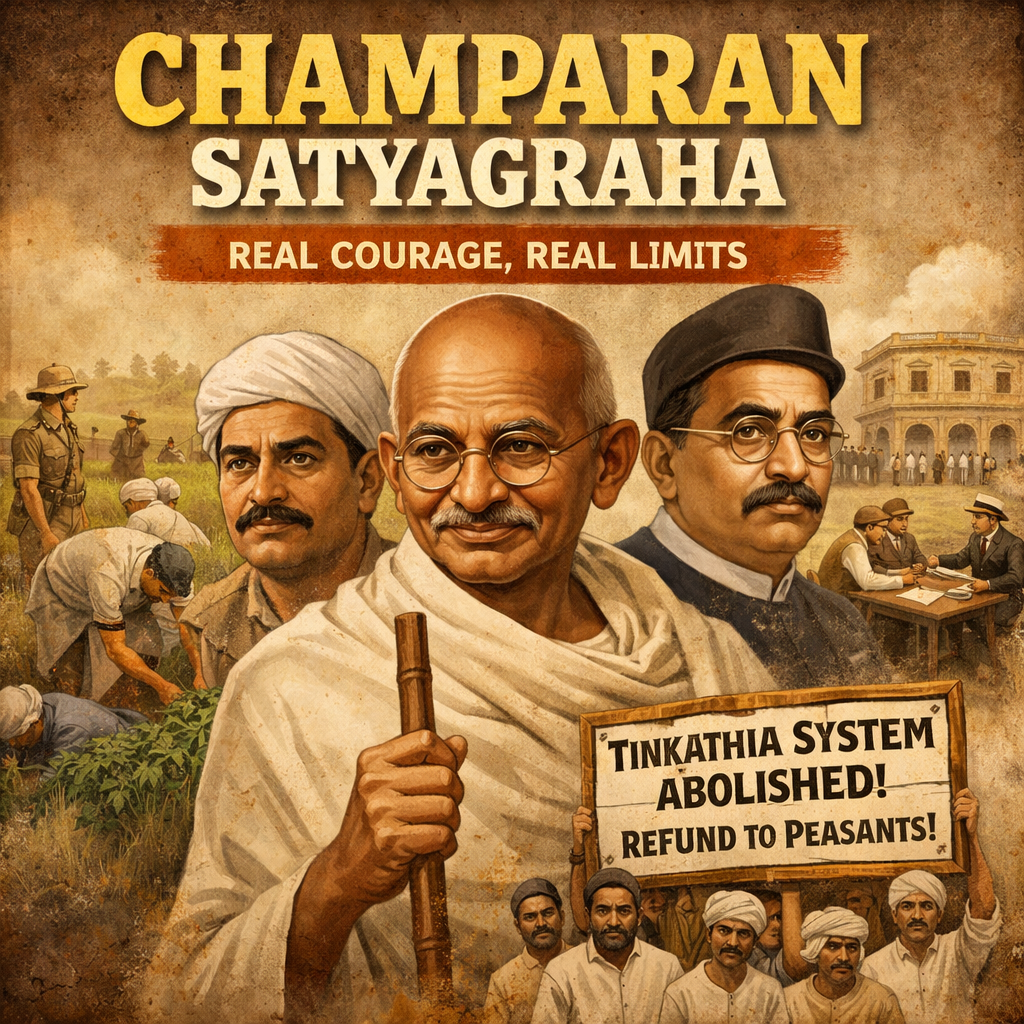
Gandhi’s rural India first encountered its most urgent face in Bihar’s Champaran district, where the indigo farmers had been locked for decades into the tinkathia system — a contractual obligation requiring tenants to cultivate indigo on three katha of land from out of 20 katha of their land regardless of market conditions. When synthetic indigo from Germany collapsed global prices in the late nineteenth century, the crop became commercially worthless. The obligation remained. European planters enforced it through legal coercion, arbitrary levies, and physical intimidation. Farmers who resisted faced eviction.
The farmers of Champaran had been petitioning for relief for decades with no result. Raj Kumar Shukla — a tenant farmer from the district — travelled to Lucknow in December 1916 specifically to find Gandhi and persuade him to come. Gandhi agreed. He arrived in April 1917.
The Investigation
What Gandhi did in Champaran was methodical and courageous. He walked the villages, sat with farmers, and filed thousands of affidavits documenting specific abuses, specific levies, specific instances of coercion. The British District Collector initially ordered him to leave. Gandhi refused and was prepared to face prosecution. The Lieutenant Governor of Bihar backed down and appointed the Champaran Agrarian Committee to investigate. The documentary discipline Gandhi applied was exactly what the situation required — not rhetoric, not mass agitation, but systematic evidence.
The Settlement: Who It Served
The Champaran Agrarian Committee produced a specific outcome in 1917. The tinkathia obligation was abolished. The European planters were required to refund a portion of the illegal levies they had extracted over decades. This was a genuine victory — documentable, measurable, real.
The refund amount was negotiated down significantly. Gandhi accepted a reduced figure, stating that securing the principle mattered more than maximising recovery. The planters agreed to a 25 per cent refund rather than full restitution. Gandhi called it a moral victory.
Gandhi’s rural India delivered at Champaran what twenty years of petitions had not: a named wrong, a formal investigation, and a partial remedy. What it did not deliver was a challenge to the tenancy structure that had made the wrong possible in the first place.
The Indian zamindars — landlords who were not European planters but Indian landowners operating the same system of rack-renting and coercive levy — were not the Committee’s focus. It is worth noting that Gandhi’s principal lieutenants in Champaran — Rajendra Prasad and Brajkishore Prasad — were themselves lawyers from landowning families, men whose class position sat comfortably above the tenant farmers whose affidavits they were filing. The settlement addressed the specific indigo grievance. The underlying tenancy structure that kept Bihar’s farmers in permanent economic subordination remained intact. Gandhi’s rural India, at Champaran, saw the tenant farmer clearly — and the landless agricultural labourer below him not at all.
Gandhi’s management of Champaran was politically brilliant. He arrived as an outsider, filed the affidavits, accepted a fraction of what was owed, declared a moral victory, and departed with a national reputation as the voice of the Indian poor. The indigo farmers received 25 paise for every rupee taken from them while they got no solution to the excesses of the landlords — thus making it a minute fraction of what was achievable. Gandhi received the Mahatma. He gave nothing to the indigo farmers while he stole their dress.
Gandhi’s management of Champaran was politically brilliant. He arrived as an outsider, filed the affidavits, accepted a fraction of what was owed, declared a moral victory, and departed with a national reputation as the voice of the Indian poor. The indigo farmers received 25 paise for every rupee taken from them while they got no solution to the excesses of the landlords — thus making it a minute fraction of what was achievable. Gandhi received the Mahatma.

The Template Arrives in India
Four years after Champaran, Gandhi adopted the loincloth in Madurai — September 22, 1921 — explicitly to identify with the poor whose suffering he had documented. He described his reasoning in his own words: seeing the “compulsorily naked” masses, he chose to “bring myself in line with the ill-clad masses.” The gesture was genuine. What is also documented is that the ill-clad masses of Champaran — whose nakedness he had witnessed four years earlier — were still tenant farmers in an intact tenancy system when he shed his clothes in their honour.
Champaran confirmed what the South Africa record had established. Gandhi’s rural India — like Gandhi’s Natal — engaged genuine suffering with genuine courage and produced settlements calibrated to what the existing power structure would accept. The NIC had seen the Passenger Indian but not the indentured Tamil. Champaran saw the tenant farmer but not the landless labourer. The boundary of the advocacy moved with the boundary of what the dominant class in each context would tolerate.
The Champaran settlement was better than nothing — measurably, legally, for specific people. The point is not that Gandhi did nothing. It is that what he did, and what he stopped short of, followed a pattern precise enough to document.
Gandhi returned from Champaran as the undisputed voice of Indian peasant suffering — the man in the dhoti, walking the villages, eating with farmers. Blog 6 will ask the question that image invites: while dressed as a poor man with no shirt, where did he sleep at night?
Series Index
Feature Image: Click here to view the image.
Glossary of Terms
- Gopal Krishna Gokhale (1866–1915): Indian political leader and social reformer. Gandhi’s acknowledged political mentor. Led the moderate wing of the Indian National Congress. Conducted a tour of South Africa in 1912 examining the condition of Indian indentured labourers. Campaigned for abolition of indentured labour — a campaign carried through to conclusion in 1917, two years after his death.
- Satyagraha: Sanskrit compound — Satya (truth) and Agraha (insistence/force). Gandhi’s political method of non-violent resistance to unjust laws through mass civil disobedience, non-cooperation, and willing acceptance of legal consequences including imprisonment. First formulated and deployed in South Africa — in the 1906 anti-registration campaign and the 1913 Great March. Later applied at continental scale in India against British colonial rule.
- Gandhi Class Framework: The analytical concept applied in this series to describe Gandhi’s consistent pattern of principled advocacy for those already organised within existing power structures, combined with symbolic invocation of the most vulnerable — without giving them structural representation. Established in the NIC period and repeated at continental scale in India after 1915.
- Indentured Labour: The system under which Indians — primarily from Bihar, eastern UP, and Tamil Nadu — were contracted to work on British colonial plantations in South Africa, Fiji, Mauritius, the Caribbean, and other territories from 1838 to 1917. Contracts bound labourers for five years under conditions documented as equivalent to slavery. The indentured Indian community in Natal formed a distinct and lower social stratum from the Gujarati merchant class Gandhi primarily represented.
- Reformism: The political approach seeking to improve conditions within an existing power structure rather than dismantle it. Gandhi’s South Africa programme — equal civic rights for Passenger Indians within the British colonial framework — is characterised in this series as reformist rather than anti-colonial. The distinction is not a moral criticism but an analytical description of what the NIC’s programme aimed to achieve.
- Anti-Colonialism: The political position seeking the dismantling of colonial rule and the assertion of the colonised population’s right to self-governance independent of the colonial power. Distinguished in this series from reformism — Gandhi’s actual position during the South Africa years — which sought equality of treatment within the colonial framework rather than its abolition.
- Raj Kumar Shukla (c.1875–1929): Tenant farmer from Champaran district, Bihar. Travelled to the Indian National Congress session at Lucknow in December 1916 to find Gandhi and persuade him to visit Champaran and investigate the indigo farmers’ conditions. Accompanied Gandhi throughout the Champaran investigation of 1917. The figure whose persistence brought Gandhi’s first major Indian campaign into being.
- Rajendra Prasad (1884–1963): Indian lawyer, nationalist politician, and first President of the Republic of India (1950–1962). One of Gandhi’s principal lieutenants during the Champaran Satyagraha of 1917. From a landowning family in Bihar — his class position sat above the tenant farmers whose affidavits he helped file. Later a leading figure in the Indian National Congress and the Constituent Assembly that drafted the Indian Constitution.
- Brajkishore Prasad (1877–1946): Bihar lawyer and nationalist politician. Worked alongside Gandhi and Rajendra Prasad during the Champaran Satyagraha. From a landowning professional family. His class position — like that of Rajendra Prasad — was above the tenant farmers the investigation was conducted to help. One of Gandhi’s key Bihar-based organisers during the Champaran period.
- Champaran Agrarian Committee (1917): The official investigation committee appointed by the Lieutenant Governor of Bihar after Gandhi refused to comply with the British District Collector’s order to leave Champaran. Included Gandhi as a member. Produced the 1917 settlement abolishing the tinkathia obligation and requiring European planters to refund a portion — ultimately agreed at 25 percent — of the illegal levies extracted from farmers over decades.
- Tinkathia System: The colonial contractual obligation imposed on tenant farmers in Champaran, Bihar, requiring them to cultivate indigo on a specified portion — typically three-twentieths — of their landholding, regardless of market conditions. Named from the unit of land measurement. When synthetic indigo collapsed global prices in the late nineteenth century, the crop became economically worthless while the obligation remained legally enforceable. European planters added arbitrary levies and coercive enforcement to the base contractual requirement.
- Zamindari System: The system of land tenure in British India under which zamindars — landlords — held revenue collection rights over agricultural land and extracted rent from tenant farmers. Zamindars were often Indian rather than European. The Champaran settlement addressed European planter abuses of the indigo system but left the zamindari tenancy structure intact. The zamindari system was not formally abolished until the Zamindari Abolition Acts passed by various Indian state governments after independence, primarily in the early 1950s.
- Rack-Renting: The practice of charging tenants the maximum possible rent — typically the full economic value of the land — leaving them no surplus after payment of rent and leaving them permanently dependent on the landlord’s continued favour. Common practice of both European planters and Indian zamindars in colonial Bihar. The Champaran settlement addressed planter illegal levies but did not challenge rack-renting as the structural basis of tenant farmer poverty.
- Tenancy Structure: The underlying legal and economic framework governing the relationship between landlords and tenant farmers in colonial India — including rent levels, security of tenure, eviction rights, and the obligations attaching to cultivation. The Champaran Satyagraha addressed the tinkathia obligation within the tenancy structure without challenging the structure itself. The series uses this term to identify the consistent limit of Gandhi’s agrarian advocacy — relief within the existing structure, never restructuring of the structure itself.
- Champaran Satyagraha (1917): Gandhi’s first major political campaign in India, conducted in Champaran district, Bihar, in April–November 1917. Involved systematic documentation of abuses under the tinkathia indigo system through thousands of farmer affidavits. Produced the Champaran Agrarian Committee and the abolition of the tinkathia obligation. Gandhi’s first direct confrontation with British colonial authority on Indian soil — he refused a District Collector’s order to leave and was prepared to face prosecution. The model for Gandhi’s documentary approach to agrarian grievance.
- Banaras Hindu University Speech (December 1916): Gandhi’s address at the inauguration ceremony of Banaras Hindu University on February 4 1916 — the first major public speech of his India years. Delivered in front of the Viceroy, maharajas, and leading nationalists, Gandhi spoke in Hindi rather than English and criticised the dirt in the railway stations, the indifference of India’s elites to the poor, and the gap between the nationalist movement’s rhetoric and its practice. The speech created controversy and marked his departure from the convention of the polished elite address. The first signal that his return to India would not follow the expected pattern.
- Champaran: A district in northern Bihar bordering Nepal, then part of the Bengal Presidency under British India. The Champaran Satyagraha of 1917 was conducted here. Champaran’s economy was dominated by European indigo planters who had held contractual cultivation rights over tenant farmer land for decades. The district’s farmers had been petitioning the colonial authorities for relief from the tinkathia system since the 1880s with no result until Gandhi’s intervention.
- Bihar: A state in eastern India, then part of the Bengal Presidency under British India until its separation as a distinct province in 1912. The site of Gandhi’s first major Indian campaign — the Champaran Satyagraha of 1917. Bihar’s agrarian economy was characterised by European indigo and sugar plantations, a dense zamindari landholding class, and a large population of tenant farmers and landless agricultural labourers. The landless labourer below the tenant farmer — invisible in the Champaran settlement — was Bihar’s most numerous and most economically vulnerable agrarian class.
- Indigo Plantation System: The colonial agricultural system under which European planters held long-term contracts with the Bengal and Bihar colonial administration to cultivate indigo using Indian tenant farmers under coercive obligations. The system combined contractual cultivation requirements — the tinkathia obligation — with arbitrary levies, physical enforcement, and denial of tenure security. The collapse of indigo prices following the development of synthetic indigo from coal tar in the 1890s made the crop economically worthless for farmers while planters continued to enforce cultivation obligations to extract compensation levies.
#GandhiRuralIndia #ChamparanSatyagraha #TinkathiaSystem #ZamindariSystem #GandhiAgrarianLimits #IndigoPlantationSystem #MahatmaGandhiSeries #GandhiPeaceEfforts #ColonialIndia #PatronClientPolitics #GandhiClassFramework #IndenturedLabour #IndianIndependence #GandhiAntiColonialismLimits #GandhiReformism #HinduinfopediaGandhi #Satyagraha #Gandhi #Bihar #Champaran
Related Blogs
Previous Blogs of The Series
- https://hinduinfopedia.in/gandhis-peace-efforts-the-man-before-the-mahatma-1/
https://hinduinfopedia.in/?p=25527 - https://hinduinfopedia.in/gandhis-south-africa-years-inner-temple-to-nic-who-paid-the-fare2/
https://hinduinfopedia.in/?p=25633 - https://hinduinfopedia.in/gandhis-train-to-nowhere-the-pietermaritzburg-moment-and-its-limits-3/
https://hinduinfopedia.in/?p=25645 - https://hinduinfopedia.in/gandhis-boer-war-bargain-phoenix-farm-and-the-british-medal-4/
https://hinduinfopedia.in/?p=25686
Previous Blogs on Mahatma Gandhi
- https://hinduinfopedia.in/martyrs-of-indian-independence-and-gandhis-influence/
- https://hinduinfopedia.in/rowlatt-act-and-gandhi/
- https://hinduinfopedia.in/gandhis-post-independence-actions-and-legacy/
- https://hinduinfopedia.in/gandhis-personal-ideologies-and-methodologies/
- https://hinduinfopedia.in/communal-relations-in-indian-history-gandhis-legacy/
- https://hinduinfopedia.in/ideological-divides-and-gandhis-leadership/
- https://hinduinfopedia.in/gandhis-post-independence-actions-and-legacy/
- https://hinduinfopedia.in/gandhi-revisited-a-critical-legacy/
- https://hinduinfopedia.in/indira-gandhis-actions-the-competition-terminator/
- https://hinduinfopedia.in/nonviolent-policy-and-making-of-gandhi-in-south-africa/
- https://hinduinfopedia.org/ambedkars-buddhist-political-move-divergence-from-gandhi-on-caste-issues/
- https://hinduinfopedia.org/mahatma-gandhi-and-nonviolence/
- https://hinduinfopedia.org/mahatma-gandhi-and-his-principles-analyzed/
- https://hinduinfopedia.org/subhash-chandra-bose-contrasting-strategies-with-gandhi/
- https://hinduinfopedia.in/on-this-day-5-march-2024-tuesday/
- https://hinduinfopedia.in/akshardham-temple-terror-attack-2002/
- https://hinduinfopedia.in/nathuram-godse-murderer-patriot-or-fractured-youth/
- https://hinduinfopedia.in/remembering-indian-freedom-struggle-of-february-5/
- https://hinduinfopedia.org/indias-freedom-struggle-and-quit-india-movement-ii/
- https://hinduinfopedia.org/indian-freedom-fighters-legacy-of-gopal-krishna-gokhale/
Follow us:
- English YouTube: https://www.youtube.com/@Hinduofficialstation
- Hindi YouTube: https://www.youtube.com/@HinduinfopediaIn
- X: https://x.com/HinduInfopedia
- Instagram: https://www.instagram.com/hinduinfopedia/
- Facebook: https://www.facebook.com/Hinduinfopediaofficial
- Threads: https://www.threads.com/@hinduinfopedia