
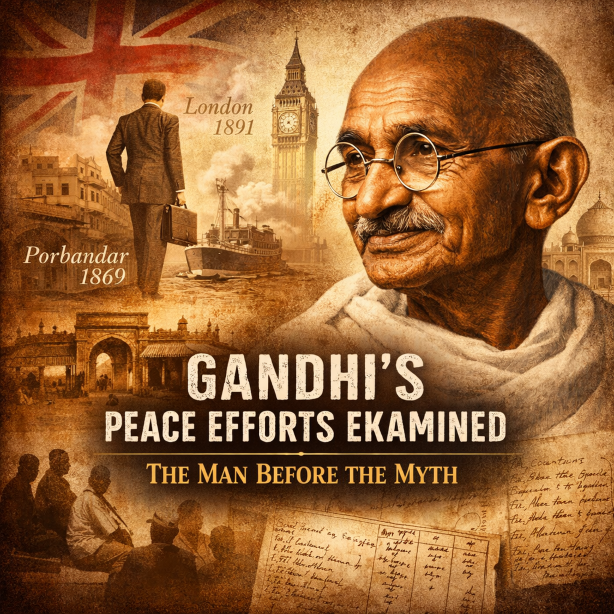
Gandhi’s Peace Efforts: The Man Before the Mahatma (1)
भारत / GB
Part 1: Mahatma Gandhi’s Peace Efforts | Series Index
Gandhi Before Being The Mahatma: The Starting Point
Gandhi’s peace efforts, examined across a century of documentation, return us first to the man before he was named the Mahatma — to Porbandar in 1869, to a merchant-caste household, and to the networks of patronage that made his rise possible.
Thank you for reading this post, don't forget to subscribe!HinduinfoPedia begins this series on 19 March 2026, a day marked across Hindu communities as the start of a new year — Gudi Padwa, Chaitra Navratri, Cheti Chand, and other regional traditions. The choice is deliberate: the series revisits Gandhi not as a symbol, but as a historical actor shaped by context, incentives, and alliances.
The story the world knows begins with a principled lawyer who seemed to have chosen conscience over comfort. The record begins earlier — in a set of social and financial arrangements that framed the choices he would later make.
The Action Taken: Gandhi pursued formal Inner Temple legal training in London, acquiring an imperial professional persona at caste and family expense.
Who Paid the Price: His family and the Modh Bania caste community in Kathiawar, who absorbed the social and ritual penalties of his overseas departure.
The Alternative Bypassed: The binding caste panchayat prohibition against sea voyages.
Why This Matters: Established the foundational British legal credentials and social standing that colonial authorities later recognized in private, extra-institutional negotiations.
Before the Mahatma: Social Position and Early Influences
Mohandas Karamchand Gandhi was born into the Modh Bania community, a trading caste with established access to colonial commerce. His father Karamchand served as diwan to the rulers of Porbandar and Rajkot — a position of local authority, not poverty. The family was not wealthy by the standards of British India’s elites, but it stood far above the conditions of indentured labourers and landless peasants who would later form the audience for Gandhi’s campaigns. When his family decided to send the young Gandhi to London to study law, the funding came from community merchants — Gujarati traders whose own incomes depended, in part, on a colonial economic structure Gandhi had not yet questioned.
Education and Colonial Aspiration
He was called to the bar at Inner Temple in 1891 and returned to India a barrister. The legal training was genuine. The intellectual ambition was real. What is equally real, and less often discussed, is the class frame within which that ambition operated. Gandhi’s peace efforts examined through this lens reveal a man who entered public life with specific sponsors, specific obligations, and a specific constituency — the Gujarati trading community — that he would serve, with rare exceptions, for the first two decades of his career.
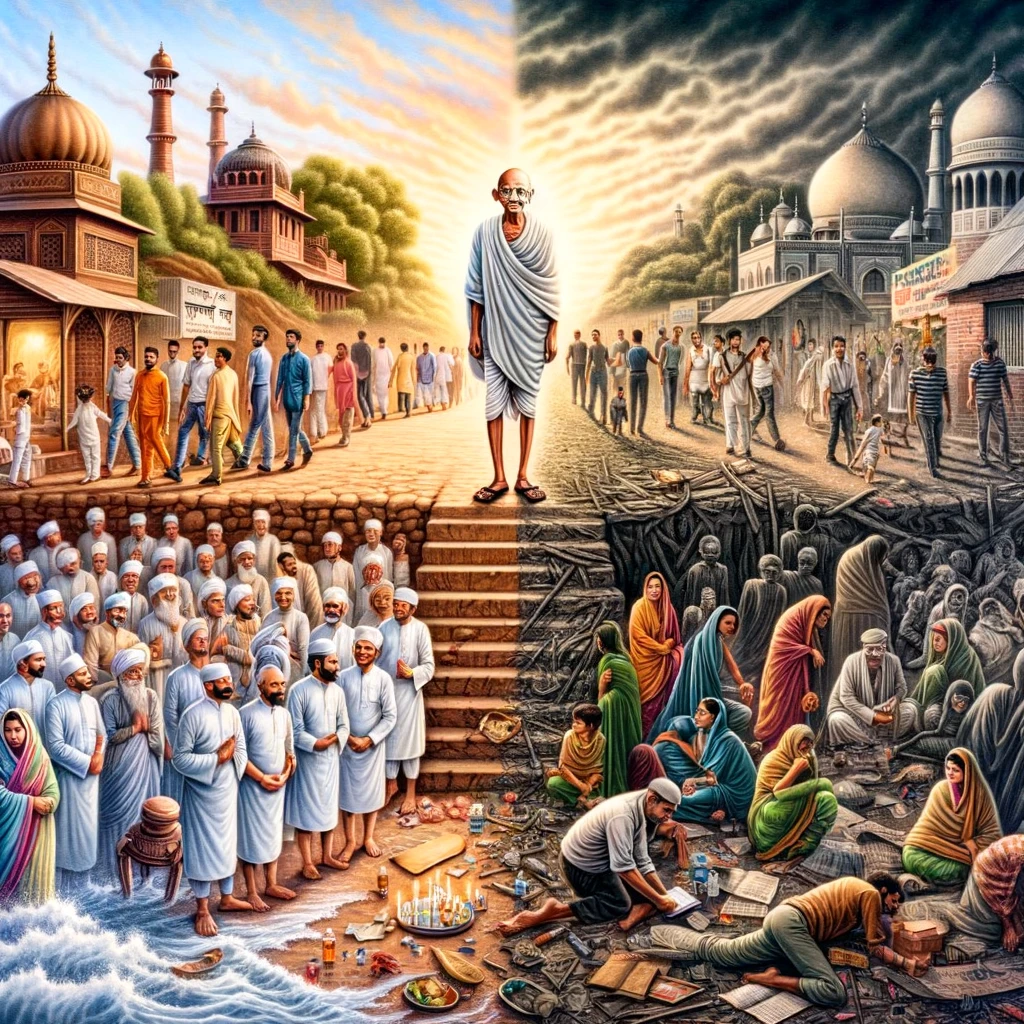
Foundation of Construction: Re-examining the Narrative of Simplicity
This matters because the history of Gandhi turning into Mahatma is inseparable from the story of his origins — the simple man, the humble seeker, the voice of the voiceless. That narrative cannot be described in a few words but requires a much deeper analysis. He did experience genuine humiliation in South Africa. He did develop genuine convictions about human dignity. But the ideologies and methodologies he built were constructed within a class framework that consistently excluded the most vulnerable from its benefits. Understanding this is not a small footnote. It is the first brick in the foundation of a much larger structure.
What drove him to London at nineteen was not political consciousness but professional ambition — the standard aspiration of a relatively influential merchant-caste family seeking colonial accreditation for its most promising son. The voyage itself required him to break his Brahmin community’s injunction against crossing the sea. He was briefly ostracised, then readmitted.
The episode reveals something useful: Gandhi’s willingness to defy convention when it served his goals, and to seek restoration within the same institution once the goal was achieved. It is a pattern that recurs.
Philosophy in Formation: Ahimsa as Reconstruction, Not Inheritance
In London he read Thoreau, Tolstoy, and the Sermon on the Mount. He was genuinely moved. His engagement with ahimsa deepened over years of reading and reflection, not as received tradition but as a personally reconstructed philosophy — part Jain, part Tolstoyan, part strategic calculation for the political conditions he would face. Gandhi’s peace efforts examined honestly acknowledge this reconstruction. The question the series will pursue is not whether the philosophy was sincere.
It was. The question is what the philosophy consistently exempted, who consistently bore the cost when the philosophy was applied, and what the documentation shows when principle and patron-client politics came into conflict.

Reassessing Legacy: Martyrs, Decisions, and the Cost of Nonviolence
The man who would come to be called the father of a nation by a section of his supporters left behind martyrs who were younger, angrier, and in many cases more strategically clear-eyed about what British rule required for its dismantling.
This series will name them. It will also name the decisions that preceded each one. Gandhi’s peace efforts examined across 317 days of documentation will show, post by post, that the record is richer, stranger, and far more morally complex than the airports and currency notes suggest.
Part 2 will follow three days from now: the formation of the Natal Indian Congress, who funded it, who was excluded, and what the Gujarati merchant class got from the man who would later call himself the servant of the poor.
Series Index
Feature Image: Click here to view the image.
Videos
Glossary of Terms
- Mohandas Karamchand Gandhi (1869–1948): Indian lawyer, political leader, and social reformer who led the non-violent resistance movement against British colonial rule in India. Born in Porbandar to a Modh Bania family. Called to the bar at Inner Temple in 1891. Spent twenty-one years in South Africa before returning to lead the Indian independence movement. Assassinated on 30 January 1948 by Nathuram Godse.
- Karamchand Gandhi: Father of Mohandas Gandhi. Served as diwan — chief administrative officer — to the rulers of Porbandar and subsequently Rajkot. His position gave the family access to colonial administrative networks without placing it among the British Indian elite.
- Modh Bania: A Gujarati trading sub-caste within the Vaishya varna. The community to which Gandhi’s family belonged. Traditionally engaged in commerce and moneylending. Had established relationships with both indigenous rulers and colonial commercial structures in the Kathiawar region of Gujarat.
- Gujarati Merchant Class: The network of Gujarati trading families — predominantly Bania and Muslim Bohra — whose commercial interests in South Africa created the conditions for Gandhi’s legal career there and who funded his early political work including the formation of the Natal Indian Congress.
- Diwan: Chief administrative officer or prime minister to an Indian princely ruler. A position of significant local authority under the colonial system — managing revenue, justice, and administration on behalf of the ruler within the framework of British paramountcy.
- Inner Temple: One of the four Inns of Court in London with the exclusive right to call barristers to the English bar. Gandhi was admitted to Inner Temple in 1888 and called to the bar in June 1891. Membership conferred formal colonial professional accreditation recognised across British India.
- British India: The territories of the Indian subcontinent under direct British Crown administration from 1858 to 1947, following the transfer of power from the East India Company after the 1857 uprising. Administered through the India Office in London and the Viceroy in Calcutta and later New Delhi. Coexisted with approximately 565 princely states under indirect British control through paramountcy agreements.
- Indentured Labour: The system under which Indians — primarily from Bihar, eastern UP, and Tamil Nadu — were contracted to work on British colonial plantations in South Africa, Fiji, Mauritius, the Caribbean, and other territories from 1838 to 1917. Contracts bound labourers for five years under conditions documented as equivalent to slavery. The indentured Indian community in Natal formed a distinct and lower social stratum from the Gujarati merchant class Gandhi primarily represented.
- Ahimsa: Sanskrit term meaning non-harm or non-violence. A foundational principle in Jain, Buddhist, and Hindu ethical thought. Gandhi reconstructed ahimsa not as received religious inheritance but as a personally synthesised political philosophy — combining Jain ethics, Tolstoyan non-resistance, and Thoreau’s civil disobedience into a strategic method for mass political action under colonial conditions.
- Patron-Client Politics: The structure of obligation and reciprocity in which a wealthy or powerful patron funds or sponsors an individual in exchange for future service, loyalty, or political representation of patron interests. Applied in this series to examine Gandhi’s relationship with the Gujarati merchant community that funded his legal training and early political career.
- Varna: The fourfold social classification in Hindu tradition — Brahmin (priestly/scholarly), Kshatriya (warrior/ruling), Vaishya (trading/agricultural), Shudra (service). Gandhi’s Modh Bania community belonged to the Vaishya varna. The series examines how varna positioning shaped Gandhi’s social alliances and political blind spots.
- Mahatma: Sanskrit honorific meaning Great Soul. Conferred on Gandhi — tradition attributes it to Rabindranath Tagore — as a mark of spiritual and moral distinction. The series examines the gap between the honorific’s implications and the documented record of Gandhi’s political decisions.
- Henry David Thoreau (1817–1862): American writer and philosopher. His 1849 essay Civil Disobedience argued that individuals have a moral obligation to resist unjust laws through non-cooperation. Gandhi read Thoreau during his London years and later acknowledged its influence on his political methods.
- Leo Tolstoy (1828–1910): Russian novelist and moral philosopher. His later writings — particularly The Kingdom of God Is Within You — argued for radical non-violence and passive resistance to state authority. Gandhi corresponded with Tolstoy and credited his thought as a formative influence on ahimsa as political strategy.
- Gudi Padwa: The Marathi and Konkani new year festival marking the first day of the Hindu lunisolar calendar month of Chaitra. Celebrated primarily in Maharashtra and Goa. The HinduInfoPedia Gandhi series launched on this day — 19 March 2026.
- Chaitra Navratri: The nine-night festival of the goddess Durga observed in the spring month of Chaitra. Marks the beginning of the Hindu new year in the North Indian calendar tradition. Runs concurrently with Gudi Padwa in March–April.
- Cheti Chand: The Sindhi new year festival marking the birth of Ishtadeva Jhulelal, the patron deity of the Sindhi community. Observed on the first day of Chaitra. One of the three concurrent new year traditions marking the series launch date of 19 March 2026.
- Porbandar: Coastal city in the Kathiawar peninsula of present-day Gujarat. Birthplace of Mohandas Gandhi on 2 October 1869. At the time of Gandhi’s birth, Porbandar was a princely state under British paramountcy. Gandhi’s father Karamchand served as diwan to its ruler.
#GandhiPeaceEfforts #MahatmaGandhiSeries #GandhiOrigins #ModhBania #GujaratiMerchants #ColonialIndia #AhimsaReconstruction #PatronClientPolitics #InnerTempleLondon #GandhiCaste #IndianIndependence #GandhiNonviolence #HinduinfopediaGandhi #IndenturedLabour #GandhiMerchantPatrons #MahatmaGandhi #Ahimsa #Porbandar #Gandhi #HinduinfopediaGeopolitics
Earlier Blogs from Hinduinfopedia
- https://hinduinfopedia.in/martyrs-of-indian-independence-and-gandhis-influence/
- https://hinduinfopedia.in/martyrs-of-indian-independence-and-gandhis-influence/
- https://hinduinfopedia.in/rowlatt-act-and-gandhi/
- https://hinduinfopedia.in/gandhis-post-independence-actions-and-legacy/
- https://hinduinfopedia.in/gandhis-personal-ideologies-and-methodologies/
- https://hinduinfopedia.in/communal-relations-in-indian-history-gandhis-legacy/
- https://hinduinfopedia.in/ideological-divides-and-gandhis-leadership/
- https://hinduinfopedia.in/gandhis-post-independence-actions-and-legacy/
- https://hinduinfopedia.in/gandhi-revisited-a-critical-legacy/
- https://hinduinfopedia.in/indira-gandhis-actions-the-competition-terminator/
- https://hinduinfopedia.in/nonviolent-policy-and-making-of-gandhi-in-south-africa/
- https://hinduinfopedia.org/ambedkars-buddhist-political-move-divergence-from-gandhi-on-caste-issues/
- https://hinduinfopedia.org/mahatma-gandhi-and-nonviolence/
- https://hinduinfopedia.org/mahatma-gandhi-and-his-principles-analyzed/
- https://hinduinfopedia.org/subhash-chandra-bose-contrasting-strategies-with-gandhi/
- https://hinduinfopedia.in/on-this-day-5-march-2024-tuesday/
- https://hinduinfopedia.in/akshardham-temple-terror-attack-2002/
- https://hinduinfopedia.in/nathuram-godse-murderer-patriot-or-fractured-youth/
- https://hinduinfopedia.in/remembering-indian-freedom-struggle-of-february-5/
- https://hinduinfopedia.org/indias-freedom-struggle-and-quit-india-movement-ii/
- https://hinduinfopedia.org/indian-freedom-fighters-legacy-of-gopal-krishna-gokhale/
Follow us:
- English YouTube: https://www.youtube.com/@Hinduofficialstation
- Hindi YouTube: https://www.youtube.com/@HinduinfopediaIn
- X: https://x.com/HinduInfopedia
- Instagram: https://www.instagram.com/hinduinfopedia/
- Facebook: https://www.facebook.com/Hinduinfopediaofficial
- Threads: https://www.threads.com/@hinduinfopedia