
Gandhi’s February Retreat: The Day Gandhi Unilaterally Suspended Movement 1922 (130)
भारत / GB
Part 130: Mahatma Gandhi’s Peace Efforts | Series Index
The Non-Cooperation Movement had run for sixteen months. By February 1922, the British administration was, by its own documented accounts, genuinely shaken. Sixty thousand Indians had passed through British jails. Gandhi was preparing to launch civil disobedience at Bardoli, Gujarat. Then February 4 1922 arrived. This post places “Gandhi’s February Retreat” before the reader to show what happened — and what Gandhi did with it.
Thank you for reading this post, don't forget to subscribe!The Action Taken: Official police station logs and trial transcripts document that police fired into an unarmed civilian crowd before the police station was attacked and burned by the infuriated crowd.
Who Paid the Price: The 172 villagers sentenced to death, who were legally classified as unprovoked rioters while the initial police firing was minimized.
The Alternative Bypassed: Investigating and highlighting colonial police provocation before unilaterally aborting the national anti-colonial struggle.
Why This Matters: Documents the missing operational context: the violence at Chauri Chaura was a retaliatory backlash to state provocation, but the leadership used it as an excuse to shut down the nationwide movement.
February 4 1922 — The Documented Events
Gandhi’s February Retreat places the documented events at Chauri Chaura before the reader in their correct sequence.
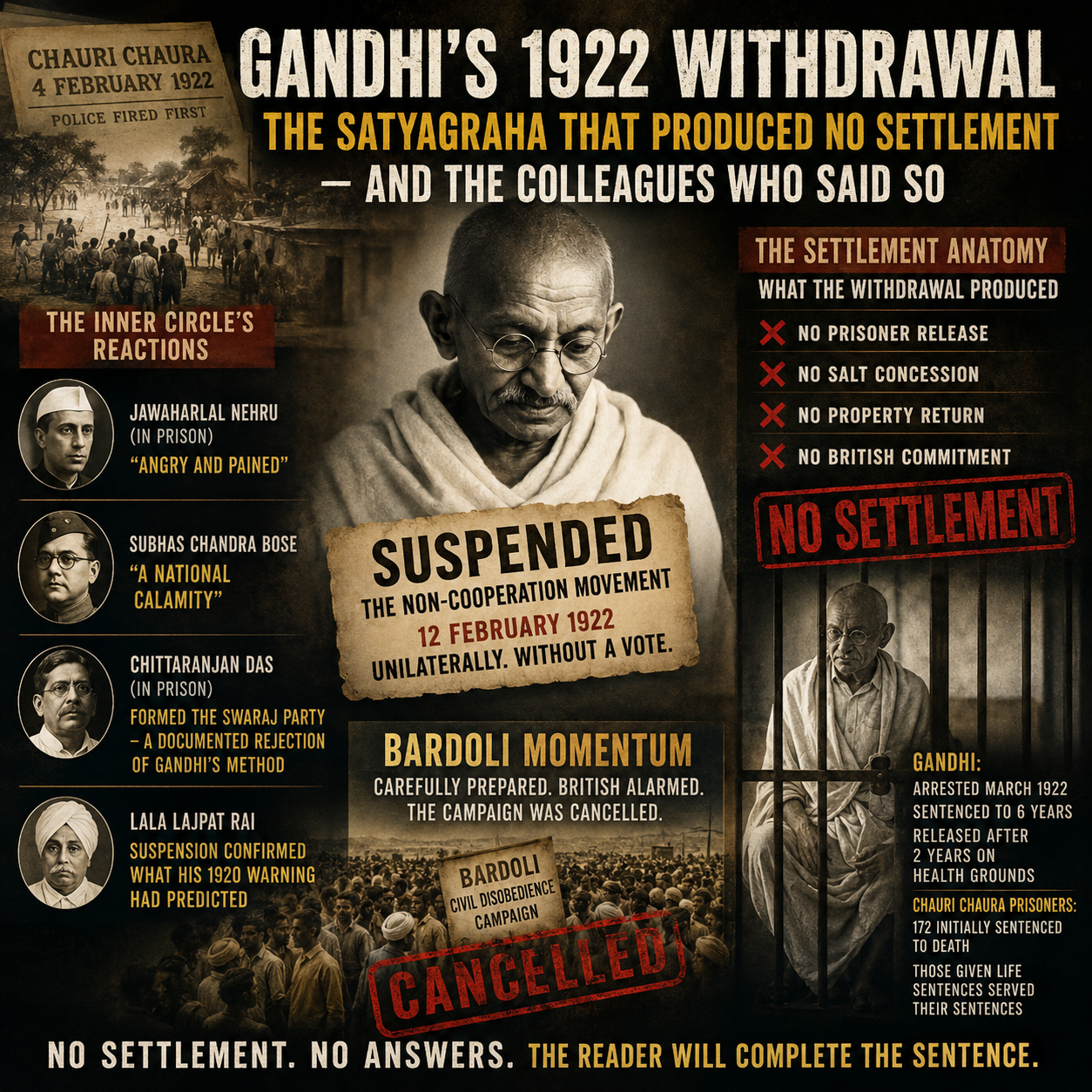
On February 4 1922, a procession of approximately 2,000 to 3,000 Non-Cooperation volunteers and local farmers gathered at the Chauri Chaura bazaar in Gorakhpur district, United Provinces. The immediate grievance was the high price of meat and kerosene. A longer grievance was documented: three days earlier, on February 1, head constable Gupteshwar Singh had beaten and humiliated Bhagwan Ahir, a volunteer leader leading a temperance picket.
The police fired upon the procession. The crowd retaliated. The local police station was set on fire. Twenty-two policemen who had taken refuge inside were killed — many of them as they attempted to flee the flames. Three civilians also died in the incident.
Gandhi’s February Retreat places the documented sequence before the reader: police fired first. The crowd retaliated. This is not a characterisation the series supplies — it is the documented order of events confirmed across multiple sources including the Wikipedia article on the Chauri Chaura incident: “The police there fired upon a large group of protesters participating in the non-cooperation movement. In retaliation, the demonstrators attacked and set fire to a police station.”
Gandhi’s Response — Eight Days
Gandhi’s February Retreat places the documented timeline before the reader. Within eight days of Chauri Chaura, Gandhi suspended the entire Non-Cooperation Movement at the national level.
In Young India, February 16 1922, Gandhi placed his documented position before the reader: he labelled Chauri Chaura a “crime” and wrote that “the suspension of mass civil disobedience… is not enough penance for my having been the instrument, however involuntary, of the brutal violence by the people at Chauri Chaura.”
Gandhi’s February Retreat places the documented framing before the reader: Gandhi’s penance. Gandhi’s instrument. The crowd’s violence was Gandhi’s burden — not the crowd’s agency, not the police’s documented act of firing first, but Gandhi’s penance for having led people who were “not yet prepared for a truly non-violent movement.”
The Unilateral Suspension
Gandhi’s February Retreat places the documented institutional fact before the reader. The suspension of the Non-Cooperation Movement was not put to a vote of the Indian National Congress. It was not submitted to any democratic mechanism of the movement’s own stated governance. Gandhi persuaded the Congress Working Committee — a body he had restructured at Nagpur in December 1920 to reflect his authority — to pass the Bardoli Resolution.
Jawaharlal Nehru, in prison, heard of the suspension there. His documented reaction was one of shock. Motilal Nehru, Subhas Chandra Bose, Chittaranjan Das, and Lala Lajpat Rai — documented critics of the suspension, as established across the Britannica source — all objected. The movement had been gaining momentum. The British administration, by documented contemporary accounts, was shaken. The Bardoli civil disobedience campaign, which Gandhi had been about to launch, was cancelled.
The prosecution places one observation before the reader: the suspension was Gandhi’s unilateral decision, made without the mandate of the not even Congress, the institution of which he was the supreme leader, let alone 300 million people the movement represented, without consultation with the Congress membership at large, without a vote of the movement’s participants.
The Documented Calculus
Gandhi’s February Retreat places the documented asymmetry before the reader — established across this series and carried here for the reader’s examination.
The Moplah rebellion, August-December 1921: documented killings, forced conversions, and temple desecrations across Malabar. Four months. Gandhi did not suspend the Non-Cooperation Movement. He did not withdraw from the Khilafat alliance. He called the Moplahs “brave God-fearing” men fighting for what they considered religion.
Chauri Chaura, February 4 1922: police fired on protesters, protesters retaliated, 22 policemen died. Eight days. Gandhi suspended the entire national movement, cancelled the Bardoli campaign, and called it a crime for which he must do penance.
The prosecution places the documented calculus before the reader without characterisation: four months of documented killings against Hindu civilians — no suspension. Eight days after police-provoked crowd violence in which 22 policemen died — full national suspension. The reader examines what the documented calculus establishes about the movement’s governing priorities — and completes the sentence.
The Documented Aftermath
Gandhi’s February Retreat places the documented legal aftermath before the reader. Of those who participated in the Chauri Chaura events, 172 were initially sentenced to death. Pandit Madan Mohan Malaviya — who returned to active legal practice specifically to take up this case — argued the appeal before the Allahabad High Court and successfully saved 153 of the 172. Nineteen were executed.
The prosecution places one observation alongside this: Malaviya’s documented legal intervention — carried in this series in Blog 37 as “Gandhi’s Forgotten Lawyer” — is the documented record of who fought for those Gandhi’s suspension left behind. Gandhi had suspended the national movement as penance for the crowd’s violence. The legal defence of those sentenced for that violence was carried by Malaviya, not by the movement Gandhi had suspended.
The Prosecution’s Position
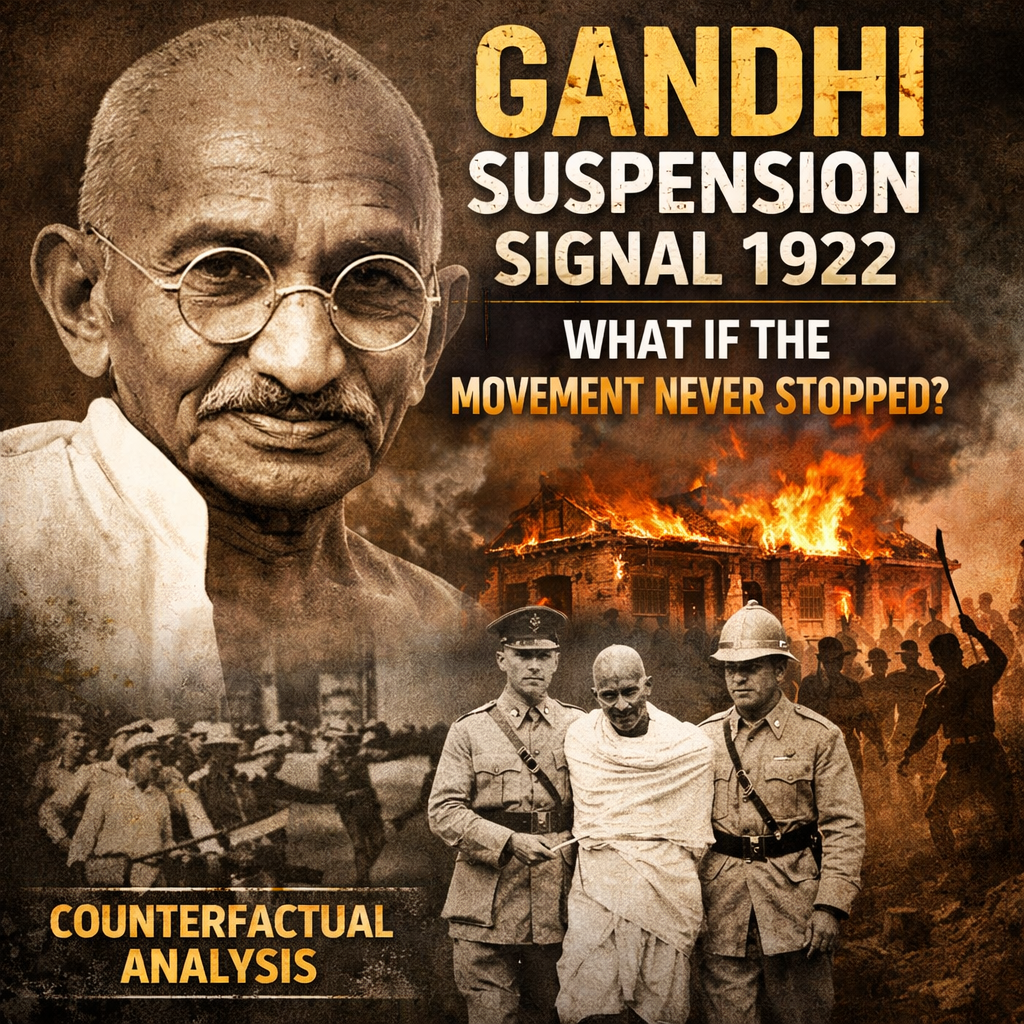
Gandhi’s February Retreat places three questions before the reader.
- Did Gandhi suspend the entire Non-Cooperation Movement unilaterally within eight days of February 4 1922 — without a vote of the Congress membership, without the mandate of the 300 million people the movement represented, over the documented objections of Nehru, Bose, Das, and Lajpat Rai — on the basis that the crowd at Chauri Chaura had not been prepared for non-violence, when the documented sequence shows the police had fired first?
- Does the documented asymmetry between Gandhi’s response to the Moplah rebellion (four months, no suspension, Moplahs called “brave God-fearing”) and his response to Chauri Chaura (eight days, full national suspension, called “a crime” requiring personal penance) constitute a documented calculus that belongs before the reader?
- Does the documented aftermath — 172 initially sentenced to death, 19 executed, 110 given life imprisonment — placed alongside Gandhi’s documented framing of Chauri Chaura as his own penance rather than the crowd’s legitimate retaliation against documented police provocation, constitute an exhibit the reader places alongside Gandhi’s documented authority over the movement?
The series does not answer. The documented events, the documented unilateral suspension, the documented asymmetry, and the documented aftermath are placed before the reader. The reader will examine what February 12 1922 established about the movement’s governing priorities — and complete the sentence.
Invitation To Defence
The floor belongs to the defense. We now invite them to present their exhibits and challenge the narrative established by the prosecution.
February 4 1922: police fired first. Crowd retaliated. 22 policemen killed. Eight days later: Gandhi suspended the entire national movement. Unilaterally. Without a vote. Over the documented objections of Nehru, Bose, Das, Lajpat Rai. Young India February 16: “a crime for which I must do penance.” The Moplah rebellion: four months, documented killings against Hindus, no suspension. Chauri Chaura: eight days, documented police provocation, full national suspension. 172 sentenced to death. 19 executed. The prosecution places the documented calculus before the reader. The reader will complete the sentence.
Feature Image: Click here to view the image.
Videos
Glossary of Terms
- Chauri Chaura Incident: The February 4, 1922 confrontation in Gorakhpur district where police fired on protesters, the crowd retaliated by burning a police station, and twenty-two policemen were killed.
- Non-Cooperation Movement: The nationwide movement launched by Mahatma Gandhi in 1920 urging Indians to boycott British institutions, courts, schools, and goods as a form of peaceful resistance.
- Civil Disobedience: A method of non-violent resistance involving the deliberate violation of specific laws to protest government policies.
- Bardoli Resolution: The Congress Working Committee resolution of February 12, 1922 that suspended the Non-Cooperation Movement and redirected efforts toward Gandhi’s constructive programme.
- Constructive Programme: Gandhi’s programme emphasizing khadi, national education, Hindu-Muslim unity, and the removal of untouchability instead of mass confrontation.
- Young India: Gandhi’s English-language weekly journal in which he explained his political decisions and public positions.
- Moplah Rebellion: The 1921 uprising in Malabar marked by documented violence, forced conversions, killings, and temple desecrations, discussed in this series for comparison with Gandhi’s later decisions.
- Bardoli Civil Disobedience Campaign: The planned nationwide phase of civil disobedience that Gandhi cancelled following the Chauri Chaura incident.
- Pandit Madan Mohan Malaviya: Lawyer, educationist, and nationalist leader who argued the Chauri Chaura appeals before the Allahabad High Court, substantially reducing the number of death sentences.
- Congress Working Committee (CWC): The principal executive body of the Indian National Congress that approved the Bardoli Resolution.
- Gandhi’s February Retreat: A term coined in this series describing Gandhi’s decision to suspend the Non-Cooperation Movement following the Chauri Chaura incident.
- Documented Calculus: A key phrase in this series referring to the comparison of Gandhi’s responses to different historical events based on documented evidence rather than interpretation.
- Unilateral Suspension: The central phrase of this blog referring to Gandhi’s decision to halt the nationwide movement without a vote of the Congress membership or movement participants.
- Penance: Gandhi’s description of his own moral responsibility for the violence at Chauri Chaura, as expressed in Young India on February 16, 1922.
- Prosecution’s Position: A recurring framework in this series that presents documented evidence and questions for readers without claiming to deliver the final verdict.
#Gandhi #ChauriChaura #NonCooperation #IndianHistory #FreedomMovement #Congress #Khilafat #Moplah #Bardoli #History #India #BritishRaj #HinduinfoPedia
https://hinduinfopedia.in/gandhis-february-retreat-the-day-gandhi-unilaterally-suspended-movement-1922-130/
Gandhi’s Peace Efforts: The Questions Before the Mahatma (0)