
Gandhi’s Ambedkar Verdict: The Non-Cooperation Movement — Whose Cause Was It? (108)
भारत / GB
Part 108: Mahatma Gandhi’s Peace Efforts | Series Index
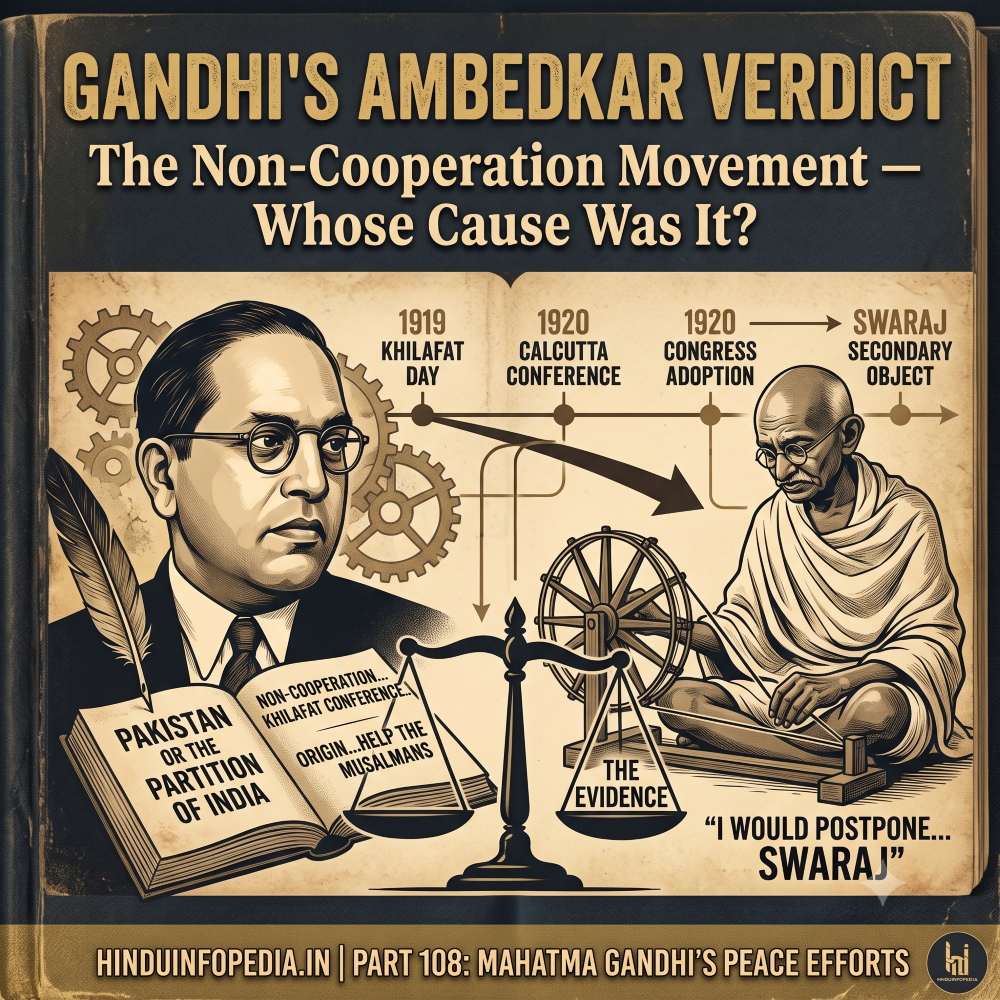
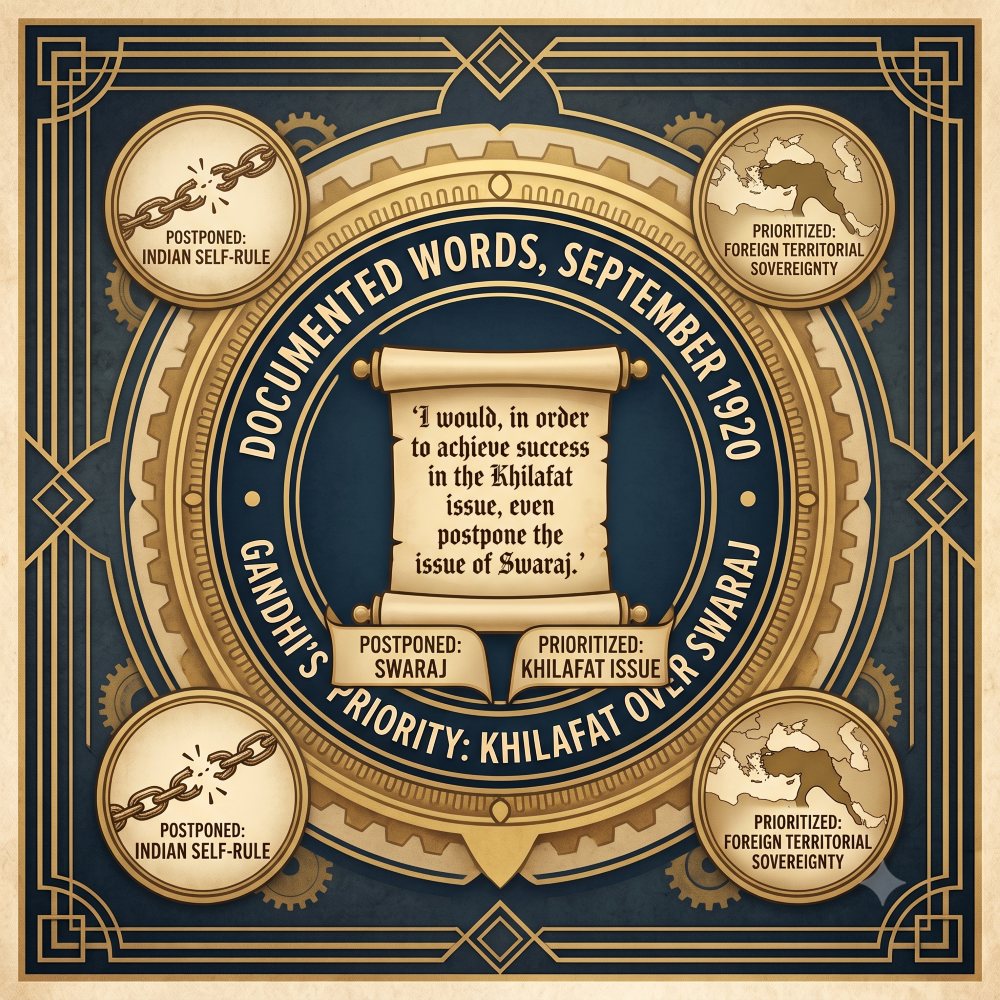
Blog 107 placed Gandhi’s own documented statement before the reader — “I would, in order to achieve success in the Khilafat issue, even postpone the issue of Swaraj.” This post, Gandhi’s Ambedkar Verdict, places the documented verdict of B.R. Ambedkar on the same question: what the Non-Cooperation Movement was, and whose cause it actually served.
Thank you for reading this post, don't forget to subscribe!The Action Taken: Gandhi formally integrated the newly founded Jamiat Ulema-e-Hind into the national decision-making apparatus, giving traditional ulema authority over political policy.
Who Paid the Price: Modernist and secular Muslim intellectuals, who were sidelined as the ulema became the recognized arbiters of community interests.
The Alternative Bypassed: Building partnerships with modern educational and constitutional associations such as Aligarh reformists.
Why This Matters: Bestowed nationalist legitimacy onto traditional theological bodies, entrenching religious authority into the political machinery of the freedom movement.
The Source — Why It Matters
Gandhi’s Ambedkar Verdict places the identity of the source before the reader first.
B.R. Ambedkar was not a British colonial administrator with an interest in discrediting the independence movement. He was not a Hindu nationalist seeking to undermine Gandhi’s legacy. He was the man who drafted India’s Constitution — the Untouchables’ greatest documented champion, a man who had worked within and alongside the independence movement, who understood its internal dynamics from documented first-hand experience, and who had no documented incentive to misrepresent what the Non-Cooperation Movement was.
Ambedkar’s documented verdict on the Khilafat-Non-Cooperation merger carries evidentiary weight precisely because of who he was. Gandhi’s Ambedkar Verdict places that verdict before the reader as the primary source it is: *Pakistan or the Partition of India*, B.R. Ambedkar, Thacker and Company Limited, 1945, pp. 137-139, available at franpritchett.com.
Ambedkar’s Documented Verdict — Verbatim
Gandhi’s Ambedkar Verdict places Ambedkar’s own documented words before the reader without paraphrase:
“This short resume shows that the non-cooperation was started by the Khilafat Committee and all that the Congress special session at Calcutta did was to adopt what the Khilafat Conference had already done, and that too not in the interest of Swaraj but in the interest of helping the Musalmans in furthering the cause of Khilafat.”
And further:
“The truth is that the non-co-operation has its origin in the Khilafat agitation and not in the Congress Movement for Swaraj: that it was started by the Khilafatists to help Turkey and adopted by the Congress only to help the Khilafatists: that Swaraj was not its primary object, but its primary object was Khilafat and that Swaraj was added as a secondary object to induce the Hindus to join it.”
These are Ambedkar’s own documented words, from a primary source available on the public record. The series does not paraphrase them. It places them before the reader as written.
The Documented Mechanism — The Timeline
Gandhi’s Ambedkar Verdict places the documented sequence Ambedkar reconstructed before the reader. The Non-Cooperation Movement did not originate at the September 1920 Congress session. Its documented origin was earlier, and in a different organisation:
October 27 1919: Khilafat Day observed across India. November 23 1919: First Khilafat Conference, Delhi — Muslims considered non-cooperation as a means to compel the British to redress the Khilafat wrong. March 10 1920: Khilafat Conference, Calcutta — decided upon non-cooperation as the best weapon. June 9 1920: Khilafat Conference, Allahabad — Gandhi steered and led policy; Executive Committee formed. July 1 1920: notice given to the Viceroy. August 1 1920: Non-Cooperation commenced — started by the Khilafat Committee. September 7-8 1920: Congress special session, Calcutta — adopted what the Khilafat Committee had already decided.
Ambedkar’s documented verdict on this sequence: “anyone, who cares to go behind September 1920 and examines the situation as it then stood, will find that this view is not true” — the view being that Congress initiated the Non-Cooperation Movement for Swaraj.
What the Verdict Inverts
Gandhi’s Ambedkar Verdict places Ambedkar’s documented factual finding before the reader precisely. The conventional narrative holds that Congress initiated the Non-Cooperation Movement for Swaraj and adopted the Khilafat cause as a secondary alliance. Ambedkar’s documented account establishes the opposite sequence: the Khilafat Committee initiated the movement, and Congress adopted what it had already decided — not for Swaraj but for Khilafat. The inversion is not of Gandhi’s stated purpose but of the documented origin and primary cause of the movement itself.
In Ambedkar’s documented framing: the Khilafat Committee initiated the movement. Gandhi was the person who suggested non-cooperation to the Khilafat Committee, who identified himself with the Committee as its leader, who took responsibility for giving effect to it, and who then brought about its adoption by Congress. The movement Gandhi is credited with leading was, by Ambedkar’s primary source account, a Khilafat movement that Congress adopted — not a Congress movement that adopted a Khilafat dimension. Swaraj was added, in Ambedkar’s documented words, as a secondary object to induce Hindus to join a cause that was primary elsewhere.
Ambedkar further documented Gandhi’s own later admission — that he would gladly ask for postponement of Swaraj activity if it could advance the interest of the Khilafat — placing Gandhi’s own documented words alongside the verdict as corroboration from the primary actor himself.
The Prosecution’s Position
Gandhi’s Ambedkar Verdict places three questions before the reader.
- Did Ambedkar — the drafter of India’s Constitution, writing from documented firsthand proximity to the independence movement — place on primary source record that the Non-Cooperation Movement was initiated by the Khilafat Committee, and that Congress adopted it not in the interest of Swaraj but in the interest of the Khilafat cause?
- Does the documented timeline — Khilafat Committee decisions of November 1919, March 1920, June 1920, and August 1920, all preceding the September 1920 Congress session — support Ambedkar’s documented verdict that Congress adopted what the Khilafat Committee had already decided?
- Does Gandhi’s own documented admission — that he would postpone Swaraj for Khilafat, documented in Blog 107 — belong before the reader alongside Ambedkar’s documented verdict as corroboration from the primary actor himself?
The series does not answer. Gandhi’s Ambedkar Verdict places Ambedkar’s primary source words, the documented timeline, and Gandhi’s own documented admission before the reader. The reader will examine whose cause the Non-Cooperation Movement served — and complete the sentence.
Invitation To Defence
The floor belongs to the defense. We now invite them to present their exhibits and challenge the narrative established by the prosecution.
Ambedkar — drafter of India’s Constitution — documented verdict: “the non-cooperation was started by the Khilafat Committee and all that the Congress special session at Calcutta did was to adopt what the Khilafat Conference had already done — not in the interest of Swaraj but in the interest of the Khilafat cause.” Swaraj was added as a secondary object to induce Hindus to join. Gandhi’s own documented words corroborate: “I would postpone Swaraj for Khilafat.” The prosecution places Ambedkar’s primary source verdict before the reader. The reader will complete the sentence.
Feature Image: Click here to view the image.
Videos
Glossary of Terms
- Non-Cooperation Movement: A mass political movement launched in nineteen hundred twenty that urged Indians to withdraw cooperation from British institutions.
- Khilafat Movement: A political campaign by sections of Indian Muslims seeking preservation of the Ottoman Caliphate after the First World War.
- Khilafat Committee: The organisation that coordinated the Khilafat Movement and, according to Dr. B.R. Ambedkar’s documented account, initiated the Non-Cooperation Movement.
- Calcutta Special Session (1920): The special session of the Indian National Congress held in September nineteen hundred twenty, where Congress adopted the Non-Cooperation programme.
- Swaraj: The demand for self-rule or self-government that became a principal objective of the Indian freedom movement.
- Dr. B.R. Ambedkar: Principal architect of the Constitution of India and author of Pakistan or the Partition of India, from which the primary evidence in this blog is drawn.
- Pakistan or the Partition of India: Dr. B.R. Ambedkar’s nineteen hundred forty-five book examining the political developments that culminated in the Partition of India.
- Primary Source: An original historical document or firsthand record used directly as evidence without interpretation by later writers.
- Documented Verdict: A conclusion supported by original documentary evidence rather than opinion or secondary interpretation.
- Documented Timeline: A chronological sequence reconstructed from historical records to explain the development of events.
- Primary Object: The principal or dominant purpose of a movement or decision, as distinguished from secondary objectives.
- Secondary Object: An additional purpose attached to a movement after its original objective had already been established.
- Corroboration: Independent documentary evidence that confirms or strengthens another historical claim or statement.
- Prosecution’s Position: A recurring analytical format in this series that presents documentary evidence before inviting readers to examine it independently.
- Invitation to Defence: A recurring section in this series inviting opposing evidence or interpretations to challenge the documented narrative.
#Gandhi #Ambedkar #Congress #Khilafat #Swaraj #History #India #Partition #Freedom #Constitution #Politics #HinduinfoPedia
Gandhi’s Peace Efforts: The Questions Before the Mahatma (0)