
Gandhi’s Empty Chair: The Chair in London And Balance Sheet of the Irwin Pact Trade (138)
भारत / GB
Part 138: Mahatma Gandhi’s Peace Efforts | Series Index
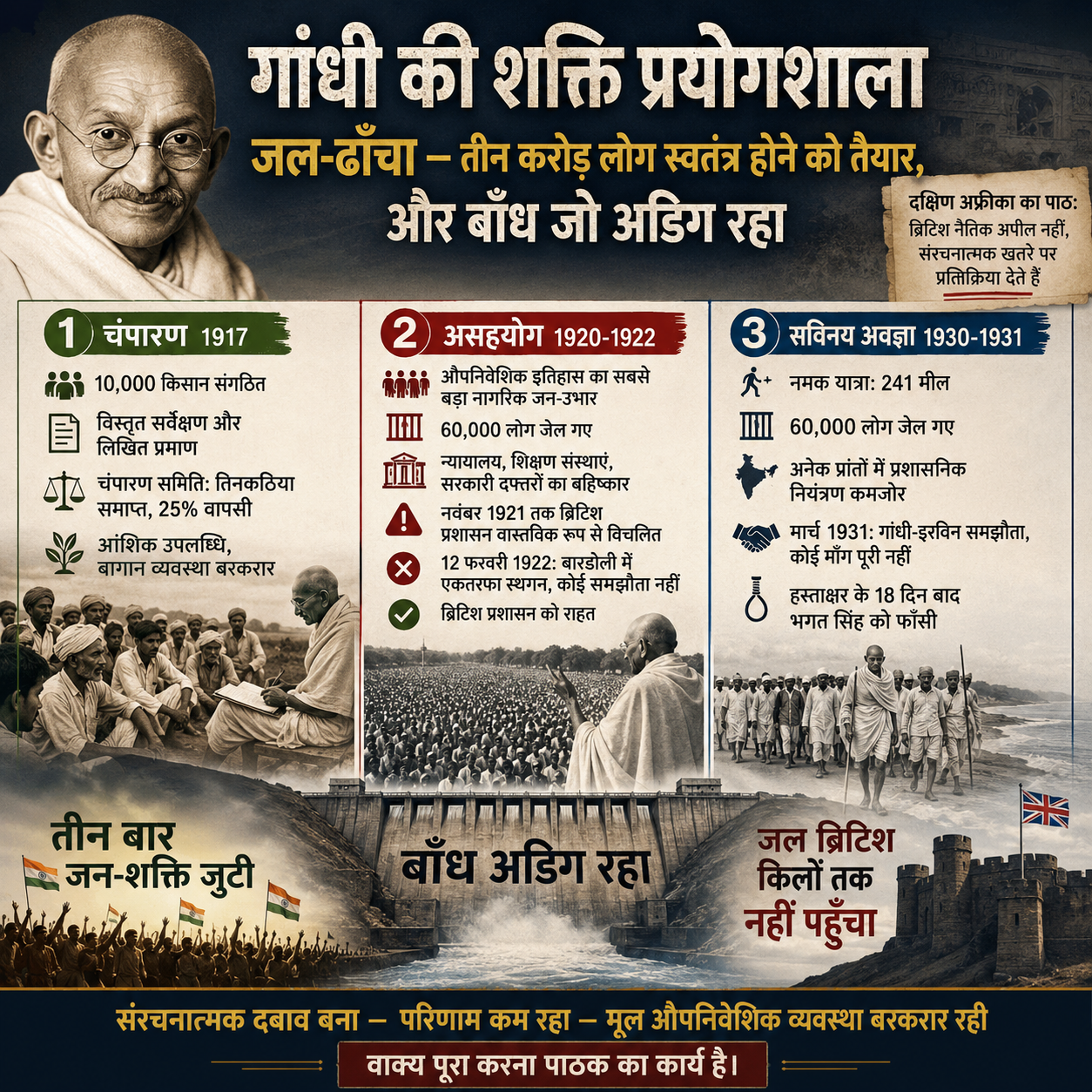
Blog 137 placed the three documented acts before the reader — Champaran, Non-Cooperation, Civil Disobedience — and the pattern of assembled reservoirs and held dams. This post places the documented balance sheet of the third act’s settlement before the reader: what the Civil Disobedience movement’s documented peak leverage was traded for — and what that trade produced.
Thank you for reading this post, don't forget to subscribe!The Action Taken: Peak Civil Disobedience was suspended for a seat at the Second Round Table Conference, which ended without a constitution.
Who Paid the Price: The demobilised 1930 volunteer machinery, which was not in the room for that seat.
The Alternative Bypassed: Conditioning the truce on enforceable terms before standing down.
Why This Matters: This is the Irwin–London trade, not the ashram-trust file.
The Trade
Gandhi’s Empty Chair places the documented trade before the reader precisely.
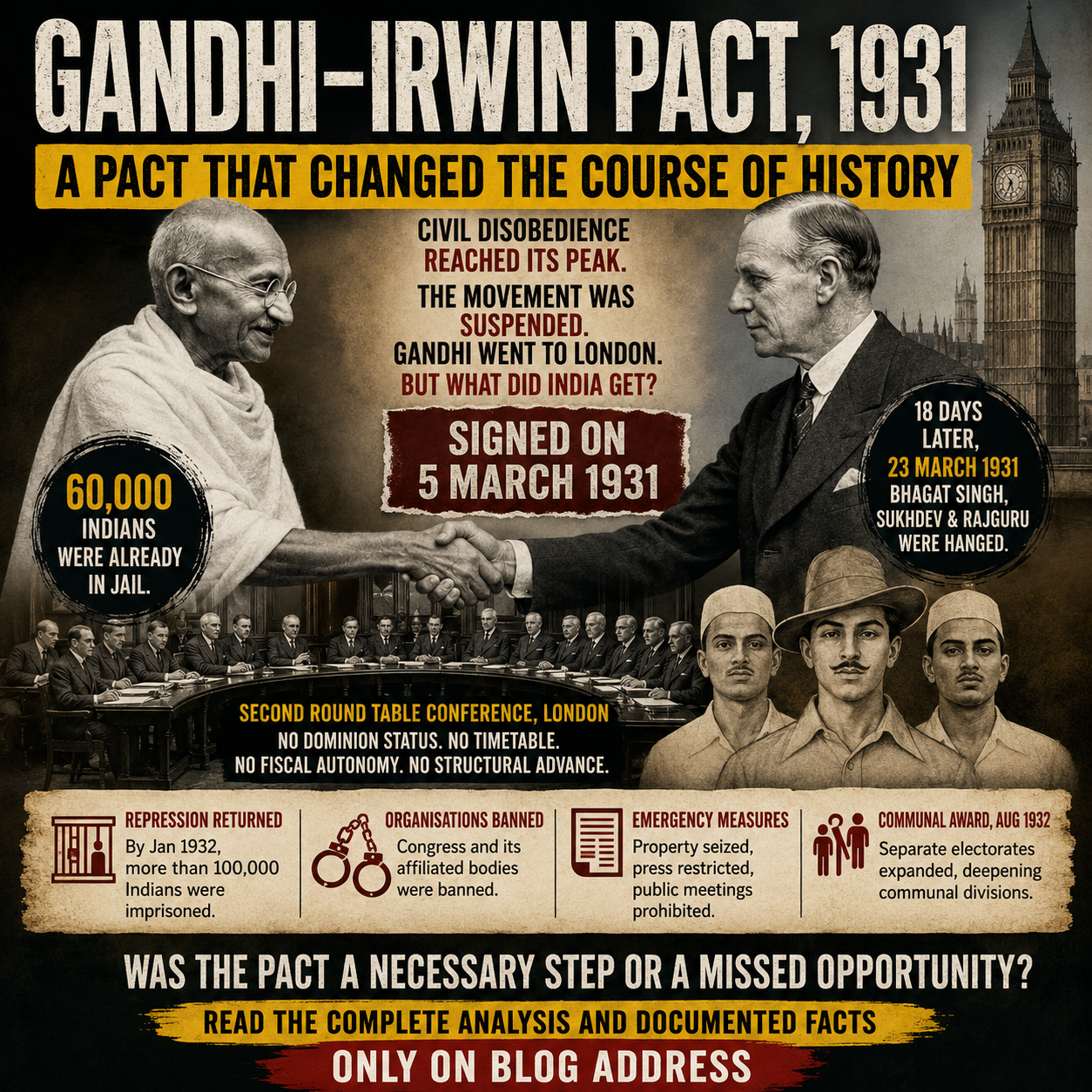
March 5 1931: Gandhi signed the Gandhi-Irwin Pact — established in Blogs 17-20 of this series. On one side of the trade: the Civil Disobedience movement at its documented peak. 60,000 jailed. Provinces losing administrative control. The British administration on the documented defensive — customs revenues collapsing, administrative machinery paralysed. The strongest documented hand any Indian leader had held.
On the other side of the trade: a seat at the Second Round Table Conference in London, Autumn 1931.
Gandhi’s Empty Chair places the documented outcome of that trade before the reader in five documented entries.
Entry 1 — Zero Constitutional Progress
The Second Round Table Conference, London, Autumn 1931. Gandhi attended as Congress’s sole representative. The conference produced absolute deadlock. No dominion status. No timeline for independence. No fiscal autonomy. No documented British commitment of any kind that constituted structural progress toward Indian self-governance.
Gandhi returned to Bombay in December 1931 empty-handed.
The prosecution places the documented conference outcome before the reader alongside the documented leverage that was suspended to obtain the seat: 60,000 jailed, provinces losing control, British administration on the documented defensive. The chair in London was obtained. The chair produced nothing.
Entry 2 — Loss of Strategic Initiative
Gandhi’s Empty Chair places the documented strategic consequence before the reader. In 1930, the British administration was on the documented defensive — customs revenues collapsing, administrative machinery across provinces documented as paralysed, Viceroy Lord Irwin’s correspondence carrying documented alarm at the movement’s scale.
The Gandhi-Irwin Pact of March 1931 suspended the Civil Disobedience movement. The British administration used the suspension to regroup. The documented initiative — the pressure that had produced the documented alarm — was surrendered by the suspension. When Gandhi returned from London in December 1931 and attempted to restart the movement in January 1932, the colonial machinery was no longer on the defensive.
Entry 3 — Tactical Regrouping by the Raj
Gandhi’s Empty Chair places the documented British response to the truce before the reader.
The colonial administration used the Gandhi-Irwin truce — the months between the Pact signing and Gandhi’s return from London — to draft contingency plans for suppressing any resumed movement. When Gandhi attempted to restart Civil Disobedience in January 1932, the colonial machinery struck proactively:
Over 100,000 Indians were jailed within months — documented as exceeding the 60,000 jailed during the peak of the original movement. The Congress Working Committee and all Congress-affiliated bodies were banned overnight. Sweeping emergency ordinances confiscated property, censored the press, and crushed public gatherings before any mass momentum could reform.
The documented sequence: the truce gave the British administration the window. The British administration used the window. The resumed movement was suppressed more comprehensively than the original had been.
Entry 4 — Division Instead of Sovereignty
Gandhi’s Empty Chair places the documented product of the London conference before the reader. The Second Round Table Conference produced no constitutional progress toward Indian sovereignty. What it produced was the documented context for the Communal Award of August 1932 — the British government’s announcement fracturing the Indian electorate along separate communal lines, awarding separate electorates to multiple communities.
The conference that was supposed to advance Indian self-governance produced instead a documented communal division of the electorate — deepening the constitutional communal framework the Morley-Minto Reforms of 1909 had established.
The chair in London produced not freedom but documented division.
Entry 5 — The Gallows
Gandhi’s Empty Chair places the documented date before the reader.
Gandhi-Irwin Pact: March 5 1931.
Bhagat Singh, Sukhdev, and Rajguru hanged: March 23 1931.
Eighteen days.
Gandhi placed a personal appeal for clemency on record. He did not make the commutation of the death sentences a binding condition for signing the Pact — established in Blog 132 of this series from the documented terms of the Delhi Pact. The revolutionaries who had chosen armed resistance were excluded from the documented amnesty the Pact provided — which covered only non-violent civil disobedience prisoners.
The pact securing the chair in London was signed eighteen days before the gallows at Lahore Central Jail were used. The men on those gallows were not covered by the documented terms of the trade.
The Documented Balance Sheet
The five documented entries are placed before the reader as a consolidated balance sheet.
What was given: Civil Disobedience at its documented peak. 60,000 jailed. Provinces losing control. British administration on the documented defensive. The strongest hand any Indian leader had held.
What was received: A seat at the Second Round Table Conference. Zero constitutional progress. Loss of strategic initiative. British tactical regrouping. Communal Award August 1932. Bhagat Singh, Sukhdev, and Rajguru — eighteen days after the signature.
The prosecution places this documented balance sheet before the reader and asks one question: does the documented trade — the documented peak leverage of 1930 suspended for the documented empty chair of 1931 — constitute an exhibit the reader places alongside Gandhi’s documented role as the movement’s unilateral decision-maker?
The Prosecution’s Position
Gandhi’s Empty Chair places three questions before the reader.
- Did the Gandhi-Irwin Pact of March 5 1931 trade the Civil Disobedience movement’s documented peak leverage — 60,000 jailed, provinces losing control, British on the documented defensive — for a seat at the Second Round Table Conference that produced zero constitutional progress, the documented loss of strategic initiative, and British tactical regrouping that suppressed the resumed movement more comprehensively than the original?
- Did the documented Communal Award of August 1932 — the product of the London conference Gandhi attended — deepen rather than dismantle the communal electoral framework the British had established in 1909, constituting a documented outcome of the trade that moved in the opposite direction from Indian self-governance?
- Does the documented date — Pact signed March 5 1931, Bhagat Singh hanged March 23 1931, eighteen days — alongside Gandhi’s documented decision not to make commutation a binding condition of the trade, constitute an exhibit the reader places alongside the documented balance sheet of what the trade produced?
The series does not answer. The documented trade, its documented terms, and its documented five-entry balance sheet are placed before the reader. The reader will examine what the empty chair in London established — and complete the sentence.
Invitation To Defence
The floor belongs to the defense. We now invite them to present their exhibits and challenge the narrative established by the prosecution.
March 5 1931: Gandhi signed. The trade: 60,000 jailed, provinces losing control, British on the documented defensive — for a seat in London. The documented balance sheet: zero constitutional progress, strategic initiative surrendered, British regrouped, 100,000 jailed when movement resumed, Communal Award August 1932. March 23 1931: Bhagat Singh, Sukhdev, Rajguru — eighteen days after the pact was signed. The chair was empty. The prosecution places the documented trade and its documented balance sheet before the reader. The reader will complete the sentence.
Feature Image: Click here to view the image.
Videos
Glossary of Terms
- Gandhi-Irwin Pact: The agreement signed by Mahatma Gandhi and Viceroy Lord Irwin on March 5, 1931, which suspended the Civil Disobedience movement and enabled Gandhi to attend the Second Round Table Conference.
- Civil Disobedience Movement: The mass political movement led by Gandhi against British rule, involving non-violent refusal to obey selected laws and administrative measures.
- Second Round Table Conference: The constitutional conference held in London in 1931, attended by Gandhi as the sole Congress representative, which ended without the constitutional progress sought by the Indian national movement.
- Strategic Initiative: The ability to determine the timing, direction, and pressure of political action. The blog argues that the suspension of Civil Disobedience surrendered this initiative to the British administration.
- British Tactical Regrouping: The British administration’s use of the truce period to prepare for renewed repression before the Civil Disobedience movement resumed in 1932.
- Communal Award: The British government’s August 1932 decision that expanded separate electorates for different communities, deepening the communal structure of electoral representation.
- Separate Electorates: An electoral arrangement in which members of a specified community vote separately to choose representatives designated for that community.
- Morley-Minto Reforms: The constitutional reforms of 1909 that introduced separate electorates for Muslims and established an important precedent for communal electoral representation in British India.
- Documented Balance Sheet: A distinctive analytical phrase used in the blog to compare what was surrendered through the Gandhi-Irwin Pact with what was obtained from that political exchange.
- Gandhi’s Empty Chair: The blog’s central analytical phrase, referring to the London seat obtained by Gandhi after the Civil Disobedience movement was suspended, while emphasizing the limited constitutional outcome of that participation.
- Peak Leverage: The maximum documented political pressure available to the movement, represented in the blog by mass imprisonment, weakening provincial control, and the British administration’s defensive position in 1930.
- Lahore Central Jail: The prison where Bhagat Singh, Sukhdev, and Rajguru were executed on March 23, 1931, eighteen days after the Gandhi-Irwin Pact was signed.
- Bhagat Singh, Sukhdev and Rajguru: Revolutionaries executed by the British government on March 23, 1931. The blog contrasts their execution with the terms of the Pact’s amnesty, which applied to non-violent civil disobedience prisoners.
- Invitation to Defence: A recurring prosecution-style device in the series that invites the opposing interpretation to present its evidence and challenge the conclusions placed before the reader.
- The Prosecution’s Position: The analytical framework used by the series to present documented evidence, formulate questions, and leave the final judgment to the reader rather than supplying a predetermined conclusion.
#Gandhi #GandhiIrwinPact #CivilDisobedience #BhagatSingh #IndianHistory #FreedomStruggle #BritishIndia #RoundTableConference #CommunalAward #IndianIndependence #HinduinfoPedia