
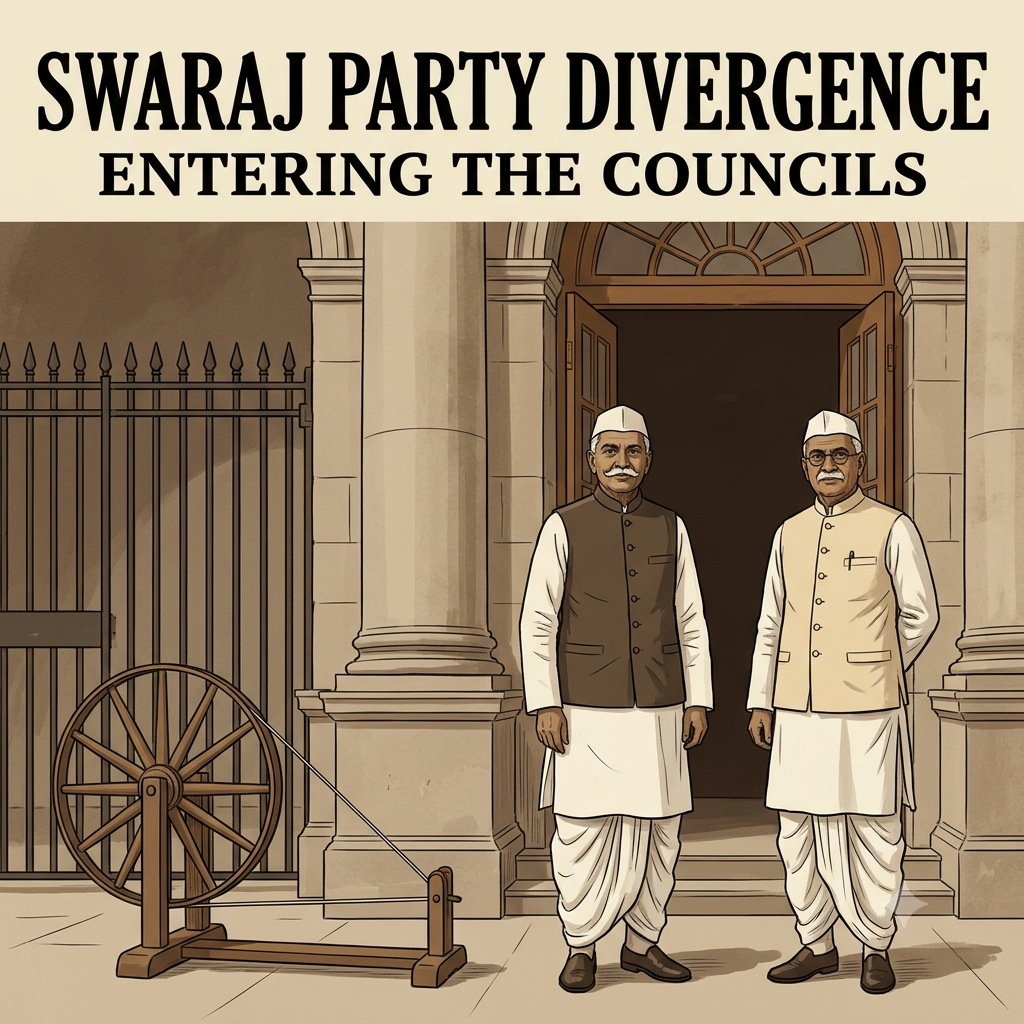
Gandhi’s Swaraj Party Divergence: Congress Seniors Enter the Councils — The Constitutional Counter-Model (207)
भारत / GB
Part 207: Mahatma Gandhi’s Peace Efforts | Series Index
Blog 206 documented Gandhi’s Khilafat rupture — the sequence by which the nominal Congress-Khilafat pact dissolved between February 1922 and late 1923: the Bardoli suspension issued without Khilafat consultation, the Khilafat Working Committee’s indictment of that suspension as unilateral abandonment, and the Ali Brothers’ formal breach upon release. That blog documented what happened to the Khilafat half of the abandoned alliance. This blog documents what happened to the Congress half. When Gandhi’s Bardoli Resolution suspended Non-Cooperation in February 1922 and his Yerwada conviction removed him from the field entirely in March 1922, a constitutional void opened inside the Indian National Congress. C.R. Das and Motilal Nehru stepped into that void — not to revive Gandhi’s programme, but to repudiate its central premise. This blog places that record before the reader.
Thank you for reading this post, don't forget to subscribe!THE ARITHMETIC OF THE DIVERGENCE
The Action Taken: At the Gaya Congress of December 1922, C.R. Das — Congress president — moved a resolution authorising entry into the reformed legislative councils established under the Montagu-Chelmsford Act of 1919. Gandhi’s council-boycott policy, the cornerstone of Non-Cooperation, was directly challenged. When the resolution was defeated by 1,740 votes to 890 — Gandhi’s “No-Changer” loyalists holding the floor alongside the clerical council-boycott bloc — Das and Motilal Nehru resigned from the Congress executive and formed the Swaraj Party on 1 January 1923, contesting the November 1923 council elections from within the Congress umbrella while operating under an independent constitutional programme.
Who Paid the Price: Gandhi, imprisoned at Yerwada after executing his own pre-arranged exit through Bardoli and his Ahmedabad guilty plea, left behind thirty thousand jailed followers and a paralysed Congress apparatus. His absence gave the constitutional wing its opening. Das and Nehru offered a realistic programme: enter the councils, obstruct colonial legislation from within, and extract constitutional concessions through parliamentary pressure rather than sacrificing cadres in an aborted street agitation.
Why This Matters: Gandhi’s Swaraj Party divergence is the name the prosecution assigns to this fracture. The divergence exposed that Gandhi’s council-boycott orthodoxy lacked an unassailable mandate inside Congress once he was removed from the room. The constitutional counter-model won decisive support in the November 1923 council elections, demonstrating that constitutional engagement, not Gandhian extra-parliamentary agitation, commanded the confidence of the educated Indian political class.
The Vacuum Left by Bardoli and Yerwada
To understand Gandhi’s Swaraj Party divergence, the sequence of withdrawals is essential. On 12 February 1922, Gandhi unilaterally suspended the Non-Cooperation Movement through the Bardoli Resolution — issued without prior consultation with the Khilafat leadership and without securing any political concession from the colonial government. The suspension left the Congress machinery holding a mobilised volunteer corps, an active fundraising apparatus built around the Tilak Swaraj Fund, and a national organisational structure — all committed to a programme that had just been cancelled by personal decree.
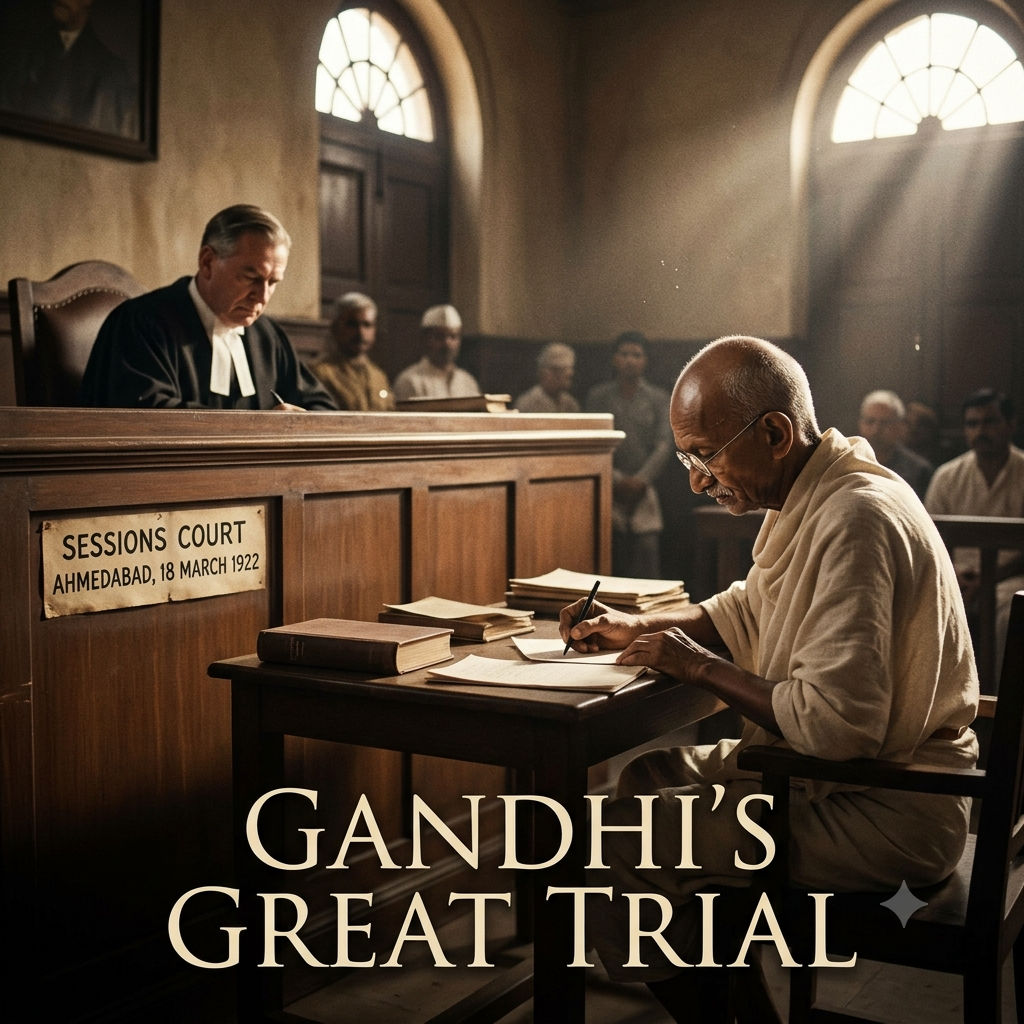
Thirty-four days later, on 18 March 1922, Gandhi was convicted at Ahmedabad on three counts of sedition for his Young India articles — “Tampering with Loyalty,” “The Puzzle and Its Solution,” and “Shaking the Manes” — and sentenced to six years’ simple imprisonment at Yerwada Central Prison, Pune. The man who had suspended the movement was now also removed from the political field entirely. The Congress Working Committee, which had been accustomed to acting as a nominal signatory to Gandhi’s personal decrees, faced its first sustained period without his physical presence since the Nagpur Congress of December 1920 that had entirely restructured Congress and made it an instrument of Mahatma Gandhi’s will. Into that vacuum, C.R. Das and Motilal Nehru moved with a fully formed alternative.
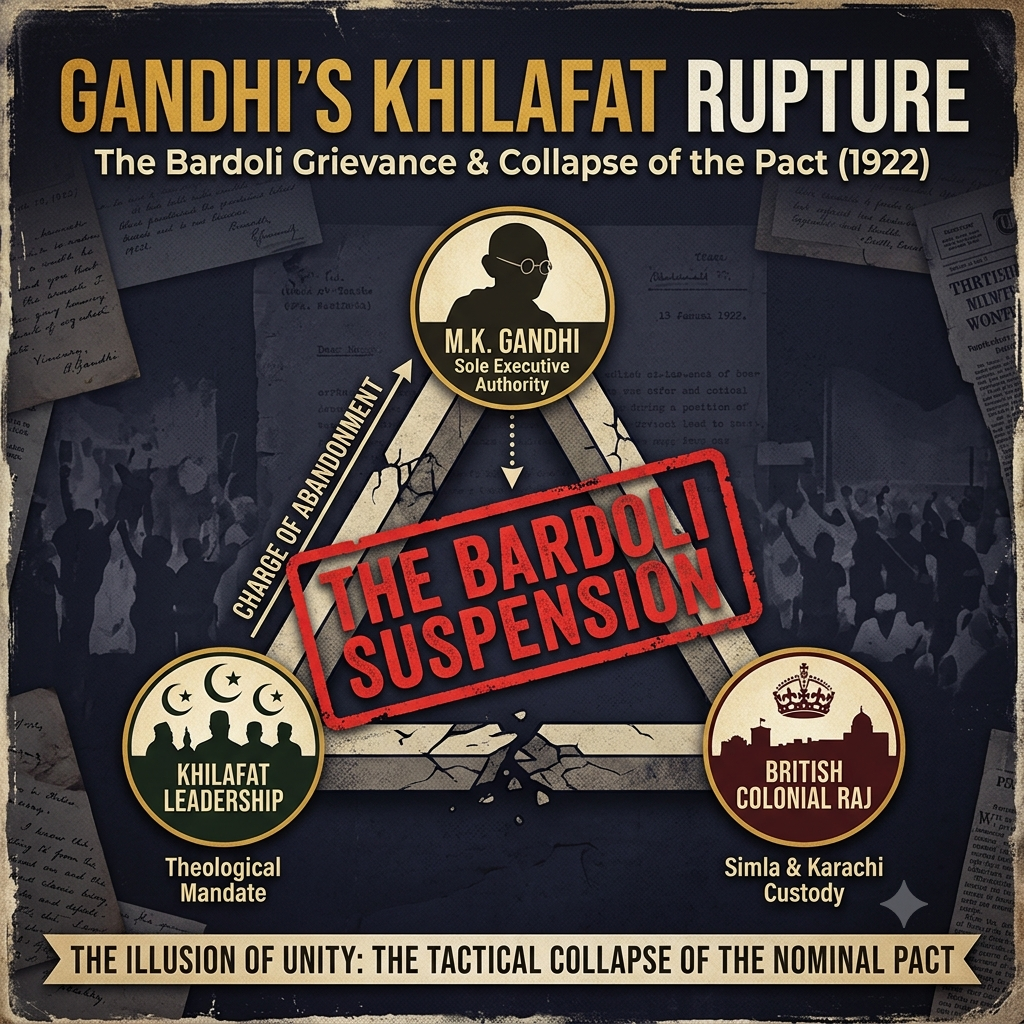
C.R. Das and the Gaya Congress: December 1922
Chittaranjan Das had accepted Gandhian Non-Cooperation in 1920 with significant personal sacrifice — dissolving his highly lucrative Calcutta legal practice and committing his personal fortune to the Congress cause. But Das had never been persuaded that council boycott was strategically sound. His position, shared by Motilal Nehru, was that the reformed legislative councils established under the Montagu-Chelmsford Reforms of 1919 represented an arena where organised nationalist pressure could obstruct colonial legislation, block hostile budgets, and demonstrate the Congress’s capacity for governance — objectives that street agitation and prison-filling could not achieve.
As Congress president presiding over the Gaya Congress of December 1922, Das moved a resolution to reverse Gandhi’s council-boycott policy and authorise Congress candidates to contest the reformed councils. The resolution was defeated by 1,740 votes to 890 — the Congress floor, controlled by Gandhi’s “No-Changer” loyalists led by C. Rajagopalachari and reinforced by the concurrent Gaya Khilafat Conference and Jamiat ulama whose religious injunction maintained the council boycott, refused to sanction the constitutional deviation. Yet the 890 votes polled by Das established that he commanded a formidable congressional bloc — and made clear that Gandhi’s boycott orthodoxy would not yield without an institutional break.
The Formation of the Swaraj Party: January 1923
Das and Motilal Nehru responded to the Gaya defeat with immediate structural organisation. Resigning from the Congress presidency and the Working Committee, they founded the Swaraj Party on 1 January 1923 — formally titled the Congress-Khilafat Swaraj Party. They operated explicitly within the broader Congress umbrella while pursuing an independent constitutional programme.
The party’s formation was the institutional act that defined Gandhi’s Swaraj Party divergence. Rather than boycotting the reformed councils as instruments of colonial co-option, the Swarajists chose to contest and enter them, using parliamentary procedure to obstruct, delay, and defeat the colonial legislative agenda from within. In doing so, they broke sharply from the “No-Changer” Gandhians, who remained stranded after their leader pleaded guilty to what he had preached yet continued enforcing his abandoned orthodoxy — demonstrating that Das and Nehru had learned far more from Gandhi’s actions than the Gandhians themselves.
The strategic logic was clearly articulated by both Das and Nehru. The Montagu-Chelmsford councils, whatever their colonial architecture, were arenas where a disciplined nationalist bloc could refuse supply votes, defeat government bills, demand accountability from executive officers, and build an Indian legislative record that the British constitutional process could not ignore. Gandhi’s programme operated on two irreconcilable standards: he demanded that his followers abandon careers, court arrest, and walk into colonial repression, while securing a pre-arranged exit for himself through bilateral accommodation with the Viceroy at Simla, unilateral termination at Bardoli, and formal submission to the Crown’s court at Ahmedabad. Having already emptied the boycott doctrine of any active reality, Gandhi left behind an empty shell — yet his “No-Changer” loyalists continued enforcing his abandoned council-boycott dogma against the Swarajists, who chose instead to enter the legislatures and obstruct colonial rule from within.
The November 1923 Council Elections
The Swaraj Party contested the November 1923 legislative council elections — the first direct electoral test of Gandhi’s Swaraj Party divergence. The results were decisive. In the Central Legislative Assembly, the Swarajists won forty-two of the one hundred and one elected seats, making them the largest single party in the house and enabling them to defeat major government budgets and bills in coalition with independents. In the Bengal Legislative Council, C.R. Das’s party won forty-seven seats to emerge as the largest single bloc, while in the Central Provinces Legislative Council, the Swarajists captured an outright majority of elected seats and brought the dyarchy administration to a standstill.
The results demonstrated two things simultaneously. First, that the Indian educated political class — lawyers, zamindars, municipal councillors, and urban professionals — preferred constitutional engagement to Gandhian boycott as the vehicle for nationalist pressure. Second, that the colonial constitutional architecture’s nominated and official seat reserve was calibrated to insulate executive power from elected majorities. The Swarajists drew both conclusions: they had the numbers to obstruct and expose the limits of dyarchy; they lacked the constitutional framework to govern. The strategy of continuous, consistent obstruction from within became the operative framework.
Gandhi’s Response from Yerwada and After
While Gandhi remained inside Yerwada Prison, his “No-Changer” loyalists continued treating council entry as a violation of the boycott principle he had already suspended at Bardoli. Yet by September 1923, the special Delhi session of Congress — presided over by Abul Kalam Azad — formally permitted Congressmen to contest the November elections, ratifying the Swarajist line under the Congress flag. When Gandhi’s early release from Yerwada came on 5 February 1924 — on medical grounds following an emergency appendicitis operation, without any political concession from the colonial government — he re-entered a Congress landscape that the Swarajists substantially controlled. Rather than reviving his abandoned boycott, Gandhi accommodated the shift, culminating in the November 1924 Calcutta pact in which he formally recognised the Swaraj Party as the legislative arm of Congress.
What the Divergence Reveals
Gandhi’s Swaraj Party divergence reveals that his council-boycott orthodoxy commanded Congress only so long as he commanded Congress in person. The Nagpur Congress of December 1920 had restructured the party and vested him with unquestionable executive authority — a personal grant, not a settled institutional consensus. When Bardoli removed his programme and Yerwada removed his person, the Congress machinery reverted to the constitutional instincts of its pre-Gandhi leadership: trained lawyers, seasoned administrators, and experienced municipal politicians who had always understood that organised legislative presence, not street agitation, was the durable instrument of nationalist pressure.
The Swarajist victory in November 1923 established a point of permanent record: the Indian political class, given a choice between Gandhian extra-parliamentary boycott and constitutional council engagement, chose the councils. The divergence was not a betrayal of the national movement; it was the national movement’s professional core asserting its own strategic judgment the moment Gandhi’s personal authority ceased to suppress it. The constitutional counter-model constructed at Gaya and institutionalised in the November 1923 elections would become the governing framework of Congress politics through the Simon Commission period and into the 1935 Act elections — long after Gandhi’s particular variant of extra-parliamentary pressure had exhausted its strategic utility.
Modern Parallel
The structural anatomy of Gandhi’s Swaraj Party divergence — where a political movement preaches total boycott of state institutions as irredeemably compromised, yet its pragmatic wing enters those exact institutions to capture seats and wield power whenever advantage dictates — recurs in contemporary democratic politics whenever political actors denounce an electoral or institutional system as rigged in defeat while seamlessly claiming its mandates and offices in victory. In such formations, institutional boycott is never a settled principle; it is a tactical posture suspended the moment institutional entry yields power. The professional political class inside any movement recognizes that constitutional arenas — however flawed their design — remain the decisive seat of leverage, leaving orthodox street-boycott loyalists defending a dogma their own leadership abandons whenever convenient.
Invitation To Defence
The Gaya Congress record of December 1922 — establishing that C.R. Das moved council-entry and was defeated by 1,740 votes to 890 by Gandhi’s loyalist floor — is in the record. The Swaraj Party’s 1 January 1923 formation, the September 1923 Delhi Congress ratification, and the November 1923 council election results are in the record. The record of Gandhi’s Swaraj Party divergence is complete. The defence is invited to identify any primary source establishing that Gandhi’s council-boycott policy commanded majority support inside Congress in the absence of his personal authority after February 1922, or that the Swarajist November 1923 results were not the clearest available expression of the Indian professional political class’s strategic preference.
Gandhi’s Bardoli suspension removed the programme. His Yerwada conviction removed the person. C.R. Das and Motilal Nehru filled the void at Gaya in December 1922 with a direct challenge to council boycott. When the Gaya resolution failed on the floor, they founded the Swaraj Party on 1 January 1923 and contested the November 1923 councils — winning forty-two elected seats in the Central Legislative Assembly, forty-seven seats in Bengal, and an outright majority in the Central Provinces. Gandhi’s Swaraj Party divergence did not fracture a settled movement; it exposed that Gandhi’s personal authority had been the only settlement holding council boycott in place.
Feature Image: Click here to view the image.
Videos
Glossary of Terms
1. Gandhi’s Swaraj Party Divergence: The political and ideological fracture within the Indian National Congress following Gandhi’s suspension of the Non-Cooperation Movement, when C.R. Das and Motilal Nehru rejected the council-boycott policy and pursued constitutional participation.
2. Constitutional Counter-Model: An alternative political strategy advocating participation in colonial legislative councils to obstruct government policies, challenge colonial authority, and secure constitutional concessions from within the existing institutional framework.
3. Bardoli Resolution: The resolution of 12 February 1922 through which Mahatma Gandhi unilaterally suspended the Non-Cooperation Movement following the Chauri Chaura incident, without prior consultation with the Khilafat leadership.
4. Yerwada Conviction: The conviction of Mahatma Gandhi on 18 March 1922 at Ahmedabad on three counts of sedition, resulting in a six-year prison sentence at Yerwada Central Prison in Pune.
5. Council Boycott: The Gandhian political policy of refusing to participate in British-established legislative councils as a means of rejecting colonial constitutional institutions and demonstrating non-cooperation.
6. Gaya Congress: The December 1922 session of the Indian National Congress, presided over by C.R. Das, where his resolution proposing entry into legislative councils was defeated by 1,740 votes to 890.
7. No-Changer Loyalists: Congress members who supported Gandhi’s original Non-Cooperation programme and opposed participation in legislative councils, preferring continuation of the boycott policy.
8. Swaraj Party: The political party founded by C.R. Das and Motilal Nehru on 1 January 1923, formally titled the Congress-Khilafat Swaraj Party, which advocated entering legislative councils to obstruct colonial administration from within.
9. Montagu-Chelmsford Reforms: Constitutional reforms introduced under the Government of India Act 1919 that expanded legislative councils and introduced dyarchy in provincial administration, creating limited opportunities for Indian political participation.
10. Dyarchy: A system of provincial administration introduced under the 1919 reforms in which governmental responsibilities were divided between transferred subjects administered by Indian ministers and reserved subjects controlled by British officials.
11. Legislative Obstruction: A political strategy of entering legislative institutions and using elected representation, parliamentary procedures, budgetary votes, and opposition to government bills to obstruct colonial administration.
12. Congress Umbrella: The broader organisational framework of the Indian National Congress under which the Swaraj Party operated while maintaining an independent constitutional programme.
13. Constitutional Engagement: Participation in established legislative and political institutions to pursue national objectives through parliamentary representation, institutional pressure, and constitutional processes rather than extra-parliamentary agitation.
14. Extra-Parliamentary Agitation: Political mobilisation conducted outside legislative institutions through demonstrations, public protests, civil disobedience, mass movements, and organised non-cooperation.
15. Gandhi’s Abandoned Orthodoxy: A distinctive expression used in this blog to describe the continued enforcement of Gandhi’s council-boycott doctrine by his loyalists even after he had suspended the movement and subsequently accommodated the Swarajists’ legislative participation.
#Gandhi #SwarajParty #MahatmaGandhi #Congress #IndianHistory #CRODas #MotilalNehru #NonCooperation #BritishIndia #IndianPolitics #FreedomMovement #ConstitutionalReforms #HinduinfoPedia
Scan Through The Entire Series at