
Gandhi’s Khilafat Motive: The Himalayan Blunder and the End-Run (178)
भारत / GB
Part 178: Mahatma Gandhi’s Peace Efforts | Series Index
Blog 177 placed before the reader the restraint that was lifted — the pre-British sovereign check on landlord extraction that British courts codified into absolute freehold, and the false promise that Gandhi’s Khilafat alliance brought to Malabar: that sovereign authority was returning. The Post, Gandhi’s Khilafat Motive, does not yet place the explosion before the reader. It places what came before it: the political collapse that made the Khilafat alliance not a matter of principle but of survival. Gandhi’s Khilafat bomb — the motive — documents the domestic crisis that drove Gandhi to reach for a political apparatus he could not have built himself, and the internal political advantage that apparatus delivered before a single British institution had been boycotted.
Thank you for reading this post, don't forget to subscribe!THE HISTORICAL RECORD — THE HIMALAYAN BLUNDER AND THE END-RUN
The Pattern: Gandhi did not capture the Indian National Congress in 1919–1920 from a position of unassailable domestic supremacy. In the immediate aftermath of the Rowlatt Satyagraha, his political standing among the established nationalist leadership was precarious, isolated, and rapidly eroding. The alliance with the Khilafat leaders was not merely an act of theological goodwill; it was the political lever by which Gandhi bypassed the sceptical old guard of the Congress to manufacture an unchallengeable personal majority. Gandhi’s Khilafat bomb — the motive — was first detonated not in Malabar but in Calcutta, against C.R. Das, Annie Besant, and Mohammad Ali Jinnah.
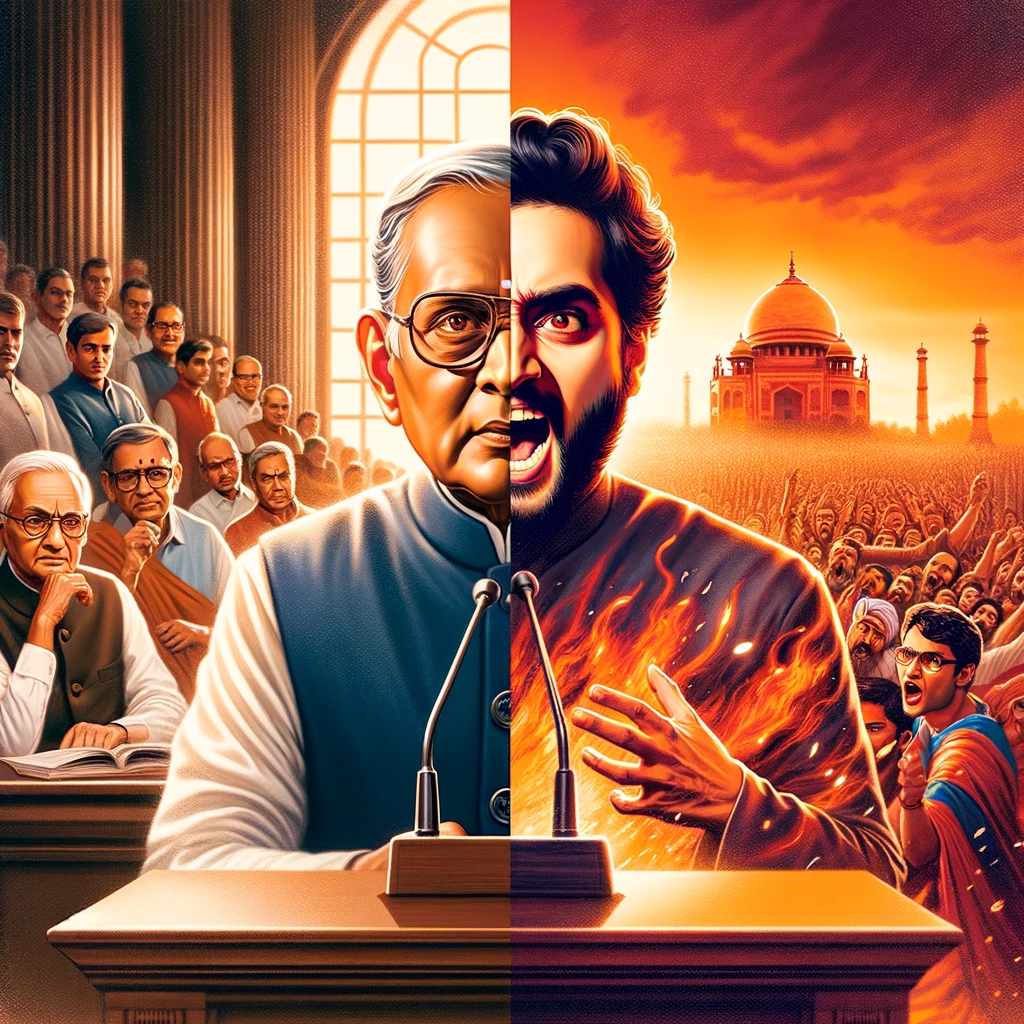
The Lethal Exhibit: When the vote on Non-Cooperation was taken at the Special Congress Session in Calcutta in September 1920, Gandhi defeated the Das-Pal-Besant coalition 1,886 votes to 884. The open-session margin was decisive; the Subjects Committee vote was reported as far narrower — a margin of roughly seven votes in some accounts. The large-scale mobilisation and organised transport of Khilafat delegates and Muslim supporters by the Central Khilafat Committee is widely attributed in contemporary and later accounts as the factor that converted a razor-thin internal leadership margin into an overwhelming open-session majority. By December 1920 at the Nagpur Congress, the surrender of the old guard was complete. Jinnah rose to address the session, refused to call Gandhi “Mahatma” — insisting on “Mr. Gandhi” — and was shouted down and booed from the floor until he walked out of the Indian National Congress into political exile. Gandhi emerged as the undisputed dictator of the Congress.
Why it matters: The prosecution does not charge Gandhi with merely procuring an external apparatus. It documents that the first use of that apparatus was domestic: to extinguish the constitutional voices inside the Congress who had warned — accurately and on the record — that the Khilafat alliance would release forces that no leader could contain. Gandhi’s Khilafat bomb — the motive — silenced those warnings at the moment of maximum political consequence. Future Blogs will place before the reader precisely what Gandhi procured to execute that seizure.
The Post-Rowlatt Collapse: The Weakened Position
In early 1919, Gandhi launched the Rowlatt Satyagraha against legislation permitting detention without trial. Within weeks, mob violence erupted in Ahmedabad, Viramgam, and Punjab. The agitation Gandhi had declared a test of national discipline descended into arson, rioting, and police reprisals, culminating in the Jallianwala Bagh massacre on 13 April 1919.
Gandhi abruptly called off the satyagraha on 18 April, admitting publicly that he had committed a “Himalayan blunder” by asking a population to offer civil disobedience before it had qualified itself by sustained obedience to law. The admission was politically devastating.
Constitutional moderates — Annie Besant, V.S. Srinivasa Sastri, Madan Mohan Malaviya — condemned his methods for inciting the mob and then retreating. Besant wrote that Gandhi had demonstrated he could not control the forces his agitation unleashed. Tilakites and nationalist extremists viewed the withdrawal as a failure of nerve — evidence that Gandhi’s doctrine of absolute non-violence was a practical impossibility when applied to mass politics. The legislative debate compounded the isolation: at the Amritsar Congress in December 1919, Bal Gangadhar Tilak, C.R. Das, and Bipin Chandra Pal advocated “responsive co-operation” — contesting the Montagu-Chelmsford Reforms from within the councils. Gandhi initially supported responsive co-operation too, leaving him without a distinctive national programme and without a platform that separated him from the constitutional mainstream.
By late 1919, Gandhi had exhausted his initial satyagraha capital. He stood between two hostile camps: constitutionalists who rejected direct action entirely, and radical nationalists who rejected his insistence on absolute non-violence. He commanded neither the votes inside the Congress apparatus nor the mass base outside it to impose his preferred programme.
The Internal Deadlock: Closed Doors Across the Congress
Faced with total irrelevance under the emerging constitutional settlement, Gandhi staged a radical gamble. In early 1920, he abandoned responsive co-operation and tabled a scorched-earth alternative: absolute Non-Cooperation. The proposal sought to sever every institutional link binding India to the Raj by boycotting law courts, government schools, and, critically, the upcoming elections under the Montagu-Chelmsford Reforms.
To the established provincial grandees, Gandhi was demanding that the Congress torch the very institutional ground it had spent three decades learning to navigate. The response across every regional committee was swift, coordinated, and categorically dismissive:
- Bal Gangadhar Tilak, whose Extremist faction had dominated nationalist politics for two decades, was highly sceptical of the council boycott. Tilak believed nationalists should contest the elections, capture the seats, and obstruct the colonial government from within — a strategy of relentless institutional attrition, not surrender of the field.
- C.R. Das in Bengal vehemently opposed the council boycott. Bengali nationalist politics had spent years constructing an electoral apparatus, cultivating regional patron-client networks, and building the institutional machinery to contest colonial governance. Boycotting would dismantle that apparatus overnight and hand the legislative benches to colonial loyalists by default.
- Lala Lajpat Rai in Punjab opposed the educational boycotts as self-destructive to Indian youth — a reckless sacrifice of a generation’s professional future for an open-ended agitation whose outcome no leader could guarantee.
- Mohammad Ali Jinnah, then the principal architect of Hindu-Muslim constitutional cooperation through the Lucknow Pact of 1916, warned Gandhi directly and on the record: mass religious appeals would unleash forces he could neither control nor direct. Jinnah’s warning was precise — constitutional cooperation rested on secular procedural containment; injecting clerical authority into political mobilisation would not unite communities, but polarise them irreversibly.
Inside the formal Congress apparatus, the machinery of consensus had jammed. Gandhi held no majority in the provincial Congress committees, no lever inside the Subjects Committee, and no route through established party procedure to convert his resolution into policy. Bengal under Das, Maharashtra under the Tilakites, and Bombay under Jinnah formed an impenetrable constitutional wall.
The End-Run: The Khilafat Machinery as Electoral Weapon
Recognising that he could not break the provincial blockade through established Congress channels, Gandhi orchestrated an end-run. He turned to an organisation operating entirely outside the Congress’s internal constitution, its provincial quotas, and its voting procedures: the Central Khilafat Committee (CKC).
The strategy was operational inversion. Rather than seeking Congress approval to build an agitation, Gandhi allied with an external apparatus already equipped with three essential instruments that the Congress lacked:
- The Clerical Cadres: The traditional network of Sunni ulema commanded by Maulana Abdul Bari of Firangi Mahal (Lucknow).
- The Mass Orators: The charismatic agitation network led by the recently released Ali Brothers (Shaukat and Mohammad Ali).
- The Industrial Treasury: The vast private funding and organizational logistics supplied by Mian Mohammad Haji Jan Mohammad Chotani, a wealthy Bombay timber magnate who served as the founding President and chief financier of the Central Khilafat Committee.
The operational timeline documents how Gandhi used this external triumvirate to dictate terms to the Congress:
- The Delhi Capture (23 November 1919): A full month before the Amritsar Congress met to debate constitutional reforms, Gandhi attended the All-India Khilafat Conference in Delhi. When delegates deadlocked over piecemeal boycotts of British goods, Gandhi offered a comprehensive blueprint: complete Non-Cooperation. The conference adopted his doctrine and elected him president on the spot, handing him a mass clerical platform completely independent of the Indian National Congress.
- The External Ratification (May–June 1920): While the provincial Congress committees continued to debate council entry, the Central Khilafat Committee met in Bombay and Allahabad to formally adopt Gandhi’s four-stage Non-Cooperation programme—beginning with the surrender of imperial titles and honours. Chotani’s treasury and the Ali Brothers’ cadres ratified Gandhi’s programme months before the Congress had even convened to consider it.
- The Payment of the Retainer (1 August 1920): On the designated launch day of Non-Cooperation, Gandhi executed Stage 1 himself. He returned his Kaisar-i-Hind Gold Medal, Zulu War Medal, and Boer War Medal to Viceroy Chelmsford. The primary justification in his accompanying letter was not the martial law atrocities in Punjab or the demand for Swaraj; it was the British breach of faith concerning the Ottoman Caliphate. The renunciation of imperial honours was Gandhi’s public down payment to the CKC, proving his absolute alignment with their theological objective.
Gandhi did not bring the Khilafat cause into the Congress as a gesture of moral fraternity. He procured the already-mobilised Khilafat apparatus—financed by Chotani’s treasury, organised across the ulema networks of Maulana Abdul Bari, and directed by the Ali Brothers—to overcome an internal constitutional opposition he could not defeat through established provincial machinery.
The Calcutta Coup: September 1920
The confrontation reached its decisive moment at the Special Session of the Congress convened in Calcutta in September 1920, summoned specifically to resolve the Non-Cooperation deadlock.
Five weeks before the session opened, the last structural barrier collapsed. Bal Gangadhar Tilak—the singular leader whose national stature, provincial base, and personal authority could have unified Das, Pal, and Besant into an unshakeable opposition bloc—died on 1 August 1920, the exact morning Gandhi surrendered his medals and launched the movement. The one figure capable of defeating Gandhi on the floor was gone before the gavel fell.
At Calcutta, the CKC executed the logistical complement to Gandhi’s political strategy. Utilizing Chotani’s financial reserves, the Khilafat Committee chartered special trains across the subcontinent, transporting thousands of Khilafat delegates and Muslim supporters directly to the venue. The resulting delegate roll was without precedent in Congress history.
The voting split exposed the divide between the established party machinery and the external influx:
- The Subjects Committee (The Party Machinery): Among the seasoned provincial leadership inside the closed Subjects Committee, the debate was fierce and the opposition unyielding. Gandhi’s resolution cleared this hurdle by the narrowest of margins—reported in contemporary accounts as a margin of roughly seven votes.
- The Open Session (The Street Assembled): When the resolution reached the plenary floor, the arithmetic was inverted. Gandhi defeated the Das-Pal-Besant coalition by 1,886 votes to 884.
The open-session majority was supplied by the transported Khilafat bloc, whose presence was qualitatively external to the provincial Congress committees. Their mandate rested on a singular transaction: Gandhi had placed the Congress behind the temporal sovereignty of the Ottoman Khalifa.
By December 1920, at the Nagpur Congress, the institutional capitulation was completed. C.R. Das and Lala Lajpat Rai, acknowledging the altered demographic reality inside the pandal, surrendered their opposition and seconded the programme. Mohammad Ali Jinnah stood alone. When Jinnah rose to oppose the inclusion of the Khilafat religious demand and insisted on addressing Gandhi as “Mr. Gandhi” rather than “Mahatma,” he was shouted down, jeered, and booed from the floor.
The constitutional architect who had warned that mass clerical appeals would release forces no leader could control was silenced by the very apparatus he had warned against. Jinnah walked out of the hall and into political exile. Gandhi walked out as the absolute director of the Indian National Congress.
The Double Deployment
The prosecution places this domestic sequence before the reader to establish a precise claim: the Khilafat apparatus served two masters simultaneously, and the domestic master was served first.
The Pan-Islamic doctrine, the Ali Brothers’ cadres, and the Chotani treasury were ostensibly mobilized to defend the Sultan of Turkey. That was the apparatus’s outward objective. But before it was ever deployed against the British Empire, Gandhi deployed it against the Indian National Congress:
- It was deployed to crush the constitutionalists who commanded the provincial machinery.
- It was deployed to sideline the provincial grandees who advocated council obstruction.
- It was deployed to silence Mohammad Ali Jinnah, who had warned that clerical injection into mass politics would lead to irreversible communal fracture.
When Jinnah delivered his warning, he spoke from within the procedural framework of the national movement. Gandhi’s imported apparatus expelled him from that framework. The warning remained on the historical record—and the machinery that silenced it in 1920 moved immediately to validate it.
The Khilafat mechanism had its first detonation in Calcutta in September 1920, shattering the constitutional core of the Congress. Its second detonation occurred in August 1921 across the taluks of Ernad and Walluvanad in Malabar.
Future Blogs will before the reader the anatomy of that apparatus: the Ottoman doctrine manufactured in Istanbul, the cadres mobilized through the ulema, and the mercantile treasury assembled in Bombay—the operational machinery Gandhi acquired to break his domestic isolation.
The Prosecution’s Position
Three questions now stand before the reader.
- Does the sequence — Gandhi’s “Himalayan blunder” admission destroying his authority with constitutionalists and radicals alike, his inability to command a Congress majority for Non-Cooperation through the established provincial networks, and his subsequent alliance with the Central Khilafat Committee which adopted his programme before the Congress did — constitute an exhibit the reader places alongside the claim that Gandhi’s alliance with pan-Islamism was an act of principled Hindu-Muslim unity rather than a calculated end-run around an internal opposition he could not defeat by constitutional means?
- Does the Calcutta Congress of September 1920 — Tilak dead barely five weeks earlier, the Central Khilafat Committee’s large-scale organised mobilisation of delegates widely attributed in contemporary accounts as decisive, the Subjects Committee margin razor-thin at roughly seven votes while the open-session count reached 1,886 to 884 — constitute an exhibit the reader places alongside the claim that Gandhi’s Congress majority was a democratic mandate representative of the established provincial leadership?
- Does the precise sequence — Jinnah’s warning at Calcutta and Nagpur that mass religious appeals would release forces no leader could control, that warning silenced when Jinnah was booed from the Nagpur floor in December 1920, and the question of what the Khilafat apparatus then transmitted into the isolated taluks of South Malabar — constitute an exhibit the reader places alongside the key phrase: Gandhi’s Khilafat bomb — the motive?
The series does not answer. Gandhi’s Khilafat bomb — the motive — places the tactical record before the reader: the Rowlatt collapse, the Congress deadlock, the Khilafat end-run, and the Calcutta coup. The reader will examine the motive — and in one of the later blogs, the apparatus Gandhi procured to execute it.
Invitation To Defence
The floor belongs to the defence. We now invite them to present their exhibits and challenge the narrative established by the prosecution.
Gandhi admitted a “Himalayan blunder” after Rowlatt. He could not command a Congress majority for Non-Cooperation through the established provincial networks. He allied with the Central Khilafat Committee, which adopted his programme before the Congress did. The Subjects Committee margin was roughly seven votes. The open-session count was 1,886 to 884. Tilak was dead barely five weeks before the session. Jinnah warned that mass religious appeals would release forces no leader could control. He was booed from the Nagpur floor and walked out of the Congress forever. Gandhi became the undisputed dictator of the organisation. Gandhi’s Khilafat bomb — the motive — places the domestic record before the reader. The reader will examine what was procured to deliver it.
Feature Image: Click here to view the image.
Videos
Glossary of Terms
1. Himalayan Blunder: Mahatma Gandhi’s own description of his decision to launch the Rowlatt Satyagraha before the population had developed sufficient discipline for non-violent civil disobedience.
2. Rowlatt Satyagraha: Gandhi’s 1919 campaign against legislation permitting detention without trial, which was followed by outbreaks of violence and his withdrawal of the agitation.
3. Non-Cooperation Movement: A political campaign launched in 1920 to withdraw Indian participation from British institutions, including law courts, government schools, and legislative councils.
4. Central Khilafat Committee (CKC): An organisation supporting the Khilafat cause that the blog describes as an external political and organisational apparatus used by Gandhi to overcome opposition within Congress.
5. Subjects Committee: The Congress committee responsible for considering resolutions and proposals before they reached the full session for a final decision.
6. Responsive Co-operation: A political strategy advocating participation in legislative councils under the Montagu-Chelmsford Reforms to challenge colonial rule from within the institutions.
7. Khilafat Movement: A political movement seeking to preserve the position and authority of the Ottoman Caliph following the First World War.
8. Ottoman Caliphate: The religious and political institution associated with the Ottoman Sultan, whose status became the central concern of the Khilafat Movement.
9. Ulema: Islamic religious scholars who interpret religious teachings and may exercise influence through religious institutions and community networks.
10. Ali Brothers: Shaukat Ali and Mohammad Ali, prominent leaders of the Khilafat Movement who helped mobilise supporters for the campaign.
11. End-Run: A key phrase in this blog describing Gandhi’s alleged strategy of bypassing established Congress procedures and provincial leadership by aligning with the Central Khilafat Committee.
12. Calcutta Coup: The blog’s interpretive term for the September 1920 Special Congress Session in Calcutta, where Gandhi’s Non-Cooperation resolution secured a large majority in the open session after a much narrower Subjects Committee vote.
13. Operational Inversion: A phrase describing the alleged reversal of the political process, whereby an external organisation adopted Gandhi’s programme before Congress formally approved it.
14. Double Deployment: The blog’s term for the argument that the Khilafat organisational machinery served both its stated objective of defending the Ottoman Caliphate and Gandhi’s domestic political objective of overcoming opposition within Congress.
15. Gandhi’s Khilafat Motive: The blog’s central key phrase, referring to its examination of Gandhi’s political calculations, his weakened position after the Rowlatt Satyagraha, his alliance with the Khilafat leadership, and the resulting shift in power within Congress.
#Gandhi #Khilafat #Congress #History #India #Politics #FreedomStruggle #Jinnah #NonCooperation #HinduinfoPedia
Scan Through The Entire Series at