
Gandhi’s Bose Destruction: The Elected President Removed — Through Undemocratic Forces (160)
भारत / GB
Part 160: Mahatma Gandhi’s Peace Efforts | Series Index
Blog 159 placed the Poona Pact before the reader — Gandhi descending from above to remove the structural political independence of the Depressed Classes, without signing the agreement his fast produced. This post, Gandhi’s Bose Destruction, places a different democratic verdict before the reader: January 1939, Subhas Chandra Bose elected Congress president — and what Gandhi’s opposition produced in the months that followed.
Thank you for reading this post, don't forget to subscribe!The Action Taken: In January 1939, Gandhi publicly characterised Bose’s democratic election victory as his personal defeat. Following mass CWC resignations, the Tripuri session passed the Pant Resolution — binding the elected president to appoint a Working Committee commanding Gandhi’s confidence. Gandhi then refused to provide names under that resolution, paralysing Bose between a binding session instruction and Gandhi’s refusal to operate it. Bose resigned the Congress presidency in April 1939, three months after his democratic election.
Who Paid the Price: Subhas Chandra Bose — twice-elected Congress president — removed from the Congress presidency without a counter-election, an impeachment, or a constitutional mechanism. The Congress electorate whose democratic verdict was reversed without their participation.
The Alternative Bypassed: Accepting the democratic verdict of the Congress electorate and working within Bose’s presidency — the constitutional position the Congress charter vested in the elected president.
Why This Matters: The documented sequence places before the reader a mechanism that operated independently of the standing Congress constitution: a session resolution passed to bind a specific elected president, combined with the refusal to operate the approval it created, produced the paralysis that reversed a democratic election result without any of the constitutional procedures that would have made the reversal accountable.
The Documented Democratic Verdict — January 1939
Gandhi’s Bose Destruction places the democratic verdict of January 1939 before the reader.
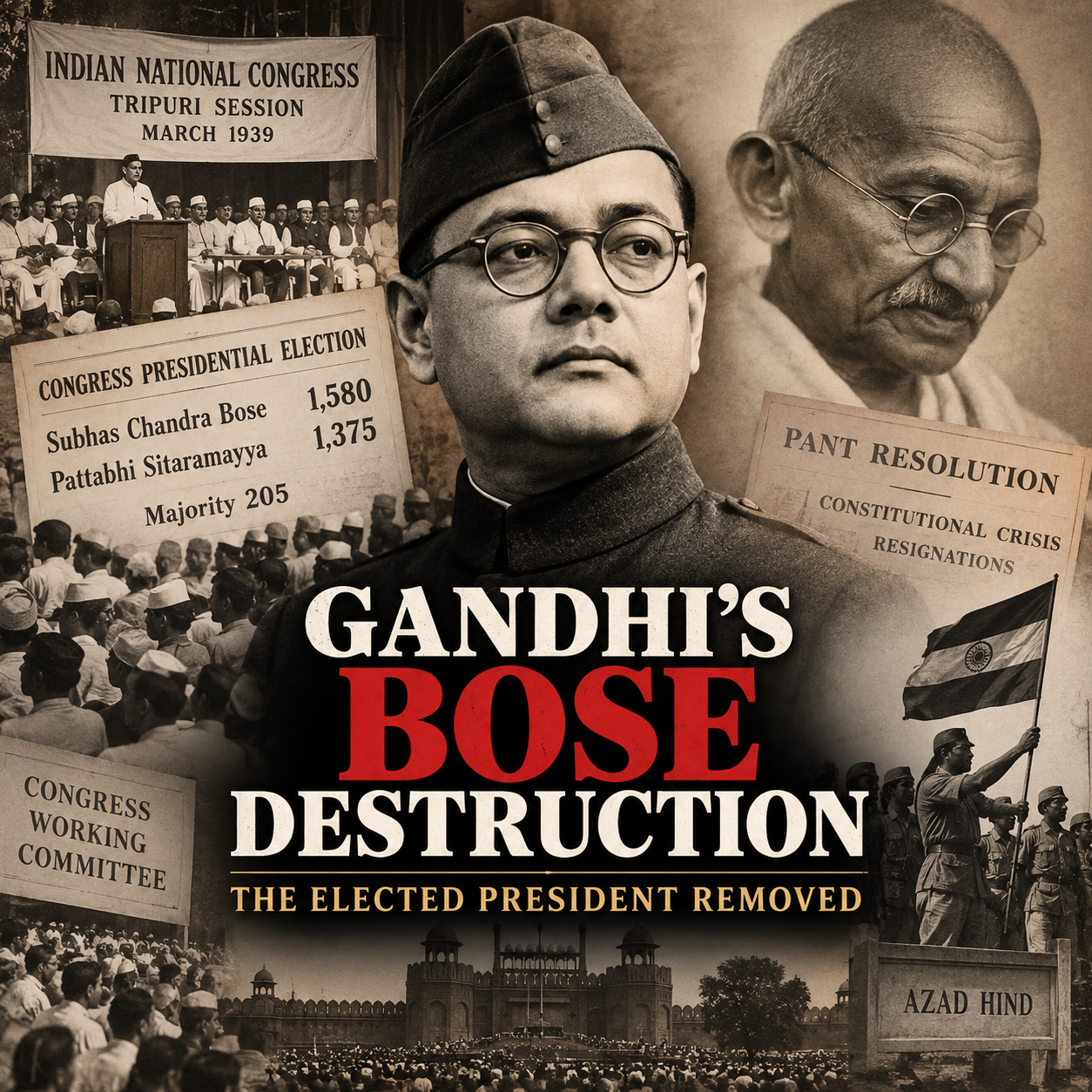
Subhas Chandra Bose stood for re-election as Congress president in January 1939. Gandhi opposed his candidacy — his preference was Pattabhi Sitaramayya. The Congress electoral process proceeded. Bose defeated Sitaramayya by 1,580 votes to 1,375 — a majority of 205 votes across the Congress electorate.
Gandhi’s response: “Sitaramayya’s defeat is my defeat.” He made the outcome a personal matter. The democratic verdict of the Congress electorate became Gandhi’s personal loss.
The Documented Removal
Gandhi’s Bose Destruction places what followed the democratic verdict before the reader.
After Gandhi’s public statement characterising Sitaramayya’s defeat as his own, the pressure on Bose became impossible to sustain.
The constitutional position is placed before the reader precisely. The regular Congress constitutional rule gave the elected president the power to choose his executive — the CWC. Gandhi’s moral veto and personal refusal to cooperate subverted that elected mandate without an impeachment of Bose, without a no-confidence vote against him directly, and without a counter-election.
The prosecution places one further constitutional exhibit before the reader. At the Tripuri session in March 1939, Congress passed the Pant Resolution — a session instruction mandating that the incoming president appoint a Working Committee in accordance with Gandhi’s wishes and commanding his implicit confidence. This was not a standing clause in the Congress constitution. It was a resolution passed specifically to bind this elected president to Gandhi’s approval.
The constitutional trap this created is placed before the reader precisely. The Pant Resolution required the new CWC to command Gandhi’s confidence. When Bose, now president, sought to constitute his executive, Gandhi wrote that he felt “utterly incompetent” to give names under that resolution, and advised Bose to form a committee leaving out those who had resigned. Bose told the AICC that following that advice would breach the Pant Resolution itself — because such a committee would not have Gandhi’s confidence.
Bose could not appoint his own CWC — the Pant Resolution bound the appointment to Gandhi’s confidence. He could not receive names from Gandhi — who refused to provide them. The elected president was paralysed between a session resolution that bound him to Gandhi’s approval and Gandhi’s refusal to exercise that approval.
The mechanism was not the standing Congress constitution. It was a session resolution passed at Tripuri, deployed against Bose, escaped by Gandhi’s refusal to operate it — while Gandhi cited the principle of presidential independence the resolution had already abandoned. The CWC members resigned en masse. The resignations left Bose without a functioning executive. He could not govern Congress without the cooperation of those whose cooperation Gandhi’s displeasure had withdrawn.
Bose resigned as Congress president in April 1939 — less than three months after his democratic election. He formed the Forward Bloc in June 1939 — his response to the impossibility of operating within Gandhi’s framework.
Who Bose Was
Gandhi’s Bose Destruction places Bose’s position before the reader.
Bose had been elected twice — 1938 and 1939. He was the leader of the fighter nationalist wing of Congress. His position: the freedom movement required a deadline ultimatum to the British, backed by the threat of direct action. His method: coordinated pressure, not suspension at the moment of maximum leverage.
Bose’s subsequent record — placed before the reader not as an argument about what might have been, but as what the record shows: the Indian National Army, 45,000 soldiers, reached the border of India, raised the Tricolour at Moirang, Manipur, April 14 1944. The British themselves documented the INA’s psychological impact on Indian soldiers in the British Indian Army as a contributing factor to Britain’s decision to leave India.
Gandhi’s opposition to Bose’s militant readiness was not merely personal — it was ideological and consistent. The same conviction that produced his January 1930 Young India article ‘The Cult of the Bomb’ — establishing that non-violence was the only legitimate instrument — made Bose’s militant orientation a departure Gandhi would not endorse. His 1930 doctrine and his 1939 refusal to let Bose steer the Congress machinery were the same position applied across a decade.
The Documented Pattern
Gandhi’s Bose Destruction places the pattern before the reader alongside the series’ established record.
Blog 155 placed the 1946 succession before the reader: 12 of 15 PCCs backed Patel for the Congress Presidency — the position that carried the mandate to head the Interim Government. Gandhi’s preference determined the outcome. The democratic verdict was set aside by Gandhi’s word.
January 1939: Bose won the democratic election. Gandhi characterised the outcome as his personal defeat. The CWC resigned. Bose was rendered ungovernable without a functioning executive. He resigned three months later.
The prosecution places the two democratic verdicts before the reader: 1939 Bose, 1946 Patel. In both cases the democratic process produced an outcome Gandhi did not prefer. In both cases the outcome was reversed — not by a counter-election, not by impeachment, but through the Tripuri Pant Resolution and Gandhi’s refusal to exercise the approval it had vested in him.
What the Removal Produced
Gandhi’s Bose Destruction places what the removal produced before the reader.
Bose left Congress. He left India. He sought alliances with Axis powers during World War II — a strategic decision the historical record places in context of the desperation of a leader who had exhausted every constitutional option within Gandhi’s framework.
The INA reached India’s border. The Azad Hind government was proclaimed. Bose died August 18 1945 — killed in a plane crash over Taiwan, though the circumstances remain disputed.
The British Indian government put the INA officers on trial at the Red Fort in November 1945 — India was not yet independent, independence coming August 15 1947. The public response was mass outrage. The British were alarmed by Indian Army sympathy for the INA defendants. The trials were abandoned.
The prosecution places before the reader: the man Gandhi removed from the democratic Congress presidency in 1939 became the leader whose soldiers’ trial produced the public outrage that contributed to British departure. The reader examines what the removal and the subsequent record established.
The Prosecution’s Position
Gandhi’s Bose Destruction places three questions before the reader.
- Does Gandhi’s characterisation of Bose’s democratic election victory as his personal defeat — followed by mass CWC resignations that rendered the elected president ungovernable — constitute an exhibit the reader places alongside the 1946 succession, where 12 of 15 PCCs backed Patel and Gandhi’s preference again determined the outcome?
- Does the record of what Bose built outside Gandhi’s framework — the INA, 45,000 soldiers, the border of India, the psychological pressure on British Indian Army loyalty — constitute an exhibit the reader places alongside Gandhi’s instruments and their outcomes across the same period?
- Does the removal of the twice-elected Congress president by Gandhi’s word — without a counter-election, without a constitutional mechanism, through the Tripuri Pant Resolution and Gandhi’s refusal to operate it — constitute an exhibit the reader places alongside the series’ full documented record of Gandhi’s relationship with democratic processes?
The series does not answer. Gandhi’s Bose Destruction places the democratic verdict, the removal, Bose’s subsequent record, and the pattern before the reader. The reader will examine what the removal of the elected president established — and complete the sentence.
Invitation To Defence
The floor belongs to the defense. We now invite them to present their exhibits and challenge the narrative established by the prosecution.
January 1939: Bose elected Congress president — 1,580 to 1,375. Gandhi: “Sitaramayya’s defeat is my defeat.” CWC resigned. Bose rendered ungovernable. April 1939: Bose resigned. June 1939: Forward Bloc formed. 1944: INA soldiers raised the Tricolour at Moirang. 1945: Red Fort trials produced the public outrage that contributed to British departure. The man Gandhi removed from the democratic Congress presidency became the leader whose soldiers’ trial helped end the Raj. The prosecution places the sequence before the reader. The reader will complete the sentence.
Feature Image: Click here to view the image.
Videos
Glossary of Terms
- Democratic Verdict: The outcome produced by a democratic election or voting process, as used in the blog to describe Bose’s 1939 Congress presidential victory and Patel’s 1946 support from the Provincial Congress Committees.
- Pant Resolution: The resolution passed at the Tripuri Congress session in March 1939 that required the newly elected president, Subhas Chandra Bose, to form the Working Committee in accordance with Gandhi’s wishes and with his confidence.
- Working Committee (CWC): The Congress Working Committee, the executive body that the elected Congress president was constitutionally expected to constitute and lead.
- Moral Veto: The influence exercised by Gandhi through his moral authority and refusal to cooperate, which the blog presents as overriding the practical authority of the elected Congress president.
- Presidential Independence: The principle that the elected Congress president should have the authority to constitute and operate his executive without being dependent on Gandhi’s approval.
- Constitutional Deadlock: The situation created when Bose was required to form a Working Committee acceptable to Gandhi while Gandhi refused to provide the names or cooperation needed to form it.
- Forward Bloc: The political group formed by Subhas Chandra Bose in June 1939 after his resignation from the Congress presidency.
- Indian National Army (INA): The army associated with Subhas Chandra Bose that had about 45,000 soldiers and reached India’s border during the Second World War.
- Azad Hind Government: The provisional government proclaimed under Bose during the Second World War in association with the Indian National Army.
- Moirang: A place in Manipur where INA soldiers raised the Tricolour on April 14, 1944, an event highlighted in the blog as part of Bose’s subsequent record.
- Red Fort Trials: The trials of INA officers conducted by the British Indian government at the Red Fort beginning in November 1945, which generated widespread public outrage.
- British Indian Army: The army of British India whose Indian soldiers’ loyalty and reactions to the INA are discussed in the blog in connection with the psychological impact of the INA.
- Leadership Succession: The process of determining who would assume Congress leadership, used in the blog in reference to the 1946 contest in which 12 of 15 Provincial Congress Committees supported Patel.
- Gandhi’s Bose Destruction: The key phrase used by the blog for its examination of Bose’s election as Congress president in 1939, the subsequent constitutional deadlock, his resignation, and the consequences that followed.
- Invitation to Defence: The closing section of the prosecution framework that invites the defence to present its evidence and challenge the narrative established by the prosecution.
#Bose #Gandhi #Congress #INA #India #Freedom #History #Politics #HinduinfoPedia
Scan Through The Entire Series at
Gandhi’s Peace Efforts: The Questions Before the Mahatma (0)
Refer to Various Arks Referred to in the Blog