
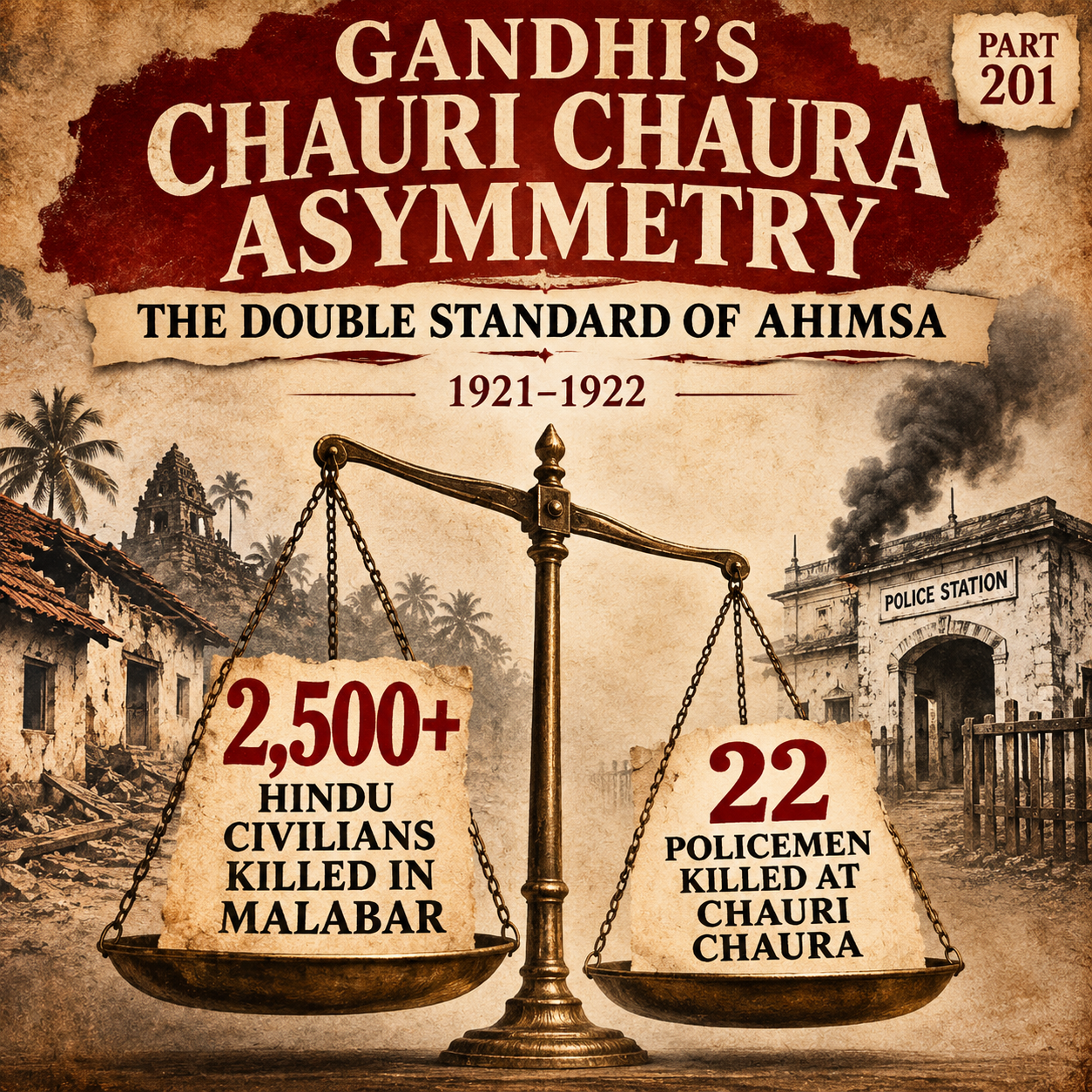
Gandhi’s Chauri Chaura Asymmetry: Over 2,500 Dead in Malabar vs. 22 Colonial Police Deaths (201)
भारत / GB
Part 201: Mahatma Gandhi’s Peace Efforts | Series Index
This series has been building to this event for two hundred blogs. Blog 54 placed the Malabar detonation before the reader — over 2,500 Malabar Hindu non-combatants killed, thousands forcibly converted, tens of thousands displaced, the Non-Cooperation Movement continuing without pause. Blog 196 documented the detonation in full. Blog 197 documented the managed narrative that followed. Blog 198 assembled the full cast, the seven stop points, and the design that made the detonation possible. Blog 200 placed the nine-pillar consolidated indictment before the reader. This blog documents what happened eleven days after Gandhi’s arrest was ordered — an event that did what 2,500 Hindu deaths did not do, and stopped a national movement in its tracks within nine days.
Thank you for reading this post, don't forget to subscribe!THE ARITHMETIC OF AHIMSA
The motive: On 4 February 1922 at Chauri Chaura, Gorakhpur District, United Provinces, a crowd of Non-Cooperation Movement protesters clashed with local police. The police fired on the crowd. The crowd retaliated. The Chauri Chaura police station was burned. Twenty-two colonial policemen — Indian constables serving the British administration — were killed.
The apparatus: Gandhi announced the suspension of the entire Non-Cooperation Movement on 12 February 1922. The movement that had been built over two years, that had mobilised millions, that had been sold to the country as the vehicle for Swaraj in one year — was halted unilaterally within nine days of twenty-two deaths. No Working Committee resolution preceded the suspension. Gandhi announced it on his own authority at Bardoli.
The Afghan pact: The movement had not been halted six months earlier, when over 2,500 Malabar Hindus — non-combatants, not armed police — were killed in the same Non-Cooperation calendar year, in an uprising directly connected to the Khilafat apparatus Gandhi had built, financed, and legally protected. Gandhi’s Chauri Chaura asymmetry is the name the prosecution gives to that arithmetic. This blog places it on the record.
The Background: What the Movement Had Already Survived
To understand what Gandhi’s Chauri Chaura asymmetry means in full, the reader requires the sequence that preceded it. The programme the country came to call the Non-Cooperation Movement did not originate with Gandhi. It originated as Tark-e-Mawalat — non-cooperation with the colonial government — a programme the Khilafat leadership had formulated as a religious obligation in defence of the Caliphate. Gandhi adopted the framework wholesale at the Calcutta Congress in September 1920, renamed it, presented it as his own strategic instrument, and had it ratified at the Nagpur session in December 1920. The vehicle that resulted was a fusion of Congress organisational machinery with the Khilafat movement’s religious apparatus. The terms of that fusion — who built it, who financed it, and what it produced — have been documented across this series. The result was a mass mobilisation unlike any India had seen, and the first sustained instance in which the Indian National Congress placed itself organisationally in service of a programme that originated outside its own constitutional tradition.
By August 1921, the bomb Gandhi had built had produced its first catastrophic output in Malabar. The Moplah uprising — documented in full at Blog 54 and Blog 196 — killed over 2,500 Hindu non-combatants. Thousands more were forcibly converted. Tens of thousands were displaced from their homes. The Khilafat Volunteer Corps, which the Congress apparatus had endorsed and provided political cover for, was at the centre of the operational machinery that produced those outcomes.
Gandhi’s response to Malabar was documented at Blog 197: a curated, nominal disapproval framed as “Moplah madness” that stopped well short of genuine condemnation; deflection of the blame onto British provocation and official secrecy; praise of the perpetrators as “brave, god-fearing men” fighting for what they believed to be religion; calculated silence on every prior warning; and the seamless continuation of the Non-Cooperation Movement without pause, inquiry, or reckoning. of the violence as “Moplah madness”; attribution of the cause to British provocation and “total ignorance” kept by the administration; description of the perpetrators as “brave God-fearing men”; silence on every prior warning channel; and continuation of the Non-Cooperation Movement without any suspension, any inquiry, or any internal reckoning with the apparatus that produced the detonation.
Between August 1921 and February 1922, the movement pressed ahead, having absorbed the Malabar detonation without breaking stride. But once Gandhi abruptly halted the campaign at Bardoli, the British administration recognized that his mass leverage had evaporated. Seeing the movement dismantled and its cadres demoralized by Gandhi’s own hand, the government finally moved in to arrest him.
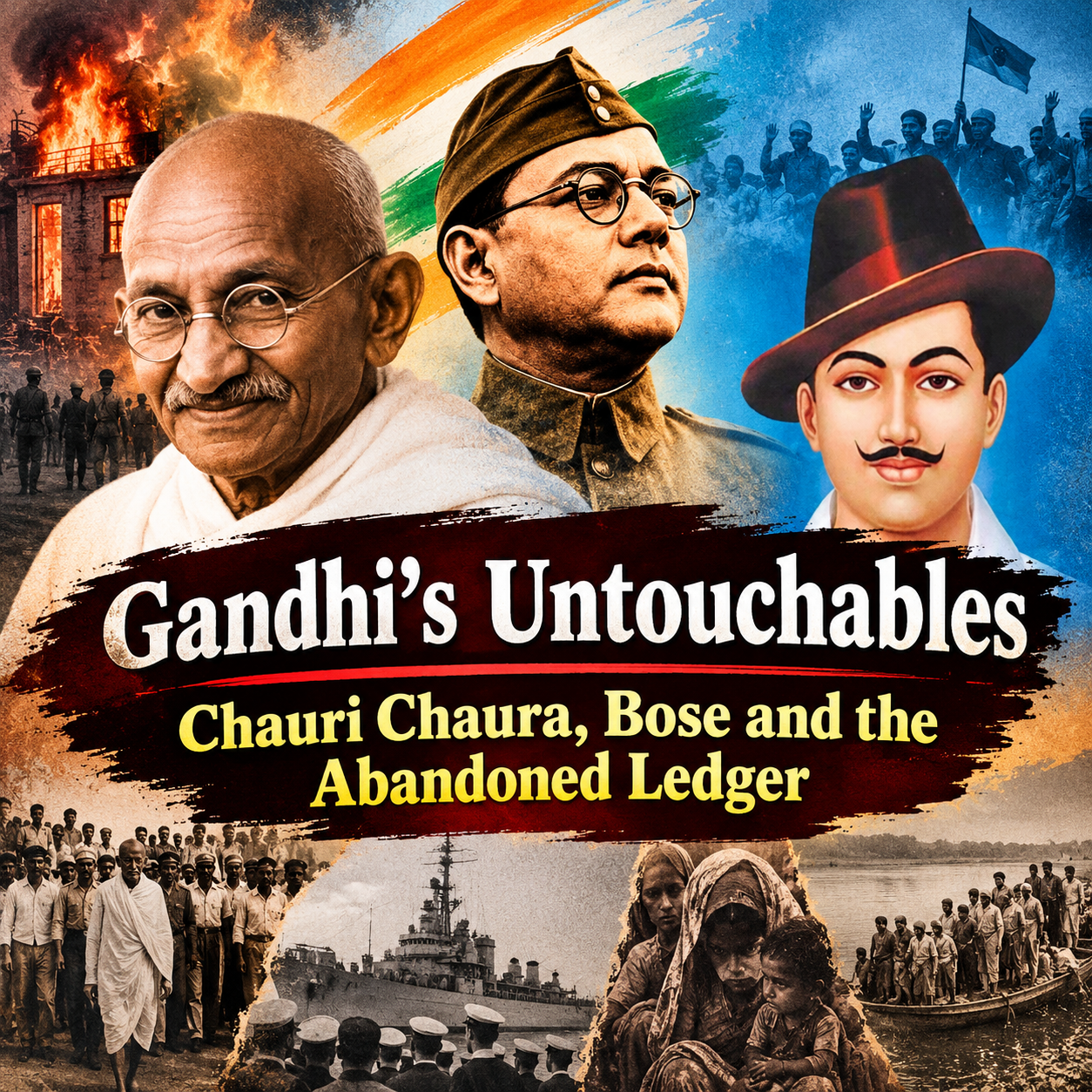
4 February 1922: The Incident at Chauri Chaura
Chauri Chaura is a market town in Gorakhpur District, United Provinces (present-day Uttar Pradesh). On 4 February 1922, a procession of Non-Cooperation Movement volunteers marched through the town. The procession was part of the mass civil disobedience campaign Gandhi had been orchestrating from Bardoli, in the Surat district of Gujarat, where he had been planning a campaign of intensified non-cooperation.
The British administrative record on Chauri Chaura does not begin on 4 February 1922. The district record shows that the Sub-Inspector of Police at Chauri Chaura had filed reports of a deteriorating situation in the preceding days. The volunteers had been conducting picketing of a local bazaar; the Sub-Inspector had been warned that the gathering was building in size and temper. That official alarm is in the British record before the incident occurred. It was not acted upon with the urgency the situation required.
On the day itself, the procession reached the local police station. The Sub-Inspector and a small number of constables confronted the crowd. The British record confirms that the police fired on the crowd — killing at least three marchers and wounding others. The crowd, which numbered in the hundreds, retaliated. The police retreated into the station. The crowd set the station on fire. Twenty-two Indian constables — men serving the British administration — were trapped inside and killed. Some were killed attempting to flee the flames.
The Chauri Chaura police station was not a symbol of alien colonial power staffed by British officers. The twenty-two men who died were Indian constables — from the same communities that had been supplying the Non-Cooperation Movement with its volunteers. This fact is part of the documented arithmetic of Gandhi’s Chauri Chaura asymmetry: the deaths that halted the national movement were the deaths of Indian policemen, not of British commanders.
Gandhi’s Response: The Bardoli Suspension
Gandhi’s response to Chauri Chaura was immediate and total. He announced, on his own authority and without prior Working Committee consultation, that the entire Non-Cooperation Movement would be suspended. The announcement came at Bardoli on 12 February 1922 — eight days after the incident.
Gandhi cited the Chauri Chaura violence as proof that the country was not ready for Swaraj — that Indians had not yet absorbed the discipline of Ahimsa. The phrase “Himalayan miscalculation” was Gandhi’s own, coined earlier in the context of the Rowlatt Act agitation of 1919, where he used it to describe the violence that had attended that campaign. He returned to the same framework in February 1922: a single incident of violence, in a single district, was cited as evidence that millions of Indians who had organised, marched, fasted, gone to jail, and bankrupted their families for the movement were spiritually unready. The logic was explicit. The movement stood down.
The formal instrument was the Bardoli Resolution, passed by the Congress Working Committee on 11–12 February 1922. The resolution suspended civil disobedience across the country. The planned Bardoli campaign — which Gandhi had been preparing as the centrepiece of the movement’s next phase — was called off. The Non-Cooperation Movement, as a mass mobilisation, effectively ended at that point. Gandhi was arrested by the British authorities on 10 March 1922. He was tried by Judge Broomfield and sentenced to six years’ imprisonment on 18 March 1922. He was transferred to Yerwada Jail in Pune.
The reaction among the nationalist leadership was immediate and severe. Approximately 30,000 Indians were in British jails on the day of the suspension — students, lawyers, merchants, and farmers who had gone to prison voluntarily for the movement. They were not consulted. They learned of the suspension after it was announced. Subhas Chandra Bose, writing from his own political experience, termed Gandhi’s sudden retreat a “national calamity.” Jawaharlal Nehru, in jail, recorded his “amazement and consternation” — he could not understand why a nationwide mass movement should be halted for an isolated incident in a single village. C.R. Das condemned the decision from his prison cell in Calcutta, calling it the “greatest blunder of his political life.” Motilal Nehru and Lala Lajpat Rai sent furious letters from prison opposing the suspension. The British administration made no commitment in return: not a single prisoner was released, not a single concession granted. The resolution was passed nonetheless. Gandhi’s authority admitted no institutional check.
The Aftermath: 172 Volunteers, the Gallows, and Malaviya
The human consequence of Chauri Chaura fell on those who had marched. One hundred and seventy-two Non-Cooperation Movement volunteers — peasants and labourers from Gorakhpur District who had organised under the banner Gandhi had raised — were tried for their role in the incident. They faced the gallows.
As documented at Blog 175, the Congress high command that had mobilised these men treated their defence as the wrong kind of problem. It was Pandit Madan Mohan Malaviya — not Gandhi, not the Working Committee — who entered the Allahabad High Court and fought their cases. Malaviya’s legal intervention saved over 150 of the 172 from the gallows.
Gandhi did not appear in court for the Chauri Chaura accused. He issued no public pledge to fight for their rights. The contrast with his later conduct is in the documented record: when Swami Shraddhanand was murdered in December 1926 by Abdul Rashid, Gandhi publicly described the killer as “brother Abdul Rashid” from the Congress platform at Gauhati — extending moral protection to the perpetrator. No equivalent public solidarity was extended to the 172 peasants who had marched under his banner and faced the gallows. The movement that had recruited them, mobilised them, and given their march political legitimacy did not mount their legal defence. The 172 men who faced hanging were the ones who paid the human price of Gandhi’s Chauri Chaura asymmetry — the men whose march Gandhi had cited as the reason the country was spiritually unready for Swaraj, abandoned to the gallows by the movement that had recruited them.
The Asymmetry: What the Record Shows
Gandhi’s Chauri Chaura asymmetry is not an inference. It is an arithmetic that the documented record places before the reader in two columns.
Column one — Malabar, August–December 1921: Over 2,500 Hindu non-combatants killed. Thousands forcibly converted. Properties seized; temples desecrated and destroyed; lands taken from Hindu families who fled or were driven from their homes. Tens of thousands displaced across the district. After the British reimposed order, thousands of Moplah participants and sympathisers were punished under colonial law — imprisoned, transported, or subjected to collective fines — while the Hindu families whose properties had been appropriated received no organised restitution. The apparatus that produced these outcomes was directly connected to the Khilafat movement Gandhi had built, financed, and legally protected. Gandhi’s Ahimsa doctrine had been explicitly overridden by the Moplah clergy in sermons documented before the detonation. Seven stop points at which the movement could have been halted — documented at Blog 198 — all passed. The Non-Cooperation Movement: continued without pause.
Column two — Chauri Chaura, February 1922: Twenty-two colonial police constables killed in one incident in one district. No prior warning record of the specific location. No apparatus built by Gandhi directly connected to the specific event. The Non-Cooperation Movement: suspended within nine days. Nationally. Unilaterally. Citing Ahimsa.
The same doctrine — Ahimsa — was available to Gandhi in August 1921, when over 2,500 Malabar Hindus were being killed by an apparatus his movement had built and protected. It was not invoked as grounds for suspension in August 1921. It was invoked as grounds for suspension in February 1922, when twenty-two colonial policemen died.
The prosecution does not, in this blog, argue the conclusion. The argument is reserved for Blog 301, the fixed climax slot of 11 January 2027. This blog places the documented record before the reader: the sequence, the dates, the numbers, the stated reasons, and the institutional consequences. The reader will complete the arithmetic.
What the Suspension Did Not Do
The Bardoli suspension ended mass mobilization, but left the communal apparatus intact. The Khilafat Volunteer Corps was never formally disbanded, the All-India Khilafat Committee remained active, and the Jamiat Ulema-e-Hind—the theological backbone of the agitation—became a permanent political institution. The clerical networks and Tanzim formations that had openly cast aside Ahimsa in Malabar were never audited, dissolved, or held accountable by the Congress leadership. Instead, the religious separatism brought into mass politics was permanently legitimized.
The aspiration for the application of religious law, which the Khilafat movement had placed at the centre of Indian Muslim political identity, was not decommissioned when the movement ended. It was institutionalised. It was later given a constitutional guarantee of non-interference through the Nehru–Liaquat Pact of 1950, which settled the framework for how the new Indian state would relate to its Muslim minority — a settlement that the clerical tradition Gandhi had empowered was well-positioned to shape.
What collapsed was the common Indian’s investment. The movement had been launched with the grand pledge of “Swaraj within one year,” funded by everyday citizens who contributed their ornaments, paid four-anna fees, and boycotted institutions. Over ₹1.2 crore was raised under the Tilak Swaraj Fund to deliver that promised freedom. When Gandhi unilaterally called off the agitation, approximately ₹60 to ₹80 lakh remained unaccounted for—neither audited for the public nor returned to the donors who had financed the struggle. Instead, millions were handed the verdict of another “Himalayan miscalculation” and told to go home. Having committed the identical strategic error for the second time in three years, Gandhi offered no accounting, no return of public funds, and no promise that he would not repeat the blunder a third time.
Gandhi was imprisoned in March 1922 and released on health grounds in February 1924. The years 1922–1924 are the years this series documents next — in which Gandhi’s Chauri Chaura asymmetry began to produce its own residue: the Caliphate’s abolition by Atatürk in March 1924, the exposure of the Khilafat movement as a vehicle that had served a cause that no longer existed, the Ali brothers’ repudiation of Gandhi, and the first urban communal pogroms of the post-Khilafat era. Those events are documented in subsequent blogs.
Invitation To Defence
The documented record is before the reader. The movement that survived 2,500 Hindu deaths in Malabar did not survive twenty-two police deaths at Chauri Chaura. The same man cited the same doctrine in both cases. If the application of Ahimsa was consistent — if the suspension at Bardoli and the continuation through Malabar reflect the same principle applied to the same standard — the defence is invited to show the reader where that standard is written and how it produces the arithmetic before them.
“Over 2,500 Malabar Hindus killed: the movement continued. Twenty-two colonial police constables killed at Chauri Chaura: the movement suspended. One hundred and seventy-two peasant volunteers faced the gallows. Malaviya saved them. Gandhi called it a bitter humiliation and went to Yerwada. The arithmetic is in the record. The argument is reserved for later blogs. The reader will hold the two columns side by side.”
Feature Image: Click here to view the image.
Videos
Glossary of Terms
1. Gandhi’s Chauri Chaura Asymmetry: A term coined in this series to describe the contrast between Gandhi’s decision to continue the Non-Cooperation Movement after over 2,500 Hindu non-combatants were killed in Malabar and his decision to suspend the entire movement within nine days of the deaths of twenty-two Indian colonial police constables at Chauri Chaura.
2. Non-Cooperation Movement: A nationwide political movement launched under Gandhi’s leadership in 1920, involving the boycott of British institutions, educational establishments, courts, and government services, with the stated objective of achieving Swaraj.
3. Tark-e-Mawalat: A programme of non-cooperation with the colonial government formulated by Khilafat leaders and presented as a religious obligation in defence of the Caliphate. It provided the original framework subsequently adopted by Gandhi for the Non-Cooperation Movement.
4. Khilafat Movement: A political and religious agitation launched by Indian Muslim leaders to defend the Ottoman Caliphate after the First World War. It became organisationally connected with the Indian National Congress through Gandhi’s adoption of its non-cooperation programme.
5. Ahimsa: The principle of non-violence, central to Gandhi’s political philosophy. In this blog, it is examined in the context of the contrasting responses to the Malabar uprising and the Chauri Chaura incident.
6. Swaraj: Self-rule or independence from colonial authority. Gandhi popularised the promise of achieving Swaraj within one year as a central objective of the Non-Cooperation Movement.
7. Bardoli Resolution: The resolution passed by the Congress Working Committee on eleven and twelve February 1922, suspending civil disobedience across the country following the Chauri Chaura incident.
8. Working Committee: The principal executive body of the Indian National Congress responsible for organisational and political decisions. The blog highlights the absence of prior consultation with this body before Gandhi announced the suspension of the movement.
9. Khilafat Volunteer Corps: An organised volunteer formation associated with the Khilafat Movement. According to the blog, its cadres were connected with the operational machinery of the Malabar uprising and had received political protection from the Congress apparatus.
10. Moplah Uprising: The uprising that began in Malabar in August 1921 and involved widespread violence against Hindu civilians, including killings, forced conversions, destruction of temples, property seizures, and mass displacement.
11. Tanzim: Organised religious and community mobilisation networks associated with the political and clerical formations discussed in the blog. The author argues that these networks were not subjected to institutional accountability after the Malabar violence.
12. Jamiat Ulema-e-Hind: An organisation of Islamic religious scholars that became an influential political institution during the Khilafat period. The blog describes it as the theological backbone of the agitation and examines its continued political relevance.
13. Himalayan Miscalculation: Gandhi’s expression for a major strategic error arising from the violence associated with a political campaign. He invoked this reasoning in connection with the Rowlatt agitation and again following the Chauri Chaura incident.
14. Tilak Swaraj Fund: A public fund established during the Non-Cooperation Movement to finance the national struggle for Swaraj. The blog refers to contributions exceeding one crore and twenty lakh rupees and raises questions about the accounting of the remaining funds after the movement was withdrawn.
15. National Calamity: The expression used by Subhas Chandra Bose to describe Gandhi’s sudden withdrawal of the Non-Cooperation Movement. It reflects the opposition among sections of nationalist leadership to the unilateral suspension.
#Gandhi #ChauriChaura #Malabar #IndianHistory #Khilafat #NonCooperation #Ahimsa #Swaraj #Congress #HinduHistory #BritishIndia #HinduinfoPedia
Scan Through The Entire Series at