
Gandhi’s Unity Lala Land: Partition Evidence Rejected by Gandhi (224)
भारत / GB
Part 224: Mahatma Gandhi’s Peace Efforts (Replication Wave + Financial Audit) | Series Index
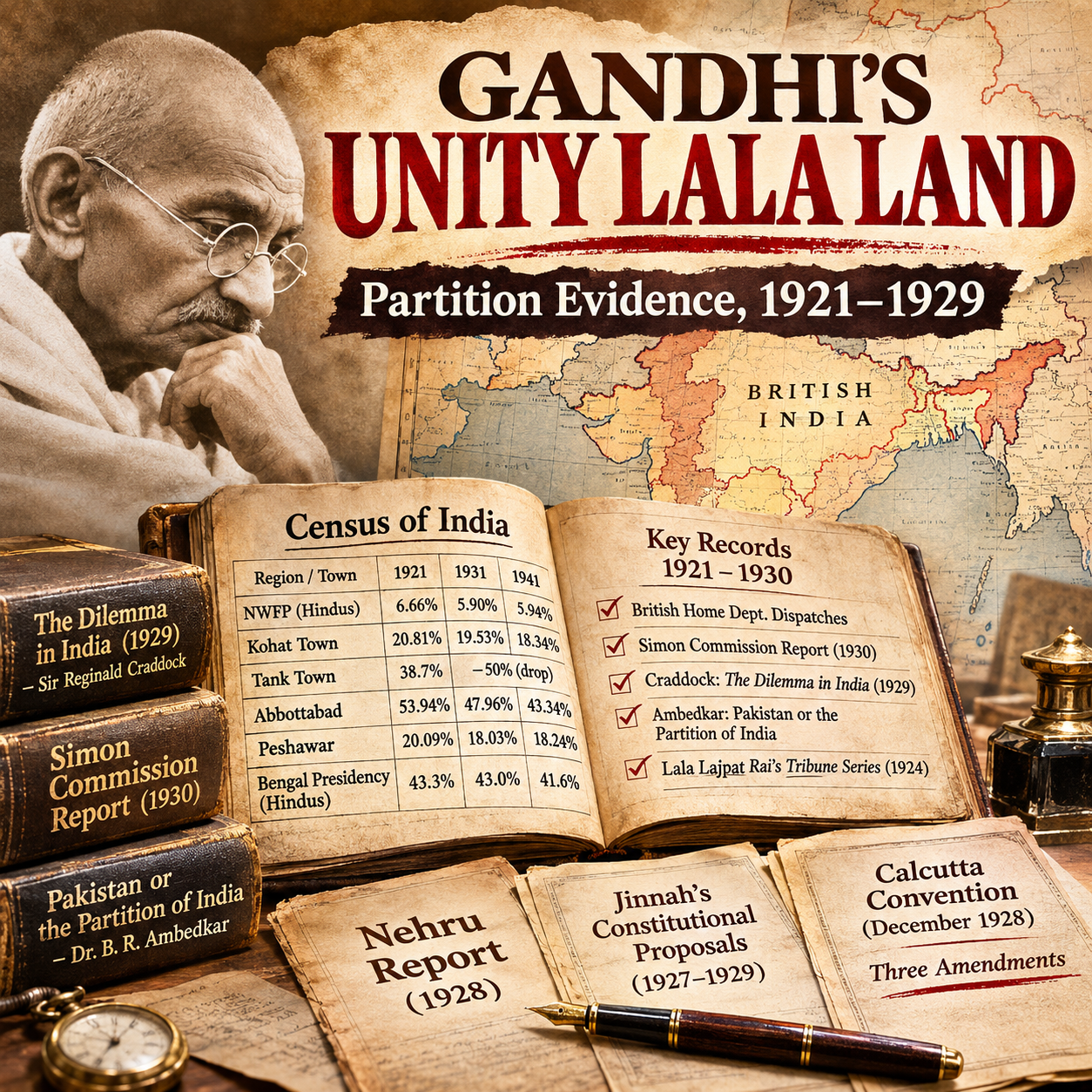
Blog 223 documented how Gandhi’s Partition began in 1924 on the streets — through over 35 communal attacks across 1922–1924, Kohat’s Rs. 9 lakh property wipeout, distress real-estate liquidations, and Gandhi’s February 1925 non-return condition. This instalment places the hard Census tables, British parliamentary and ICS records, and Indian primary authorships on the table: between 1921 and 1929, both foreign administrators and Indian leaders documented the demographic contraction and territorial rupture in black and white, yet Gandhi kept Hindus and the entire Indian public inside Gandhi’s unity lala land while Congress rejected every settlement as Muslim demands narrowed from ~30 points to the Madras/14-point framework and finally just 3 amendments at Calcutta in December 1928.
THE HARD HISTORIOGRAPHICAL RECORD: 1921–1929
The Action Taken: Official Census of India volumes (1921, 1931, 1941), British Home Department dispatches, the 1930 Simon Commission Report, Sir Reginald Craddock’s The Dilemma in India (1929), Dr. B.R. Ambedkar’s Pakistan or the Partition of India, and Lala Lajpat Rai’s 1924 Tribune series all recorded that India was fracturing demographically and territorially in the 1920s. Gandhi read these reports and knew the numbers, yet kept Hindus and the electorate hypnotised by unity slogans while refusing every settlement — as Muslim demands shrank from ~30 early-1920s points to the 1927–1929 14-point framework and down to just 3 core amendments at the December 1928 Calcutta Convention.
Who Paid the Price: Hindus and the entire Indian population — kept inside an artificial unity narrative without demographic warning or constitutional safeguards while realistic power-sharing deals were voted down in 1928, leaving millions unprotected when territorial Partition hit in August 1947.
Why This Matters: Partition was neither unforeseen nor sudden. Hard Census numbers, British administrative reports, and Indian primary texts prove it was visible by 1924 — and sealed politically when Congress rejected even three minimal amendments at Calcutta in December 1928.
1. Foreign and British Primary Authorship: What Official Records Documented (1921–1930)
Contemporary British administrators and parliamentary inquiries recorded the post-Khilafat rupture as an irreversible structural shift in Indian politics long before the 1940 Lahore Resolution:
-
- 1921 Malabar “Khilafat Kingdoms” (Government of India Home Department Records): Official dispatches compiled under Home Member Sir William Vincent and Madras Governor Lord Willingdon documented that Ali Musaliar and Variyamkunnath Kunjahammed Haji dismantled British and Hindu civic authority across Ernad and Walluvanad in August 1921 and proclaimed parallel Khilafat Raj rule — the first armed territorial secession of the twentieth century.
- Sir Reginald Craddock — The Dilemma in India (1929): Drawing on decades as Home Member of the Viceroy’s Executive Council and Governor of Burma, Craddock documented that Gandhi’s Khilafat alliance had shattered pre-1920 civic cooperation and created two irreconcilable political nations on Indian soil, as documented in our Blog 183.
- Indian Statutory (Simon) Commission Report, Vol. 1 (1930): Parliamentary commissioners tabulated over 112 major communal riots between 1921 and 1927 (resulting in ~450 deaths and over 5,000 injuries in major outbreaks alone), concluding officially that the struggle in India had shifted from anti-British constitutional reform to a contest for territorial and political dominance between Hindus and Muslims.
- Sir Penderel Moon — Divide and Quit (1961): A senior Indian Civil Service (ICS) officer serving in Punjab from 1929 onward, Moon traced the administrative breakdown of 1947 directly back to the communal polarisation and failed constitutional bargains of the 1920s.
Every major foreign administrative record between 1921 and 1930 treated India’s communal fracture as an established operational fact — standing in direct contradiction to Gandhi’s unity lala land.
2. Hard Census Evidence (1921 → 1931 → 1941): The Demographic Contraction on Paper
The decennial Census of India reports for 1921, 1931, and 1941 provide hard quantitative proof of how the 1920s violence altered the demographic map before Partition:
| Region / Town | 1921 Census | 1931 Census | 1941 Census & Structural Trend |
|---|---|---|---|
| NWFP (Whole Province — Hindus) | 149,881 (6.66%) | 142,977 (5.90%) | Absolute population drop of 6,904 in 1921–31 after Kohat & 1930 unrest; consolidated into cantonments by 1941 (180,321 / 5.94%) before collapsing to 2,432 in 1951. |
| Kohat Town (NWFP) | 20.81% Hindu (down from 25.46% in 1901) |
19.53% Hindu | 18.34% Hindu — continuous four-decade share erosion following the September 1924 expulsion of ~3,500 residents. |
| Tank Town (D.I. Khan Frontier) | 4,197 Hindus (38.7%) | 2,244 Hindus | Nearly 50% Hindu collapse in a single decade after exposed Frontier bazaar raids and distress departures. |
| Abbottabad & Peshawar (NWFP) | Abbottabad: 53.94% Peshawar: 20.09% |
Abbottabad: 47.96% Peshawar: 18.03% |
Abbottabad fell to 43.34% by 1941; Peshawar stood at 18.24% as surviving mercantile families clustered inside garrisoned cities. |
| Bengal Presidency (Hindus) | 43.3% Hindu | 43.0% Hindu | Dropped to 41.6% in 1941, with steeper drops across rural East Bengal districts (Bogra, Noakhali, Tippera). |
These official Census tables prove two facts simultaneously: exposed Frontier and rural minorities contracted sharply between 1921 and 1931, while surviving urban business families concentrated inside British-garrisoned hubs until August 1947 — a demographic warning completely erased inside Gandhi’s unity lala land.
3. Indian Primary Authorship: Ambedkar, Lajpat Rai, and Shraddhanand (1921–1940)
Indian thinkers across the political spectrum published detailed primary audits between 1921 and 1940 proving that Gandhi knew the scale of the fracture and refused to act on it:
-
- Maulana Hasrat Mohani (December 1921 Ahmedabad Congress): Openly tabled a separate Muslim-zone / federated autonomy framework inside the Congress session itself (Blog 218) — proving territorial separatism was articulated on Gandhi’s own platform nineteen years before the 1940 Lahore Resolution.
- Swami Shraddhanand — Hindu Sangathan: Saviour of the Dying Race (1924): Compiled district-by-district demographic and riot records showing Hindu population stagnation and forced departures across north India, warning Gandhi directly in letters and print.
- Lala Lajpat Rai — The Hindu-Muslim Problem (The Tribune, Nov–Dec 1924): In thirteen documented articles, Lajpat Rai concluded that clerical mobilisation had destroyed the basis for a unitary state and explicitly proposed partitioning Punjab into a Muslim-majority western province and a non-Muslim eastern province, with parallel division in Bengal.
- Dr. B.R. Ambedkar — Pakistan or the Partition of India (1940 / 1945): Audited the 1920–1940 riot ledgers and reproduced Lajpat Rai’s 1924 partition map verbatim, indicting Gandhi for treating an undeclared communal civil war as a temporary misunderstanding curable by fasts and unity slogans.
Gandhi read The Tribune, debated Lajpat Rai, received Shraddhanand’s letters, and saw the riot figures — proving he was never ignorant of the facts when he kept the nation inside Gandhi’s unity lala land.
4. The Shrinking Settlement Funnel for United India From 30 to 3
Placing the December 1920 Nagpur baseline alongside the subsequent constitutional negotiations exposes the full trajectory of Congress’s failure — starting from zero communal partition demands before Gandhi’s Khilafat experiment, escalating to ~30 demands after the post-Khilafat rupture, and then refusing to settle even as Jinnah narrowed Muslim League terms down to 14 points and finally just 3 amendments:
-
- Stage 0 — December 1920 Nagpur Baseline (0 Partition or Veto Demands): When Congress met at Nagpur in December 1920, there were zero demands for separate Muslim zones, provincial vetoes, or territorial division; it was Gandhi’s decision to fuse Congress with pan-Islamic Khilafat clericalism that legitimised separate religious-political sovereignty.
- Stage 1 — Early-to-Mid 1920s Post-Khilafat Explosion (~30 Points): Once Khilafat mobilisation fractured civic trust and collapsed into the 1922–1924 riots, Muslim organisations tabled roughly thirty overlapping religious, educational, linguistic, provincial, and weightage demands (including the May 1924 Lahore Muslim League resolutions and All-Parties Conference submissions).
- Stage 2 — 1927 Delhi–Madras Compromise & Jinnah’s 14 Points: In March 1927 (Delhi Muslim Proposals), Jinnah offered to abolish separate electorates in exchange for joint electorates with reserved seats in Punjab and Bengal, 1/3rd central legislature representation, and provincial status for Sindh and NWFP — a deal ratified by the December 1927 Madras Congress, repudiated eight months later by the August 1928 Nehru Report, and subsequently codified by Jinnah into his 14 Points (March 1929).
- Stage 3 — December 1928 Calcutta Convention (Just 3 Core Amendments): At the December 1928 All-Parties Convention in Calcutta, Jinnah stripped his entire position down to just three amendments to the Nehru Report: (1) 1/3rd Muslim seats in the Central Legislature, (2) population-based seats in Punjab and Bengal for ten years pending adult franchise, and (3) residuary powers vested in the provinces. All three were voted down — prompting Jinnah’s verdict: “This is the parting of the ways.”
Refusing to settle as demands compressed from ~30 points to the 14-point Madras framework and finally down to just 3 amendments at Calcutta proved that Gandhi’s unity lala land blocked every constitutional exit before 1940.
Modern Parallel
The political formula behind Gandhi’s unity lala land — coining a hypnotic mass slogan to keep the Indian electorate pacified while refusing to execute the concrete institutional changes required to solve the crisis — became Congress’s standard playbook after 1947. In 1971, Indira Gandhi won a landslide on the slogan “Garibi Hatao” (“Abolish Poverty”), followed in July 1975 by the heavily promoted 20-Point Programme — yet neither dismantled the Licence Raj stranglehold or delivered structural poverty eradication, leaving mass deprivation intact while the slogan secured political monopoly. Just as “Garibi Hatao” and the 20-Point Programme substituted catchphrases for real economic reform, Gandhi’s unity slogans substituted theatrical fasts for binding constitutional settlements.
Read together with Blog 223, the Census tables, British parliamentary records, and Indian primary texts leave zero ambiguity. Partition was documented in numbers and print between 1921 and 1929 — yet by keeping Hindus and the entire Indian population inside Gandhi’s unity lala land and rejecting every settlement from ~30 points to 14 and finally just 3 Calcutta amendments, Congress left the country unguarded for August 1947.
Invitation To Defence
The Census of India reports (1921, 1931, 1941), the 1930 Simon Commission Report, Sir Reginald Craddock’s The Dilemma in India (1929), Lala Lajpat Rai’s 1924 Tribune series, Dr. B.R. Ambedkar’s Pakistan or the Partition of India, and the December 1928 Calcutta All-Parties Convention records are all established primary sources. The defence is invited to explain why Gandhi kept the Indian public inside an unbroken unity narrative while refusing to back even Jinnah’s three-amendment compromise at Calcutta in December 1928 — when separate electorates could still have been abolished within a united India.
Official Census tables (1921–1941), British Home Department and Simon Commission reports, Dr. B.R. Ambedkar, Lala Lajpat Rai, and Swami Shraddhanand all recorded between 1921 and 1929 that India was fracturing demographically and territorially. Yet Gandhi kept Hindus and the entire Indian population inside Gandhi’s unity lala land — rejecting every settlement as demands narrowed from ~30 early-1920s points to the Madras/14-point framework and finally just 3 amendments at Calcutta in December 1928.
Feature Image: Click here to view the image.
Videos
Glossary of Terms
1. Census of India: The official decennial population survey of British India, providing demographic figures and regional population statistics for 1921, 1931, and 1941.
2. Khilafat Raj: The parallel system of rule reportedly proclaimed by Ali Musaliar and Variyamkunnath Kunjahammed Haji in parts of Malabar during the August 1921 uprising.
3. Home Department Dispatches: Official British administrative communications documenting political developments, disturbances, and governance conditions in colonial India.
4. Indian Civil Service (ICS): The administrative service that governed British India and provided senior officials responsible for provincial and central administration.
5. Simon Commission Report: The 1930 report of the Indian Statutory Commission examining India’s constitutional and political conditions, including communal disturbances.
6. Demographic Contraction: A reduction in the population or population share of a particular community in a specified geographical area over time.
7. Territorial Rupture: The breakdown of an integrated political or geographical arrangement through growing demands for separate territorial or political authority.
8. Tark-e-Mawalat: A form of social and economic boycott involving the withdrawal of commercial and social cooperation, discussed in the blog in connection with the disruption of Hindu–Muslim trade networks.
9. Hindu Sangathan: A movement advocating Hindu social organisation and consolidation, associated in the blog with Swami Shraddhanand’s writings and demographic warnings.
10. Delhi Muslim Proposals: Constitutional proposals presented by Muslim leaders in 1927, under which Jinnah offered to accept joint electorates in exchange for specified political and provincial safeguards.
11. Nehru Report: The 1928 constitutional proposal prepared under Motilal Nehru’s chairmanship, recommending a framework for self-government and addressing questions of representation and federal arrangements.
12. Jinnah’s Fourteen Points: Fourteen constitutional demands formulated by Muhammad Ali Jinnah in March 1929, covering Muslim political representation, provincial autonomy, and safeguards within India’s constitutional framework.
13. Calcutta Convention (1928): The All-Parties Convention held in December 1928, where Jinnah proposed three amendments to the Nehru Report concerning central representation, provincial representation, and residuary powers.
14. Unity Lala Land: A distinctive critical expression coined in this blog to describe the political narrative of national unity that, according to the article, overshadowed demographic warnings and unresolved constitutional disagreements.
15. Distress Real-Estate Liquidation: The forced or financially compelled sale of property under adverse circumstances, discussed in the blog in connection with the displacement and economic losses experienced by Hindu and Sikh families.
#Gandhi #Partition #IndianHistory #BritishIndia #Census #Jinnah #Khilafat #Ambedkar #Congress #HinduinfoPedia
Scan Through The Entire Series at