
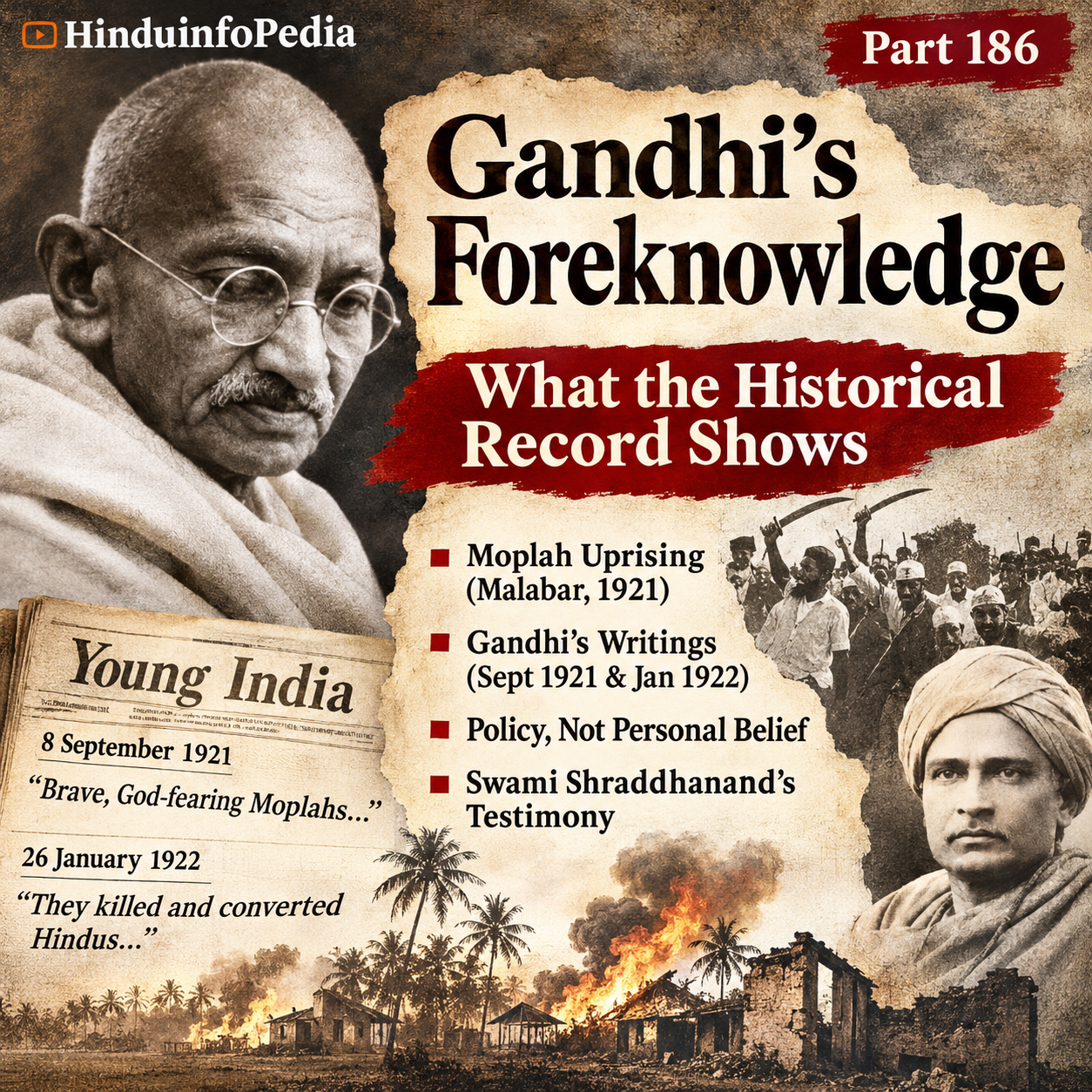
Gandhi’s Foreknowledge: The Record of What Gandhi Knew (186)
भारत / GB
Part 186: Mahatma Gandhi’s Peace Efforts | Series Index
The previous blog placed before the reader the Nagpur exchange of December 1920 — Shraddhanand’s warning to Gandhi that the verses being chanted on the Khilafat platform would be directed against Hindus once feeling reversed, Gandhi’s dismissal, and the sequence that followed: Malabar in August 1921, Shraddhanand’s murder in December 1926, and the question the reader is left to answer regarding August 1947. Gandhi’s foreknowledge places before the reader what Gandhi knew about the apparatus as it was operating — in his own signed, dated words.
Thank you for reading this post, don't forget to subscribe!THE HISTORICAL RECORD — GANDHI’S FOREKNOWLEDGE
The Pattern: The standard defence of Gandhi’s role in the Khilafat mobilisation holds that the violence which followed was unforeseeable — that Gandhi could not have anticipated what a theological mass movement would produce in the field. Gandhi’s foreknowledge places before the reader Gandhi’s own signed, dated writings between 1920 and 1924, in which he described the Moplah violence in Malabar, the Hijrat’s devastation, and the communal fractures spreading across northern India — and continued the programme. The question the series places before the reader is not whether Gandhi foresaw the violence. It is what he did with what he saw.
The Lethal Exhibit: Young India, 8 September 1921: Gandhi wrote that the Moplah uprising was the “brave” act of men who had acted in accordance with their belief. He did not retract the Khilafat programme. He did not address the Moplah victims. He continued. Young India, 26 January 1922: Gandhi acknowledged that the Moplahs had acted on a religious instruction and that Hindus had suffered. He called for patience and continued. Gandhi’s foreknowledge places both entries before the reader alongside the question: what does continued action, in the face of documented evidence, constitute?
Why it matters: Naivety is the most charitable defence available. Gandhi’s foreknowledge places that defence before the reader and asks it to survive four signed, dated exhibits from Gandhi’s own pen, written as the apparatus was operating.
The Naivety Defence — and What It Requires
The most generous reading available to the defence is this: Gandhi did not understand what the Dar-ul-Harb classification meant when it left the mosque and reached the village. He was a lawyer-politician operating at the level of constitutional programmes; the theological machinery he allied with operated at a level he could not fully anticipate. He acted in good faith on an incomplete picture.
The written record does not dispute that this reading is the most generous available. It places before the reader what Gandhi’s own picture contained — in his own signed, dated words, in the public record, as the apparatus was operating — and asks whether the picture was, in fact, incomplete. Gandhi’s foreknowledge is the prosecution’s answer to that question: not an inference about what he might have known, but a documented account of what he demonstrably did know, in his own hand, at the time.
Exhibit One: The Moplah — September 1921
The Moplah uprising of August–September 1921 in Malabar is documented in the administrative record: forced conversions, Hindu temples desecrated, approximately 2,500 non-combatant Hindu deaths by district records, an estimated 10,000 displaced. The Calicut District Collector’s reports, the Madras Government’s administrative records, and the subsequent Malabar Rebellion Special Commission document the pattern: Hindus who refused conversion were killed; Hindus who accepted conversion were spared; the Khilafat flag flew over at least one police station during the first days of the uprising. The administrative record matched the textual mandate: the classical injunction of Surah At-Tawbah (9:5)—recited on the Khilafat platform at Nagpur eight months earlier—was applied on the ground: the Mushrik faced the binary choice between acceptance of Islam or death.
The written record places before the reader what Gandhi wrote in Young India of 8 September 1921 — after the uprising had begun and as its character was becoming known to the Congress leadership.
Gandhi described the Moplahs as “brave God-fearing Moplah[s] who are fighting for what they consider as religion.” The phrase “what they consider as religion” is Gandhi’s own. The verses that defined that religion — recited on the Khilafat platform at Nagpur eight months earlier, recorded in the Mutafiqa Fatwa circulated in December 1920 — are in the record. The reader will place Gandhi’s characterisation alongside those texts. He did not retract the Khilafat programme. He did not address the Hindu victims of Malabar. He continued.
The prosecution notes the precise calibration required here. Gandhi did not endorse the specific violence against Hindus in those words. The prosecution does not claim he did. What the record places before the reader is something more precise: the men Gandhi described as “brave” had killed unarmed Hindu civilians. The men he described as “God-fearing” had converted Hindus at sword-point, assaulted Hindu women, and destroyed Hindu temples. Gandhi applied both words — brave, God-fearing — and continued the programme that had placed the theological authority of the Khilafat at the centre of the national movement. He had been warned. Nine months before Malabar, at Nagpur in December 1920, Shraddhanand had told him directly that the Maulanas reciting jihad verses on the Khilafat platform were referring to Hindus — not to the British Bureaucracy — and would not refrain from directing those verses against Hindus once feeling reversed. Gandhi’s response at Nagpur had been: “They are alluding to the British Bureaucracy.” His response in September 1921, as the Moplah fighters carried out what those verses instructed, was to call them brave and God-fearing. The series places both responses before the reader in sequence.
Exhibit Two: The Moplah — January 1922
By January 1922, the full character of the Malabar events was in the public record. Gandhi acknowledged in Young India of 26 January 1922 that the Moplahs had killed and converted Hindus. He acknowledged that the Khilafat movement was connected to the uprising. He called the Hindu suffering real.
He did not suspend the Khilafat programme. He called for patience. He continued.
Gandhi’s foreknowledge places this January 1922 entry before the reader not as proof of malice — the prosecution makes no such claim — but as proof that the naivety defence requires a precise end date. By January 1922, Gandhi knew. The Congress Enquiry Committee’s own report — compiled by Gandhi’s movement — also recorded that Moplah preachers had characterised Hindus as cowards unworthy of resistance and had used that characterisation to incite violence in the Ernad and Valluvanad mosques before August 1921. This was in the same record Gandhi was reading when he called the fighters brave and God-fearing. The question the prosecution places before the reader is what continued action, after documented knowledge, constitutes.
Exhibit Three: The Policy, Not the Creed
Across Young India from 1920 to 1922, Gandhi’s public writing on the Khilafat made a consistent distinction: the Hindu–Muslim alliance was a political necessity, not a theological endorsement. Gandhi acknowledged that the Khilafat’s doctrinal foundations — the Dar-ul-Harb classification, the ulema’s authority — were not his creed. He treated them as the legitimate political expression of a community whose cause was just.
This distinction is the prosecution’s third exhibit — not because it proves malice, but because it proves consciousness. A man who describes his alliance with a theological programme as policy rather than creed has necessarily understood what the theological programme contains. The man who called the Moplah fighters brave and God-fearing had already publicly stated he did not share their theological framework. He understood the framework. He allied with it. He continued after the massacre in Malabar. The written record places that sequence before the reader as a documented chain, not as an inference.
Exhibit Four: Swami Shraddhanand’s Witness
Swami Shraddhanand, the Hindu religious leader who worked alongside Gandhi in the Khilafat period, documented what he witnessed within the alliance from the inside. His account — written before his murder in December 1926 — records that the Khilafat ulema preached openly in Congress sessions that the Dar-ul-Harb classification was operative and that the duties it activated were incumbent on every Muslim. He records that Gandhi was present at sessions where this language was used.
The prosecution presents Shraddhanand’s account as a witness exhibit, not as Gandhi’s own words. It is attributed accordingly: this is what a named witness who was present recorded. The series places it before the reader as the inside account of the apparatus’s public operation — the testimony of a man who was there, who had trusted the Khilafat alliance from within, and who documented what he saw before he was murdered in December 1926 by a man the Ali Brothers publicly defended. The prosecution asks whether a leader surrounded by witnesses who documented what the apparatus was doing in his presence can claim he did not see it.
The Prosecution’s Position
Four questions stand before the reader.
- Does Gandhi’s description of the Moplah fighters as “brave God-fearing” men — written in September 1921 as the Malabar killings and forced conversions were underway — constitute an exhibit the reader places alongside the naivety defence, and asks whether naivety is the correct category?
- Does Gandhi’s January 1922 acknowledgment — that Moplahs had killed and converted Hindus, that the Khilafat was connected, that Hindu suffering was real — followed by continued prosecution of the programme, constitute an exhibit the reader places alongside the claim that the violence was unforeseeable?
- Does Gandhi’s own public distinction between policy and creed — his written acknowledgment that he allied with the Khilafat’s theological framework as a political instrument, not as a personal conviction — constitute an exhibit the reader places alongside the claim that he did not understand what the framework contained?
- Does Shraddhanand’s witness account — a man present in the Congress sessions, documenting the ulema’s public use of Dar-ul-Harb language in Gandhi’s presence — constitute an exhibit the reader places alongside the claim that Gandhi could not have known what the apparatus was preaching?
The series does not answer. Gandhi’s foreknowledge places the written record before the reader and asks the reader to name what it constitutes. The next blog places before the reader the architecture that the foreknowledge built — the structural components of the Khilafat bomb, unfolded.
Invitation To Defence
The floor belongs to the defence. We now invite them to present their exhibits and challenge the narrative established by the prosecution.
In September 1921, as Moplah fighters killed and converted Hindus in Malabar, Gandhi called them brave and God-fearing and continued the programme. In January 1922, he acknowledged the Hindu deaths and continued. He had already written publicly that the Khilafat alliance was his policy, not his creed — which means he understood the creed. Shraddhanand, who was present, recorded the ulema using Dar-ul-Harb language in Congress sessions. Gandhi’s foreknowledge places the signed, dated record before the reader. The reader will name what continued action, after documented knowledge, constitutes.
Feature Image: Click here to view the image.
Videos
Glossary of Terms
1. Gandhi’s Foreknowledge: The central theme of this blog, examining what Gandhi knew about the Khilafat apparatus while it was operating, based on his own signed and dated writings and contemporary documentary records.
2. Khilafat Mobilisation: The political and religious mobilisation organised around the Khilafat movement, which Gandhi supported as part of his Hindu–Muslim political alliance.
3. Dar-ul-Harb: An Islamic jurisprudential classification traditionally referring to territory considered outside Islamic rule. The blog examines its significance in the theological framework promoted by Khilafat ulema.
4. Moplah Uprising: The August–September 1921 uprising in Malabar, associated with killings, forced conversions, destruction of Hindu temples and large-scale displacement of Hindu civilians.
5. Hijrat: Migration undertaken for religious reasons, particularly the movement of Indian Muslims to Afghanistan during the Khilafat period, which resulted in considerable hardship and devastation.
6. Naivety Defence: A phrase used in this blog for the argument that Gandhi did not fully understand the consequences of the theological machinery with which he had allied himself.
7. Theological Machinery: A distinctive phrase used in the blog to describe the religious doctrines, interpretations, clerical authority and mobilisation mechanisms operating within the Khilafat alliance.
8. Surah At-Tawbah (9:5): A Quranic verse discussed in the blog in connection with the religious instructions recited at the Nagpur Khilafat platform and their alleged relationship to subsequent events in Malabar.
9. Mushrik: An Islamic theological term referring to a person who associates partners with God; the blog uses it while discussing the religious classification and choices described in its examination of the Moplah violence.
10. Mutafiqa Fatwa: The December 1920 religious ruling referred to in the blog, in which the relevant religious instructions were recorded and circulated during the Khilafat mobilisation.
11. Ulema: Islamic religious scholars or authorities who interpret and teach religious doctrine and jurisprudence. The blog examines their role in promoting the Dar-ul-Harb classification during Congress sessions.
12. Creed: A system of religious beliefs or personal convictions. The blog uses this term to distinguish Gandhi’s personal religious beliefs from his political alliance with the Khilafat movement.
13. Clerical Leverage: The influence exercised by religious authorities over political institutions and decision-making. The phrase describes the pressure exerted by religious leadership within the political framework examined in the blog.
14. Witness Exhibit: Documentary testimony presented as evidence from an identified witness. In this blog, it refers particularly to Swami Shraddhanand’s account of what he witnessed during the Khilafat period.
15. Forensic Archive: The documentary collection and analytical framework used by the series to examine historical statements, testimony, contemporary records and political decisions through an evidence-based approach.
#Gandhi #MahatmaGandhi #Khilafat #Malabar #Moplah #IndianHistory #IndianNationalism #History #HinduHistory #Congress #Shraddhanand #HinduinfoPedia
Scan Through The Entire Series at