
Gandhi’s Hijrat Teachings: The Root Causes of Kohat 1920 (217)
भारत / GB
Part 217: Mahatma Gandhi’s Peace Efforts (The Communal Contagion & Malabar Prototype) | Series Index
Blog 216 documented the classical jurists and constitutionalists Gandhi bypassed when endorsing the 1920 Khilafat–Hijrat agitation, identifying Ahmed Raza Khan of Bareilly and Jinnah’s Nagpur protest as the contemporaneous counter-voices excluded from Young India. Blog 215 traced the three-tier transmission machine by which Gandhi’s English-language endorsements became Urdu-language theological mobilisation. This instalment isolates the Kohat-specific structural causes — Hijrat distress land sales, destitute muhajirin returns, the July 1921 Karachi military fatwa, and the commercial severance pattern — that converted latent hostility into the September 1924 expulsion. The forensic ledger of that expulsion is in Blog 213; Gandhi’s response fast is in Blog 155.
Thank you for reading this post, don't forget to subscribe!ROOT CAUSES OF THE SEPTEMBER 1924 KOHAT ATTACKS ON HINDUS AND SIKHS (1920–1924)
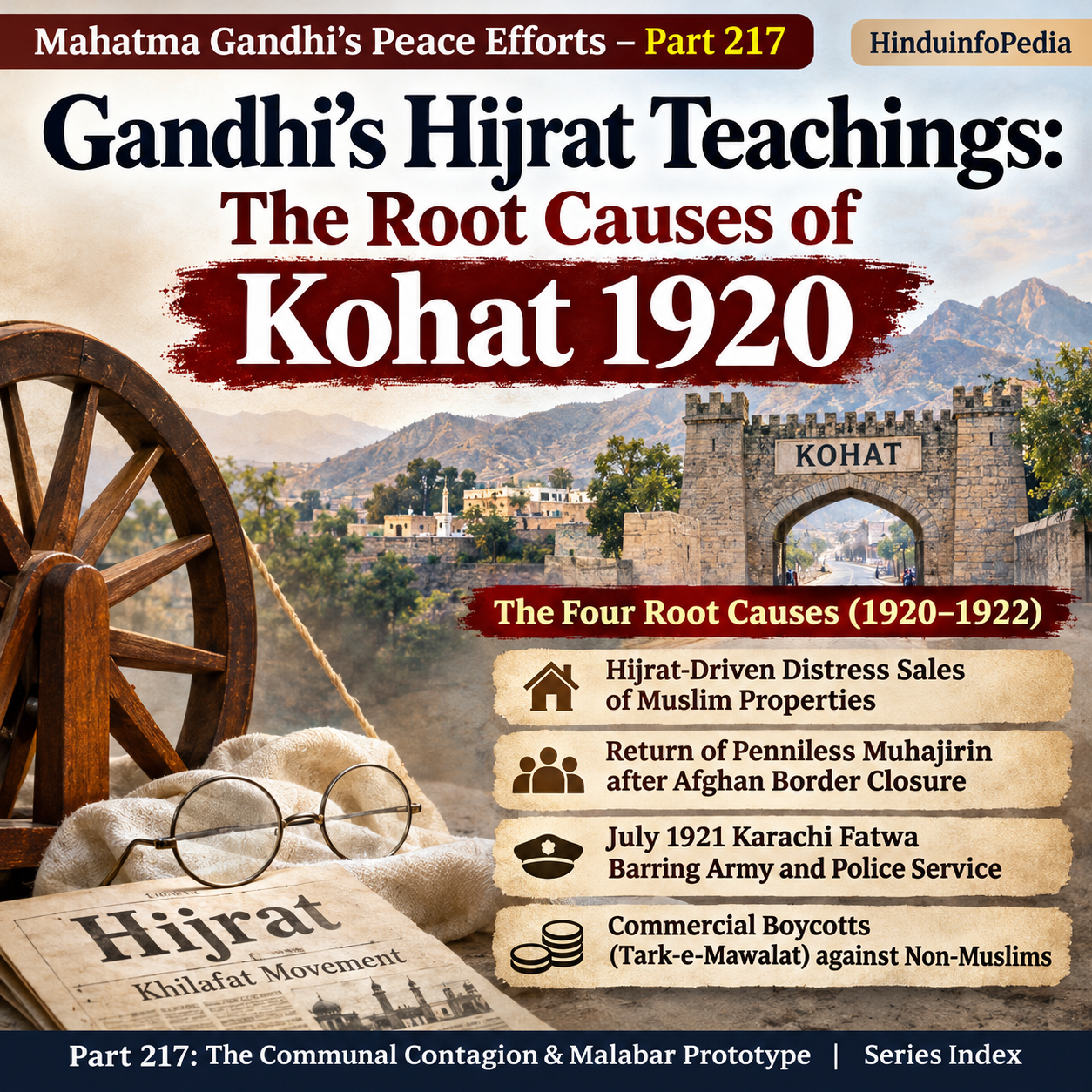
The Action Taken: Why did Muslim mobs launch a coordinated attack, loot homes and shops, burn account books, and expel Kohat’s Hindu and Sikh community in September 1924? Standard accounts treat the event as a spontaneous clash over a pamphlet. This record documents the four root causes assembled between 1920 and 1922 that directly targeted Kohat’s Hindus and Sikhs: (1) Hijrat-driven distress sales of Muslim land and houses to Hindu and Sikh buyers at collapsing prices in summer 1920; (2) the return of bankrupt, humiliated muhajirin to Kohat after Afghanistan sealed its border on 9 August 1920, living face-to-face with the Hindu and Sikh families occupying their former homes; (3) the July 1921 Karachi Khilafat Conference fatwa declaring British army and police service religiously prohibited (haram), which paralysed Kohat’s predominantly Muslim civil police when Hindus and Sikhs needed protection; and (4) Khilafat-era commercial boycotts (Tark-e-Mawalat) that severed business and credit ties with non-Muslim polytheist traders.
Who Paid the Price: Kohat’s approximately 3,500 Hindu and Sikh residents — whose properties were looted, whose bahi-khata credit ledgers were burned to erase debts, and who were driven out of Kohat in September 1924 while the local Muslim police stood passive or joined the plunder.
Why This Matters: The September 1924 attack on Kohat’s Hindus and Sikhs was not an unpredicted riot sparked by a pamphlet. Every element of the attack — why Hindu and Sikh homes were looted, why account books were burned, and why the police failed to defend them — was built between 1920 and 1922 through the Hijrat mandate, the army-police fatwa, and commercial boycotts against non-Muslims.
The Hijrat Distress Sales Vs Rich Hindu -Sikh Community
When the 1920 Khilafat–Non-Cooperation movement’s clerical apparatus declared British India Dar-ul-Harb and mandated Hijrat — migration of Muslims to Muslim territory as a religious duty — the exodus from Kohat district and the North-West Frontier Province created an immediate property transfer. Muslim households in Kohat town and nearby villages who obeyed the Hijrat mandate sold town houses, shops, and movable assets rapidly in the summer of 1920 to whoever held liquid cash — predominantly the local Hindu and Sikh merchants, moneylenders, and shopkeepers.
Because Hijrat theology declared living under non-Muslim rule spiritually impermissible, Muslim sellers could not wait for fair market prices. British district records for Kohat, Kurram, and Hangu sub-divisions record properties changing hands well below assessed revenue valuations during June–August 1920. Hindus and Sikhs were among the rich communities in the town and are presumed to have purchased some of the properties sold below fair market value. This established the first layer of Gandhi’s Kohat tinder and directly explains why Kohat’s Hindu and Sikh commercial families — along with their homes, shops, and bahi-khata debt ledgers — were singled out for looting and arson during the September 1924 attacks. The three-tier transmission that turned Gandhi’s English endorsements into mass Hijrat is detailed in Blog 215.
The Muhajirin Return: Penniless Living Next to Hindus and Sikhs
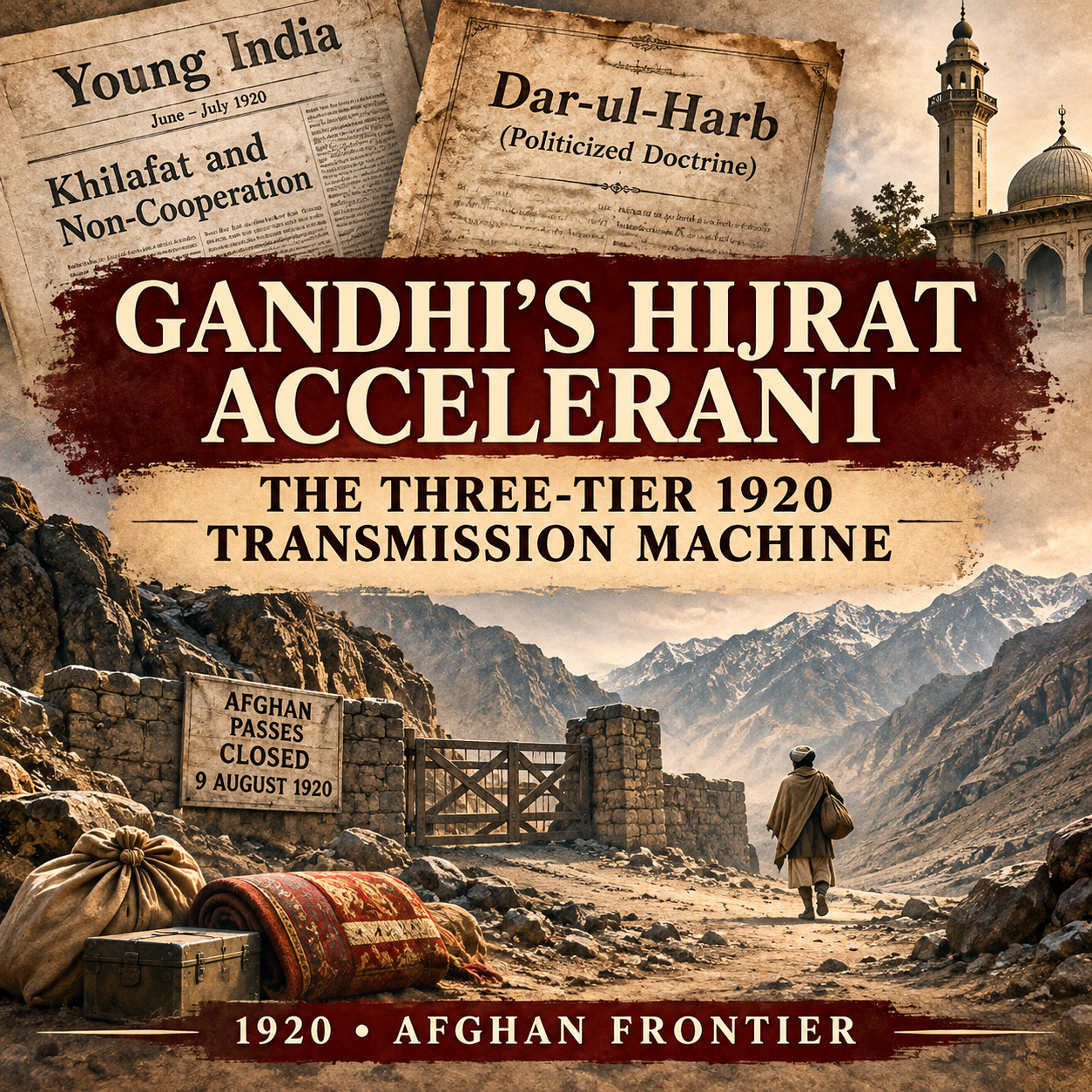
On 9 August 1920, Afghan Amir Amanullah Khan sealed the Khyber, Kurram, and Torkham passes, refusing entry to tens of thousands of Hijrat migrants who had already sold or abandoned their property. Kabul could not feed or house them and had never approved the migration. Stranded in the Parachinar–Kurram staging areas without shelter or work, penniless muhajirin began returning to Kohat district from August–September 1920, their property gone and their religious migration publicly humiliated.
They returned to Kohat’s neighbourhoods to see Hindu and Sikh buyers occupying the town houses and shops they had sold at distress prices. The bahi-khata credit ties that had long linked Muslim cultivators with Hindu shopkeepers now carried intense resentment tied to religious obligation, Afghan rejection, and personal bankruptcy. Funnelled back through the narrow Kurram–Parachinar–Kohat route, thousands of destitute migrants lived face-to-face with the non-Muslim buyers of their urban properties — forming the second layer of Gandhi’s Kohat tinder and supplying the direct human anger unleashed against Kohat’s Hindus and Sikhs in September 1924. The scale and mechanics of that 1920 exodus are recorded in Blog 215.
Karachi Military Fatwa In Action: Hindus and Sikhs Without Police Protection
In July 1921, the All-India Khilafat Conference in Karachi issued a collective fatwa — signed by Deobandi and Khilafat-aligned ulama — declaring service in the British army and police religiously prohibited (haram) for Muslims. The fatwa targeted the Muslim recruitment base of the British Indian Army and the provincial police of the North-West Frontier Province, Punjab, and Bengal, where Pathans, Punjabi Muslims, and Baloch formed the bulk of the garrison and civil police.
British Intelligence Branch reports from 1921–1922 record how this fatwa weakened loyalty to Crown service across Frontier Muslim communities: recruitment dropped, serving policemen faced religious pressure from their own families, and police willingness to enforce the law declined. When mobs attacked Kohat’s minority quarter in September 1924, Kohat’s predominantly Muslim civil police — conditioned by three years of religious stigma against serving a non-Muslim government — stood passive or joined the looting instead of protecting Hindu and Sikh residents. This formed the third layer of Gandhi’s Kohat tinder, explaining why Kohat’s Hindus and Sikhs had no functioning police shield when the attack began.
Commercial Boycotts (Tark-e-Mawalat): Isolating Hindu and Sikh
The Khilafat programme of Tark-e-Mawalat — grounded in the core theological doctrine requiring believers to sever close social, political, and commercial ties with non-Muslims — was directed not only against the British administration, but by its own doctrinal definition against non-Muslim merchants and neighbours as well. Far from being confined to Delhi and Agra–Mathura as documented in Blog 183, this theological mandate spread directly into Kohat, Hangu, and the Kurram valley, where Hindu and Sikh grain dealers, cloth merchants, and moneylenders connected local Muslim cultivators to the wider Punjab market.
Between 1920 and 1922, Khilafat-era mosque sermons in Kohat condemned business dealings with non-Muslim polytheists as un-Islamic and incompatible with the Hijrat mandate, breaking apart bahi-khata credit partnerships that had lasted three generations. Added to the distress land sales and the anger of returning muhajirin, this boycott isolated Kohat’s Hindu and Sikh traders economically during 1921–1922 before their shops were looted and burned in September 1924 — completing the fourth layer of Gandhi’s Kohat tinder.
Four Causes One Target: Attack on Hindus and Sikhs
None of these four causes — Hijrat distress sales, returning penniless muhajirin, the Karachi military-police fatwa, or commercial boycotts against non-Muslims — acted alone in Kohat. Each reinforced the others: bankrupt migrants returned with religious and financial bitterness into a bazaar already broken by Tark-e-Mawalat boycotts against Hindu and Sikh shopkeepers, while the fatwa against Crown service ensured the Muslim police force would not defend the minority quarter.
The September 1924 dispute followed a clear chain of action and reaction rooted in the division of hearts created by Gandhi’s Khilafat push. That sectarian estrangement first emboldened Muslim writers to publish derogatory attacks on Hindu deities in the Lahaul poem, which provoked a Hindu counter-response in the Risala-i-Vartman (Krishan Sandesh) pamphlet — and that pamphlet reaction became the lit match dropped onto fuel stacked step by step between 1920 and 1922. That combined chain is Gandhi’s Kohat tinder: a documented sequence running from summer 1920 to the night of 9 September 1924, driven by leaders and preachers who had shared Gandhi’s political platforms in 1920 and culminating in the violent expulsion of Kohat’s Hindus and Sikhs. The full contemporaneous record of the attack itself is in Blog 213; Gandhi’s subsequent 21-day fast is examined in Blog 155.
Modern Parallel
The action-and-reaction trigger documented in Section 5 also recurred in the 2022 Nupur Sharma case. Just as derogatory Muslim writings on Hindu deities in the Lahaul poem provoked Jiwan Das’s Krishan Sandesh reply in 1924 — becoming the pretext for street mobilisations and attacks on Kohat’s Hindus — Nupur Sharma’s televised counter-response citing accounts of the Prophet’s life from the Hadith and Quran during a debate where Hindu deities were mocked triggered nationwide street rallies, death threats, and targeted killings of Hindus, from chemist Umesh Kolhe in Amravati to tailor Kanhaiya Lal in Udaipur, murdered simply for sharing a social media post in her support. Even the subsequent film depicting Kanhaiya Lal’s killers faced legal efforts by the Jamiat Ulama-i-Hind to block its public release, mirroring the pattern in which street and institutional pressure silences public documentation while initial provocations against Hindu deities carry no comparable consequence.
Invitation To Defence
British district revenue records for Kohat and Kurram (1920–1921), August 1920 Afghan correspondence closing the border passes, 1921–1922 British Intelligence Branch reports on the Karachi military fatwa, September 1924 NWFP reports on police inaction during the attack on Kohat’s Hindus and Sikhs, and the July 1921 Karachi Khilafat Conference proceedings are all established archival records. The defence is invited to produce any primary document showing that Khilafat leaders in the Frontier — several of whom shared tour platforms with Gandhi in summer 1920 — ever instructed Muslims not to sell land before Afghan entry was confirmed, exempted police protection of Hindu and Sikh citizens from the Karachi fatwa, or halted commercial boycotts against non-Muslims in Kohat district.
Between summer 1920 and September 1924, four direct causes built up inside Kohat: distress land sales to Hindu and Sikh buyers, bankrupt returning muhajirin, a fatwa-paralysed Muslim police force, and commercial boycotts against non-Muslims. When the pamphlet dispute erupted on 8 September 1924, it ignited Gandhi’s Kohat tinder — producing not a spontaneous riot, but the planned looting and expulsion of Kohat’s 3,500 Hindus and Sikhs.
Feature Image: Click here to view the image.
Videos
Glossary of Terms
The following glossary includes important historical, religious, political, administrative and series-specific expressions appearing in the English version of the blog. The definitions retain the terminology and context of the original article.
1. Hijrat: Migration undertaken for religious reasons. In the 1920 Khilafat movement, it referred to the call for Muslims to leave British India and migrate to Muslim-governed territory.
2. Dar-ul-Harb: A theological classification used by certain Islamic jurists for territory not governed under Islamic authority. The classification of British India under this term was used to justify the Hijrat movement.
3. Khilafat Movement: A political and religious movement in British India seeking to defend the position of the Ottoman Caliph after the First World War. It became associated with Gandhi’s Non-Cooperation Movement.
4. Muhajirin: Muslim migrants who undertook Hijrat from British India towards Afghanistan in 1920. Many returned after Afghanistan closed its border to incoming migrants.
5. Tark-e-Mawalat: A programme of severing social, political and commercial relationships with non-Muslims. The blog examines its implications for Hindu and Sikh merchants and business communities.
6. Bahi-Khata: Traditional Indian account books used by merchants and moneylenders to maintain records of business transactions, loans, credit and outstanding debts.
7. Fatwa: A religious legal opinion issued by an Islamic religious authority. The blog discusses the July 1921 Karachi Khilafat Conference declaration against Muslim service in the British army and police.
8. Non-Cooperation Movement: Gandhi-led political campaign advocating withdrawal of cooperation from British colonial institutions. It became politically associated with the Khilafat agitation.
9. Distress Sales: Property transactions conducted under urgent circumstances, often at prices substantially below normal market valuations. The blog applies this expression to property sales during the 1920 Hijrat exodus.
10. Karachi Khilafat Conference: The July 1921 gathering associated with a collective religious declaration against Muslim participation in British army and police service.
11. North-West Frontier Province (NWFP): The historical British Indian administrative province encompassing Kohat and other Frontier districts discussed in the blog.
12. Crown Service: Employment under the British Crown, particularly in government administration, military and police establishments during British India.
13. Commercial Severance: The breaking of established business, credit and trading relationships between different communities. The blog uses this expression to describe the economic isolation of Hindu and Sikh merchants.
14. Kohat Tinder: A distinctive expression coined in this series to describe the accumulation of four interconnected conditions between 1920 and 1922: distress property sales, returning Muhajirin, the Karachi military-police fatwa and commercial boycotts. The expression connects these developments to the September 1924 Kohat attacks.
15. Three-Tier Transmission Machine: A series-specific expression describing how Gandhi’s English-language endorsements in Young India were transmitted into Urdu-language theological mobilisation, helping spread the Hijrat movement.
#Gandhi #Kohat #Hijrat #Khilafat #History #India #BritishIndia #HinduHistory #SikhHistory #Muhajirin #Kohat1924 #HinduinfoPedia
Scan Through The Entire Series at
Refer to Various Arks Referred to in the Blog
https://hinduinfopedia.in/the-root-causes-of-kohat-1920-hijrat-mulsim-pains-and-theology-217/