

Gandhi’s Fitness to Lead: Measure of His Fitness to Succeed or Fail as a Leader (135)
भारत / GB
Part 135: Mahatma Gandhi’s Peace Efforts | Series Index
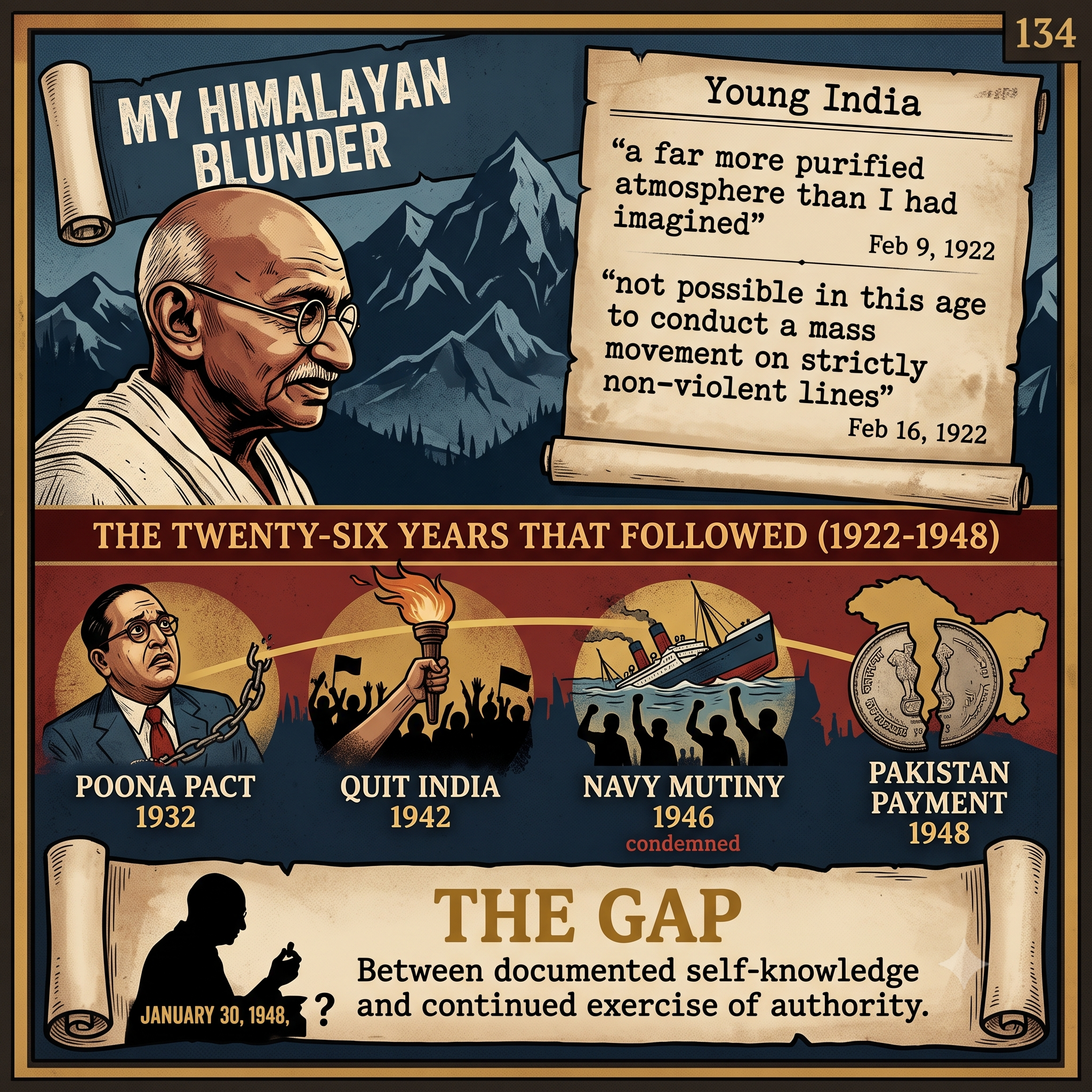
Blog 134 placed Gandhi’s two documented Himalayan admissions before the reader — April 1919 and February 1922 — and the twenty-six years that followed them. This post places the specific condition Gandhi documented for his own fitness to lead alongside three instances where that condition encountered a documented environment in which its failure was not a participant deficiency but a natural outcome. Gandhi’s Fitness to Lead attempts to analyse the probability of success as measured by Mahatma Gandhi himself and not by his critics
Thank you for reading this post, don't forget to subscribe!The Action Taken: Across twenty-five years, the mechanism of summoning mass civil mobilization and unilaterally halting it without structural concessions was maintained without procedural redesign.
Who Paid the Price: Four successive generations of freedom fighters whose mass leverage was discharged without achieving statutory constitutional self-rule.
The Alternative Bypassed: Building institutional, democratic movement controls where elected representatives decided when to escalate or end campaigns.
Why This Matters: Documents the systemic continuity: the cycle of mass mobilization followed by unilateral suspension was a consistent feature of his leadership, operating without institutional challenge.
Gandhi’s Fitness to Lead — Gandhi’s Own Documented Words
Gandhi’s Fitness to Lead places the documented criterion before the reader precisely. Gandhi did not say he was unfit to lead. He said he was unfit to lead on one specific condition — if the participants had not qualified themselves in non-violent discipline.
From his autobiography, Part V, Chapter 33: “I had called on the people to launch upon civil disobedience before they had thus qualified themselves for it.”
From Young India, February 16 1922: “It is not possible in this age to conduct a mass movement on strictly non-violent lines.”
The condition was not about Gandhi. It was about the participants. If they had qualified themselves — if they had demonstrated spontaneous obedience to laws and non-violent discipline — Gandhi’s documented standard placed him as fit to lead them. If they had not, his documented standard placed him as having made a Himalayan miscalculation in leading them.
The First Instance — Ahmedabad Mill Strike 1918
Gandhi’s Fitness to Lead places the Ahmedabad mill strike before the reader as the first documented instance where the condition encountered the environment.
In 1918 Gandhi led a strike of mill workers in Ahmedabad — a contained, relatively homogeneous workforce. The workers were Hindu. The mill owners were Hindu. The dispute was economic — the workers demanded a 50% wage increase. Gandhi led the strike on non-violent lines. A settlement was reached at 35%.
Then the mill owners retaliated. Strike leaders were dismissed. Wages were reduced below the settlement. The workers responded with further unrest — outside Gandhi’s non-violent framework.
Gandhi’s Fitness to Lead places one observation before the reader: this was not a communal environment, not a colonial authority using lethal force, not a population with divided religious loyalties. This was a contained industrial dispute between two Hindu communities. And even in this environment — the most contained and homogeneous of the three instances — the non-violent framework did not hold once the more powerful party chose not to honour the settlement.
The natural response of people facing economic retaliation from a more powerful party was not non-violent submission. It was further unrest. Gandhi observed this in 1918.
The Second Instance — Rowlatt Satyagraha 1919
Gandhi’s Fitness to Lead places the Rowlatt Satyagraha before the reader as the second documented instance — one year after Ahmedabad, in a significantly less contained environment.
Gandhi called upon the general population of India to offer civil disobedience against the Rowlatt Act. The population was mixed — Hindu and Muslim, urban and rural, trained and untrained. The authority they were opposing was the British colonial administration, which routinely used lethal force against protest. Violence broke out across Gujarat and Punjab. The Jallianwala Bagh massacre followed on April 13 1919.
Gandhi suspended the Satyagraha on April 18 1919. At Nadiad he placed his documented assessment before the reader: “I had called on the people to launch upon civil disobedience before they had thus qualified themselves for it. This mistake seemed to me of Himalayan magnitude.”
Gandhi’s Fitness to Lead places one observation alongside this: the natural response of a population facing a colonial authority that uses lethal force is not non-violent discipline. It is retaliation. The participants were not deficient. They were responding naturally to the documented conditions of the environment in which Gandhi had placed them.
Gandhi observed this in 1919. The next year he launched the Khilafat experiment.
The Third Instance — Khilafat and Chauri Chaura 1920-1922
Gandhi’s Fitness to Lead places the Khilafat experiment and Chauri Chaura before the reader as the third documented instance — in the most complex environment of the three.
The environment now carried: a colonial authority using lethal force, a communal landscape documented across the Khilafat arc as carrying tensions established across centuries, a Khilafat alliance whose leadership was documented as having priorities distinct from non-violent Swaraj, and a mass population Gandhi had already once documented as not having qualified themselves for non-violent discipline.
The Moplah rebellion of 1921 — documented across Blogs 54-68 (Group 7 and Moplah Unrest) of this series — was the natural outcome of the Malabar environment: a specific documented communal context in which the tensions Gandhi’s alliance had mobilised were not containable within a non-violent framework.
Chauri Chaura of February 4 1922 was the natural outcome when police fired on protesters. The crowd retaliated. The natural response of people facing lethal force is not non-violent discipline. It is retaliation.
Gandhi documented this on February 16 1922: “It is not possible in this age to conduct a mass movement on strictly non-violent lines.”
The Documented Asymmetry — What the Record Shows About Hindu Participation
Gandhi’s Fitness to Lead places one documented observation before the reader that the three instances together establish.
The documented record of Hindu participation in Gandhi’s non-violent movements — across Champaran, the Khilafat-Non-Cooperation movement, the Salt March — shows sustained and disciplined non-violent engagement at significant personal cost. Arrests accepted. Lathi charges absorbed. Property confiscated without retaliation.
The documented instances of violence that produced Gandhi’s two Himalayan admissions came from specific environments: an industrial dispute where mill owners violated a settlement (1918), a colonial authority using lethal force (1919), a specific communal rebellion in Malabar (1921), and a police provocation at Chauri Chaura (1922).
The prosecution places this documented asymmetry before the reader without characterisation. The condition Gandhi placed on his fitness to lead — non-violent qualification of participants — encountered three documented environments in which the failure of that condition was the natural outcome of the environment, not of participant deficiency.
The Question the Three Instances Place Before the Reader
One documented question is placed before the reader across the three instances.
Gandhi’s criterion — participants must have qualified themselves in non-violent discipline before being called upon — was a standard appropriate for a specific kind of movement in a specific kind of environment. The prosecution places the three documented instances before the reader and asks: was this condition ever achievable in the documented environment Gandhi was working in?
A colonial authority that routinely used lethal force against protest. A communal landscape carrying documented tensions. A workforce facing economic retaliation from a more powerful party. In each documented instance the violence was not random — it was the natural response of people in those specific conditions.
Gandhi documented the condition twice as having been violated. He continued to lead for twenty-six years. The prosecution places Gandhi’s own documented criterion, the three documented environments in which it was naturally violated, and the twenty-six years of continued leadership before the reader — and asks the reader to complete the sentence.
The Prosecution’s Position
Gandhi’s Fitness to Lead places three questions before the reader.
- Did Gandhi’s documented criterion — participants must have qualified themselves in non-violent discipline before being called upon — place a single condition on his fitness to lead, documented twice in his own words: at Nadiad April 1919 and in Young India February 16 1922?
- Do the three documented instances — Ahmedabad mill strike 1918, Rowlatt Satyagraha 1919, Khilafat and Chauri Chaura 1920-1922 — each show the condition failing not through participant deficiency but through the natural response of people placed in documented environments where a more powerful party used economic retaliation, colonial lethal force, or communal provocation?
- Does the documented asymmetry — sustained and disciplined Hindu participation across multiple movements placed alongside the specific documented environments that produced the violence Gandhi twice called a Himalayan miscalculation — belong before the reader alongside Gandhi’s documented continuation of leadership for twenty-six years after the second admission?
The series does not answer. The documented criterion, the three documented environments, and the documented continuation are placed before the reader. The reader will examine what the natural outcome of the environment established about the condition Gandhi placed on his own fitness to lead — and complete the sentence.
Invitation To Defence
The floor belongs to the defense. We now invite them to present their exhibits and challenge the narrative established by the prosecution.
1918: Ahmedabad mill owners violated the settlement. Workers responded. The condition failed in a contained Hindu environment. 1919: colonial authority used lethal force. Population retaliated. “Himalayan miscalculation.” 1920-1922: Moplah — the natural outcome of the Malabar communal environment. Chauri Chaura — police fired first, crowd retaliated. “Not possible in this age.” The condition Gandhi placed on his own fitness to lead. Three documented environments in which its failure was the natural outcome. Twenty-six years of continued leadership after the second admission. The prosecution places the documented criterion and the documented environments before the reader. The reader will complete the sentence.
Feature Image: Click here to view the image.
Videos
Glossary of Terms
- Gandhi’s Fitness to Lead: The central phrase of the blog referring to Gandhi’s own documented condition for his fitness to lead: participants had to qualify themselves in non-violent discipline.
- Himalayan Miscalculation: Gandhi’s own description of the magnitude of his error in calling for civil disobedience before participants had sufficiently qualified themselves for non-violent discipline.
- Non-violent Discipline: The disciplined conduct Gandhi required from participants before they could be called upon to participate in a mass movement based on non-violence.
- Civil Disobedience: Deliberate and public refusal to obey a law or authority as a form of political action, used by Gandhi as part of his mass movements.
- Rowlatt Satyagraha: Gandhi’s 1919 campaign against the Rowlatt Act, during which widespread violence occurred and Gandhi subsequently acknowledged his Himalayan miscalculation.
- Khilafat Movement: A political movement associated with the Ottoman Caliphate that Gandhi joined with the Congress movement, creating the broader Khilafat-Non-Cooperation framework.
- Chauri Chaura: The February 1922 incident in which police fired on protesters and the crowd retaliated, becoming a major reason for Gandhi’s withdrawal of the Non-Cooperation movement.
- Moplah Rebellion: The 1921 uprising in Malabar discussed in the series as a documented example of violence arising within the communal environment surrounding the Khilafat period.
- Natural Outcome of the Environment: A key analytical phrase in this blog describing violence as a response produced by the specific economic, colonial, or communal conditions in which participants were placed.
- Documented Asymmetry: The blog’s term for the contrast between sustained, disciplined Hindu participation in several non-violent movements and the specific environments associated with episodes of violence.
- Participant Deficiency: The alleged failure of participants to possess the non-violent discipline required by Gandhi’s stated leadership criterion.
- Ahmedabad Mill Strike: The 1918 industrial dispute in which Gandhi led mill workers in a non-violent strike before unrest followed the mill owners’ alleged violation of the settlement.
- Prosecution: The analytical framework used by the series to place documented evidence, questions, and Gandhi’s own statements before the reader rather than directly supplying the final judgment.
- Invitation to Defence: A recurring series device inviting the opposing side to present its evidence and challenge the narrative established by the prosecution.
- Twenty-Six Years of Continued Leadership: The period emphasized in the blog between Gandhi’s second documented Himalayan admission in February 1922 and the continuation of his leadership for the following twenty-six years.
#Gandhi #GandhiHistory #GandhiLeadership #GandhiQuotes #Satyagraha #Nonviolence #Khilafat #ChauriChaura #Moplah #Congress #IndiaHistory #HinduinfoPedia
Gandhi’s Peace Efforts: The Questions Before the Mahatma (0)