
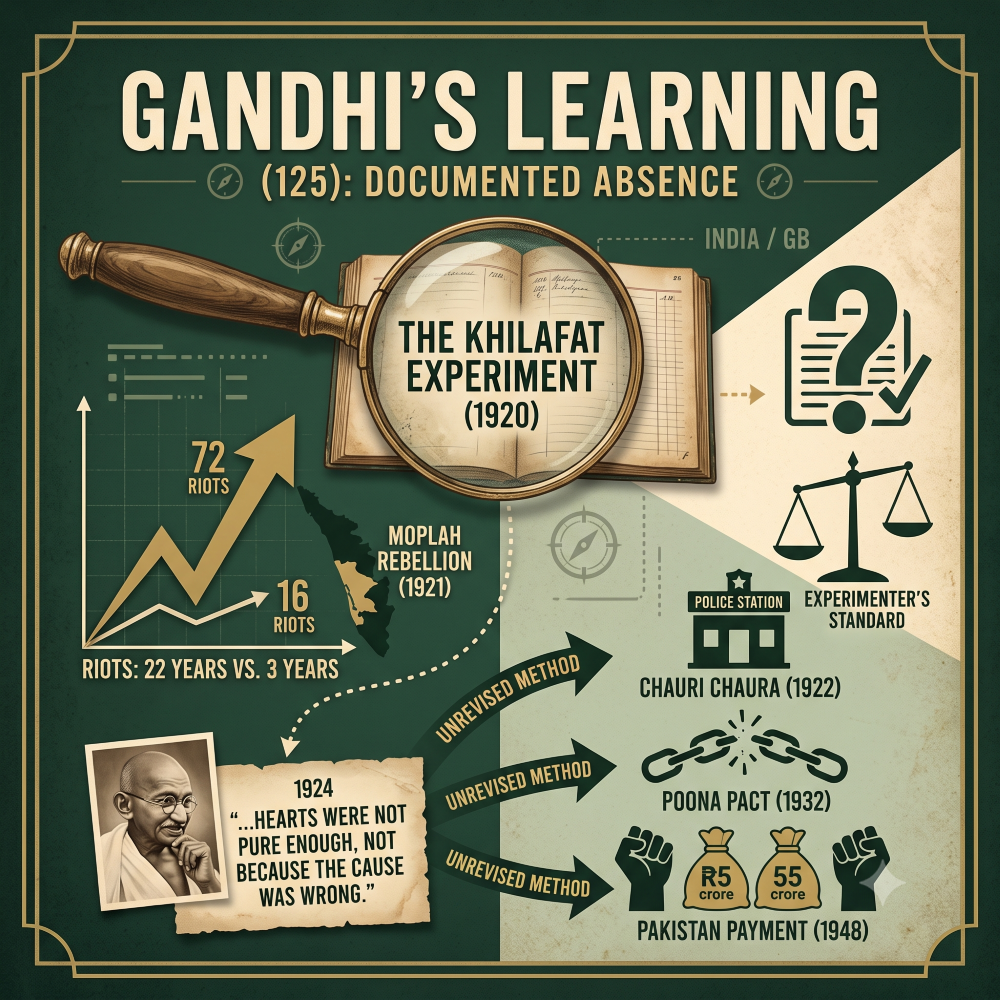
Gandhi’s Learning: What the Experimenter’s Standard Requires, and What the Record Shows (125)
भारत / GB
Part 125: Mahatma Gandhi’s Peace Efforts | Series Index
Blog 112 placed Gandhi’s own word “experimenting” before the reader — his documented description of what he was doing when he introduced religion into politics. Blog 111 placed his no-regret position before the reader — his documented 1924 response after the results arrived. This post places the gap between the two before the reader: what the experimenter’s standard requires when results contradict the hypothesis, and what the record shows Gandhi did instead.
Thank you for reading this post, don't forget to subscribe!The Action Taken: Across five major communal riots, Gandhi followed an identical template: attributing psychological blame to victims, minimizing organized aggression, and advising against legal prosecution.
Who Paid the Price: The rule of law and the physical protection of minority populations in riot-affected towns.
The Alternative Bypassed: Establishing a permanent Congress anti-riot investigative bureau dedicated to transparent legal prosecution of aggressors.
Why This Matters: Proves a systematic institutional pattern across five geographically distinct riots: communal violence was consistently managed to protect political alliances rather than secure justice.
The Standard — What an Experiment Requires
Gandhi’s Learning places the scientific standard before the reader first — not as the series’ characterisation of Gandhi, but as the logical framework Gandhi’s own documented word “experimenting” invites.
Gandhi wrote in Young India, May 12 1920: “I have been experimenting with myself and my friends by introducing religion into politics.”
He chose the word “experimenting.” An experiment has a hypothesis, a method, subjects, and results. The experimenter’s obligation when results arrive is not optional: if the results contradict the hypothesis, the hypothesis is examined. If the hypothesis cannot account for the results, it is revised. The experimenter who places the failure inside the subjects — who says the results were wrong, not the hypothesis — cannot learn from the experiment. The experiment simply repeats.
Gandhi’s Learning places one question before the reader at the outset: what did Gandhi’s documented record show he did when the Khilafat experiment’s results arrived?
The Hypothesis — May 1920
Gandhi’s documented hypothesis, established across Blogs 102-112 of this series: introducing religion into politics — specifically, adopting the Khilafat cause as Congress’s primary programme — would produce Hindu-Muslim unity. Gandhi’s documented strategic rationale (Blog 114): Hindu-Muslim unity was the prerequisite for Swaraj. The experiment was designed to test whether the Khilafat alliance would produce that unity.
The Results — 1921 to 1924
The results arrived across four years and are on the record across this series:
The Moplah rebellion, August-December 1921 — established in Blogs 54-68 and returned to in Blogs 117-124. Documented killings, forced conversions, temple desecrations across Malabar.
The communal riot data, established in this series from historian S. Gopal:
| Period | Timeframe | Recorded Communal Riots |
|---|---|---|
| Pre-Khilafat Alliance | 22 Years | 16 riots |
| Post-Khilafat Alliance | 3 Years | 72 riots |
Jinnah’s departure from Congress at Nagpur December 1920 — the constitutional Muslim political leadership whose documented position the alliance had been designed to win over, documented across Blogs 81-98 as having moved in the opposite direction.
The Caliphate abolished by Atatürk’s Turkey in March 1924 — the cause itself rendered obsolete by the people whose cause it was.
Gandhi’s own words, Young India May 29 1924, CWMG Vol. 24, p. 136: “The awakened Mussalmans have proclaimed a kind of Jihad against us Hindus.” Gandhi placed the result on the record in his own words — the experiment that was designed to produce Hindu-Muslim unity had produced a documented communal fracture Gandhi himself identified as resembling a Jihad against Hindus.
The results contradicted the hypothesis on every documented measure examined in this series.
The Prosecution’s Case: What Gandhi Did With the Results
Gandhi’s Learning places Gandhi’s documented response to the contradicting results before the reader. Young India 1924, established in Blog 111 of this series:
“I do not regret having engaged in the Khilafat agitation… If the unity achieved was temporary, it is because our hearts were not pure enough, not because the cause was wrong.”
The prosecution places the logical structure of this response before the reader precisely. Gandhi did not revise the hypothesis. He revised the results. The failure was placed inside the character of the participants — their hearts were not pure enough. The cause was declared sound. The method — introducing religion into politics — was not re-examined. The experiment was declared a noble endeavour whose results reflected the inadequacy of those who participated in it, not the inadequacy of the experiment itself.
An experimenter who revises the results rather than the hypothesis cannot learn from the experiment. The experiment will repeat — with different subjects, in different conditions, under a different name — because the experimenter has established that when results contradict the hypothesis, the hypothesis is not the problem.
Immunity From Falsification — and the Pattern It Produced
Gandhi’s Learning places one analytical observation before the reader. By attributing the Khilafat experiment’s failure to spiritual impurity — “not because the cause was wrong” — Gandhi placed the method outside empirical critique. A method that can only fail because its practitioners were unworthy cannot be tested, cannot be falsified, and cannot be revised. The method becomes a dogma: if the results are wrong, the practitioners failed the doctrine; the doctrine cannot have failed the practitioners.
This is not the series’ characterisation. It is the logical consequence of Gandhi’s own documented words — placed before the reader for the reader to examine.
The pattern the immunity produced across Gandhi’s documented career is placed before the reader across three documented instances:
Rowlatt Satyagraha 1919 — the agitation escalated into violence across Punjab and Gujarat. Gandhi’s documented response: the “Himalayan Blunder” — the people had not mastered Ahimsa. The method of mass mobilisation combined with unready crowds was not audited. The readiness of the public was questioned. Source: An Autobiography: The Story of My Experiments with Truth.
Khilafat collapse 1921-1924 — Moplah rebellion, 72 riots in 3 years, Jinnah’s departure, Caliphate abolished by the Turks. Gandhi’s documented response: Young India May 29 1924, CWMG Vol. 24 — “I do not regret… hearts were not pure enough, not because the cause was wrong.” The method was not audited. The hearts of the participants were questioned.
Quit India Movement 1942 — immediately devolved into widespread violence and sabotage after top Congress leaders were arrested. Gandhi’s documented response: placed full responsibility on British provocation. The strategy was declared pure. Gandhi’s correspondence with the Government of India 1942-1944 carries this position on the record.
Three documented instances across twenty-three years. The same documented mechanism in each: the strategy cannot be wrong; only the practitioners or external forces can be inadequate. C.R. Das and Motilal Nehru’s documented departure to form the Swaraj Party in 1923 was a direct rejection of this stance — a documented contemporary verdict from within Congress itself on Gandhi’s refusal to audit the method after the Khilafat collapse.
Ambedkar’s documented verdict, already placed before the reader in Blog 120, completes the external corroboration: Gandhi was “so much obsessed by the necessity of establishing Hindu-Muslim unity that he was prepared to make light of the doings of the Moplas.” The obsession with unity insulated the method from the evidence that unity was not what the method was producing.
The Falsification Principle (Popperian Logic)
The core strength of this post lies in its epistemological critique:
   [Hypothesis]  ───►  Religion in Politics = Hindu-Muslim Unity
        │
        ▼
   [Empirical Results] ───►  Moplah Atrocities + 72 Riots in 3 Years + Jinnah's Exit
        │
        ▼
   [Standard Reaction] ───►  Revise / Abandon Hypothesis
        │
        ▼
   [Gandhi's Reaction] ───►  Declare Cause Pure + Blame "Impure Hearts" (Participants)
By showing that Gandhi shifted the failure from the hypothesis to the moral failings of the subjects, you demonstrate how he made his political strategy immune to empirical falsification.
The Prosecution’s Position
Gandhi’s Learning places three questions before the reader.
- Did Gandhi’s own documented word — “experimenting” (Young India May 12 1920) — establish a standard against which his response to the Khilafat experiment’s results can be assessed: that an experimenter whose results contradict the hypothesis is obligated to examine the hypothesis, not revise the results?
- Did Gandhi’s documented 1924 response — “hearts were not pure enough, not because the cause was wrong” — constitute a revision of the results rather than the hypothesis, placing the failure inside the character of the participants and leaving the experiment’s method unexamined?
- Does the documented pattern of repetition across Gandhi’s career — Chauri Chaura 1922, Poona Pact 1932, Royal Indian Navy Mutiny 1946, Pakistan payment 1948 — suggest that the same method continued after the Khilafat experiment because the experiment’s failure was not attributed to the method, and does that pattern belong before the reader alongside Gandhi’s own documented word “experimenting”?
The series does not answer. Gandhi’s Learning places the experimenter’s standard, the documented hypothesis, the documented results, and Gandhi’s documented response to those results before the reader in sequence. The reader will examine what an experimenter is obligated to do when results contradict the hypothesis — and what the record shows Gandhi did instead — and complete the sentence.
Invitation To Defence
The floor belongs to the defense. We now invite them to present their exhibits and challenge the narrative established by the prosecution.
May 12 1920: “I have been experimenting.” The hypothesis: religion in politics would produce Hindu-Muslim unity. The results: Moplah 1921, 72 riots in 3 years, Jinnah’s departure, Caliphate abolished by Turks, “the awakened Mussalmans have proclaimed a kind of Jihad.” Gandhi’s 1924 response: “hearts were not pure enough, not because the cause was wrong.” The hypothesis unchanged. The method repeated: Chauri Chaura, Poona Pact, Navy Mutiny, Pakistan payment. The prosecution places the experimenter’s standard alongside the experimenter’s record. The reader will complete the sentence.
Feature Image: Click here to view the image.
Videos
Glossary of Terms
- Experimenting: Gandhi’s own documented term used in Young India (12 May 1920) to describe introducing religion into politics as an experiment.
- Experimenter’s Standard: The principle that when experimental results contradict a hypothesis, the hypothesis should be examined or revised rather than the results.
- Hypothesis: The original proposition that introducing religion into politics through the Khilafat alliance would create Hindu-Muslim unity.
- Khilafat Experiment: The series’ coined term for Gandhi’s political strategy of supporting the Khilafat Movement to achieve Hindu-Muslim unity and Swaraj.
- Khilafat Movement: A political-religious movement launched to preserve the Ottoman Caliphate after the First World War, supported by Gandhi in India.
- Moplah Rebellion: The 1921 uprising in Malabar that involved documented violence, killings, forced conversions, and temple desecrations, discussed in this series as a major outcome of the Khilafat period.
- Young India: Gandhi’s English weekly journal where many of his documented political views and statements were published.
- CWMG (Collected Works of Mahatma Gandhi): The official multi-volume collection of Gandhi’s speeches, letters, writings, and published statements.
- Poona Pact: The 1932 agreement between Mahatma Gandhi and Dr. B. R. Ambedkar that replaced separate electorates for the Depressed Classes with reserved seats.
- Royal Indian Navy Mutiny: The 1946 naval uprising against British rule, regarded by many historians as a significant anti-colonial military revolt.
- Pakistan Payment Fast: Gandhi’s January 1948 fast that resulted in the release of ₹55 crore to Pakistan during the Kashmir conflict.
- Moral Coercion: The series’ term for achieving political or public outcomes through moral pressure, such as fasting, instead of constitutional or institutional processes.
- Revision of Results: The series’ analytical phrase describing the interpretation that Gandhi explained adverse outcomes by blaming participants rather than reconsidering the original hypothesis.
- Religion in Politics: The political method examined in this blog in which religious causes were incorporated into national political movements.
- Gandhi’s Learning: A coined series title referring to the examination of whether Gandhi’s documented responses reflected learning from the outcomes of his own stated political experiment.
#Gandhi #Khilafat #History #India #Freedom #Politics #Congress #Jinnah #Moplah #Swaraj #Partition #HinduMuslim #MahatmaGandhi #HinduinfoPedia
Gandhi’s Peace Efforts: The Questions Before the Mahatma (0)