
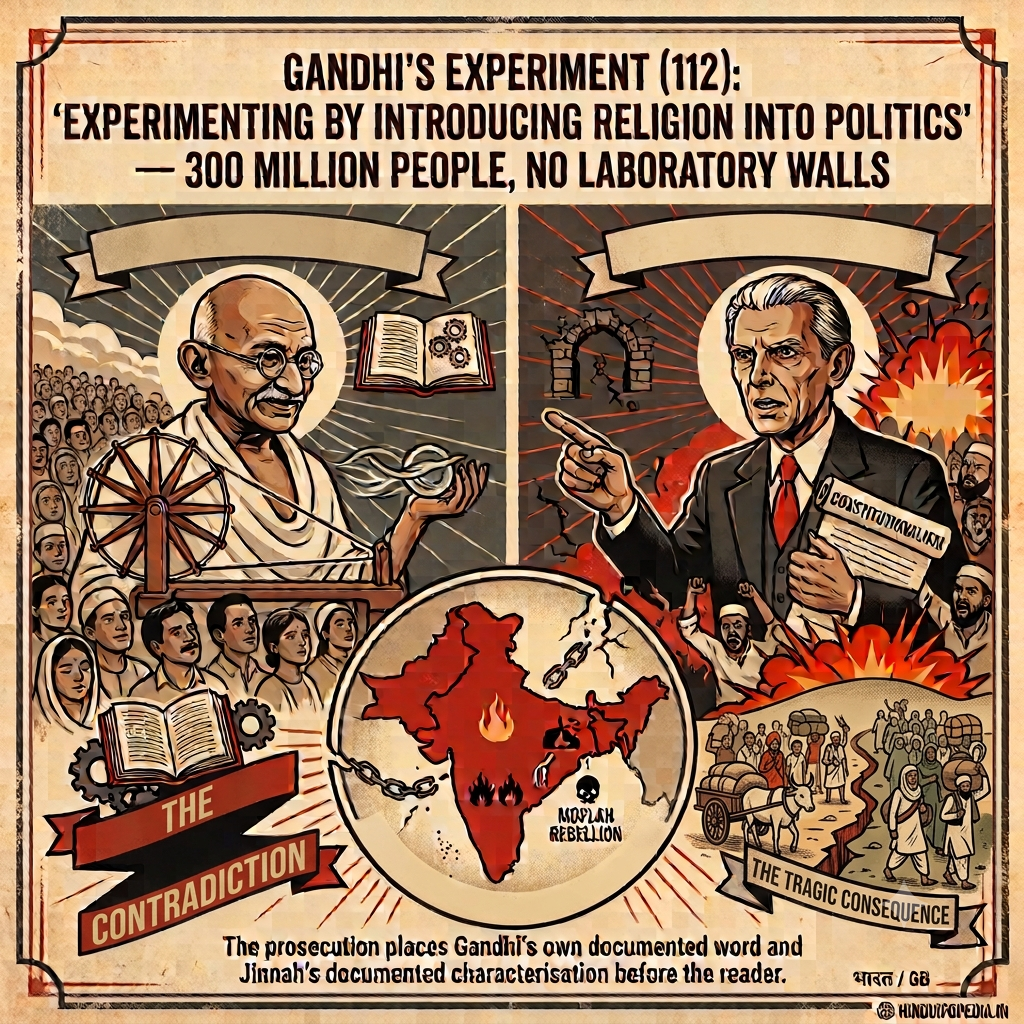
Gandhi’s Experiment: ‘Experimenting’ — 300 Million People, No Laboratory Walls (112)
भारत / GB
Part 112: Mahatma Gandhi’s Peace Efforts | Series Index
Blog 111 placed Gandhi’s no-regret position before the reader — his own documented 1924 words, the Himalayan Blunder defined narrowly, what he chose not to retract. This post on Gandhi’s Experiment isolates the single documented word Gandhi used in May 1920 to describe what he was doing — before the September Calcutta session, before the December Nagpur session, before the consequences arrived — and places the experiment’s documented subjects beside it.
Thank you for reading this post, don't forget to subscribe!The Action Taken: Gandhi explicitly framed his political campaigns and mass alliances as personal spiritual experiments with truth, evaluating national outcomes by internal moral purity rather than empirical human costs.
Who Paid the Price: The 300 million people of British India, who were treated as experimental subjects in an unchallengeable moral laboratory.
The Alternative Bypassed: Grounding national statecraft in empirical political science, legal accountability, and measurable constitutional progress.
Why This Matters: Defines the operating philosophy: national movements were treated as personal moral laboratories where catastrophic external failures were framed as necessary spiritual tests.
The Word Gandhi Chose
On May 12, 1920— four months before Congress formally adopted the Khilafat demands alongside Swaraj at the Calcutta special session — Gandhi wrote in Young India:
“I have been experimenting with myself and my friends by introducing religion into politics.”
Gandhi’s Experiment places one observation before the reader at the outset: Gandhi did not write “trying.” He did not write “working toward.” He did not write “believing.” He wrote “experimenting” — the documented language of a controlled test, of a process whose outcome is uncertain, of a method whose results are to be observed and assessed.
Gandhi immediately clarified in the same article what he meant by “religion”: not institutional Hinduism, but “the religion which transcends Hinduism, which changes one’s very nature, which binds one indissolubly to the truth within.” The prosecution places this clarification before the reader alongside what the practical application of the experiment produced: the Khilafat Movement’s documented demands, established in Blog 102, were the territorial restoration of a defeated foreign empire — the return of Arabia, Syria, Iraq, and Palestine to Ottoman sovereignty. What Gandhi called a spiritual experiment, Jinnah called something else. The documented language of both is placed before the reader.
The Experiment’s Subjects
Consider the sheer scale of the medium. In 1920, British India’s population was approximately 300 million people — the raw environment in which the trial was launched. The documented record does not show that these millions were consulted about whether they wished to be subjects of a political-religious experiment. The documented record does not show that Congress was consulted — Gandhi was not Congress President when he launched the experiment. The documented record does not show that the Working Committee was consulted before the experiment’s terms were set. The documented record does not show that the movement’s own participants were consulted. What the documented record shows, established across this series from Blog 19 (Chauri Chaura) to Blog 91 (Nehru selection): Gandhi carried the experiment forward through documented unchallengeable moral authority that made institutional challenge structurally impossible — not through any documented mandate from the organisation he led, let alone from the 300 million people who were the experiment’s subjects.
This trial was not contained within laboratory walls. It was conducted upon a communal landscape where the human cost unfolded in documented numbers. The series has already placed before the reader: 91 communal riots in Uttar Pradesh alone between 1923 and 1927 (Blog 47). Historian S. Gopal’s documented figures place the full national picture: 16 communal riots in the 22 years before the Khilafat alliance, 72 riots in the 3 years that followed. From the Moplah rebellion — documented in Blogs 54-58 (54, 55, 56, 57 , 58) of this series — to the Jinnah arc documented across Blogs 81-98 (The Jinnah Arc, Split Between Congress and Muslim League, Closing Arc), to the Lahore Resolution of March 1940, the full documented population inherited the consequences of the experiment. The laboratory had no walls. The subjects had no choice.
What Jinnah Called the Same Action
Gandhi’s Experiment places three documented Jinnah characterisations of the same action before the reader — all dated December 1920, the same documented period as the experiment’s formal adoption. All three are dated December 1920 — the same documented period as the experiment’s formal adoption.
At the Nagpur session, December 1920: “it is not the right step to take at this moment… you are committing the Indian National Congress to a programme which you will not be able to carry out.” (Documented in session proceedings, cited in A.G. Noorani.)
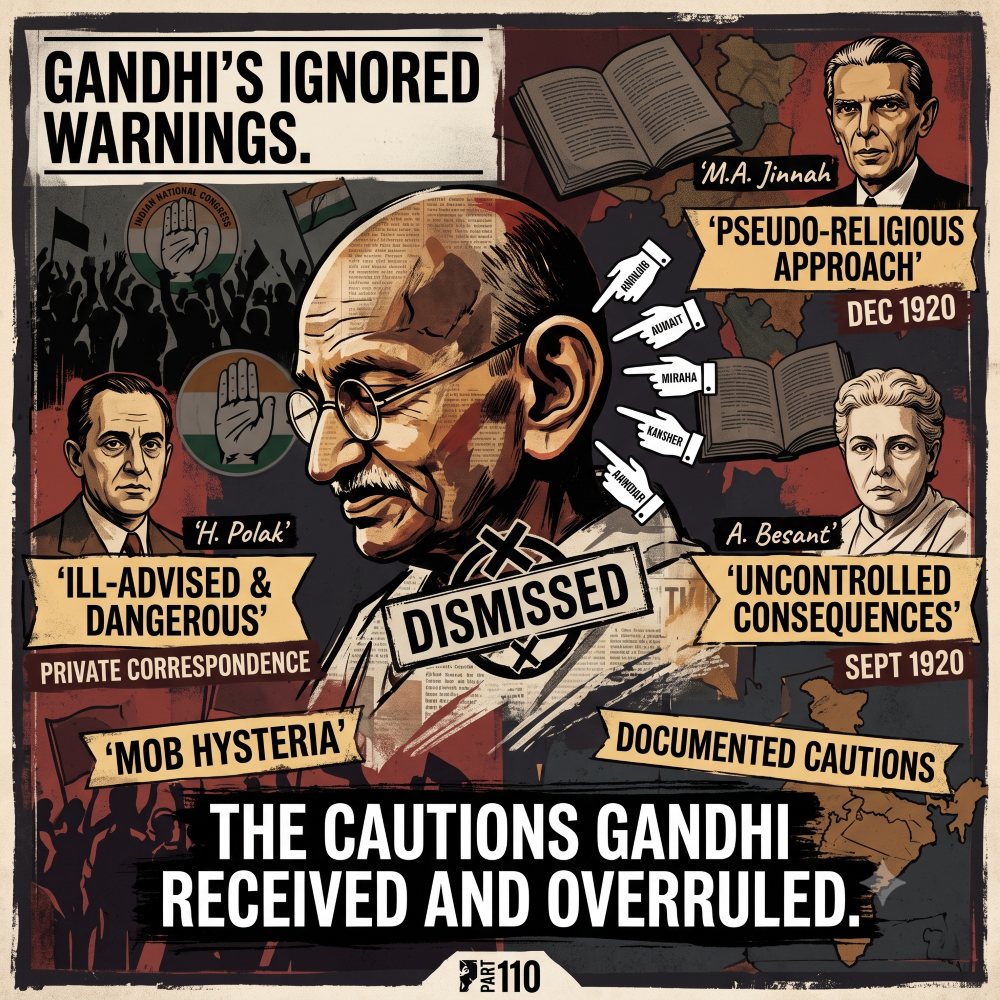
After the Nagpur session, to journalist Durga Das — documented in Das’s India from Curzon to Nehru and After: “I will have nothing to do with this pseudo-religious approach to politics. I part company with Congress and Gandhi. I do not believe in working up mob hysteria.”
Jinnah’s documented characterisation of Gandhi’s Khilafat advocacy, recorded across multiple contemporary sources: an endorsement of religious zealotry, and Gandhi’s proposed satyagraha campaign as political anarchy.
Three documented descriptions of the same action: Gandhi’s own word (experimenting), and Jinnah’s documented words (pseudo-religious, mob hysteria, religious zealotry, political anarchy).
The Nagpur Mechanism
The documented mechanism by which the experiment was carried forward is placed before the reader precisely. At the Nagpur session, Jinnah was the solitary dissenter. He rose to speak and was shouted down. The documented account from Kanji Dwarkadas (India’s Fight for Freedom, Bombay, Popular Prakashan, 1966, pp. 286-287), cited in DAWN, records: had there been a standard delegate composition, Jinnah would have prevailed. Gandhi prevailed because of a highly organised, pro-Khilafat contingent whose vocal presence in the pandal overrode Jinnah’s constitutional dissent — a mobilised bloc Gandhi’s own Khilafat alliance had brought into the session.
The prosecution places this documented mechanism alongside Gandhi’s documented word: Gandhi’s experiment was carried forward at Nagpur by the very religious mobilisation Jinnah was warning against, through the very crowd dynamic Jinnah had called mob hysteria.
The Prosecution’s Position
Gandhi’s Experiment places three questions before the reader.
- Did Gandhi’s own documented word — “experimenting” — place on record that the introduction of religion into politics in 1920 was a deliberate test whose outcome was uncertain, conducted on the documented population of 300 million people in British India?
- Did Jinnah — the man shouted down at Nagpur by the pro-Khilafat contingent Gandhi’s alliance had mobilised — place three documented characterisations of the same action on record: pseudo-religious politics, mob hysteria, religious zealotry and political anarchy?
- Does the documented mechanism by which the experiment was carried forward — a contrived pro-Khilafat mobilisation overriding Jinnah’s solitary constitutional dissent — belong before the reader alongside Gandhi’s own documented word for what he was doing?
The series does not answer. Gandhi’s Experiment places Gandhi’s own documented word, Jinnah’s three documented characterisations, and the documented Nagpur mechanism before the reader. The reader will examine what Gandhi called an experiment — and what its subjects experienced — and complete the sentence.
Invitation To Defence
The floor belongs to the defense. We now invite them to present their exhibits and challenge the narrative established by the prosecution.
May 12 1920, Young India: “I have been experimenting with myself and my friends by introducing religion into politics.” The experiment’s medium: 300 million people. December 1920, Nagpur, Jinnah — shouted down by the pro-Khilafat mobilisation Gandhi’s alliance had brought: “I will have nothing to do with this pseudo-religious approach to politics. I do not believe in working up mob hysteria.” The experiment proceeded. The prosecution places Gandhi’s own documented word and Jinnah’s documented characterisation before the reader. The reader will complete the sentence.
Feature Image: Click here to view the image.
Videos
Glossary of Terms
- Gandhi’s Experiment: The key phrase of this blog, referring to Mahatma Gandhi’s own documented description in Young India of “experimenting” by introducing religion into politics in May 1920.
- Young India: The English weekly journal edited by Mahatma Gandhi in which he published many of his political writings and statements.
- Khilafat Movement: A political movement in British India seeking restoration of the Ottoman Caliphate after the First World War, which Gandhi supported as part of the Non-Cooperation Movement.
- Ottoman Empire: The Turkish empire that ruled large parts of the Middle East, North Africa, and southeastern Europe until its defeat in the First World War.
- Calcutta Special Session (1920): The September 1920 session of the Indian National Congress where the Non-Cooperation programme linked with the Khilafat issue was approved.
- Nagpur Session (1920): The December 1920 Congress session that formally adopted Gandhi’s programme and reorganized the Congress structure.
- Muhammad Ali Jinnah: Prominent constitutional leader who opposed combining religion with politics and later became the founder of Pakistan.
- Pseudo-religious Politics: Jinnah’s documented description of Gandhi’s political approach after the Nagpur Session.
- Mob Hysteria: Jinnah’s documented expression describing mass emotional political mobilisation associated with Gandhi’s movement.
- Political Anarchy: Jinnah’s documented characterization of the proposed political consequences of Gandhi’s mass agitation.
- Moplah Rebellion: The 1921 uprising in Malabar examined extensively in this series as one of the major developments following the Khilafat alliance.
- Lahore Resolution (1940): Resolution adopted by the Muslim League in March 1940, widely regarded as the foundation of the demand for Pakistan.
- Constitutional Dissent: Opposition expressed through constitutional methods, represented in this series by Jinnah’s objections at Nagpur.
- Nagpur Mechanism: A term used in this series describing the documented process through which organised pro-Khilafat mobilisation overrode Jinnah’s constitutional dissent during the Nagpur Session.
- Experiment’s Subjects: A key phrase coined in this series referring to the approximately three hundred million people of British India who were affected by Gandhi’s political experiment.
#Gandhi #Jinnah #Khilafat #Congress #History #India #Politics #Freedom #Ottoman #HinduinfoPedia
Gandhi’s Peace Efforts: The Questions Before the Mahatma (0)