Gandhi’s Death Arithmetic: 22 Policemen, 2,500 Hindus — One Response, One Silence (57)
भारत / GB
Part 57: Mahatma Gandhi’s Peace Efforts | Series Index
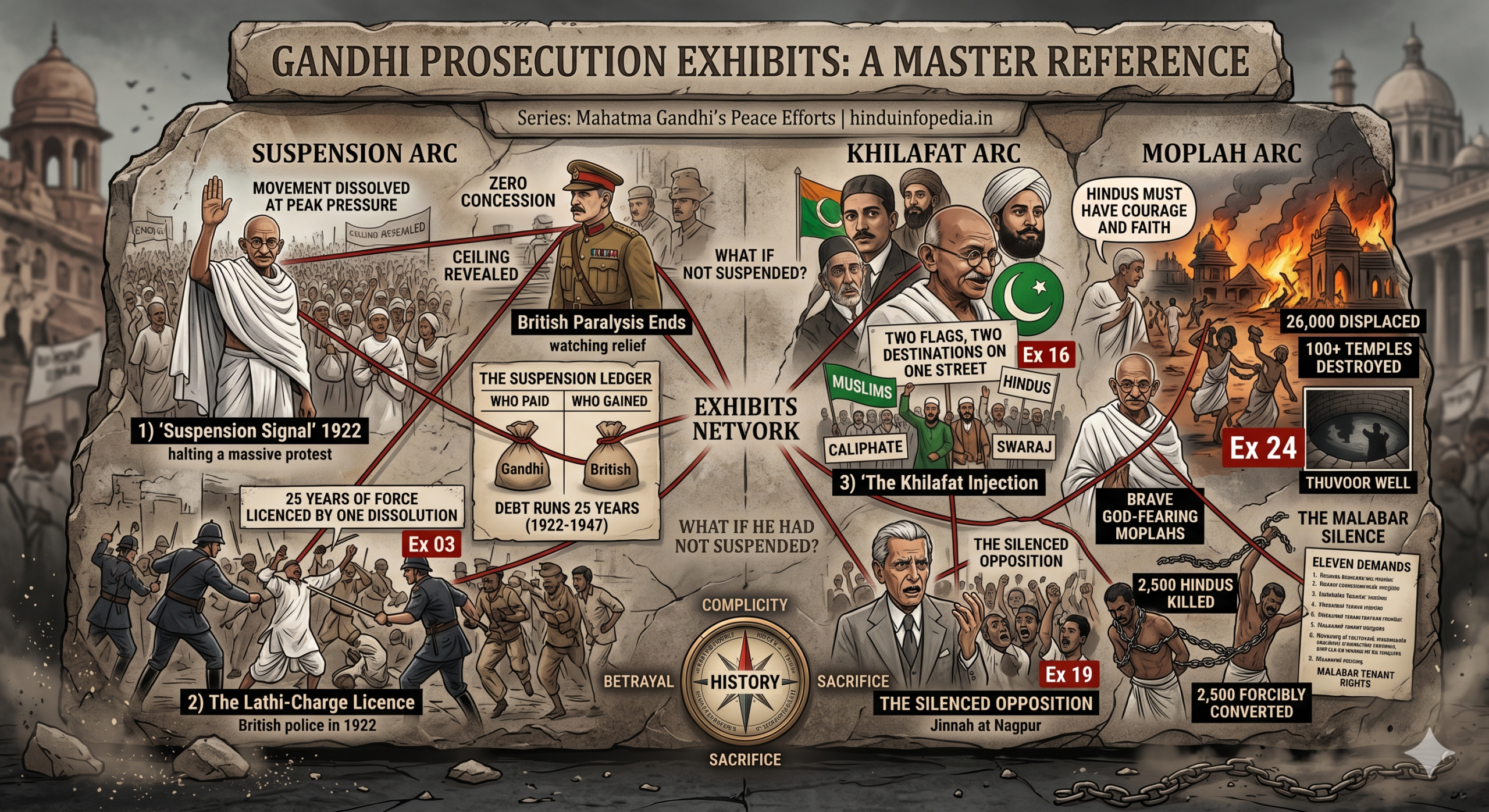
Blog 54 documented the Moplah massacre — 2,500 Hindus killed, 2,500 forcibly converted, 26,000 displaced, 100 temples destroyed. This post places that documentation alongside the event Gandhi did respond to — Chauri Chaura, February 4, 1922 — and asks the reader to examine the two responses side by side. The prosecution does not characterise the comparison. The arithmetic states itself.
Thank you for reading this post, don't forget to subscribe!The Action Taken: Gandhi and the Working Committee maintained the national campaign through 2,500 civilian deaths in Malabar, but dissolved the entire movement over 22 police deaths at Chauri Chaura.
Who Paid the Price: The credibility of a uniform ethical standard, as moral absolute non-violence was applied selectively.
The Alternative Bypassed: Applying a consistent ethical and political standard to violence regardless of who the victims or perpetrators were.
Why This Matters: The central comparative exhibit of the series: places before the reader the documented asymmetry between maintaining alliances through mass civilian casualties versus halting campaigns over state police deaths.
The Two Events — Stated Precisely
Gandhi’s Death Arithmetic begins with the documented facts of both events — stated without commentary, placed side by side.
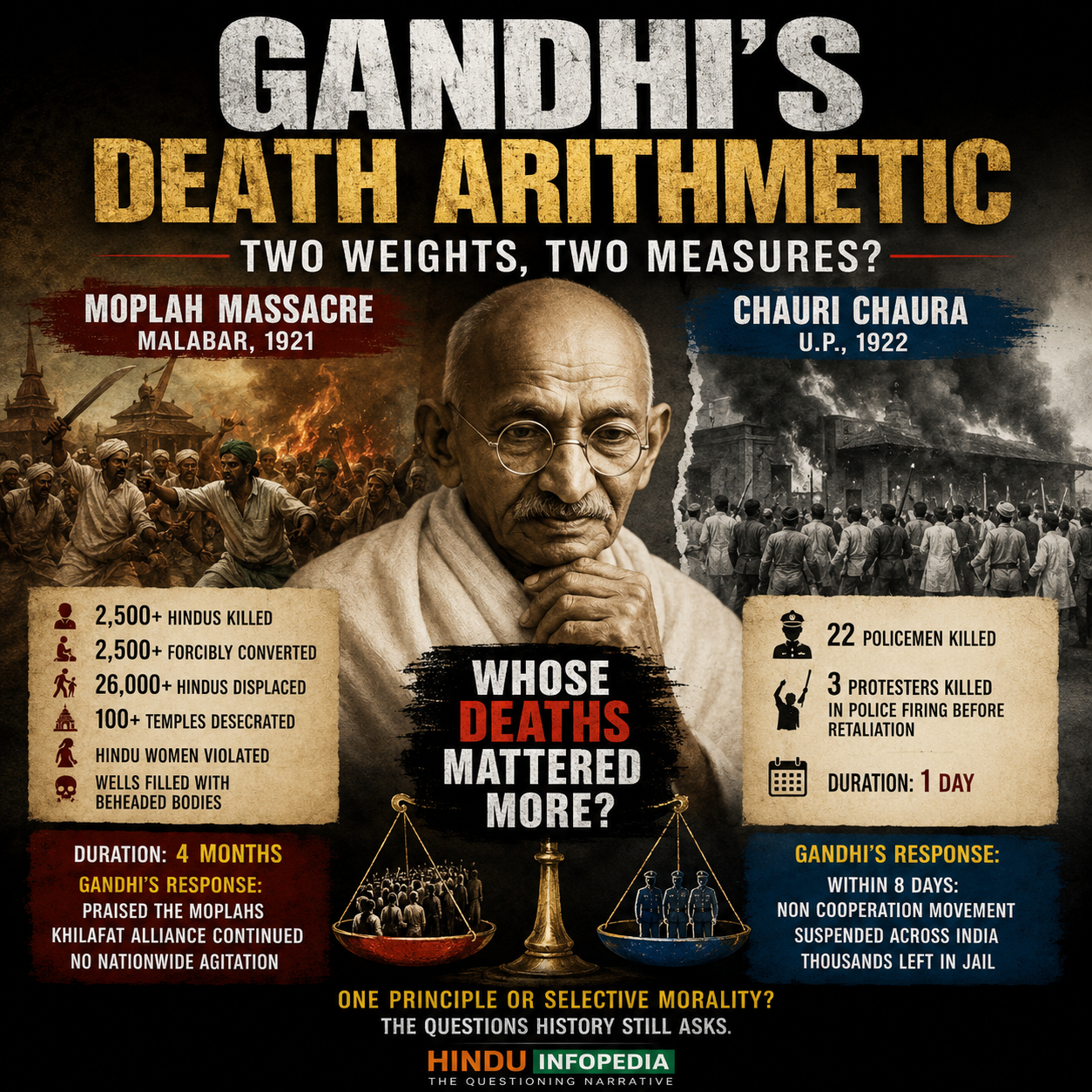
Moplah Massacre — August to December 1921:
Moplahs — energised by the Khilafat movement Gandhi had allied to the independence movement — attacked Hindu landlords and peasants in Malabar. At least 2,500 Hindus were killed. At least 2,500 Hindus were forcibly converted to Islam. 26,000 Hindus fled as refugees. More than 100 Hindu temples were desecrated or destroyed. Hundreds of Hindu women were raped and sexually assaulted. The Thuvoor well was filled with the beheaded bodies of 38 Hindus on September 25, 1921. The massacre ran for four months — August to December 1921.
Chauri Chaura — February 4, 1922:
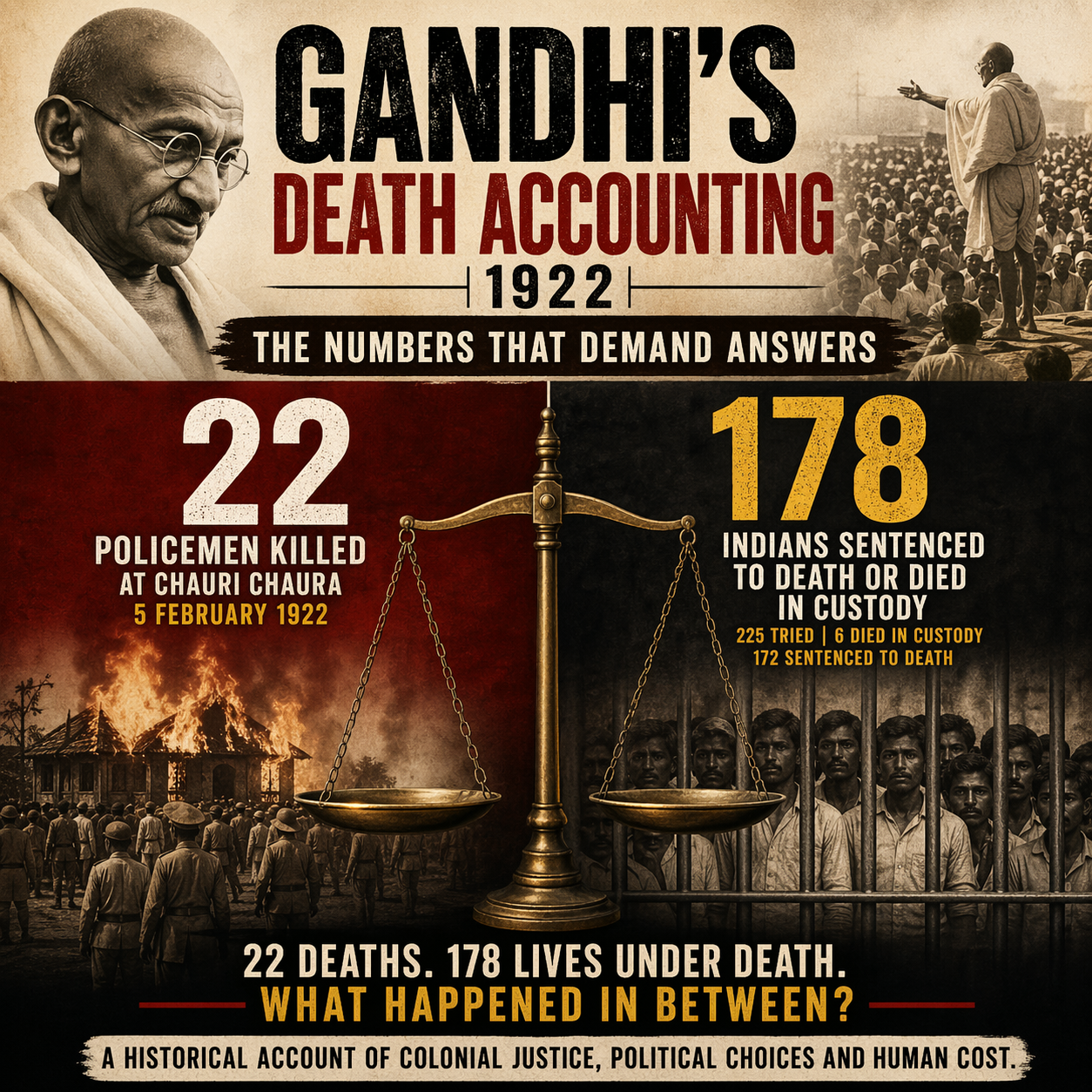
Indians who had trusted Gandhi’s call as genuine — freedom fighters who had joined the independence struggle, not Gandhi’s personal followers — were marching in Chauri Chaura in the United Provinces. The police opened fire on the crowd first. The crowd retaliated, chased the police into their station, and set the building on fire. Twenty-two policemen died — some killed in the confrontation, some burned alive in the station. Three freedom fighters were also killed by police fire before the retaliation. The incident lasted one day.
The Two Responses — Stated Precisely
Gandhi’s response to the Moplah Massacre:
Gandhi described the perpetrators as the “brave God-fearing Moplahs who were fighting for what they consider as religion and in a manner which they consider as religious.”
He told the Hindus of Malabar they must have the courage and faith to protect their religion in spite of such fanatical eruptions.
He did not condemn the killing. He did not condemn the forced conversions. He did not condemn the temple destruction. He did not fast. He did not call satyagraha. He did not demand that the Khilafat leadership condemn the massacre. He did not withdraw his support for the Khilafat alliance. The alliance continued. The Khilafat movement continued. Gandhi’s support continued.
Gandhi’s response to Chauri Chaura:
Gandhi suspended the entire Non-Cooperation Movement on February 12, 1922 — eight days after Chauri Chaura. He did not consult the Congress Working Committee. He did not seek a mandate from the thirty thousand in jail. He announced the suspension unilaterally. He called Chauri Chaura a tragedy that had shamed India and demonstrated that the country was not ready for non-violent resistance.
The thirty thousand in jail received nothing. 172 Chauri Chaura defendants were sentenced to death. The movement that had brought the British to documented alarm was dissolved. The British administration’s seventeen months of paralysis ended in twenty-six days. The Lathi-Charge Licence was issued — the British now knew Gandhi’s ceiling and could deploy force with operational confidence for twenty-five years.
The Arithmetic — Column by Column
Gandhi’s Death Arithmetic places the two events in parallel columns — not to assert equivalence of circumstance but to document the difference in Gandhi’s response:
Who died:
Moplah — at least 2,500 Hindus.
Chauri Chaura — 22 policemen.
Who killed:
Moplah — Moplah Muslims energised by Gandhi’s Khilafat alliance.
Chauri Chaura — Indian protesters energised by Gandhi’s Non-Cooperation movement.
Gandhi’s characterisation of the killers:
Moplah — brave, God-fearing, fighting for religion.
Chauri Chaura — a mob that had shamed India and demonstrated its unreadiness for non-violent resistance.
Gandhi’s instrument deployed:
Moplah — nothing.
Chauri Chaura — dissolution of the entire movement.
What the victims received:
Moplah Hindus — instruction to have courage and faith.
Chauri Chaura policemen — the movement dissolved in their name.
What the movement’s participants received:
Moplah — nothing. Alliance maintained. Khilafat movement continued.
Chauri Chaura — thirty thousand in jail received nothing. Movement dissolved overnight.
Beneficiary:
Moplah — Khilafat alliance preserved. Gandhi’s Muslim numerical support protected.
Chauri Chaura — British administration received Gandhi’s ceiling, paralysis ended, and the Lathi-Charge Licence was issued. Twenty-five years of operational confidence to deploy force against Indians — granted by one dissolution.
The Timeline — Five Months
Gandhi’s Death Arithmetic requires one additional documented fact — the timeline between the two events.
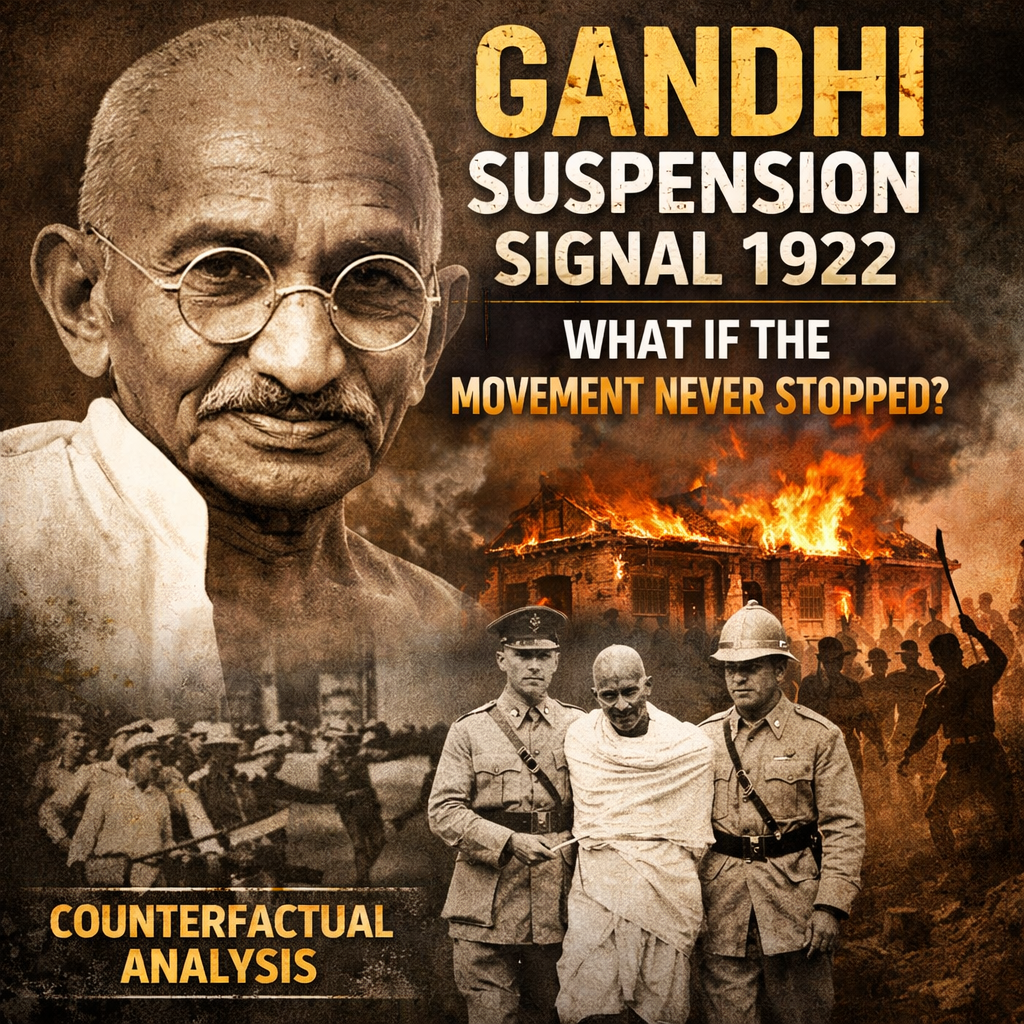
The Moplah massacre began August 20, 1921. It ran until December 1921. Gandhi’s response: brave God-fearing men. Alliance maintained.
Chauri Chaura occurred February 4, 1922 — five months after the Moplah massacre began, two months after it ended. Gandhi’s response: movement dissolved in eight days.
The principle of non-violence did not activate during four months of Hindu killing in Malabar. It activated eight days after twenty-two policemen died in the United Provinces.
The prosecution does not assert what this timeline means. It places it before the reader.
The Three-Column Ahimsa Record
Blog 40 documented the ahimsa asymmetry across two columns — Jallianwala Bagh and Chauri Chaura. Gandhi’s Death Arithmetic adds the Moplah column to complete the three-column record:
British violence against Indians:
At least 489 documented dead at Jallianwala Bagh including Hassan Mohammad, nine years old.
Gandhi’s response: no fast, no satyagraha, movement continued.
Muslim violence against Hindus:
At least 2,500 Hindus killed, 2,500 forcibly converted, 26,000 displaced.
Gandhi’s response: brave God-fearing men. No fast. No satyagraha. Alliance maintained.
Indian backlash to British provocation at Chauri Chaura:
Police fired first. Freedom fighters who trusted Gandhi’s call retaliated. Twenty-two policemen died.
Gandhi’s response: entire movement dissolved in eight days. Thirty thousand who had trusted his call received nothing. The Lathi-Charge Licence was the British administration’s reward.
The principle activated once across three columns — against Indian violence against British authority. It did not activate against British violence against Indians. It did not activate against Muslim violence against Hindus.
The Prosecution’s Position
Gandhi’s Death Arithmetic does not claim Gandhi did not care about Hindu lives. It claims the documented record of his responses across three categories of violence is inconsistent with a principle of non-violence applied universally.
A principle applied universally produces consistent responses. A principle applied selectively produces a pattern. The pattern the series has documented across three domains — Jallianwala, Moplah, Chauri Chaura — is consistent in one direction: the instrument activated against the resistance that threatened British administrative authority. It did not activate against British violence. It did not activate against Muslim violence against Hindus.
The question the Complicity Test placed before the reader applies here with its full documented weight: why should critics not call the man whose principle activated consistently in one direction a British asset?
The series does not answer. The reader has the arithmetic. The next post documents what Gandhi said — in his own words — while 2,500 Hindus were being killed in Malabar.
2,500 Hindus killed in Malabar — brave God-fearing men, Gandhi said. 22 policemen killed at Chauri Chaura — movement dissolved in eight days, Gandhi did. The principle activated once across three documented domains. The reader will identify the direction in which it activated — and the direction in which it did not.
Feature Image: Click here to view the image.
Videos
Glossary of Terms
- Moplah Massacre: The large-scale violence in Malabar during nineteen twenty one in which thousands of Hindus were reportedly killed, displaced, forcibly converted, and subjected to attacks during the Khilafat period.
- Chauri Chaura Incident: A February nineteen twenty two घटना in the United Provinces where protesters retaliated after police firing and a police station was burned, leading Gandhi to suspend the Non Cooperation Movement.
- Khilafat Movement: A political and religious mobilisation launched after the First World War to support the Ottoman Caliphate, later aligned with Gandhi’s Non Cooperation campaign.
- Non Cooperation Movement: A nationwide movement launched by Mahatma Gandhi in nineteen twenty against British rule through boycott of institutions, goods, and administration.
- Malabar: A coastal region in present-day Kerala where the Moplah uprising and associated violence occurred during nineteen twenty one.
- Thuvoor Well: A location repeatedly cited in historical accounts of the Moplah violence where Hindu victims were reportedly killed and their bodies disposed of in a well.
- Ahimsa Asymmetry: A phrase used in this series to describe the argument that Gandhi’s principle of non violence appeared to operate differently across separate categories of violence.
- Lathi Charge Licence: A coined expression in this series referring to the argument that suspension of the Non Cooperation Movement gave British authorities confidence to use force against Indian protests.
- Death Arithmetic: A coined phrase in this blog describing the comparison between Gandhi’s responses to deaths in Malabar and Chauri Chaura.
- Complicity Test: A framework developed in this series examining whether repeated political outcomes linked to Gandhi’s decisions consistently benefited British administrative authority.
- Congress Working Committee: The principal decision-making body of the Indian National Congress during the freedom movement.
- United Provinces: The British Indian administrative region where Chauri Chaura occurred, largely corresponding to present-day Uttar Pradesh.
- Jallianwala Bagh: The Amritsar site where British troops fired on an unarmed gathering in nineteen nineteen, killing hundreds according to historical records.
- Forced Conversion: The coercive conversion of individuals from one religion to another under threat, violence, or intimidation.
- Satyagraha: Gandhi’s method of political resistance based on non violent protest and civil disobedience against authority.
#HinduinfoPedia #Gandhi #History #India #Khilafat #Moplah #ChauriChaura #Congress #Freedom #BritishIndia