
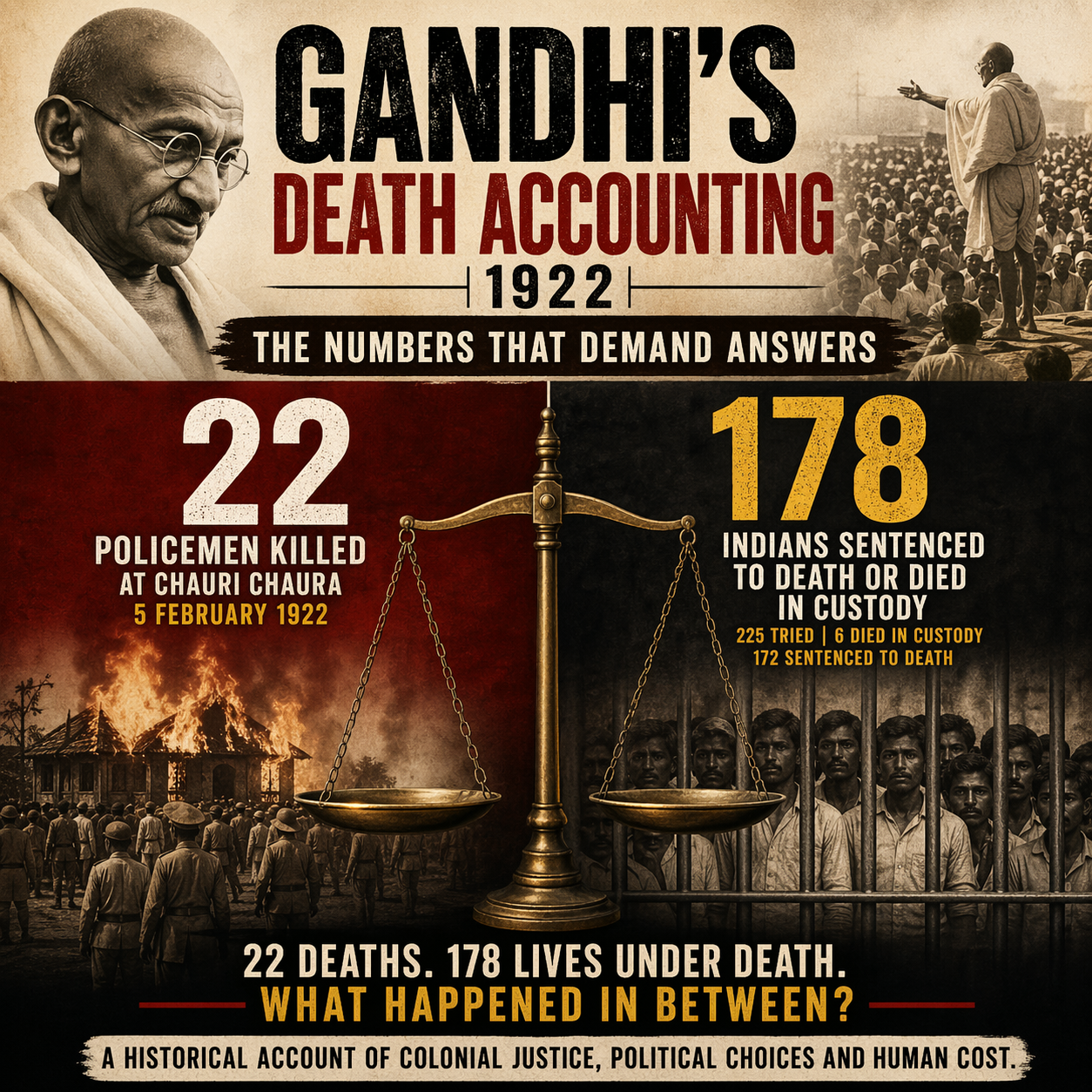
Gandhi’s Death Accounting 1922: 22 Against 178 (35)
भारत / GB
Part 35: Mahatma Gandhi’s Peace Efforts | Series Index
Blog 34 opened the Suspension Ledger — four entries, two columns, the arithmetic of February 12, 1922 stated in its plainest form. Entry Two documented the Chauri Chaura defendants: the people Gandhi cited as his reason for the suspension, and the people the suspension left most exposed. This post takes that entry out of the ledger and places it under a light of its own. The numbers are not complicated. The accounting is. Gandhi’s Death Accounting 1922 looks at the death toll counting that triggered Gandhi’s conscience to stop the non-cooperation movement and in an unfortunate incident at Chauri-Chaura.
Thank you for reading this post, don't forget to subscribe!The Action Taken: The national leadership cited the deaths of 22 colonial policemen to terminate the movement, but organized no nationwide satyagraha or fast for the 172 marchers condemned to the gallows.
Who Paid the Price: The 172 local villagers who faced colonial capital sentencing without an active national political campaign to plead their mitigation.
The Alternative Bypassed: Linking movement cessation to a general political amnesty for all incidents arising directly out of police provocation.
Why This Matters: The moral accounting of the suspension record: the loss of twenty-two colonial police lives produced immediate dissolution, while 172 capital convictions of followers produced silence.
The Numbers the Series Has Been Carrying
Gandhi’s Death Accounting 1922 begins with two numbers that have appeared in every blog in this arc without being placed side by side until now.
Twenty-two. One hundred and seventy-eight.
Twenty-two is the number of policemen who died at Chauri Chaura on February 5, 1922 — killed when a crowd, provoked by police lathi charges on Congress volunteers, attacked and burned the local police station.
One hundred and seventy-eight is the number of Indians sentenced to death by the Gorakhpur Sessions Court in the trials that followed as a consequence of Gandhi’s Lathi-charge license to the British Raj or, otherwise, or killed by the British as detailed.
Gandhi’s Death Accounting 1922
| Category | Number |
| Died in police custody during trial | 6 |
| Sentenced to death initially | 172 |
| Total Accountable Death | 178 |
Gandhi’s Death Accounting is the ratio between these two numbers — and what that ratio reveals about the colonial administration’s response, Gandhi’s response, and the variance between the two.
The Colonial Arithmetic
A total of 225 people were brought to trial. Of these, six died while in police custody, 172 were convicted and sentenced to death, while 47 were acquitted.
The Sessions Court judge — H.E. Holmes — processed the trial in eight months and delivered death sentences at a rate that M.N. Roy, the Indian communist leader, characterised as legalised murder.
The ratio: for twenty-two policemen killed, the colonial Sessions Court sentenced one hundred and seventy-eight Indians to death. Nearly eight death sentences for every life taken.
This was not justice. It was colonial arithmetic — the systematic conversion of one incident into the maximum possible number of executions, designed to make the cost of resistance visible to every village in the United Provinces. The extraction machine documented in Blog 13 ran not only on revenue and trade. It ran on exemplary punishment. One hundred and seventy-eight death sentences for twenty-two deaths was not proportionate response. It was a message.
The message required a movement to answer it. The movement had been dissolved seven days before the trial even began.
Gandhi’s Death Accounting 1922: The Arithmetic
Gandhi’s Death Accounting 1922 requires a second column — what Gandhi did while the colonial administration processed one hundred and seventy-eight death sentences against men who had marched under his movement.
The record is unambiguous.
Gandhi suspended the Non-Cooperation Movement on February 12, 1922 — citing the twenty-two deaths as the moral justification.
He then went on trial himself on March 18, 1922, pleaded guilty to sedition, and was sentenced to six years. He served two before release on health grounds.
For the one hundred and seventy-eight: no satyagraha. No hunger strike. No organised political pressure on the colonial administration processing their executions. No appeal filed. No fast announced. No statement demanding their release or commutation.
Gandhi fasted for five days in November 1921 when traders and Congress supporters clashed in Bombay. He fasted for twenty-one days in 1924 for Hindu-Muslim unity. He fasted unto death in 1932 to overturn the Communal Award that protected Dalit political rights. He fasted in 1943 for his own release from detention.
For one hundred and seventy-eight men sentenced to die because they had participated in his movement — nothing.
The Instrument He Did Not Use
The series has documented across thirty-four blogs what Gandhi’s instruments were capable of producing when he chose to deploy them.
A hunger strike in 1932 compelled Ambedkar — who held a legally constituted British government award — to surrender the separate electorate that protected Dalit political representation. The fast lasted six days. The pressure it generated was sufficient to overturn a formal British government decision.
A fast in 1924 lasted twenty-one days and commanded the political attention of the entire country.
The question Gandhi’s Death Accounting 1922 places before the reader is not complicated: if a six-day fast could overturn a British government award, what would a fast for the one hundred and seventy-eight have produced — announced before the Sessions Court delivered its verdict, at the moment when the movement still had residual moral authority and Gandhi still had his freedom?
The series does not answer this. It places the question next to the documented record of what Gandhi chose to fast for, and what he did not.
What the Ratio Means
Gandhi’s Death Accounting 1922 is not primarily about the colonial administration’s excess. The colonial administration’s excess was predictable — Jallianwala Bagh had shown it four years earlier, and the administration had no reason to moderate its response to a movement it now knew had dissolved itself.
The licence had been issued on February 12, 1922. The Sessions Court issued its death sentences in January 1923 — eleven months after the movement had been dissolved, with no organised political pressure remaining and no possibility of a reconstituted satyagraha creating cost for the administration. The colonial arithmetic of eight death sentences for every policeman killed was issued into a political vacuum. Gandhi’s suspension had created that vacuum.
The one hundred and seventy-eight are not a footnote to the suspension. They are its most precise consequence — the documented human cost of a political vacuum Gandhi created and then declined to fill.
The prosecution has stated from Blog 10 that the arithmetic was consistent. Gandhi’s Death Accounting 1922 is the arithmetic of one specific consequence, stated in two numbers: twenty-two deaths produced the justification for the suspension. One hundred and seventy-eight death sentences were the suspension’s most direct human cost.
The ratio is the prosecution’s exhibit. The series does not add a verdict.
But one man did not leave the sentenced freedom fighters without a voice. He was not Gandhi. He was not Congress. He went to the Allahabad High Court with a legal brief and saved a hundred and fifty-one of them from the gallows.
That man is the subject of the next post.
Not a Prosecution
This post is not a prosecution. It is an account. The twenty-five Indians who died in police custody and on the gallows, the one hundred and seventy-eight who spent years under a death sentence, the thousands who marched into a movement that was dissolved without warning — they have no memorial in the standard history of the independence movement. The history that carries Gandhi’s name does not carry theirs.
Gandhi’s Death Accounting does not exist to diminish the independence movement. It exists because these people were part of it — they built it, they paid for it, and they were left out of its record. An honest account of what the movement cost requires their names in the ledger.
The series places them there.
Twenty-two policemen died. One hundred and seventy-eight men were sentenced to die. Gandhi suspended the movement that might have made those sentences a political cost — seven days before the trial began. He deployed his instrument for Bombay, for Hindu-Muslim unity, for the Communal Award, for his own release. For the one hundred and seventy-eight who had marched under his movement: Gandhi’s Death Accounting records nothing in that column.
Feature Image: Click here to view the image.
Videos
Glossary of Terms
- Chauri Chaura Incident: A 1922 घटना in Gorakhpur where a हिंसक भीड़ set fire to a police station, killing 22 policemen, triggering major political consequences.
- Non-Cooperation Movement: A mass आंदोलन led by Mahatma Gandhi urging Indians to withdraw from British institutions as a form of peaceful resistance.
- Colonial Arithmetic: A term used in this series to describe disproportionate punitive actions by the British Raj, converting one incident into large-scale repression.
- Sessions Court: A higher judicial court in British India that handled serious criminal trials, including capital punishment cases like Chauri Chaura.
- United Provinces: A British-era administrative region (now largely Uttar Pradesh) where the Chauri Chaura trials and executions occurred.
- Satyagraha: A philosophy and method of non-violent resistance developed by Mahatma Gandhi based on truth and moral force.
- Death Accounting 1922: A key phrase coined in this blog referring to the comparative numerical analysis of 22 policemen killed versus 178 Indians sentenced or dead.
- Political Vacuum: A condition described in this series where withdrawal of a mass movement leaves no organized resistance against state actions.
- Lathi Charge: A police tactic involving baton charges on crowds, commonly used by British authorities to suppress protests.
- Commutation: The legal process of reducing a death sentence to a lesser punishment, often through appeals or executive intervention.
- Sedition Trial (1922): The trial of Mahatma Gandhi in March 1922 where he pleaded guilty to anti-colonial writings and was sentenced to imprisonment.
- Communal Award: A 1932 British decision granting separate electorates to minorities, later opposed by Gandhi through a fast.
- Hunger Strike / Fast: A political method used by Gandhi to exert moral pressure by voluntarily abstaining from food.
- Extraction Machine: A term from this series describing the economic and coercive mechanisms of the British colonial system.
- Legalised Murder (Phrase): A characterization attributed to M. N. Roy describing the mass death sentences as unjust judicial action
#Gandhi #ChauriChaura #IndianHistory #FreedomStruggle #BritishRaj #ColonialIndia #Satyagraha #Independence #History #HinduinfoPedia
Scan Through The Entire Series at
Gandhi’s Peace Efforts: The Questions Before the Mahatma (0)
Refer to Various Arks Referred to in the Blog