
Gandhi’s Day of Deliverance: Ending of Ministry Period — and Gandhi’s Reaction (93)
भारत / GB
Part 93: Mahatma Gandhi’s Peace Efforts | Series Index
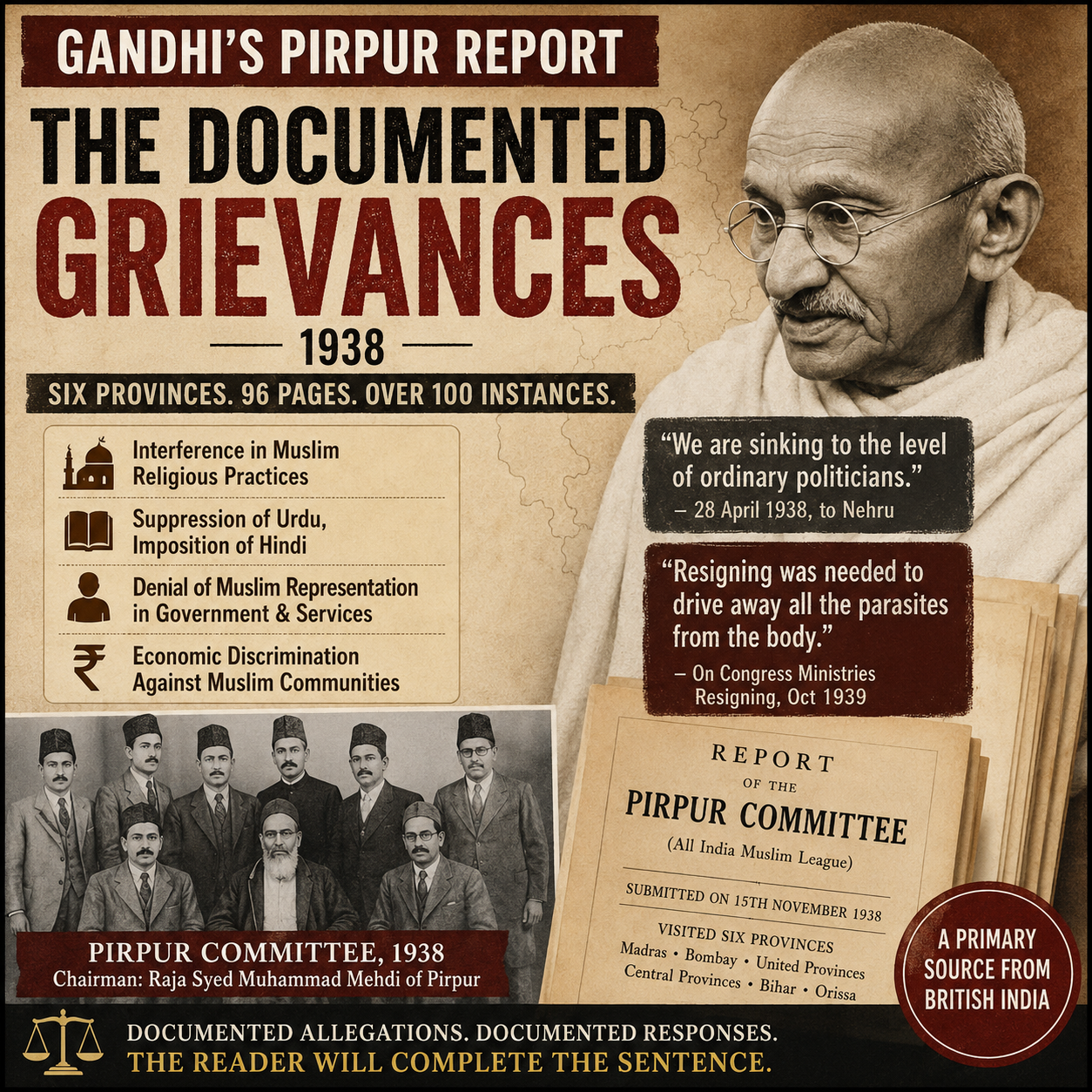
Blog 92 documented the Pirpur Report — the Muslim League’s catalogued grievances against Congress ministry rule, 1937-1939. This post documents how the ministry period ended, and places Gandhi’s own dated words on the episode before the reader.
Thank you for reading this post, don't forget to subscribe!The Action Taken: Following the resignation of Congress provincial ministries, Jinnah organized a nationwide “Day of Deliverance and Thanksgiving,” drawing Dr. B.R. Ambedkar and diverse minority groups onto a shared anti-Congress platform.
Who Paid the Price: The claim of the Indian National Congress to represent the universal, undivided interests of all non-British Indians.
The Alternative Bypassed: Constructing constitutional and administrative guarantees that would assure minority communities of equitable participation in provincial power.
Why This Matters: Documents the convergence of minority dissent: the coalition of Dalits, Muslims, and other minorities publicly celebrating the departure of Congress rule exposed the failure of moral hegemony.
The Resignation — Documented
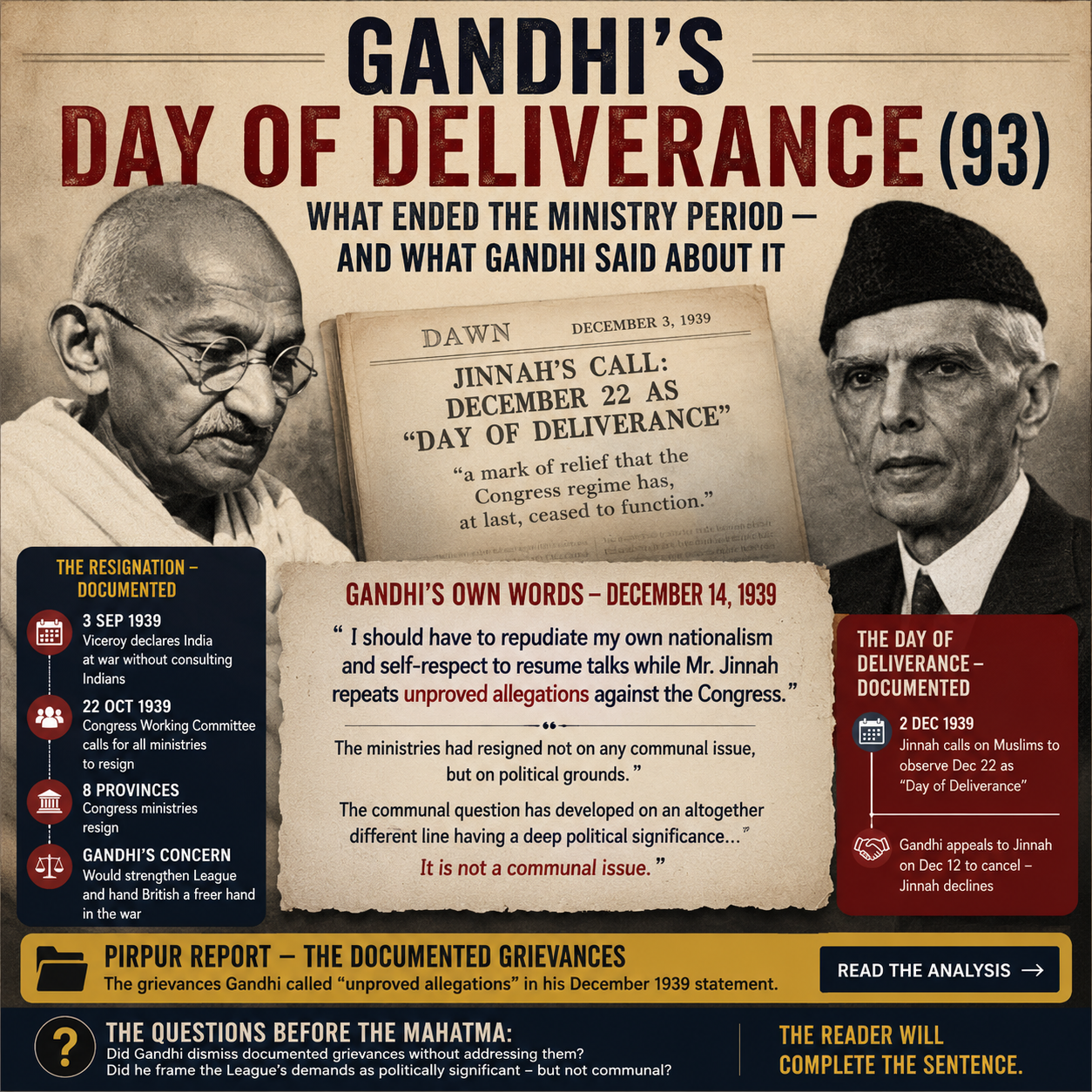
On September 3 1939, Viceroy Lord Linlithgow declared India at war with Germany without consulting elected Indian representatives. Congress objected to the unilateral declaration. On October 22 1939, the Congress Working Committee called upon all Congress ministries to resign.
Congress ministers in eight provinces resigned. The documented record on Gandhi’s own position is precise: the resignation was supported by Jawaharlal Nehru, but less so by Mahatma Gandhi, who felt it would strengthen the Muslim League and hand the British a freer hand to militarise India during the war. Both the Viceroy and Jinnah were documented as pleased with the outcome — the resignation that Gandhi himself had reservations about produced the precise consequence he had feared.
Gandhi’s Day of Deliverance places this documented fact before the reader at the outset — Gandhi himself had reservations about the resignation decision before Jinnah’s response made it a documented exhibit.
Jinnah’s Declaration — Documented
On December 2 1939, Jinnah called on Indian Muslims to observe December 22 as a “Day of Deliverance” — his own documented words: “a mark of relief that the Congress regime has, at last, ceased to function.” The Viceroy had personally convened Gandhi, the Congress President, and Jinnah for discussion, advising that Congress would need to settle its differences with the League on provincial matters. Jinnah declined to send a joint note to the Viceroy.
Gandhi personally appealed to Jinnah on December 12 1939 to cancel the observance, arguing it would damage prospects for communal harmony. Jinnah declined.
Gandhi’s Own Documented Words
Gandhi’s Day of Deliverance places Gandhi’s own dated statement before the reader, preserved in full at nehruarchive.in, dated December 14 1939:
Gandhi wrote that he would have to repudiate his own nationalism and self-respect to resume talks with Jinnah while Jinnah repeated what Gandhi called “unproved allegations against the Congress.” Gandhi stated the ministries had resigned “not on any communal issue, but on political grounds” — over the war declaration, not over Muslim grievances. He wrote that the communal question in India had, over the preceding two years, developed “on an altogether different line having a deep political significance” — citing the demand for League representation in ministries and coalition formation as the substance of that line, while denying it was a communal issue.
Gandhi’s Day of Deliverance places this characterisation before the reader without alteration. Gandhi himself, in his own dated December 1939 words, framed the League’s coalition demands — documented across Blogs 88, 89, and 90 — as a matter he did not classify as communal. This is a documented contradiction within Gandhi’s own statement: he identified the political significance of the League’s exclusion while simultaneously dismissing the League’s account of its consequences as unproved.
The Documented Asymmetry
Gandhi’s Day of Deliverance places one further documented fact before the reader. Gandhi called Jinnah’s grievances “unproved allegations.” The Pirpur Report’s documented findings — corroborated in part by Congress’s own Muslim Mass Contact office, as established in Blog 92 — are not addressed in Gandhi’s December 14 statement on their substance. Gandhi’s documented response was to dispute the characterisation of the resignation, not to engage with the catalogued grievances themselves.
The Prosecution’s Position
Gandhi’s Day of Deliverance places three questions before the reader.
- Did Gandhi, in his own dated December 14 1939 statement, characterise the Pirpur Report’s documented grievances as “unproved allegations” without addressing their specific documented content?
- Did Gandhi’s own words frame the League’s coalition demands — documented across Blogs 88, 89, and 90 — as a matter of “deep political significance” that he explicitly did not classify as communal, even as the League experienced it as exclusion from political participation?
- Did Gandhi’s initial reservation about the ministry resignation — that it would strengthen the League — followed by his December 1939 dismissal of the League’s grievances as unproved, represent a consistent documented position toward the League’s documented case?
The series does not answer. Gandhi’s own words are the primary source, preserved at nehruarchive.in. The reader will examine Gandhi’s documented statement alongside the Pirpur Report it dismissed and complete the sentence.
Invitation To Defence
We now invite the defence to present its exhibits, offering a direct rebuttal to the evidence put forth in the prosecution’s case.
December 14 1939. Gandhi’s own words: “unproved allegations against the Congress.” The ministries had resigned “not on any communal issue, but on political grounds.” The communal question had “a deep political significance” — but was, in Gandhi’s own framing, not communal. The Pirpur Report’s documented grievances, corroborated in part by Congress’s own outreach office, are not engaged on their substance. The prosecution places Gandhi’s own dated words before the reader. The reader will complete the sentence.
Feature Image: Click here to view the image.
Videos
Glossary of Terms
- Day of Deliverance: The observance called by Muhammad Ali Jinnah for twenty-second December nineteen thirty-nine to mark what he described as relief from Congress ministry rule after the resignations of Congress governments.
- Congress Ministries: Provincial governments formed by the Indian National Congress after the elections held under the Government of India Act of nineteen thirty-five.
- Congress Working Committee: The principal decision-making body of the Indian National Congress that directed Congress ministries to resign in October nineteen thirty-nine.
- Lord Linlithgow: The Viceroy of India who declared India at war with Germany on behalf of the British Empire without consulting elected Indian representatives.
- Muhammad Ali Jinnah: Leader of the All-India Muslim League who later became the founding leader of Pakistan.
- Pirpur Report: A report prepared under the auspices of the Muslim League that catalogued complaints and grievances regarding Congress ministry rule between nineteen thirty-seven and nineteen thirty-nine.
- Muslim League: A political organization founded in nineteen hundred and six that represented Muslim political interests in British India.
- Communal Question: The political issue concerning relations, representation, and power-sharing among India’s religious communities during the late colonial period.
- Coalition Formation: The process of forming a government through cooperation between multiple political parties or groups.
- Muslim Mass Contact Office: A Congress initiative intended to expand political outreach among Muslims and assess support and grievances within the community.
- Provincial Autonomy: The system introduced under the Government of India Act of nineteen thirty-five that granted elected provincial governments greater administrative authority.
- Unproved Allegations: Gandhi’s characterization, in his December fourteen nineteen thirty-nine statement, of the accusations being made against Congress by the Muslim League.
- Gandhi’s Day of Deliverance: The key phrase of this blog, referring to Gandhi’s response to Jinnah’s Day of Deliverance declaration and the political debate surrounding it.
- Documented Asymmetry: A term used in this series to describe a situation where allegations are dismissed while their underlying claims are not substantively addressed.
- Prosecution’s Position: The series’ narrative framework in which evidence, quotations, and historical questions are presented to readers without explicitly delivering a final verdict.
#HinduinfoPedia #Gandhi #Jinnah #Congress #History #India #Politics #Partition #Freedom #MuslimLeague
Gandhi’s Peace Efforts: The Questions Before the Mahatma (0)
Refer to Various Arks Referred to in the Blog