
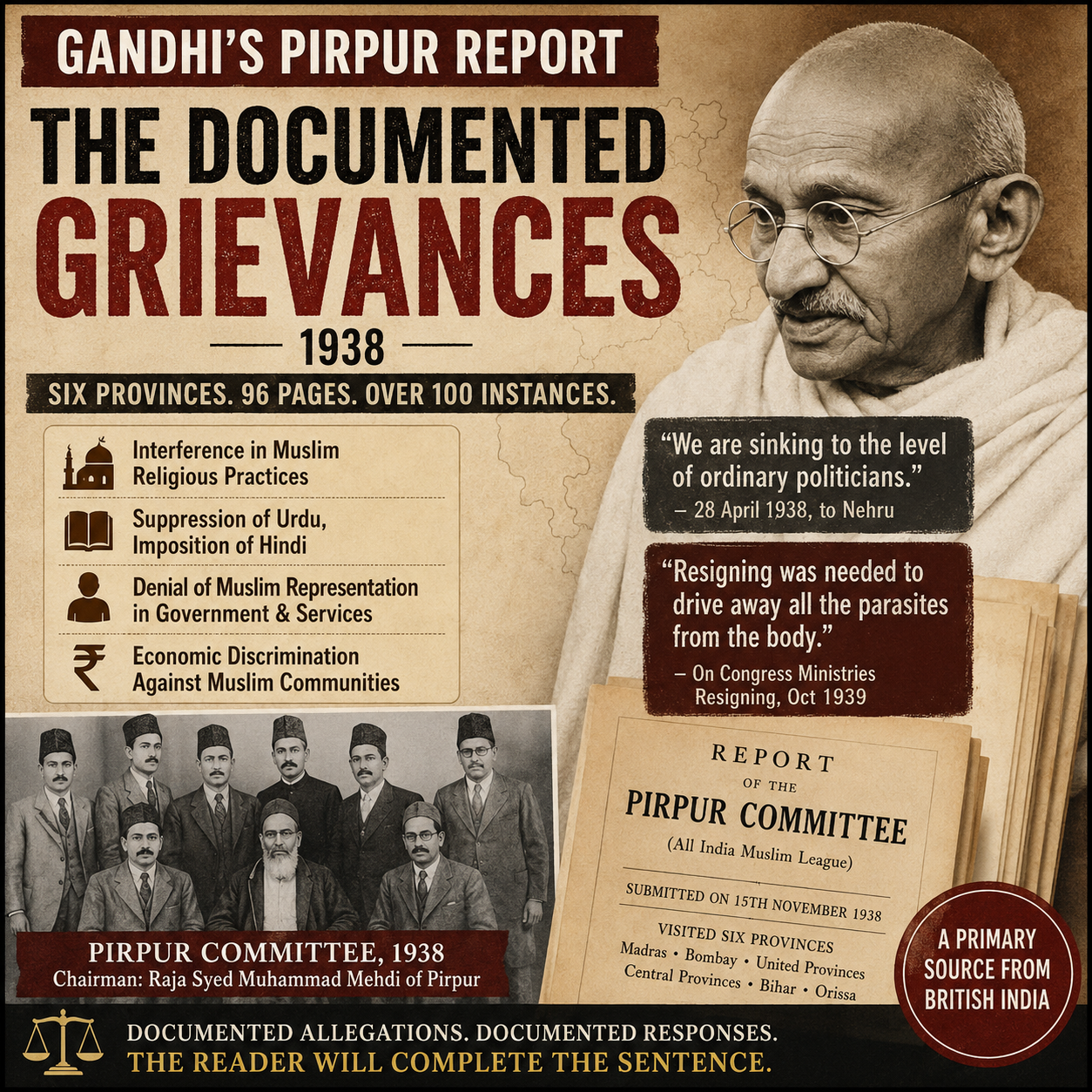
Gandhi’s Pirpur Report: The Documented Grievances — 1938 (92)
भारत / GB
Part 92: Mahatma Gandhi’s Peace Efforts | Series Index
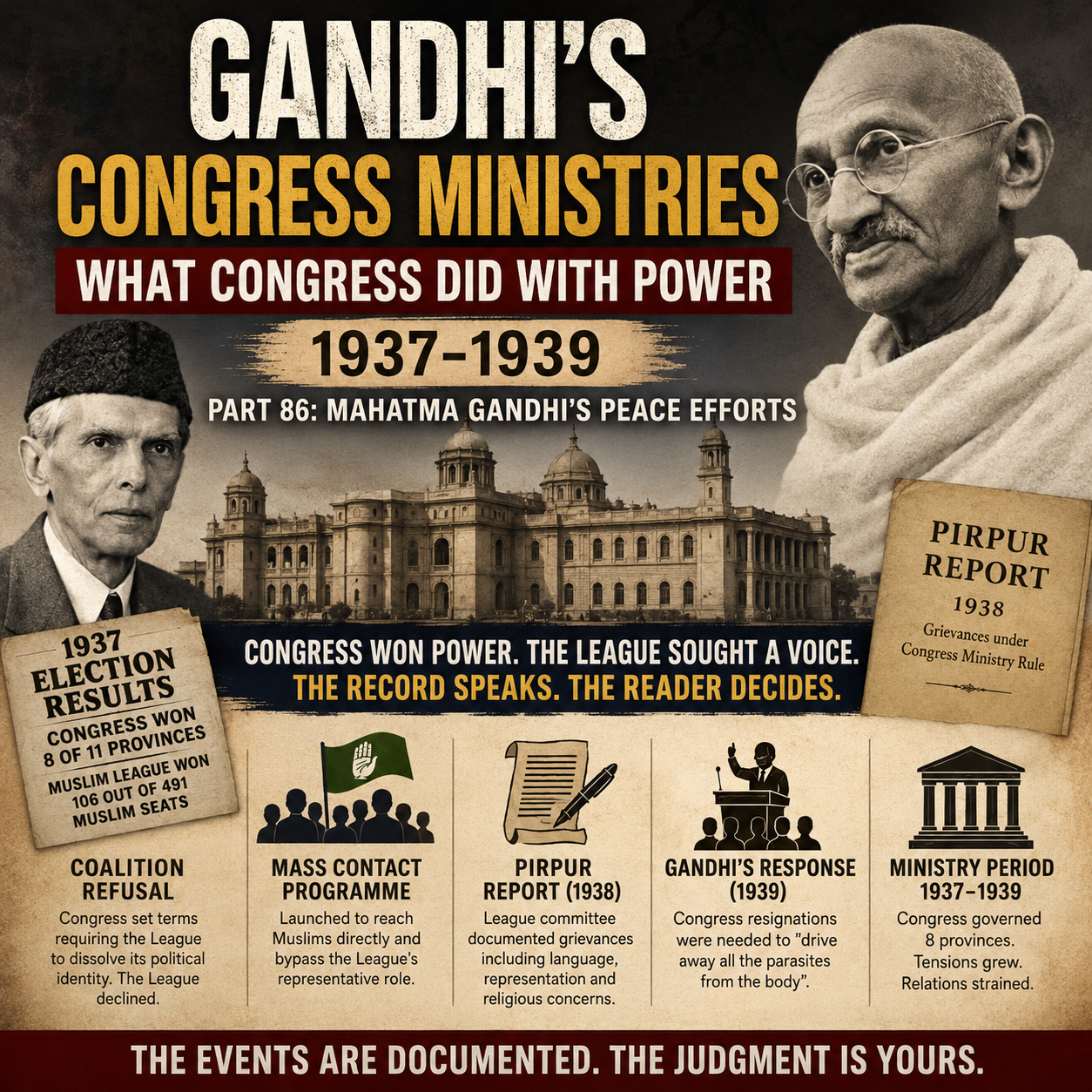
Blog 86 documented the Congress ministry period 1937-39. This post examines the Muslim League’s documented response to that period — the Pirpur Report of November 1938 — and places Gandhi’s documented response alongside it.
Thank you for reading this post, don't forget to subscribe!The Action Taken: When the Muslim League published the Pirpur Report—compiling detailed grievances alleging cultural majoritarianism under Congress provincial ministries—the Congress leadership rejected the document out of hand without instituting an independent judicial audit.
Who Paid the Price: The secular credibility of Congress provincial rule, as unrefuted grievances were widely accepted by the Muslim public as institutionalized discrimination.
The Alternative Bypassed: Appointing an independent, multi-community judicial commission to publicly examine each specific allegation of bias in the Pirpur Report.
Why This Matters: Demonstrates how dismissing minority administrative grievances without formal verification enabled the Muslim League to build an irreversible mass grievance narrative.
The Pirpur Committee — Documented
The All India Muslim League established the Pirpur Committee in 1938 to document grievances under Congress ministry rule. The committee was headed by Raja Syed Muhammad Mehdi of Pirpur and visited six provinces — Madras, Bombay, United Provinces, Central Provinces, Bihar, and Orissa. On November 15 1938 it presented its report of 96 pages. The full text is available at archive.org.
Gandhi’s Pirpur Report places the evidentiary status of the document before the reader at the outset — and maintains it throughout. The report was compiled by the Muslim League’s own committee and carries the League’s political interest. The prosecution carries the documented fact of its existence, its documented findings, and Gandhi’s documented response — not the specific allegations as established facts.
What the Report Documented
The Pirpur Report charged Congress ministries with four documented categories of conduct across six provinces: interference in Muslim religious practices; suppression of Urdu in favour of Hindi; denial of legitimate Muslim representation in government appointments and public services; and economic discrimination against Muslim traders and communities.
The report catalogued over 100 instances of alleged anti-Muslim discrimination across the provinces visited. It was followed by the Shareef Report of 1939, documenting similar grievances in Bihar. Together the two reports represented the Muslim League’s documented case against two years of Congress ministry rule — a case the League would deploy to build the political momentum that produced the Day of Deliverance in December 1939 and the Pakistan demand in March 1940.
Gandhi’s Pirpur Report places one further documented fact before the reader: many of the grievances catalogued in the Pirpur and Shareef reports were corroborated by Congress’s own Muslim Mass Contact office — documented in Blog 89. Congress’s own outreach mechanism recorded the same categories of grievances the League was independently compiling.
Gandhi’s Documented Response
Gandhi’s documented response to the Congress ministry period is on record. On April 28 1938 he wrote to Nehru that Congress ministries were “adapting themselves far too much to the old order and trying to justify it. We are sinking to the level of ordinary politicians.”
When the Congress ministries resigned in October 1939, Gandhi welcomed the resignations for cleansing Congress of rampant corruption. He wrote to Rajagopalachari that resigning was needed to “drive away all the parasites from the body.”
Gandhi’s Pirpur Report places the documented sequence before the reader: Gandhi urged Congress to accept office in 1937 — documented in Blog 86. Congress governed eight provinces. The Pirpur Committee visited six of them and documented over 100 instances of alleged anti-Muslim discrimination. Gandhi’s documented response addressed Congress internal corruption. The specific grievances documented in the Pirpur Report — interference in religious practices, suppression of Urdu, denial of representation, economic discrimination — do not appear in Gandhi’s documented public statements of the period.
The prosecution places this alongside the documented pattern established earlier in the series. At Moplah 1921 — Gandhi’s documented response addressed Hindu courage and faith, not the documented Hindu grievances. At Kohat 1924 — Gandhi’s documented inquiry apportioned blame to the Hindu minority. At the Pirpur Report 1938 — Gandhi’s documented response addressed Congress internal corruption, not the documented Muslim grievances. Both communities. Two decades. The documented response in each case directed elsewhere.
The Prosecution’s Position
Gandhi’s Pirpur Report places three questions before the reader.
- Did the Pirpur Committee — visiting six provinces across the Congress ministry period — document over 100 instances of alleged anti-Muslim discrimination, with categories corroborated in part by Congress’s own outreach office?
- Did Gandhi’s documented response to the Congress ministry period address the specific documented Muslim grievances the Pirpur Report catalogued — or did it address Congress internal conduct?
- Did Gandhi, who held documented unchallengeable authority over Congress and had urged Congress to accept office in 1937, deploy that authority to investigate or address the documented grievances — or does the documented record show his response directed elsewhere?
Gandhi’s Pirpur Report does not answer. The Pirpur Report is a documented primary source available at archive.org. Gandhi’s documented statements are from the record. The reader will examine both and complete the sentence.
Invitation To Defence
We now invite the defense to present its exhibits to the reader, contesting the evidence laid bare in the prosecution’s case.
November 1938. The Pirpur Report: 96 pages, six provinces, over 100 documented instances. Gandhi’s documented response to the same period: Congress was sinking to the level of ordinary politicians — the resignations were needed to drive away the parasites. The Pirpur Report’s documented grievances are absent from Gandhi’s documented public statements of the period. The prosecution places both documents before the reader. The reader will complete the sentence.
Feature Image: Click here to view the image.
Videos
Glossary of Terms
- Pirpur Committee: Muslim League committee established in 1938 to investigate and document complaints against Congress provincial ministries.
- Pirpur Report: A ninety-six-page report submitted in November 1938 presenting grievances and allegations gathered from multiple Congress-governed provinces.
- All India Muslim League: Political organization representing Muslim political interests in British India and later leading the Pakistan movement.
- Raja Syed Muhammad Mehdi of Pirpur: Chairman of the Pirpur Committee and principal figure associated with the report.
- Congress Ministries: Provincial governments formed by the Indian National Congress after the 1937 elections under provincial autonomy.
- Provincial Autonomy: Governance system introduced under the Government of India Act 1935 granting limited self-government to provinces.
- Shareef Report: A 1939 report documenting grievances raised by Muslims in Bengal and frequently discussed alongside the Pirpur Report.
- Muslim Mass Contact Programme: Congress initiative designed to expand support among Muslim communities independent of Muslim League leadership.
- Day of Deliverance: Political observance declared by the Muslim League in December 1939 after Congress ministries resigned.
- Primary Source: Original historical material created during the period being studied, such as reports, letters, speeches, or official records.
- Documented Grievances: Complaints recorded in historical documents whose existence is verifiable regardless of whether the allegations are proven.
- Documented Response: A response supported by recorded letters, speeches, writings, or other contemporaneous evidence.
- Prosecution’s Position: A recurring series phrase presenting evidence and arguments critical of Gandhi’s actions while inviting opposing interpretations.
- Documented Sequence: A series term referring to events arranged according to verifiable historical chronology and source material.
- Historical Commentary: Interpretation and analysis of historical evidence rather than neutral presentation of facts alone.
#Gandhi #Congress #MuslimLeague #Pirpur #History #India #Nehru #Pakistan #Politics #FreedomMovement #HinduinfoPedia
Gandhi’s Peace Efforts: The Questions Before the Mahatma (0)
Refer to Various Arks Referred to in the Blog