
Gandhi’s Mass Contact Programme: Bypassing Jinnah — and Its Consequence (89)
भारत / GB
Part 89: Mahatma Gandhi’s Peace Efforts | Series Index
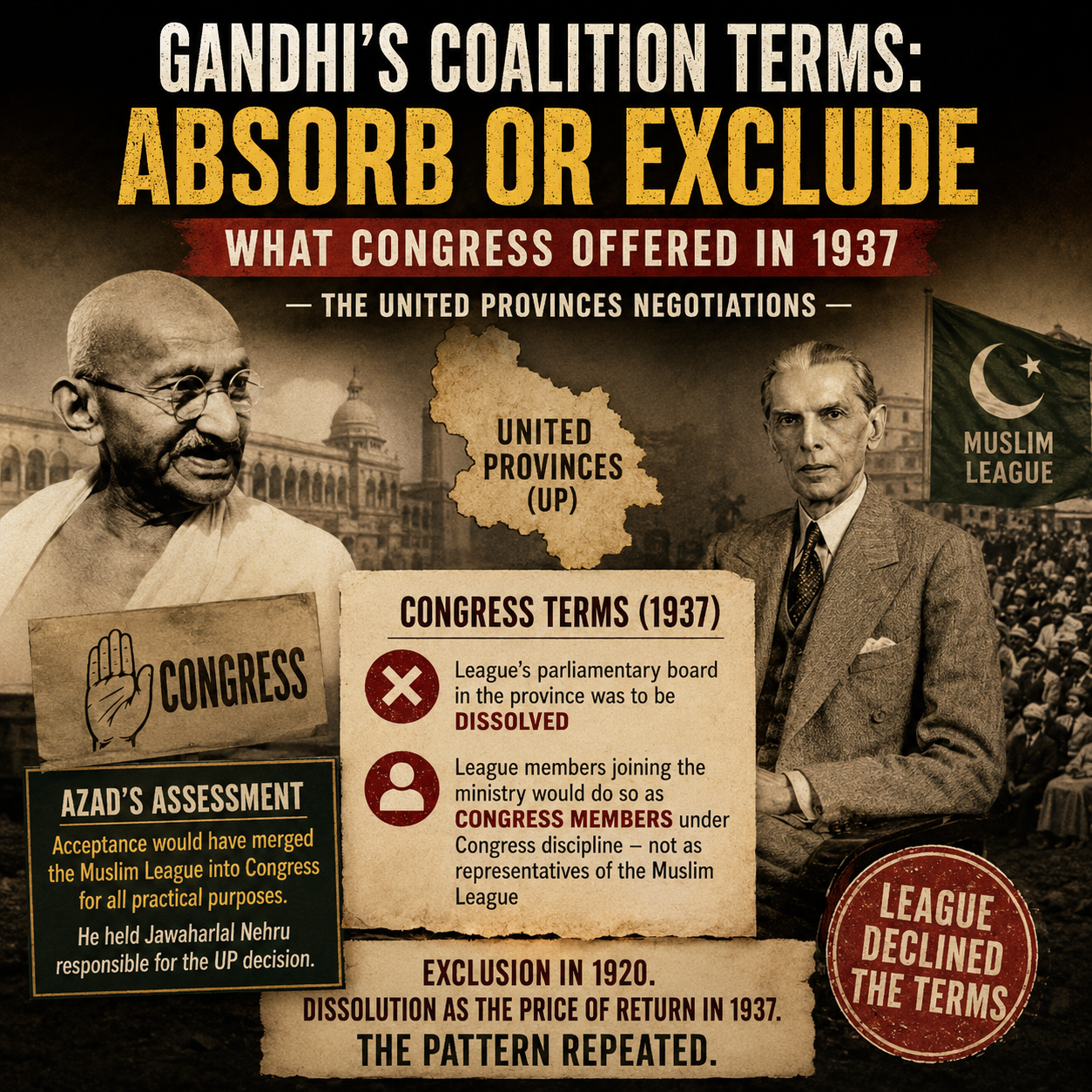
Blog 88 documented the 1937 United Provinces coalition terms that required the Muslim League’s dissolution. This post examines what Congress did simultaneously — a documented programme to reach Muslim voters directly, bypassing the League’s leadership — and what the documented record shows it produced.
Thank you for reading this post, don't forget to subscribe!The Action Taken: Congress contested the provincial elections under the Government of India Act 1935, winning sweeping absolute majorities in five major provinces and forming governments in seven.
Who Paid the Price: The colonial administration’s strategy of provincial fragmentation, as Congress established unified executive control across central and southern India.
The Alternative Bypassed: Refusing to accept provincial office and maintaining pure non-cooperation boycott tactics.
Why This Matters: Demonstrated the immense political authority of the Congress apparatus when contesting elections, granting the leadership statutory administrative power over law and order.
The Documented Trigger
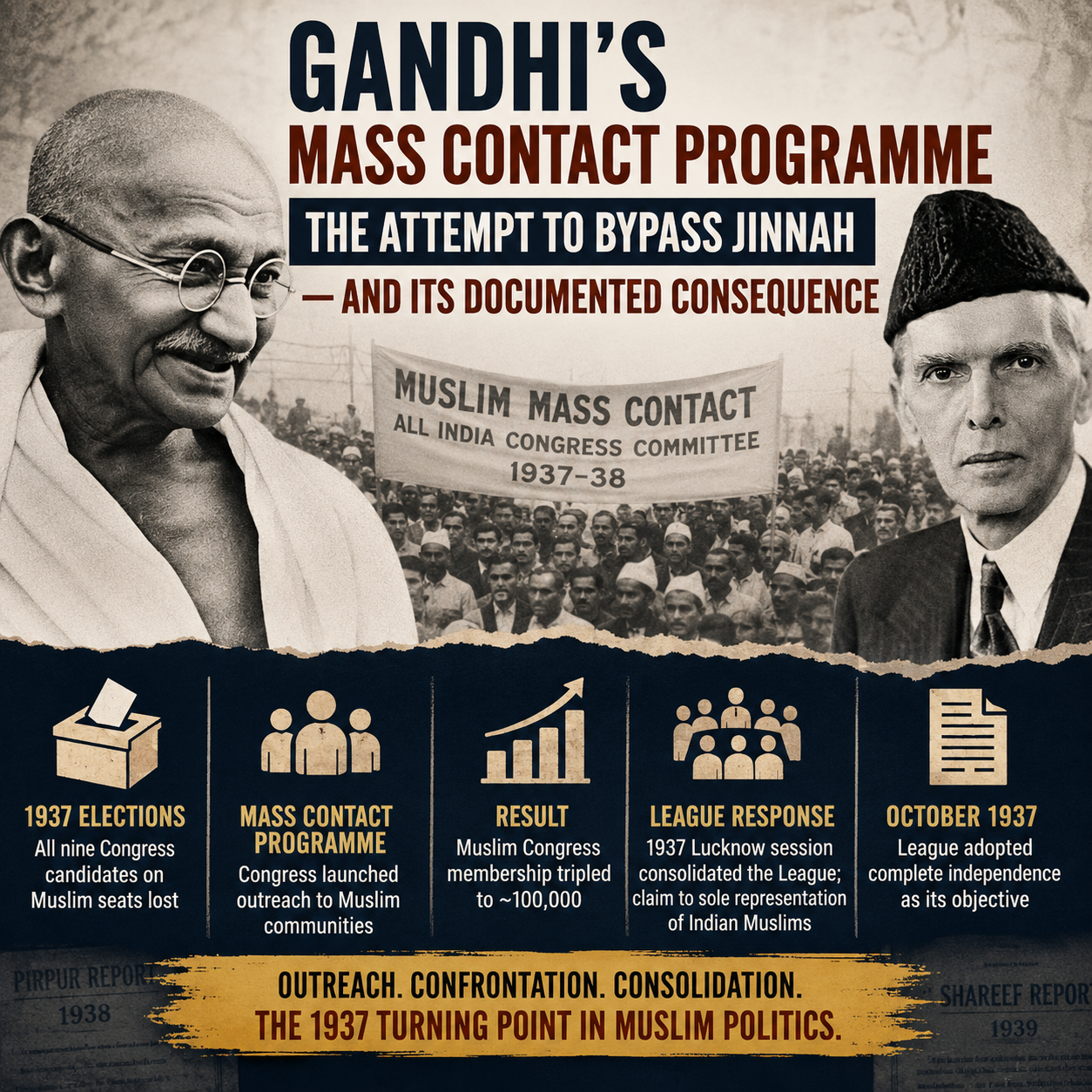
In the 1937 elections, all nine Congress candidates contesting Muslim seats lost. Gandhi’s Mass Contact Programme places this documented result before the reader as the trigger for what followed. The result demonstrated that Congress, despite its overall electoral dominance, held negligible direct support among Muslim voters where Muslims chose between Congress and other Muslim candidates.
Congress had won a commanding majority overall. It did not need Muslim votes to govern. Despite this, Congress launched a Muslim Mass Contact Campaign in 1937-38 — a documented decision to build Congress support among Muslims directly, separate from the Muslim League. Gandhi’s Mass Contact Programme places this decision before the reader: an organisation that did not require Muslim political support to hold power chose to expend resources building an alternative Muslim political base outside the existing Muslim leadership structure.
The Documented Characterisation of the League
The Mass Contact Programme showed an initial documented effect — Muslim membership of Congress tripled to approximately 100,000. An increase of this magnitude, by any measure was large enough to raise alarm among League leaders about Congress penetrating their core base. Given the internal contradictions within Muslim League, this was a great challenge to Muslim League.
Gandhi’s Mass Contact Programme places it before the reader as evidence that the programme had genuine reach among Muslim communities. Gandhi’s Mass Contact Programme places a second documented effect before the reader, from the same period.
The Muslim League’s 1937 Lucknow session saw an influx of influential Muslim groups and parties from across British India — groups that had previously operated independently or stayed outside formal League structures.
This consolidation enabled the League to stake its claim as the sole representative organisation of Indian Muslims, a claim it had not been able to substantiate before 1937. In October 1937, the League adopted complete independence as its objective and became a mass party for the first time in its history — a documented transformation from the organisation that had won only a handful of seats earlier that same year.
Read together, the two effects document a confrontation between Congress — managed under Gandhi’s authority with Nehru as its public face — and the Muslim League as an organised political entity. Congress reached directly into the League’s base while simultaneously refusing it coalition participation. The League responded by consolidating and radicalising.
The Documented Initial Result
The Mass Contact Programme showed an initial documented effect — Muslim membership of Congress tripled to approximately 100,000 according to Pratinav Anil’s documented account in Another India, published 2023. This was a substantial increase by any measure, and Gandhi’s Mass Contact Programme places it before the reader as evidence that the programme had genuine reach among Muslim communities.
Gandhi’s Mass Contact Programme places a second documented effect before the reader, from the same period. The Muslim League’s 1937 Lucknow session saw an influx of influential Muslim groups and parties from across British India — groups that had previously operated independently or stayed outside formal League structures. This consolidation enabled the League to stake its claim as the sole representative organisation of Indian Muslims, a claim it had not been able to substantiate before 1937. In October 1937, the League adopted complete independence as its objective and became a mass party for the first time in its history — a documented transformation from the organisation that had won only a handful of seats earlier that same year.
Ambedkar’s Documented Misgiving
Ambedkar’s documented assessment of the Mass Contact Campaign records that Congress sought political unity between Hindus and Muslims but ignored or circumvented the established leaders of the Muslims in doing so.
A further documented fact carries particular weight. Many of the grievances later catalogued in the Muslim League’s Pirpur and Shareef reports of 1938 and 1939 were corroborated by Congress’s own Muslim Mass Contact office — Congress’s own outreach mechanism documented the same grievances the League was independently compiling.
Gandhi’s Mass Contact Programme places one further documented fact before the reader. Gandhi held documented unchallengeable authority over Congress throughout this period — established across Blogs 21–22. The Mass Contact Programme, the characterisations of Jinnah, and the coalition terms documented in Blog 88 all occurred under that authority, in the same year, as part of the same documented sequence.
The Prosecution’s Position
Gandhi’s Mass Contact Programme places three questions before the reader.
- Did Congress, having refused coalition terms to the Muslim League in 1937 — documented in Blog 88 — simultaneously launch a programme to build Muslim support independent of the League’s leadership?
- Did the documented characterisations of Jinnah and the League made during this campaign — out of touch with the masses, nothing in common with ordinary Muslims — originate from the organisation Gandhi held unchallengeable authority over?
- Did the documented consequence of the Mass Contact Programme — the Muslim League’s consolidation at its 1937 Lucknow session and its adoption of complete independence as its objective in October 1937 — represent the opposite of the programme’s stated aim?
The series does not answer. The documented election trigger, the documented characterisations, Ambedkar’s documented misgiving, Congress’s own corroboration of League grievances, and the documented consolidation of the League are placed before the reader. The reader will examine the sequence — coalition terms requiring dissolution, characterisations of the League leadership as out of touch, and the League’s consolidation in response, all within the same year — and complete the sentence in full.
Invitation To Defence
The reader is now invited to examine the defence exhibits to counter the evidence presented in the prosecution’s dossier.
1937 — all nine Congress candidates for Muslim seats lost. Congress launched the Mass Contact Programme — bypassing the League, characterising Jinnah as out of touch with ordinary Muslims. Muslim Congress membership tripled. The Muslim League’s Lucknow session, the same year, consolidated it as the sole representative of Indian Muslims. October 1937 — the League adopted complete independence as its objective. The prosecution places the documented sequence before the reader. The reader will complete the sentence.
Feature Image: Click here to view the image.
Videos
Glossary of Terms
- Mass Contact Programme: Congress campaign launched in 1937–38 to recruit Muslims directly into Congress and expand its support among Muslim communities.
- Muslim League: Political organisation that increasingly claimed to represent Indian Muslims during the final decade of British rule.
- Congress: The Indian National Congress, the principal nationalist political organisation during the freedom movement.
- United Provinces (UP): A British Indian province, roughly corresponding to present-day Uttar Pradesh, where the 1937 coalition dispute occurred.
- Coalition Terms: Conditions proposed for a joint government between Congress and the Muslim League after the 1937 elections.
- Lucknow Session (1937): A major Muslim League meeting held in Lucknow that marked significant organisational expansion and consolidation.
- Muslim Mass Contact Campaign: Alternative description of the Mass Contact Programme aimed at increasing Congress influence among Muslim voters.
- Pirpur Report: Muslim League report published in 1938 documenting alleged grievances of Muslims under Congress provincial ministries.
- Shareef Report: Muslim League report published in 1939 recording complaints and allegations regarding Congress rule.
- Complete Independence: Political objective adopted by the Muslim League in 1937, referring to full independence from British rule.
- Ambedkar’s Misgiving: Dr. B. R. Ambedkar’s criticism that Congress sought Hindu-Muslim unity while bypassing established Muslim political leadership.
- Sole Representative Organisation: The Muslim League’s claim that it alone represented the political interests of Indian Muslims.
- Documented Sequence: A recurring phrase in the series referring to a chain of recorded historical events presented for reader examination.
- Prosecution’s Position: The series’ narrative framework presenting evidence and inviting readers to assess responsibility or consequences.
- Defence Exhibits: Material, arguments, or evidence that may challenge or counter the prosecution narrative presented in the series.
#Gandhi #Jinnah #Congress #MuslimLeague #Partition #IndiaHistory #FreedomMovement #Nehru #Ambedkar #BritishIndia #Politics #History #HinduinfoPedia
Gandhi’s Peace Efforts: The Questions Before the Mahatma (0)
Refer to Various Arks Referred to in the Blog