
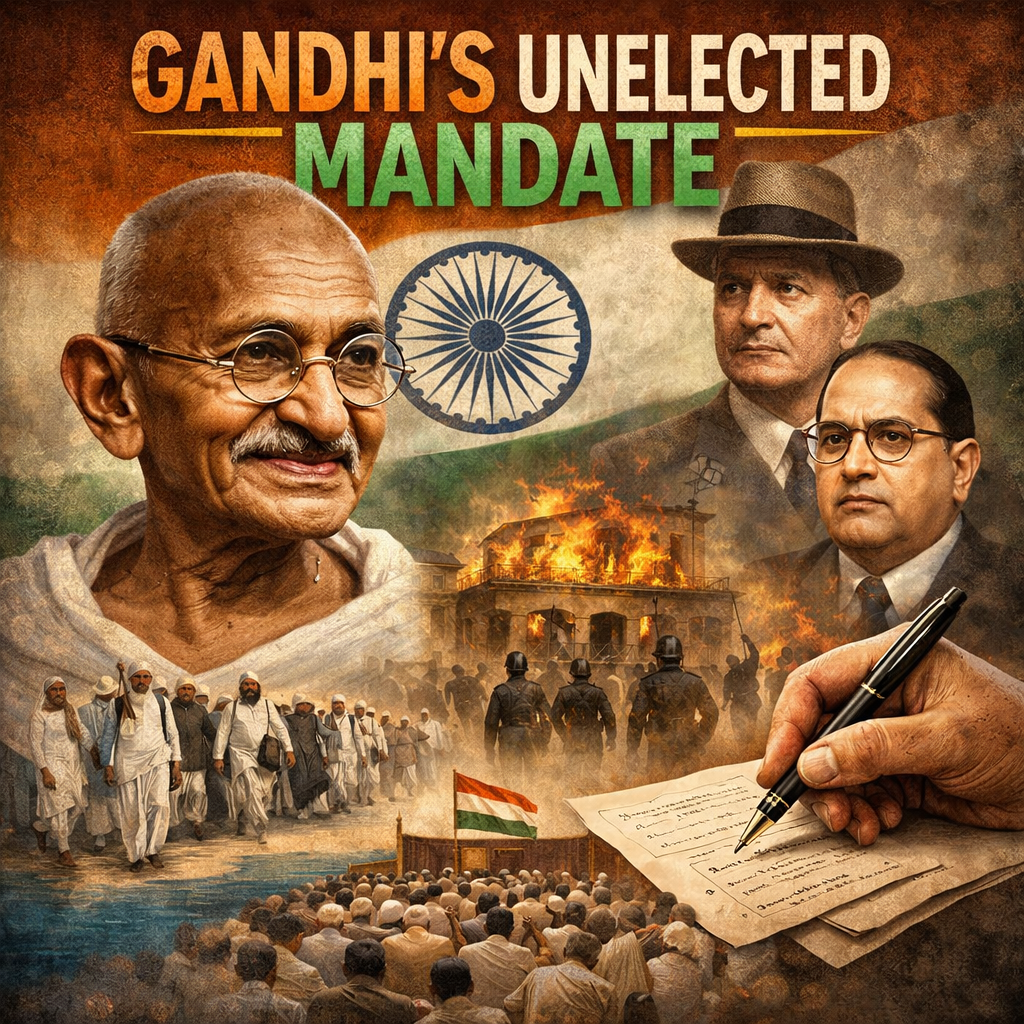
Gandhi’s Unelected Mandate: The Authority Nobody Granted (21)
भारत / GB
Part 21: Mahatma Gandhi’s Peace Efforts | Series Index
Gandhi’s Unelected Mandate And Its Impact
Twenty posts have built the prosecution from four acts. Blog 20 measured what the Irwin Pact delivered against what the movement had earned — eleven demanded, three partially delivered, eight abandoned, one refused. The gap is documented. The question it raises has not yet been answered: who authorised him to accept it? This post goes looking for the answer in the institutional record.
Thank you for reading this post, don't forget to subscribe!The Action Taken: Gandhi directed national civil disobedience and negotiated truces with the Viceroy without holding elected executive office within the Congress organization.
Who Paid the Price: Elected Congress party officials whose formal constitutional roles were subordinated to extra-legal moral authority.
The Alternative Bypassed: Internal party voting and committee approval procedures mandated by the Congress constitution.
Why This Matters: Created an extra-constitutional command structure where major policy decisions could not be challenged or reviewed through institutional voting.
The Question the Pact Raises
Gandhi’s Unelected Mandate is the institutional question that runs beneath every decision documented in this series. The pact of March 5, 1931 was signed by one man on behalf of sixty thousand who had gone to jail, millions who had marched, and a movement that had shaken the British government to its foundations. The question is simple: what position did Gandhi hold when he signed it?
The answer is in the record. Gandhi was not the president of the Indian National Congress when he negotiated the Irwin Pact. He was not its president when he launched the Civil Disobedience Movement. He was not its president when he launched Non-Cooperation a decade earlier. He was not its president when he called Non-Cooperation off.
Gandhi’s Unelected Mandate is the thread connecting every major decision of his public career to the same institutional fact: The decisions were made without formal institutional authority from the organisation he claimed to represent.
The Institutional Record
Non-Cooperation — 1920 to 1922
The Non-Cooperation Movement was announced on August 1, 1920. Gandhi made the announcement without prior consultation with Congress leaders. Multiple senior figures — Jinnah, Annie Besant, Bipin Chandra Pal — opposed it outright. Gandhi was not Congress president at the time. He had not been given a mandate to launch the largest civilian uprising in colonial history.
The Congress ratified the movement at Calcutta in September 1920 and again at Nagpur in December — after Gandhi had already announced it, after the pressure to support it had made institutional dissent politically unthinkable. The ratification followed the announcement. The institution confirmed what Gandhi had already decided.
On February 12, 1922, Gandhi suspended the movement. He did so without consulting the Congress Working Committee. No conditions were extracted from the British before the suspension. No partial achievement was secured. The movement was not paused — it was ended. The Congress Working Committee, meeting in Bardoli, passed a resolution accepting the suspension. It had not been asked whether to suspend. It was informed that the suspension had occurred and invited to agree.
Motilal Nehru and C.R. Das opposed the decision. They formed the Swaraj Party in protest. Their opposition made no difference. The organisation’s response can also be understood in the context of its evolution. The Indian National Congress had emerged as a forum of elite negotiation within the colonial framework, not as a mass-command structure. Gandhi’s entry transformed it into a mass movement centred around his leadership, particularly after early mobilisations such as Champaran. At the same time, his political method combined confrontation with negotiation, without seeking to structurally dismantle the colonial framework. This dual approach strengthened his centrality within the organisation while limiting its ability to independently oppose his decisions. Gandhi’s Unelected Mandate operated above the institution’s capacity to refuse.
Civil Disobedience and the Irwin Pact — 1930 to 1931
Gandhi was not Congress president when he presented the eleven demands to Lord Irwin on January 31, 1930. He was not Congress president when he led the Salt March. He was not Congress president when he negotiated the Irwin Pact in eight meetings through February 1931.
The Congress Working Committee was not in a position to mandate him. Most of its members were in prison. Gandhi negotiated largely on his own behalf, without holding institutional office and without a formally recorded mandate from the organisation whose movement he was settling.
The Karachi Congress session met on March 29–31, 1931. It ratified the Irwin Pact. The pact had been signed on March 5. The institution ratified, twenty-four days later, an agreement the institution had not been consulted on and could not in practice have refused. The gap between what was on the table and what was agreed to had already been closed. The Karachi session endorsed the fait accompli and called it endorsement.
The Poona Pact — 1932
In August 1932, the British government announced the Communal Award — a separate electorate for Scheduled Castes, giving Dalit voters the ability to elect their own representatives independent of the Congress. Ambedkar had negotiated this through the Round Table Conference. It was a legal, formally constituted award made by the governing authority.
Gandhi announced a fast unto death to overturn it.
Gandhi held no institutional position that gave him authority over the Communal Award. He held no electoral mandate from the Dalit community whose political rights the Award protected. He had not been authorised by the Congress to fast on this question. The fast was not a political act within an institutional framework. It was a moral act that derived its force entirely from what Gandhi had become — a figure whose death the nation could not permit itself to cause.
Ambedkar signed the Poona Pact in conditions widely described as being shaped by that pressure. The separate electorate was surrendered. Gandhi broke his fast. The Dalit political framework was compressed from what the Award had granted into what Gandhi’s survival required.
Ambedkar’s own assessment, documented and cited across decades of scholarship: he had been coerced. The instrument of coercion was not a vote, not a legal authority, not an institutional mandate. Gandhi’s fast did not operate in isolation as a purely moral force. It functioned within a political system where multiple actors — including the British — had strong incentives to prevent his death. The resulting pressure on Ambedkar was not merely moral but systemic, produced by the convergence of mass sentiment, institutional weakness, and colonial strategic calculation.
The World That Had No Parallel
Every major liberation leader of the twentieth century operated within an institutional structure that could, in principle, challenge or override them.
Lenin reported to the Bolshevik Central Committee, which had the formal authority to remove him. Mao operated within the structures of the Chinese Communist Party — he was purged twice before 1966, which demonstrates the institution had the mechanism to act against him. Ho Chi Minh worked through the Viet Minh’s collective leadership. Castro operated through the structures of the Cuban revolutionary government. De Gaulle led the Free French through a government-in-exile with its own institutional form.
None of these were democracies in any conventional sense. All of them contained institutional mechanisms through which Gandhi’s Unelected Mandate would not have survived. A Central Committee vote, a party congress resolution, a cabinet decision — any of these would have been the mechanism by which a Chauri Chaura suspension, a unilateral pact negotiation, or a fast coercing a legal award could have been challenged, overturned, or refused.
Gandhi’s authority had no such mechanism. The Congress could ratify after the fact. It could not act before the fact. It could not remove him. It could not override him. It could express displeasure — as Motilal and Das did after Chauri Chaura, as Nehru and Bose did after the Pact — and the displeasure changed nothing.
The closest parallel in the twentieth century is not political leadership at all. It is religious authority — the kind that derives from perceived sanctity rather than institutional mandate, and that is ratified after the fact by institutions that cannot in practice refuse. Papal doctrinal authority operates by this mechanism. It is confirmed by a College of Cardinals that has already elected the pope. The institution ratifies what the authority has already decided.
Gandhi’s Unelected Mandate worked the same way. He acted. The Congress confirmed. Opposing him was, as Nehru wrote, “like hitting a saint.” The institution cannot vote against the saint.

The Mechanism
Gandhi’s Unelected Mandate rested on a mechanism with no political parallel in the liberation movements of the twentieth century. His authority derived not from election or appointment but from perceived moral sanctity — a quality that made institutional challenge structurally impossible. This authority operated with legitimacy in practice, even in the absence of formal mandate. To oppose Gandhi was, as Nehru wrote, like hitting a saint. Lajpat Rai, after the Chauri Chaura suspension had ended the movement he had given years to build, said: “Our defeat is in proportion to the greatness of our leader.” The institution cannot vote against the saint. It can only ratify what the saint has already decided.
The Karachi Congress of March 1931 ratified the Irwin Pact that Gandhi had already signed. The Poona Pact was ratified by the relief of a nation that had been told it was responsible for his death if it refused. The Non-Cooperation suspension was ratified by a Congress that had no mechanism to reinstate a movement its leader had ended.
The institution did what it always did when Gandhi acted without mandate — it confirmed the fait accompli and called it endorsement.
What this authority was used for across forty years is the subject of this series. What it consisted of — how it was built, how it was maintained, and why it was unchallengeable — is the subject of the next post.
No election produced it. No institution granted it. No vote could remove it. Gandhi’s Unelected Mandate was the most complete personal authority in the history of the independence movement. The question is not whether he had it. The question is what he did with it.
Series Index
Feature Image: Click here to view the image.
Videos