
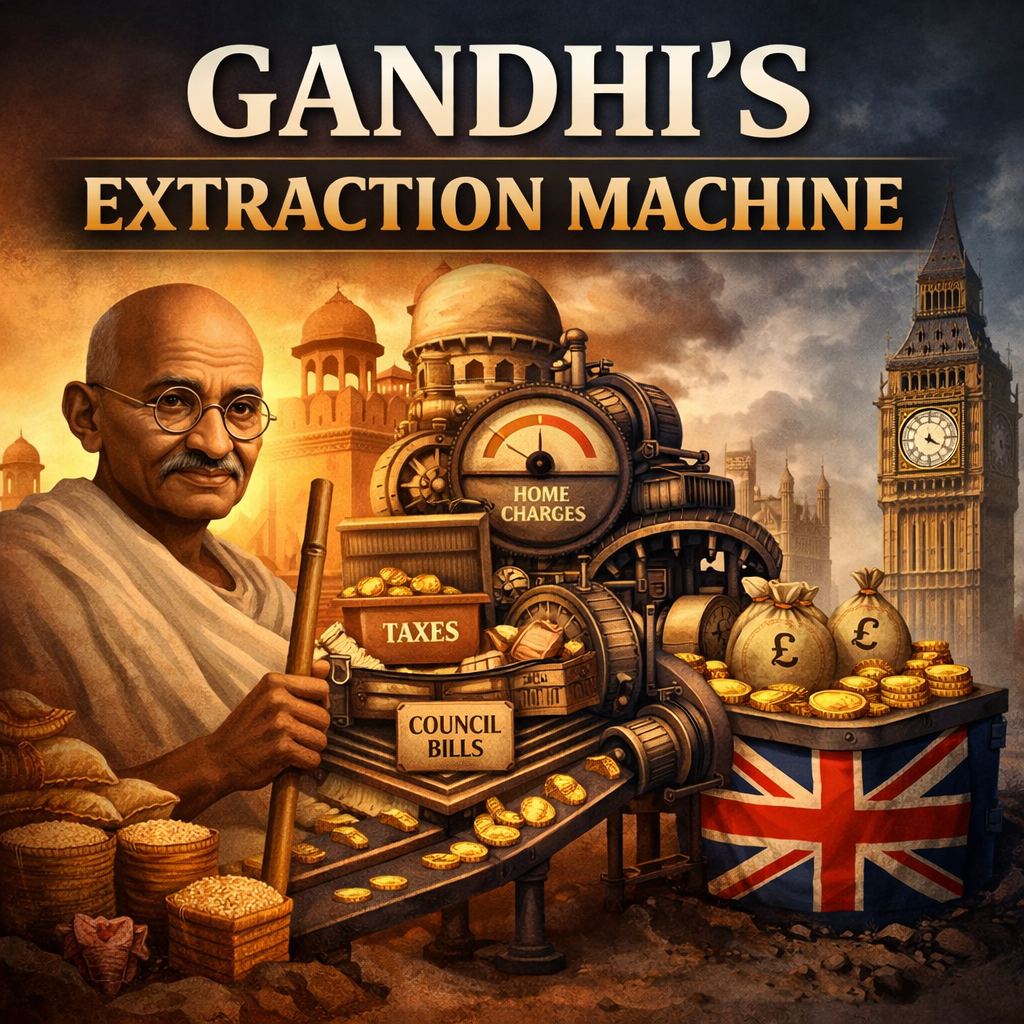
Gandhi’s Extraction Machine: The £9.2 Trillion Apparatus (13)
भारत / GB
Part 13: Mahatma Gandhi’s Peace Efforts | Series Index
Gandhi’s Extraction Machine: The Mahatma’s Strategic Genius
Twelve posts have established the method, the mass, the four satyagrahas, the chemical bomb, and the eleven demands — the charter Gandhi placed before Irwin on January 31, 1930. Before the series examines what Irwin was being asked to dismantle, it must first document what the machine actually was. This post contains not what Gandhi was, but what he confronted. It examines only the apparatus he aimed at — what we call Gandhi’s Extraction Machine.
Thank you for reading this post, don't forget to subscribe!The Action Taken: British imperial administration operated systematic fiscal extraction through Council Bills, Home Charges, currency pegging, and unrequited export surpluses.
Who Paid the Price: The entire Indian agrarian and productive economy across four generations of colonial rule.
The Alternative Bypassed: Sovereign domestic expenditure and public reinvestment of domestic agricultural and commercial surpluses.
Why This Matters: Documents the objective material baseline of colonial harm against which the yield of every subsequent nationalist negotiation must be measured.
What the Raj Actually Was
Gandhi’s Extraction Machine is not a metaphor. It is a documented apparatus — a precisely engineered system of financial, commercial, and administrative mechanisms designed to transfer wealth from India to Britain continuously, invisibly, and at scale. Understanding why Irwin could not grant Gandhi’s eleven demands begins with understanding what each demand would have switched off.
At the beginning of the eighteenth century, India’s share of the world economy was 23% — as large as all of Europe combined. When Britain departed in 1947, that share had fallen to just over 3%. In the same period, British per capita GDP grew by 347%. Indian per capita GDP grew by 14%.
This divergence was not accidental. It was the output of a machine. And the machine had components.
Component One — The Tax-and-Buy System
When the East India Company established its monopoly over Indian trade in 1765, it solved a problem that had previously constrained British commerce: how to acquire Indian goods without spending British money.
Before 1765, Britain had purchased Indian textiles, rice, and spices in the normal way — paying in silver, as any trading partner would. After 1765, the Company began collecting taxes from Indian merchants and peasants. It then used approximately one third of that tax revenue to purchase goods from the same people it had just taxed — goods that were then shipped to Britain for sale at profit.
The mechanism was elegant in its brutality. Indian producers were paid — but paid with money that had just been extracted from them. Britain acquired Indian goods at no net cost to itself. The Indian producer worked, produced, was taxed, and was paid with his own taxes. Britain received the goods. Britain received the profit from selling those goods. India received nothing it had not already owned.
As economist Jason Hickel, Fellow of the Royal Society of Arts, summarised the system: traders acquired Indian goods for free, buying from peasants and weavers using money that had just been taken from them.
Component Two — The Council Bills
The Upgrade to the System
When the East India Company’s formal monopoly ended in 1858 and the British Crown took direct governance of India, the tax-and-buy mechanism required refinement. Indian producers were now permitted to export directly to other countries. But Britain had no intention of allowing those export earnings to reach Indian hands.
The solution was Gandhi’s Extraction Machine’s most ingenious component: the Council Bill.
Anyone who wished to purchase Indian goods — any foreign importer, anywhere in the world — was required to do so using Council Bills. These were a special paper currency issued exclusively by the British Crown in London. The only way to acquire Council Bills was to purchase them from London using gold or sterling.
The mechanism worked as follows: a German merchant wishing to buy Indian cotton paid gold in London to acquire Council Bills. He used those bills to pay the Indian cotton producer. The Indian producer took the bills to the local colonial office and received rupees. Those rupees were paid out of the Indian tax revenue that had already been collected from the Indian population.
The gold the German merchant had paid in London stayed in London. The transaction appeared complete. In reality, its value had been diverted.
What this mechanism achieved was not just control of trade — but control of where its value accumulated.
The Result
India was running a trade surplus with the rest of the world for three consecutive decades in the early twentieth century. Indian goods were in demand globally. Indian producers were exporting at scale. But the foreign exchange those exports generated — the gold and sterling paid by foreign importers — never reached India. It was intercepted in London through the Council Bills system and retained by Britain.
In India’s national accounts, this surplus appeared as a deficit — because the rupee payments made to Indian producers were recorded as expenditure, while the gold accumulating in London was not recorded as Indian income.
The drain was invisible in the accounting precisely because the accounting had been designed to make it invisible.
Professor Utsa Patnaik of Jawaharlal Nehru University, in research published by Columbia University Press in 2018, calculated that the Council Bills system alone — from 1765 to 1938 — transferred £9,184 billion (approximately $45 trillion at 2018 exchange rates) from India to Britain. This figure uses India’s merchandise export surplus as the measure and compounds at a conservative 5% interest rate.
To place that number in scale: it is 17 times the entire annual GDP of the United Kingdom today.
Component Three — The Home Charges
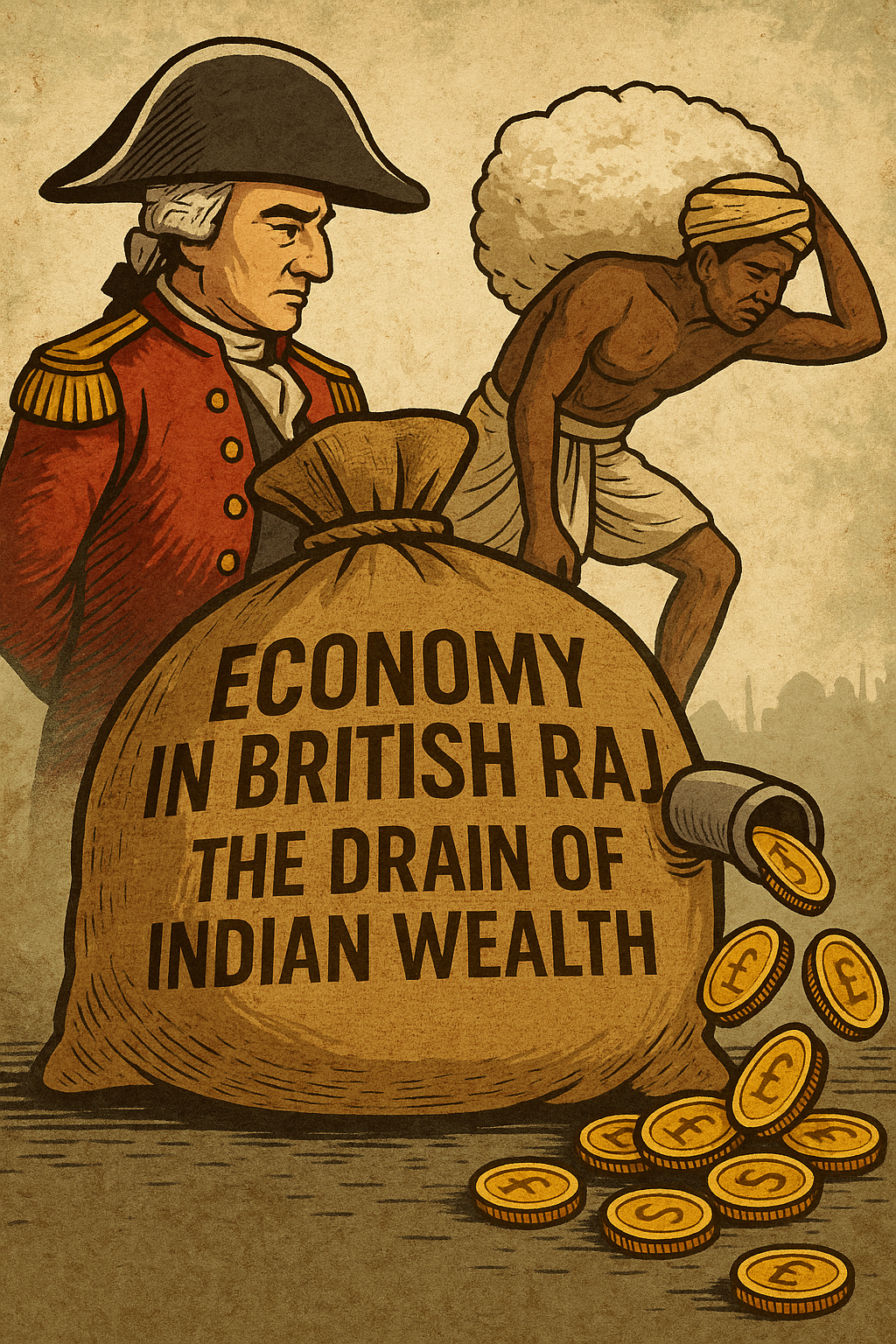
Beyond the Council Bills, Gandhi’s Extraction Machine operated through a second channel: the Home Charges.
These were the payments India was required to make to Britain annually for the “privilege” of being governed.
Home Charges included: salaries of British civil servants serving in India, pensions of retired British officials who had returned to England, the administrative costs of the India Office in London, interest on public debt raised in Britain for Indian railways and infrastructure, and the cost of military operations conducted in India’s name across the British Empire — in China, Egypt, Mesopotamia, and Africa.
The Indian Army consumed 40% of India’s central revenue. It was not used to defend India; it was used to protect British interests against Indian revolutionaries.
The 1903 Hansard debate in the British Parliament — in which a British MP acknowledged on the floor of the House that India had paid £30 million for 30,000 troops that were “neither more nor less than a reserve force for the British Army” — documents this explicitly. India financed the military instrument of British imperial expansion across the globe, and received no return.
Home Charges averaged £15–17 million annually through the late nineteenth and early twentieth centuries. British officials in India were paid at rates described by Gandhi in his 1930 letter to Irwin as the most expensive civil administration in the world — the Viceroy drawing Rs. 700 per day (5600 times) against India’s average daily income of less than two annas.
Component Four — Commercial Captivity
Gandhi’s Extraction Machine did not only extract what India had. It prevented India from building what it could have had.
Before the East India Company arrived, India was the world’s foremost textile manufacturer. Indian share of global industrial output stood at 25% in 1750. By 1900 it had fallen to 2%. This collapse was not a natural consequence of industrialisation — it was produced by a specific policy. Britain prohibited the import of finished Indian textiles while flooding Indian markets with machine-made British cloth. Lancashire’s mills required a captive market. India was that market.
Indian cotton was harvested by Indian hands, shipped to British mills, woven into cloth by British machines, shipped back to India, and sold to Indians at a markup. The East India Company chairman told the British Parliament in 1840: “This company has succeeded in converting India from a manufacturing country into a country exporting raw produce.” He said it without embarrassment. It was the objective.
The rupee-sterling exchange rate was a further instrument. Manipulated to systematically overvalue sterling, it ensured that every commercial transaction between India and Britain transferred additional value to London. Every government remittance, every official salary paid in sterling, every railway bond redeemed in London — all calculated at a rate that drained India of resources with every transaction.
Component Five — The Surveillance and Disarmament Architecture
Gandhi’s Extraction Machine required enforcement. An apparatus extracting at this scale from a population of 300 million could only function if that population was simultaneously monitored, informationally controlled, and physically disempowered.
The Criminal Investigation Department was the surveillance arm — monitoring nationalists, infiltrating organisations, maintaining files on dissidents, feeding the colonial administration intelligence on any organised resistance before it could coalesce. The Arms Act of 1878 disarmed the population by design. An Indian could not own a firearm without a colonial licence that the state had every incentive to deny. A disarmed, surveilled population was a manageable one.
The political prisoner system served a complementary function. Thousands of Indians were imprisoned not for violence but for political speech, organisation, and dissent. Their imprisonment demonstrated to every other Indian that resistance carried a personal cost. The cost suppressed the resistance. The suppressed resistance protected the machine.
The Machine in Its Totality
Taken together, Gandhi’s Extraction Machine had five interlocking components: the tax-and-buy system that paid Indian producers with their own taxes; the Council Bills that intercepted India’s export earnings before they could reach Indian hands; the Home Charges that billed India for the cost of its own subjugation; commercial captivity that destroyed Indian industry while protecting British markets; and the surveillance and disarmament architecture that suppressed organised resistance to all of the above.
Dadabhai Naoroji had named the machine in 1867. He called it the drain. He estimated the annual extraction at £200–300 million in 1901 values. R.C. Dutt documented the deindustrialisation. Shashi Tharoor quantified the civilisational cost in An Era of Darkness (2017): 16% literacy at independence, a 27-year life expectancy, 90% of the population below the poverty line, an economy that had gone from 23% of world GDP to 3%.
By the end of this period, British incomes per person had grown to nearly three-and-a-half times their earlier levels, while India’s saw only marginal improvement.
Each of Gandhi’s eleven demands targeted one or more of these components — which is why conceding them would have meant dismantling the system itself.
This is Gandhi’s Extraction Machine. It operated across nearly two centuries, with 163 years of that history explicitly reflected in the charter of demands. It produced £9.2 trillion — by Patnaik’s conservative calculation, compounding at 5% from the midpoint of each extraction period. The next post prices what that machine cost the people who ran it for Britain.
The British did not hold India out of affection. They held it because it paid. The question the next three posts will answer is: what exactly did it pay — and what would have happened if the payment had stopped?
Feature Image: Click here to view the image.
Glossary of Terms
- Gandhi’s Extraction Machine: A conceptual framework describing the structured economic, administrative, and commercial systems used by Britain to transfer wealth from India during colonial rule.
- East India Company: A British trading corporation that gained political and economic control over large parts of India after seventeen sixty five.
- Tax-and-Buy System: A mechanism where taxes collected from Indian producers were used to purchase goods from them, effectively paying them with their own money.
- Council Bills: Financial instruments issued in London that foreign buyers had to use to purchase Indian goods, ensuring export earnings remained in Britain.
- Home Charges: Annual payments made by India to Britain to cover administrative costs, pensions, and imperial expenditures.
- Drain Theory: The idea, articulated by Dadabhai Naoroji, that wealth was systematically transferred from India to Britain without equivalent return.
- Dadabhai Naoroji: Indian nationalist and economist who first quantified the economic drain from India under British rule.
- R. C. Dutt: Economic historian who documented the impact of British policies on Indian agriculture and industry.
- Shashi Tharoor: Author who analyzed the long-term economic and social consequences of British colonialism in India.
- Commercial Captivity: A condition where India was restricted to supplying raw materials while being dependent on British manufactured goods.
- Deindustrialisation: The decline of India’s traditional industries, especially textiles, due to colonial economic policies.
- Criminal Investigation Department (CID): A colonial intelligence agency used to monitor and suppress political dissent in India.
- Arms Act of 1878: A colonial law that restricted Indians from possessing weapons without government approval.
- Home Government (India Office, London): The British administrative authority in London responsible for governing India and managing its finances.
- Eleven Demands (1930): A set of demands presented by Mahatma Gandhi to Lord Irwin, targeting key elements of colonial economic control.
#HinduinfoPedia #Gandhi #BritishRaj #IndiaHistory #Colonialism #DrainTheory #Economy #Satyagraha #Empire #History
Scan Through The Entire Series at
Gandhi’s Peace Efforts: The Questions Before the Mahatma (0)
Refer to Various Arks Referred to in the Blog
- English YouTube: https://www.youtube.com/@Hinduofficialstation
- Hindi YouTube: https://www.youtube.com/@HinduinfopediaIn
- X: https://x.com/HinduInfopedia
- Instagram: https://www.instagram.com/hinduinfopedia/
- Facebook: https://www.facebook.com/Hinduinfopediaofficial
- Threads: https://www.threads.com/@hinduinfopedia