
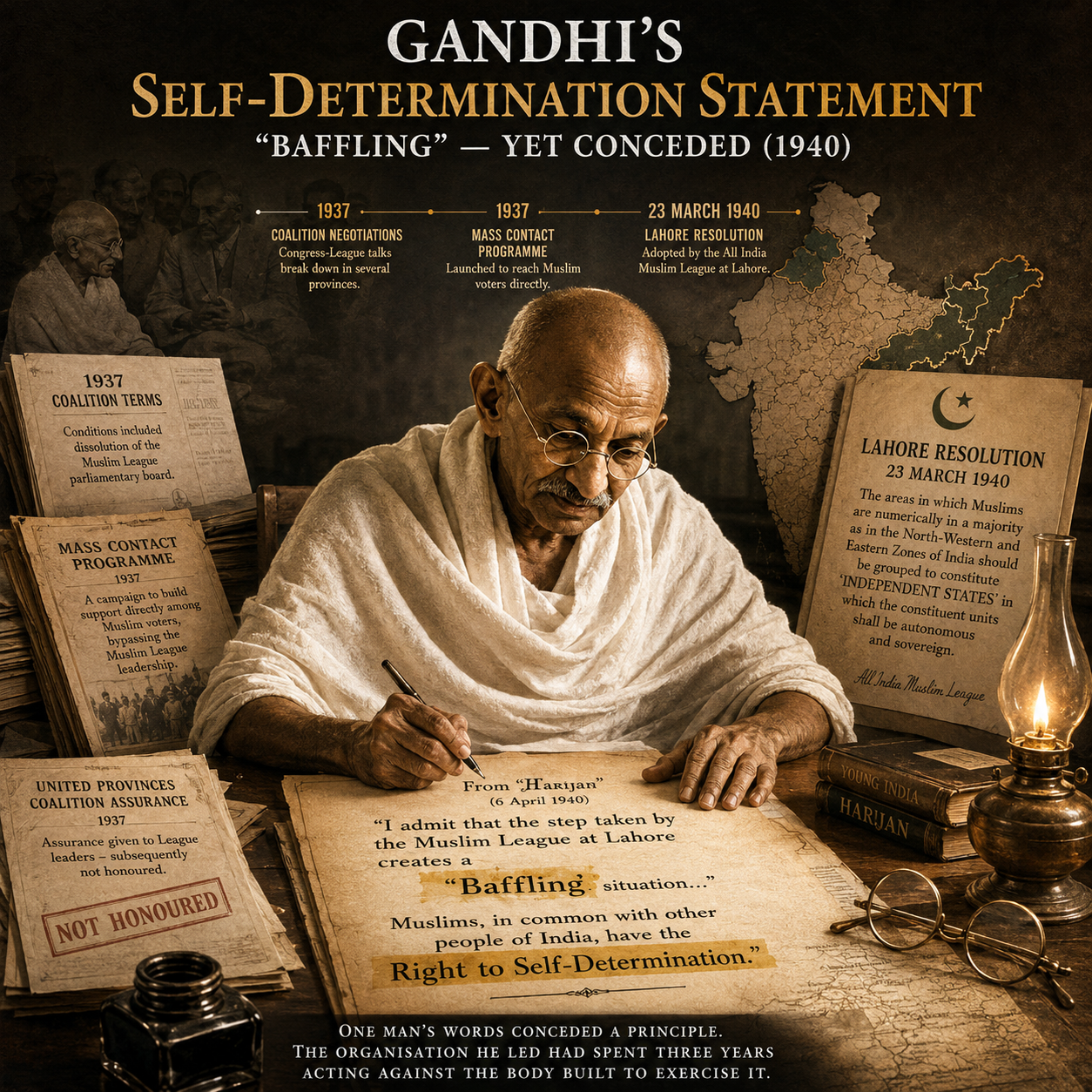
Gandhi’s Self-Determination Statement — “Baffling,” Yet Conceded (96)
भारत / GB
Part 96: Mahatma Gandhi’s Peace Efforts | Series Index
Blog 95 closed the documented twenty-year arc from Jinnah’s 1920 objection to the Lahore Resolution of March 1940. This post isolates a single statement from that moment — Gandhi’s own documented reaction to the resolution — and places it beside the documented conduct of Congress in the same period.
Thank you for reading this post, don't forget to subscribe!The Action Taken: Confronting the acute crisis of World War II and the rise of the Pakistan demand, Gandhi restricted national protest to “Individual Satyagraha”—hand-picking single volunteers to make public anti-war speeches and court arrest.
Who Paid the Price: The momentum of the nationalist movement, which was restricted to symbolic tokenism while the Raj mobilized millions of recruits and immense resources for the war.
The Alternative Bypassed: Launching a disciplined, nationwide mass movement or asserting conditional cooperation in exchange for immediate national executive governance.
Why This Matters: Demonstrated the minimal ceiling of resistance: avoiding mass embarrassment to the imperial power while providing the illusion of sustained non-violent struggle through token arrests.
Gandhi’s Words — Documented
When the Lahore Resolution passed on March 23, 1940, Gandhi’s documented reaction was muted. He called it “baffling.” He told his disciples that Muslims, in common with other people of India, had the right to self-determination. This reaction came eight days after Gandhi had himself proposed an impartial tribunal to settle minority disputes within a single constitutional framework — a proposal documented separately and examined in the next blog in this series — making the self-determination statement a documented shift within the space of a single week.
Gandhi’s Self-Determination Statement places this exact wording before the reader without alteration. Two distinct documented elements sit inside one reaction: bafflement at the demand itself, and an explicit concession of the principle behind it — that Muslims, as a people, possessed the right to determine their own political future. This was not a casual aside. It was a recorded statement made to his own followers in the immediate aftermath of the resolution that would, over the following seven years, define the constitutional question facing the subcontinent.
What Congress Was Doing in the Same Period
Gandhi’s Self-Determination Statement places the documented conduct of the organisation Gandhi led beside his words.
In 1937, coalition terms offered to the Muslim League required the dissolution of its parliamentary board — documented in Blog 88. The same year, the Congress Mass Contact Programme was launched with the documented aim of building support directly among Muslim voters, bypassing the League’s own leadership — documented in Blog 89. A coalition assurance given to League leaders in the United Provinces was documented as broken — Blog 90. None of these documented actions recognised the Muslim League’s standing as the political organisation through which Muslim self-determination, in practice, would have had to be exercised.
The documented record places these facts side by side without resolving them: Gandhi’s words in March 1940 conceded a principle. Congress’s documented conduct in the three years preceding that statement had been directed at dissolving, bypassing, or excluding the very body that had organised itself to exercise that principle. By the time Gandhi made his March 1940 statement, the documented record already showed the League had grown stronger, not weaker, through this period — the Mass Contact Programme’s own documented consequence, examined in Blog 89, was the consolidation of Muslim premiers in Punjab, Bengal, and Assam behind the League rather than away from it.
The Documented Phrase Itself
Gandhi’s Self-Determination Statement places one further observation before the reader: the word “baffling” is itself significant. Gandhi did not call the demand illegitimate, nor did he dispute the underlying right he named in the same breath. He called it puzzling — a reaction that acknowledges the claim’s coherence in principle while expressing surprise at its specific form. The documented choice of word matters: a leader who held documented unchallengeable authority over Congress, established across Blogs 21–22, chose bafflement rather than rejection when responding to the most consequential political demand of the period.
The documented contrast with other Congress reactions to the same resolution sharpens this. Jawaharlal Nehru called it “Jinnah’s fantastic proposals.” Chakravarti Rajagopalachari called Jinnah’s views “a sign of a diseased mentality.” Gandhi’s own documented language, by comparison, conceded the principle even as he expressed bewilderment at its application — a measurably different register from his own colleagues’ immediate dismissals. The documented gap between leadership reactions within the same party, on the same day, to the same document, is itself part of the record: Congress did not speak with one documented voice on the principle Jinnah had invoked, even as it spoke with considerable unity in its conduct toward the League as an institution.
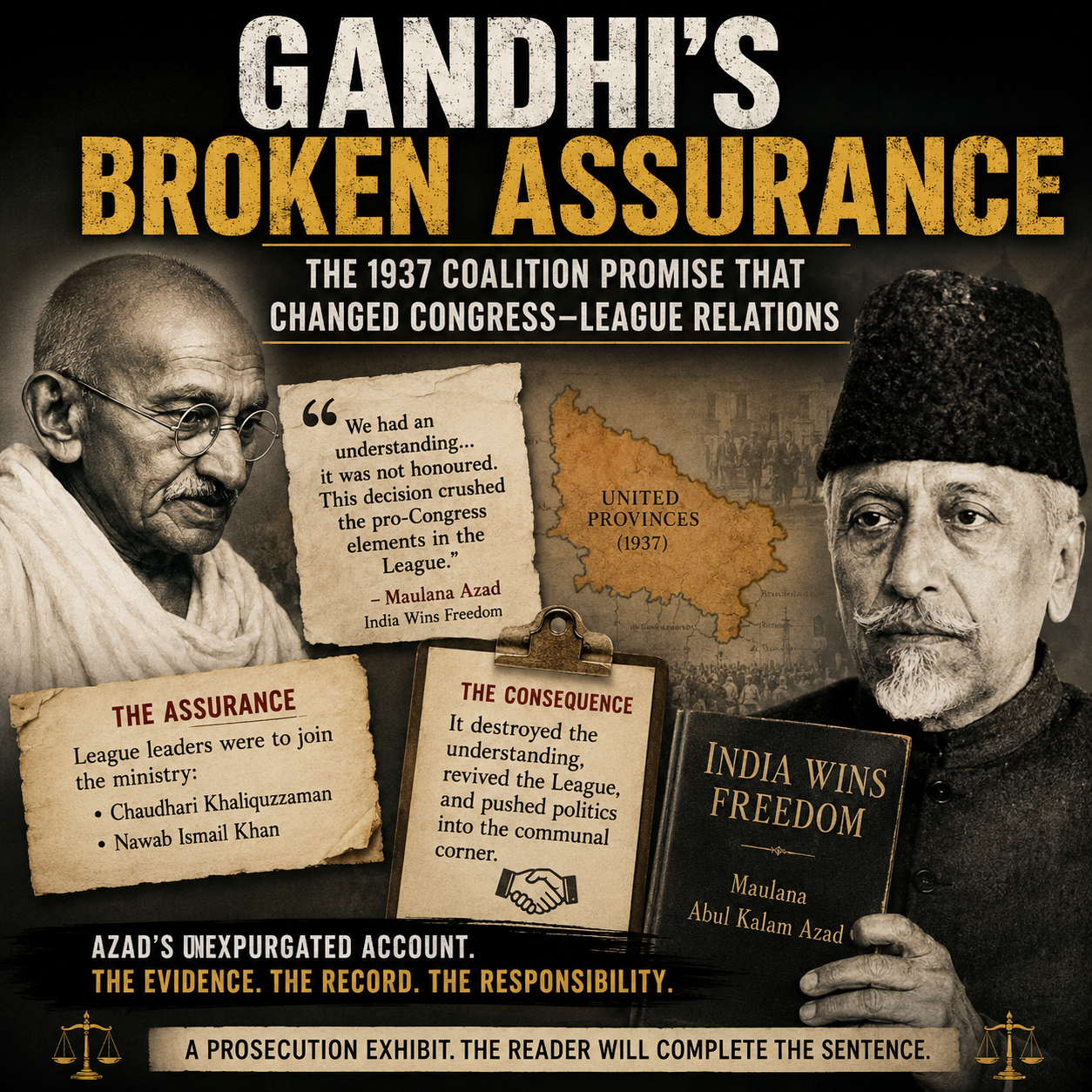
The Prosecution’s Position
Gandhi’s Self-Determination Statement places three questions before the reader, each grounded in the documented record this series has already established.
- Did Gandhi, in his own documented words of March 1940, concede that Muslims possessed the right to self-determination, even while calling the specific demand “baffling”?
- Did Congress, under Gandhi’s documented leadership, act in the three preceding years to dissolve, bypass, or exclude the political organisation — the Muslim League — through which that self-determination would have had to be exercised in practice?
- Does the documented gap between Gandhi’s conceded principle and Congress’s documented conduct toward the body representing that principle constitute a contradiction the reader is entitled to weigh?
The series does not answer. Gandhi’s own words, dated and sourced, are placed before the reader beside the documented conduct of the organisation he led for two decades. Gandhi’s Self-Determination Statement makes no claim about what Gandhi privately believed or intended. It places only what is documented — the statement, the exact timing, and the conduct that preceded it — and leaves the weighing of that record to the reader.
Invitation To Defence
The floor belongs to the defense. We now invite them to present their exhibits and challenge the narrative established by the prosecution.
March 1940. Gandhi: “baffling” — yet Muslims, like all people of India, have the right to self-determination. The same years: coalition terms requiring the League’s dissolution, a Mass Contact campaign aimed at its base, a broken assurance to its leaders. One man’s words conceded a principle. The organisation he led had spent three years acting against the body built to exercise it. The prosecution places both documented facts before the reader. The reader will complete the sentence.
Feature Image: Click here to view the image.
Videos
Glossary of Terms
- Lahore Resolution: The resolution adopted by the All-India Muslim League on 23 March 1940, calling for independent states in Muslim-majority regions of British India.
- Self-Determination: The principle that a people or community has the right to determine its own political future and form of governance.
- Muslim League: The All-India Muslim League, the principal political organisation that represented a large section of Muslim political opinion in late colonial India.
- Mass Contact Programme: A Congress initiative launched in 1937 to build direct political support among Muslim voters rather than working through the Muslim League leadership.
- Coalition Terms: The conditions discussed during post-election government formation negotiations between Congress and the Muslim League in 1937.
- Parliamentary Board: The organisational body through which a political party managed candidate selection, legislative strategy, and electoral affairs.
- United Provinces: A major province of British India, broadly corresponding to present-day Uttar Pradesh, where Congress-League coalition negotiations became highly contentious in 1937.
- Impartial Tribunal: A proposed neutral adjudicatory body intended to resolve constitutional or minority-related disputes between political communities.
- Constitutional Framework: The legal and political structure within which governance, representation, and rights are organised.
- Congress Leadership: The senior decision-making figures of the Indian National Congress during the late colonial period, including Gandhi and other national leaders.
- Political Representation: The process through which individuals, communities, or organisations act on behalf of a larger group in public affairs.
- Self-Determination Statement: A key phrase in this series referring to Gandhi’s March–April 1940 acknowledgement that Muslims, like other peoples of India, possessed the right to self-determination.
- Documented Shift: A series term describing the movement between two documented positions or statements within a short period, without asserting motives beyond the historical record.
- Prosecution’s Position: A recurring analytical framework used in this series that assembles documentary evidence and places questions before readers without claiming judicial finality.
- Documented Record: The collection of speeches, writings, correspondence, resolutions, and political actions relied upon as evidence throughout this series.
#Gandhi #Jinnah #Pakistan #Congress #MuslimLeague #Partition #India #History #Politics #Freedom #LahoreResolution #BritishIndia #SelfDetermination #Independence #HinduinfoPedia
Gandhi’s Peace Efforts: The Questions Before the Mahatma (0)
Refer to Various Arks Referred to in the Blog
Gandhi’s Self-Determination Statement — “Baffling,” Yet Conceded (96)