
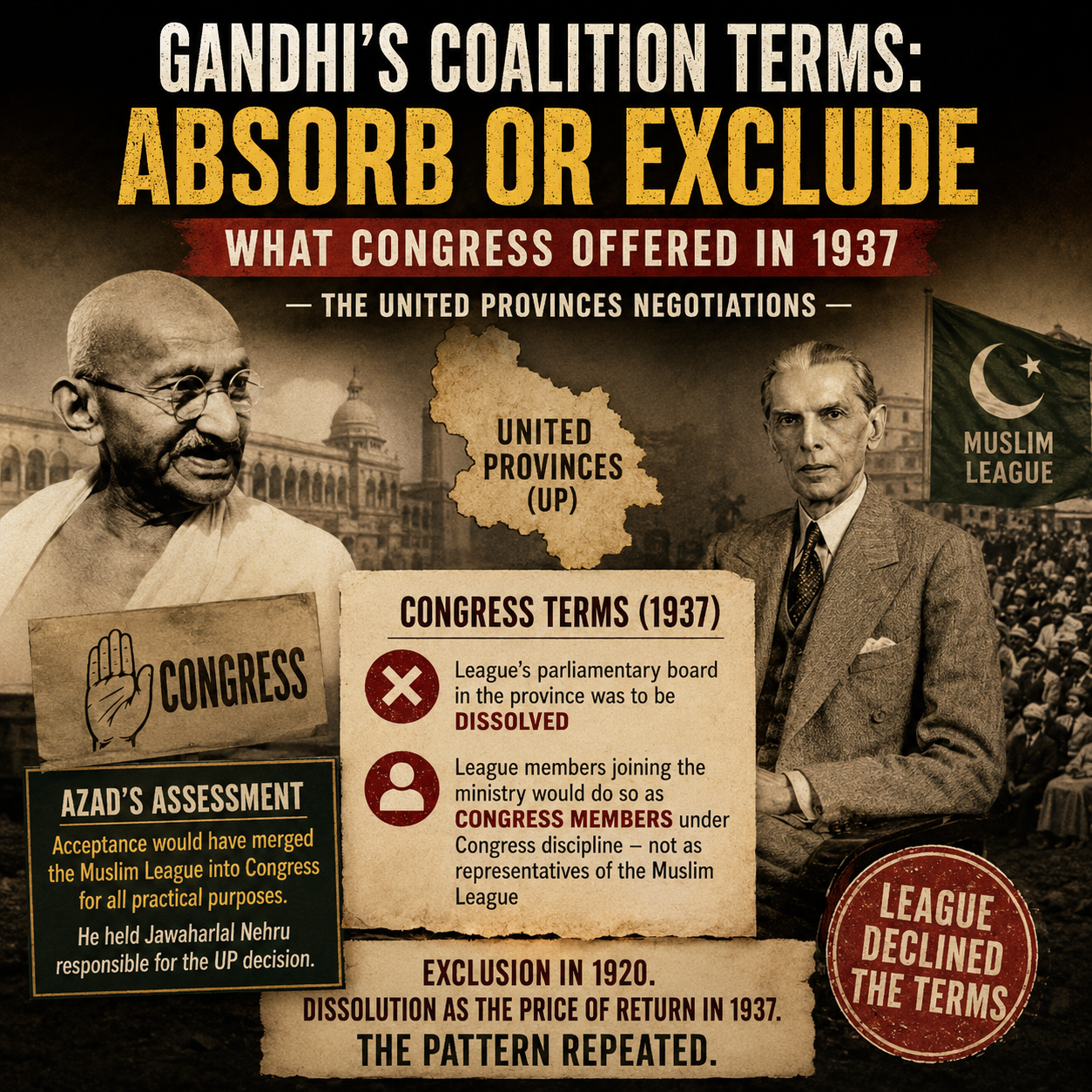
Gandhi’s League Coalition Terms: Absorb or Exclude — What Congress Offered in 1937 (88)
भारत / GB
Part 88: Mahatma Gandhi’s Peace Efforts | Series Index
Blog 87 documented the eighteen-year arc from Jinnah’s tears at Calcutta station in 1928 to his 1946 declaration. This post examines a specific documented episode within that arc — the 1937 United Provinces coalition negotiations — and what Congress offered the Muslim League as the price of participation.
Thank you for reading this post, don't forget to subscribe!The Action Taken: Gandhi used the moral coercion of his impending death in Yerwada to compel Dr. Ambedkar to surrender the British statutory separate electorate in exchange for increased joint-electorate reserved seats.
Who Paid the Price: The political independence of Dalit representation, which became subordinated to the campaign finances and party machinery of the caste-majority Congress.
The Alternative Bypassed: Honoring the Communal Award’s provision granting Dalits independent legislative representation for a transitional 20-year period.
Why This Matters: Ambedkar’s documented evaluation: the Poona Pact disenfranchised Dalits from authentic autonomous representation, making reserved-seat candidates dependent on majority party approval.
The 1937 Election Results — Documented
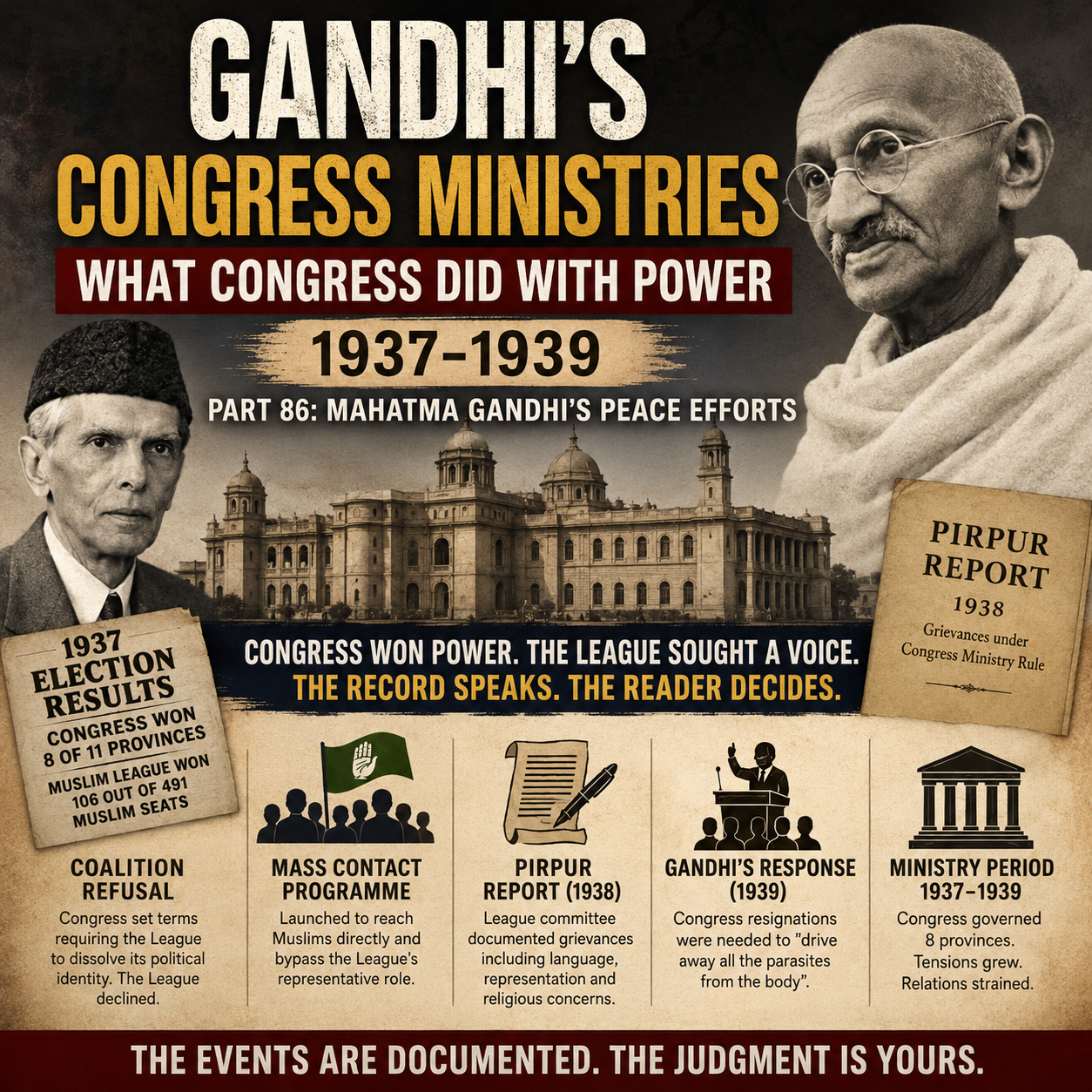
The 1937 provincial elections produced results that surprised the Muslim League. Despite separate electorates, the League’s performance in Muslim-majority provinces was poor in 1937 — three seats in Sind, one in Punjab, none in the North-West Frontier Province. The election results came as a documented shock to Muslim political opinion. The League had pinned its hopes on these provinces, and the results showed Muslim political representation as weak, divided, and disorganised — a documented assessment from the period itself.
In the United Provinces, Congress won a clear majority. The Muslim League also won seats. The expectation among contemporaries was that a Congress-League coalition would govern the province — the same kind of arrangement that had defined Congress-Muslim political cooperation since the Lucknow Pact of 1916, documented in Blog 82.
The Documented Negotiation
Gandhi’s League Coalition Terms places the documented account of what followed before the reader — drawn from Maulana Abul Kalam Azad’s autobiography, India Wins Freedom.
Azad, then Congress President, held out hope for a Congress-League coalition in the United Provinces )UP). The Muslim League sought the inclusion of its representatives in the UP ministry. Azad’s documented account records that he had given assurances on this point — assurances that were not honoured when the ministry was formed.
The documented terms Congress ultimately required: the League’s parliamentary board in the province was to be dissolved, and any League members joining the ministry would do so as Congress members under Congress discipline — not as representatives of the Muslim League as a political organisation in its own right.
The League declined these terms. Congress formed the UP ministry without League participation. Gandhi’s League Coalition Terms places this documented outcome before the reader as the second documented instance — after the 1937 statewide coalition refusal documented in Blog 86 — of the same pattern playing out at the provincial level, with the same organisation, in the same year.
Azad’s Documented Assessment
Gandhi’s League Coalition Terms places Azad’s own documented assessment before the reader — recorded in his autobiography, written by Congress’s own wartime President, a man who opposed Jinnah and opposed Partition throughout his life and who reviewed these events with the benefit of a decade’s hindsight.
Azad’s documented view was that had the League’s offer of cooperation been accepted on the terms the League sought, the Muslim League as a political organisation would, for all practical purposes, have merged into Congress.
Azad also documented that he held Jawaharlal Nehru specifically responsible for the UP decision — recording it as one of two instances where Nehru’s conduct widened the gulf between Congress and the League. Gandhi’s League Coalition Terms notes that Azad’s criticism was directed at Nehru’s conduct, not at Gandhi’s authority over Congress as an institution. The documented unchallengeable authority Gandhi held over Congress — established across Blogs 21–22 — extended over the period in which this decision was made.
The Documented Parallel to 1920
Gandhi’s League Coalition Terms places one structural observation before the reader.
In 1920, at Nagpur, the documented record shows that Jinnah’s constitutional approach was rejected when Gandhi introduced the Khilafat-Non-Cooperation alliance, after which Jinnah left Congress — documented across Blog 82. Jinnah’s constitutional path was foreclosed at that point. Gandhi held documented unchallengeable authority over Congress at Nagpur, as established across Blogs 21–22 that was reinforced in this case as well.
In 1937, seventeen years later, Congress — the organisation Gandhi had built and over which he held documented unchallengeable authority — was offered the opportunity to bring the Muslim League back into its fold. The terms offered required the League’s dissolution as a political organisation, not its inclusion as a political partner.
The prosecution places both documented episodes before the reader. 1920: exclusion at the point of entry — Jinnah shut out of Congress when the Khilafat alliance was formalised. 1937: a structurally similar outcome at the point of potential return — the League could rejoin only by ceasing to exist as the League. Seventeen years separated the two episodes. The documented pattern was the same.
The Prosecution’s Position
Gandhi’s League Coalition Terms places three questions before the reader.
- Did Congress, in the United Provinces in 1937, require the Muslim League to dissolve its political identity as the condition for joining the ministry — and did the League decline on those terms?
- Does Azad’s own documented assessment — that acceptance would have merged the League into Congress for all practical purposes — establish what the terms were designed to achieve?
- Does the documented parallel between Nagpur 1920 and the United Provinces 1937 — exclusion at entry, dissolution as the price of return — establish a consistent pattern in how the organisation Gandhi built related to organised Muslim political representation?
The series does not answer. Azad’s documented account is the primary source — written by Congress’s own wartime President, a lifelong opponent of Jinnah and of Partition. The 1920 exclusion is documented across Blog 82. The reader will examine both documented episodes, separated by seventeen years, and complete the sentence.
Invitation To Defence
We Invite the defence to present the defence exhibit to counter the contents in the prosecution exhibition.
1920, Nagpur: Jinnah excluded as Gandhi’s Khilafat alliance was formalised. 1937, United Provinces: the Muslim League offered terms requiring its dissolution as the price of coalition. Azad’s documented assessment: acceptance would have merged the League into Congress for all practical purposes. The League declined both times — exclusion in 1920, dissolution in 1937. The prosecution places both documented episodes before the reader. The reader will complete the sentence.
Feature Image: Click here to view the image.
Videos
Glossary of Terms
- United Provinces (UP): A major province of British India, corresponding largely to present-day Uttar Pradesh, where the 1937 coalition negotiations took place.
- Muslim League: The All-India Muslim League, a political organization founded in 1906 to represent Muslim political interests in British India.
- Indian National Congress: The principal political organization of the Indian independence movement and the governing party in the United Provinces after the 1937 elections.
- Provincial Elections of 1937: Elections held under the Government of India Act 1935 that established elected ministries in British Indian provinces.
- Coalition Government: A government formed through cooperation between two or more political parties.
- Parliamentary Board: The organizational body responsible for selecting and directing party candidates and legislative strategy.
- Maulana Abul Kalam Azad: Senior Congress leader, Islamic scholar, freedom movement participant, and author of India Wins Freedom.
- India Wins Freedom: Maulana Azad’s autobiographical account containing his recollections of Congress, the Muslim League, and Partition-era politics.
- Jawaharlal Nehru: Senior Congress leader who later became independent India’s first Prime Minister.
- Muhammad Ali Jinnah: Leader of the Muslim League who later became the principal advocate of Pakistan.
- Lucknow Pact (1916): An agreement between Congress and the Muslim League that represented a significant phase of political cooperation.
- Nagpur Session (1920): Congress session where Gandhi’s Non-Cooperation strategy became dominant and where Jinnah’s constitutional approach lost influence.
- Khilafat-Non-Cooperation Alliance: The political movement combining Gandhi’s Non-Cooperation campaign with support for the Khilafat cause.
- Gandhi’s League Coalition Terms: The key phrase of this blog, referring to the conditions discussed during the 1937 United Provinces coalition negotiations.
- Prosecution’s Position: A recurring analytical device in this series that presents evidence and questions for reader evaluation rather than imposing a final conclusion.
#HinduinfoPedia #Gandhi #Jinnah #Congress #MuslimLeague #Partition #History #India #Politics #Freedom
Gandhi’s Peace Efforts: The Questions Before the Mahatma (0)
Refer to Various Arks Referred to in the Blog