
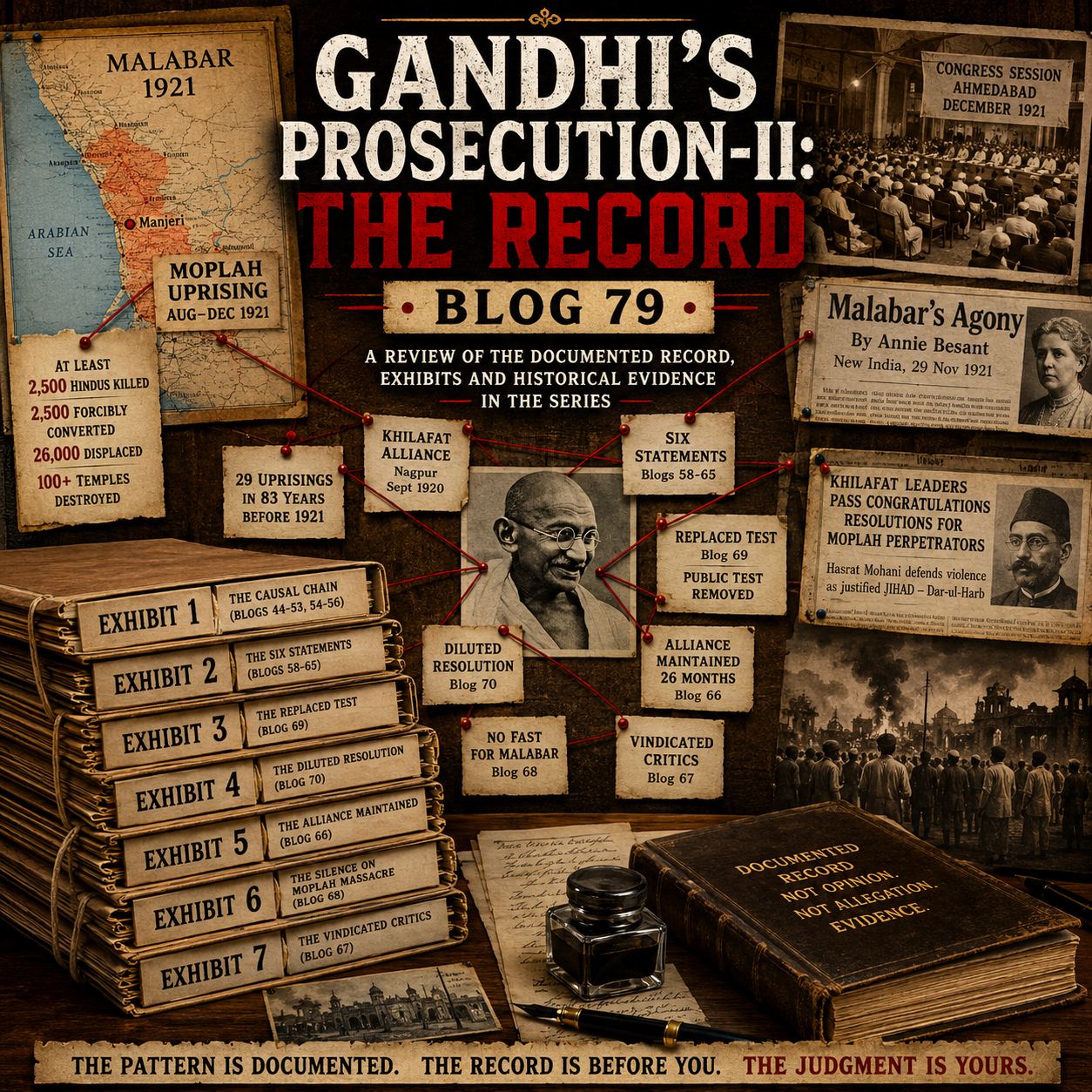
Gandhi’s Prosecution-II: The Record at Blog 79
भारत / GB
Part 79: Mahatma Gandhi’s Peace Efforts | Series Index | Exhibits Master Table
Blog 53 mapped the prosecution’s record through the Khilafat Foundation Arc — what had been established, what remained, what the central charge required. This post does the same at Blog 80. It is not a summary. It is a reckoning — an honest account of where the series stands after twenty-seven additional blogs across the Moplah Arc and the Vidyarthi-Shraddhananda Arc.
Thank you for reading this post, don't forget to subscribe!The Action Taken: The series reconciled the documentation of Malabar, Kanpur, Shraddhanand, and the riot statements into Charge v2.0, distinguishing CWMG verbatim texts from press accounts.
Who Paid the Price: The assumption that Gandhian riot responses were merely spontaneous pacifism, exposed as a systematic doctrine of unilateral demobilization.
The Alternative Bypassed: Emotional polemical commentary detached from chronological primary sources.
Why This Matters: Establishes the second major forensic milestone: proving that between 1921 and 1931, communal violence was systematically whitewashed while victims were doctrinally disarmed.
The Event — Established Once, Referenced Across Seventeen Blogs
August 20 to December 1921. The Moplah uprising in Malabar. At least 2,500 Hindus killed. 2,500 forcibly converted. 26,000 displaced from their homes. More than 100 temples destroyed. The uprising ran for four months — the ceiling was unknown until British suppression arrived.
This is the event the seventeen blogs documented from multiple angles — the massacre, the statements, the silences, the session, the alliance, the arithmetic. The prosecution does not re-examine the event in each blog. It places Gandhi’s documented choices before the reader against this fixed reference point.
Exhibit 1 — The Causal Chain (Blogs 44-53, 54-56)
Before the massacre, Gandhi’s Prosecution-II documented the instrument Gandhi had built — the Khilafat alliance, formalised at Nagpur in September 1920, over documented objections from Jinnah and Besant. The Moplah community joined the Congress-Khilafat platform through the Manjeri Conference of April 1920, four months before Gandhi’s formal ratification of the alliance. Their agrarian grievance — Hindu jenmis as landlords, Muslim Moplahs as tenants — merged with pan-Islamic theological mobilisation. Twenty-nine documented uprisings across 83 years preceded 1921. The instrument’s properties were known before it was deployed.
- https://hinduinfopedia.in/gandhis-first-flood-the-khilafat-injection-44/
- https://hinduinfopedia.in/gandhis-khilafat-experiment-the-instrument-before-the-alliance-45/
- https://hinduinfopedia.in/gandhis-two-platform-march-hindus-for-swaraj-muslims-for-caliphate-46/
- https://hinduinfopedia.in/gandhis-muslim-front-creation-the-consolidation-he-did-not-intend-47/
- https://hinduinfopedia.in/gandhis-muslim-front-creation-the-consolidation-he-did-not-intend-48/
- https://hinduinfopedia.in/gandhis-silenced-opposition-the-voices-that-warned-and-were-overridden-49/
- https://hinduinfopedia.in/gandhis-guilty-plea-the-boycott-leader-who-bowed-to-the-boycotted-court-50/
- https://hinduinfopedia.in/gandhis-legitimisation-the-two-acts-that-validated-british-authority-51/
- https://hinduinfopedia.in/gandhis-complicity-test-five-exhibits-one-pattern-one-question-52/
- https://hinduinfopedia.in/gandhis-prosecution-the-record-compiled-53/
- https://hinduinfopedia.in/gandhis-moplah-massacre-the-first-downstream-flood-54/
- https://hinduinfopedia.in/gandhis-moplah-timeline-the-four-months-the-ceiling-was-unknown-55/
- https://hinduinfopedia.in/gandhis-malabar-silence-the-agrarian-crisis-he-did-not-address-56/
Exhibit 2 — The Six Statements (Blogs 58-65)
Gandhi made six documented statements on the Moplah massacre. All six were examined individually.
Brave and God-fearing:
Gandhi’s characterisation of the Moplah perpetrators — courage and faith prescribed for victims, admiration for those who killed them.
Voluntary conversion:
Gandhi’s characterisation of forced conversions as choice — contradicted by three standards: legal, moral, and Islamic jurisprudence.
The standard Gandhi applied to himself — one incident of injustice warranted full commitment. The standard applied to Moplah Hindus: courage and faith.
The uninvited precedent:
Gandhi had required no British invitation for forty years of action. He required one for Malabar — where acting without invitation would have cost him the Khilafat alliance.
The key admission:
Gandhi’s own statement confirmed the causal chain — he and the Ali Brothers held the authority to stop the massacre and chose not to use it without a British invitation.
The brave death prescription:
Gandhi prescribed brave acceptance of death to Hindus facing Muslim violence — documented across 1921, 1946, and 1947. Twenty-six years, consistent direction.
- https://hinduinfopedia.in/gandhis-moplah-response-the-brave-god-fearing-moplahs-58/
- https://hinduinfopedia.in/gandhis-moplah-statements-six-statements-one-direction-59/
- https://hinduinfopedia.in/gandhis-voluntary-conversion-knifepoint-called-choice-60/
- https://hinduinfopedia.in/gandhis-pietermaritzburg-test-the-standard-he-applied-to-himself-61/
- https://hinduinfopedia.in/gandhis-admiration-prescription-the-but-that-negated-the-condemnation-62/
- https://hinduinfopedia.in/gandhis-uninvited-precedent-the-man-who-never-needed-an-invitation-until-malabar-63/
- https://hinduinfopedia.in/gandhis-key-admission-the-statement-that-named-the-causal-chain-64/
- https://hinduinfopedia.in/gandhis-brave-death-prescription-what-he-told-others-what-he-did-himself-65/
Exhibit 3 — The Replaced Test (Blog 69)
In October 1921, Gandhi removed verbal condemnation as the test of Muslim friendship. The full CWMG statement: Muslims must work silently and effectively so that such things become impossible — an interior, private, unverifiable standard replacing a public, observable, accountable one. At the same Ahmedabad session, Khilafat leaders passed congratulations resolutions for the Moplah perpetrators. Hasrat Mohani blocked even a diluted condemnation resolution, defending the Moplah violence as a justifiable religious war (jihad) because British martial law had turned the region into dar-ul-harb (an abode of war). The test Gandhi removed was the test the Khilafat leadership was simultaneously failing — and inverting into celebration.
Exhibit 4 — The Moplah Condemnation Resolution Diluted (Blog 70)
December 1921. Gandhi chaired the Congress session at Ahmedabad. At the same session: he actively defeated Mohani’s independence resolution — demonstrating capability and effective intervention. The Moplah condemnation resolution was progressively diluted from condemning the massacre wholesale to condemning certain individuals to not passing unanimously even then. The Congress resolution that passed denied the Khilafat alliance’s role in the massacre and blamed the British administration for not permitting Non-Cooperation leaders to enter Malabar. RC Majumdar documented his assessment: the resolution was unworthy of a great national organisation.
Exhibit 5 — The Alliance Maintained (Blog 66)
The Khilafat alliance continued for twenty-six months after 2,500 Hindus died. It ended when the Turks abolished the Caliphate in March 1924 — not when Gandhi chose to end it. The Non-Cooperation Movement was dissolved eight days after twenty-two policemen died at Chauri Chaura. The documented arithmetic of the two decisions is placed before the reader without characterisation.
Exhibit 6 — The Silence on Moplah Massacre (Blog 68)
Gandhi’s Prosecution-II places before the reader what Gandhi did not do. No fast for Hindu victims of the Moplah massacre — contrasted with the documented five-day fast Gandhi undertook within forty-eight hours of the Bombay riots of November 1921, in which 58 people died. Both events in the same months of the same year. The instrument of personal fast — deployed immediately for 58 dead in Bombay — was not deployed for 2,500 dead in Malabar. The prosecution places this documented arithmetic before the reader without characterisation. The Bombay fast is documented in Gandhi’s own Young India. The absence of a Malabar fast is documented by its absence from the same publication across the same period.
Exhibit 7 — The Vindicated Critics (Blog 67)
Besant’s Malabar’s Agony, published in New India on November 29 1921, named Gandhi’s preaching as a direct cause of the massacre. The gap between her warning at Nagpur in 1920 and her vindication in print was eleven months. The alliance Gandhi maintained after her vindication continued for two years and four months. Besant had warned Gandhi personally at Nagpur before he deployed the instrument. The documented timeline places the warning, the deployment, the massacre, and the maintained alliance before the reader in sequence.
What the Moplah Arc Does Not Establish
Gandhi’s Prosecution-II: The Moplah Arc documents Gandhi’s choices and their documented consequences. It does not establish Gandhi’s intent. It does not assert that Gandhi foresaw the massacre or designed it. The prosecution places documented choices alongside documented consequences and asks the reader to examine whether the pattern — across seven documented exhibits — constitutes something the reader wishes to name.
The central charge has not yet been stated. The Moplah arc is one component of the evidence the central charge requires. The remaining arcs — post-Khilafat riots, Direct Action Day, Noakhali, Partition — will add to the documented record before the prosecution places its central charge before the reader in full. The Moplah arc is the foundation. It is not the complete case.
Twenty-nine documented uprisings across eighty-three years told Gandhi what the instrument could produce. The instrument was deployed. The massacre ran for four months. Six documented statements went in one direction. The replaced test removed the observable standard at the moment Khilafat leaders were inverting it. The Ahmedabad session blamed the British. The alliance continued for twenty-six months. No fast. The prosecution places seventeen documented exhibits before the reader. The reader will examine the pattern and complete the sentence.
Feature Image: Click here to view the image.
Videos
Glossary of Terms
- Khilafat Alliance: The political partnership forged by Mahatma Gandhi and Congress with the Khilafat Movement in 1920 to mobilize support against British rule and defend the Ottoman Caliphate.
- Moplah Uprising (1921): A violent rebellion in the Malabar region of present-day Kerala involving sections of the Moplah Muslim community, resulting in killings, forced conversions, displacement, and destruction of property.
- Moplah Arc: A term used in this series to describe the collection of blogs examining Gandhi’s responses, decisions, and public statements related to the 1921 Moplah uprising.
- Manjeri Conference: A 1920 political gathering in Malabar where local support for the Congress-Khilafat platform was organized before Gandhi formally ratified the alliance.
- Jenmis: Traditional Hindu landowners of Malabar who were often involved in agrarian disputes with tenant cultivators during the colonial period.
- Ali Brothers: Maulana Mohammad Ali and Maulana Shaukat Ali, prominent leaders of the Khilafat Movement and close political allies of Gandhi during the Non-Cooperation era.
- Pietermaritzburg Test: A phrase coined in this series referring to the comparison between Gandhi’s strong reaction to his personal experience of discrimination in South Africa and his response to the suffering of Moplah victims.
- Replaced Test: A term coined in this series describing Gandhi’s shift from requiring public condemnation of violence to emphasizing private and unverifiable goodwill as the measure of communal friendship.
- Dar-ul-Harb: An Islamic jurisprudential term meaning “abode of war,” historically used in some interpretations to describe territories not governed by Islamic authority.
- Jihad: An Arabic term meaning “struggle” or “striving.” In the context discussed in this blog, it refers to the religious justification cited by certain Khilafat leaders for the Moplah violence.
- Ahmedabad Session (1921): The annual Congress session held in Ahmedabad in December 1921 where debates occurred regarding resolutions related to the Moplah uprising and national strategy.
- Non-Cooperation Movement: A mass political campaign launched by Gandhi in 1920 urging Indians to withdraw cooperation from British institutions and administration.
- Chauri Chaura Incident: A violent confrontation in February 1922 in which protesters killed twenty-two policemen, leading Gandhi to suspend the Non-Cooperation Movement.
- Malabar’s Agony: A publication by Annie Besant criticizing the consequences of the Khilafat alliance and discussing the suffering caused by the Moplah uprising.
- Documented Arithmetic: A recurring phrase in this series referring to the comparison of numerical facts, timelines, actions, and outcomes without adding interpretive conclusions, leaving judgment to the reader.
#Gandhi #Khilafat #Moplah #Malabar #Congress #History #India #Partition #Politics #Freedom #Nationalism #HinduinfoPedia
Gandhi’s Peace Efforts: The Questions Before the Mahatma (0)