
Gandhi’s Guilty Plea: The Boycott Leader Who Bowed to the Boycotted Court (50)
भारत / GB
Part 50: Mahatma Gandhi’s Peace Efforts | Series Index
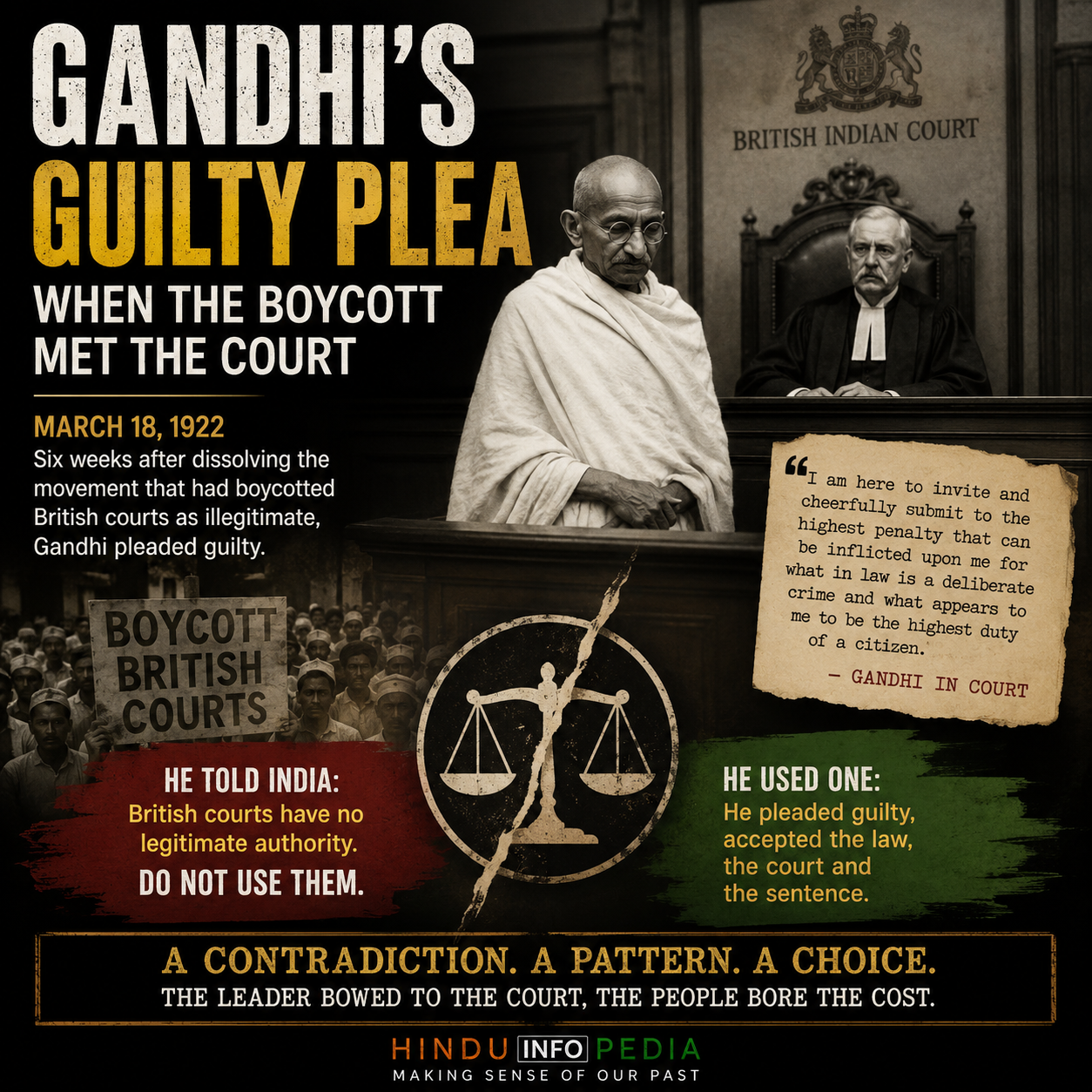
Blog 49 documented the voices Gandhi silenced — Besant’s warning that boycotting constitutional institutions was self-destructive, Pal’s warning that abandoned frameworks cannot be rebuilt on Indian terms. This post documents the moment Gandhi verified both warnings with his own conduct. On March 18, 1922 — six weeks after dissolving the movement that had boycotted British courts as illegitimate — Gandhi stood before a British colonial judge and pleaded guilty.
Thank you for reading this post, don't forget to subscribe!The Action Taken: Gandhi pleaded guilty before Judge Broomfield, using the colonial courtroom as an elevated moral platform to articulate his personal philosophy while accepting a six-year simple imprisonment sentence.
Who Paid the Price: Ordinary satyagrahis serving harsh labor terms in overcrowded district jails without personal accommodations.
The Alternative Bypassed: Mounting an active political and legal challenge against colonial sedition statutes.
Why This Matters: Elevated his personal moral stature through dignified court proceedings, securing protected custodial status while rank-and-file prisoners absorbed standard penal labour.
What the Movement Had Declared
Gandhi’s Guilty Plea begins with the declaration the movement had made about British courts.
The Non-Cooperation Movement’s boycott of British courts was not a tactical inconvenience. It was a moral and constitutional statement — that British judicial authority over Indians had no legitimacy, that Indians who participated in British courts were collaborating with an illegitimate system, and that the independence movement’s integrity required withdrawal from all colonial institutions, courts included.
Thousands of lawyers had suspended their practices. Thousands of litigants had withdrawn their cases. The boycott was real, its moral foundation explicit, and Gandhi was its architect and loudest advocate.
On February 12, 1922 — Gandhi suspended the Non-Cooperation Movement. The boycott of British courts ended for India.
Six weeks later, on March 18, 1922, Gandhi appeared before Judge C.N. Broomfield of the Ahmedabad Sessions Court. He did not challenge the court’s jurisdiction. He did not refuse to recognise the proceedings as illegitimate — which is what a man who genuinely held that British judicial authority had no legitimacy over Indians would have done. He pleaded guilty to sedition under Section 124A of the Indian Penal Code — a British colonial law, in a British colonial court, before a British colonial judge.
The boycott leader bowed to the boycotted court.
What the Plea Did Not Do — and What It Did
Gandhi’s Guilty Plea was not a private capitulation. It was performed — Gandhi delivered a statement in court that has been celebrated ever since as one of the great speeches of the independence movement. He told the judge: I am here to invite and cheerfully submit to the highest penalty that can be inflicted upon me for what in law is a deliberate crime and what appears to me to be the highest duty of a citizen.
The performance was for the gallery. The submission was for the record.
The performance said: I am a martyr accepting unjust punishment. The submission said: this court has the right to punish me. These two statements cannot coexist. A martyr accepting unjust punishment from an illegitimate court does not plead guilty to the court’s charge. He challenges the court’s jurisdiction — as Tilak did in his sedition trial, as Bhagat Singh did in 1930 when he used his trial as a platform to deny the court’s right to try him at all.
Gandhi pleaded guilty. He accepted the charge, the court, the law, and the sentence — and dressed the acceptance as defiance.
The Institutional Contradiction
Blog 49 documented Besant’s warning — that boycotting constitutional institutions was self-destructive — and Pal’s warning that abandoned frameworks cannot be rebuilt on Indian terms. Gandhi’s Guilty Plea is the moment both warnings were verified by Gandhi’s own conduct.
He told India: British courts have no legitimate authority over Indians. Do not use them. He used one to enter his own plea.
He told India: the British legal framework is an instrument of colonial oppression. He accepted its instrument — Section 124A — as the basis of his own prosecution without challenge.
He told India: participation in British institutions is collaboration. He participated in the most visible British institution available — the colonial criminal court — at the moment of maximum public attention.
The contradiction was not incidental. It was structural. Gandhi could have challenged the court’s jurisdiction and forced the British to either proceed against a non-cooperating defendant or drop the prosecution. Either outcome would have served the movement’s stated principles. He chose neither. He pleaded guilty — preserving the British court’s procedural authority while performing martyrdom within it.
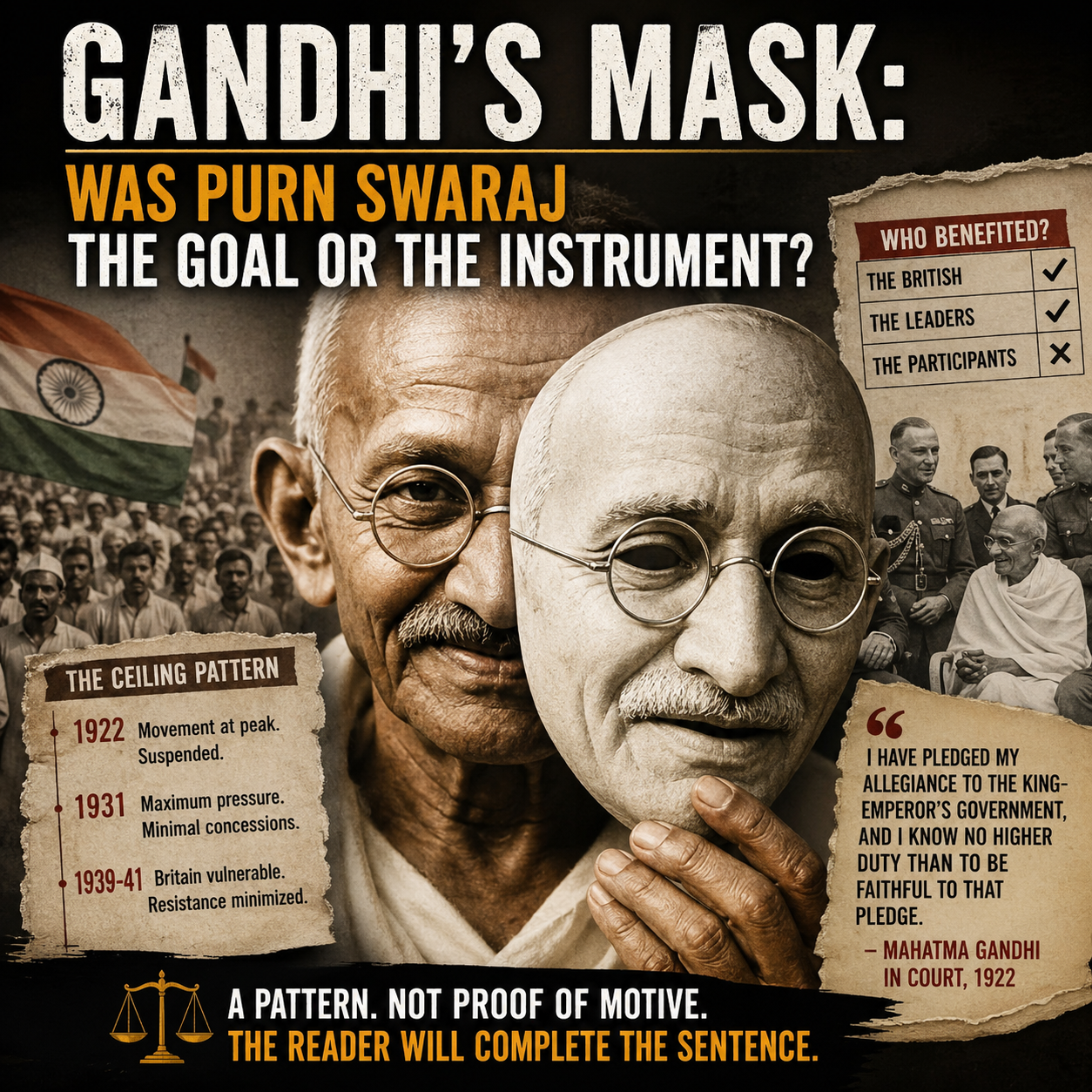
The Ahimsa Contradiction — The Same Pattern in a Different Domain
Gandhi’s Guilty Plea is not an isolated exhibit. It belongs to a pattern documented in full in Blog 40 — the selective activation of Gandhi’s stated principles.
The ahimsa asymmetry: at least 489 documented dead at Jallianwala Bagh including Hassan Mohammad, nine years old — Gandhi did not fast, the movement continued. Indians clashing with Indians in Bombay — five-day fast. Twenty-two policemen killed at Chauri Chaura — entire movement dissolved.
The principle of non-violence activated against Indian violence. It did not activate against British violence.
The principle of non-cooperation activated against British institutions — publicly, loudly, for India’s consumption. It did not activate when Gandhi himself faced a British institution — privately, quietly, in a courtroom.
Both principles were selectively applied. Both selections consistently served the same outcome: British institutional authority was preserved or submitted to, while Indian resistance was bounded, dissolved, or punished. This is historical fact and not an interpretation of the author.
The reader who has seen the ahimsa asymmetry in Blog 40 will recognise the institutional asymmetry in Gandhi’s Guilty Plea without being told what to see.
The Prosecution’s Position
Gandhi’s Guilty Plea does not claim Gandhi was a coward or a hypocrite. It claims the documented record of March 18, 1922 places one fact before the reader that cannot be explained away by the standard defence of principled conviction.
A man of principled conviction who genuinely held that British judicial authority had no legitimacy over Indians would not plead guilty to a British colonial charge. He would refuse to recognise the proceedings. The refusal might result in the same imprisonment — but it would be imprisonment imposed on a non-cooperating defendant, not accepted by a guilty-pleading one.
Gandhi chose the guilty plea. The choice preserved the British court’s procedural authority. It produced a celebrated speech. It produced six years imprisonment reduced to two on health grounds. It produced no challenge to the colonial judicial framework.
The Suspension Ledger’s question applies here precisely: who benefited from the guilty plea? The British court received procedural legitimacy from the most prominent defendant in the independence movement. Gandhi received martyrdom status and a celebrated speech. The movement received nothing — it had already been dissolved six weeks earlier.
The prosecution places the sequence before the reader. The reader will complete the sentence.
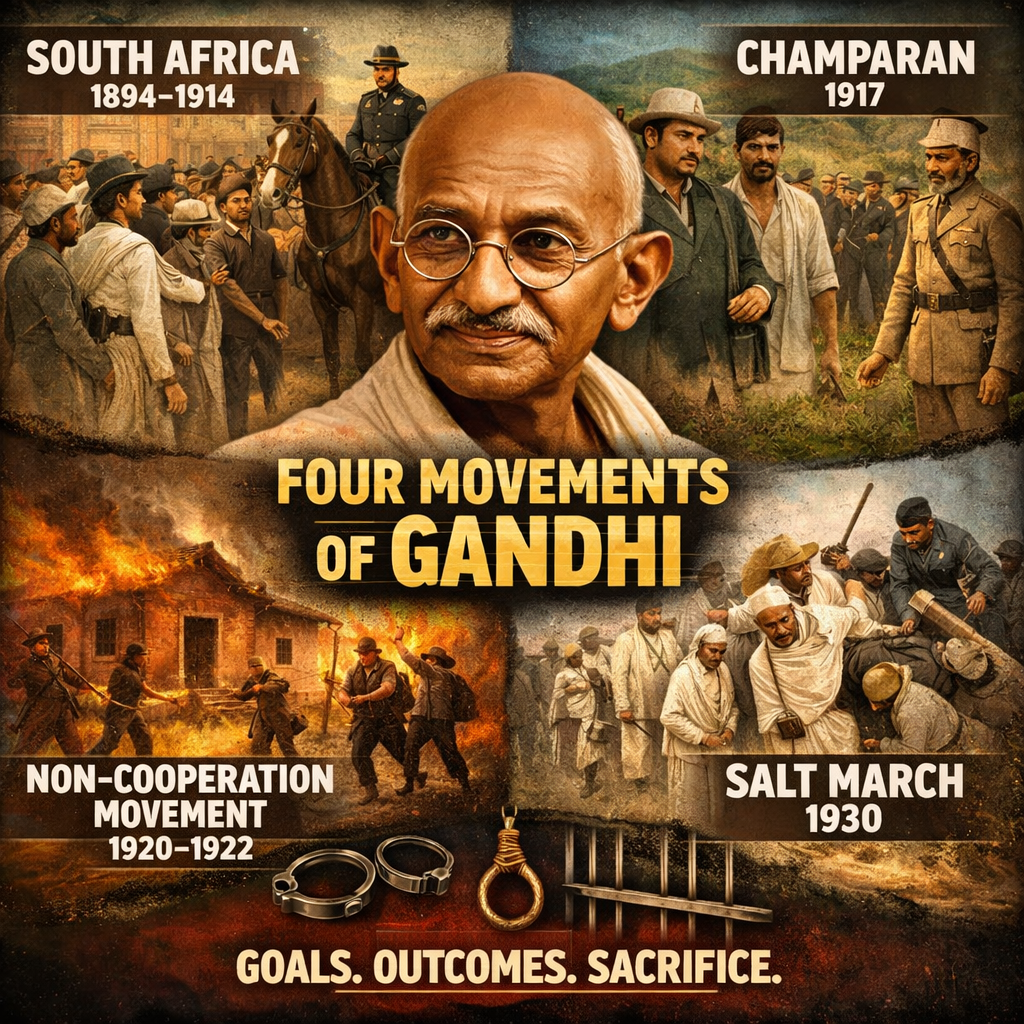
Gandhi told India that British courts had no legitimate authority over Indians. Six weeks later he stood in a British colonial court, accepted its jurisdiction, and pleaded guilty. Bhagat Singh denied the court’s right to try him and used his trial as a platform to expose colonial justice. Gandhi submitted to it — and called the submission a sacrifice. The boycott leader bowed to the boycotted court. The series places this before the reader without characterisation. The reader will supply the word.
Feature Image: Click here to view the image.
Videos
Glossary of Terms
- Gandhi’s Guilty Plea (गांधी की अपराध-स्वीकारोक्ति): The March 18, 1922 event where Mahatma Gandhi pleaded guilty in a British colonial court under Section 124A after leading a boycott of such institutions.
- Non-Cooperation Movement: A mass protest (1920–1922) led by Gandhi urging Indians to withdraw from British institutions including courts, schools, and titles.
- Boycott of British Courts: A central element of the movement where lawyers and litigants refused to participate in colonial judicial processes, declaring them illegitimate.
- Section 124A (Sedition Law): A colonial-era provision of the Indian Penal Code used to prosecute actions deemed seditious against the British government.
- Ahmedabad Sessions Court Trial (1922): The legal proceeding where Gandhi appeared before Judge C.N. Broomfield and entered a guilty plea.
- Institutional Contradiction: A key concept in this blog referring to the tension between rejecting colonial institutions publicly and engaging with them when personally prosecuted.
- Ahimsa (Non-violence): Gandhi’s principle of non-violent resistance, examined here for selective application in different contexts of violence.
- Ahimsa Asymmetry: A term used in this series to describe uneven application of non-violence—strict against Indians, less so against colonial actions.
- Chauri Chaura Incident (1922): A violent clash leading to the killing of 22 policemen, after which Gandhi abruptly suspended the movement.
- Jallianwala Bagh Massacre (1919): A British-led mass shooting of unarmed civilians in Amritsar, referenced to contrast responses to violence.
- Procedural Authority: The formal power of a court to try, judge, and sentence an individual within its legal framework.
- Satyagraha: Gandhi’s philosophy of resistance based on truth and moral force, often involving acceptance of legal penalties.
- Suspension Ledger: A conceptual framework in the series evaluating who benefited and who bore costs when movements were halted.
- Selective Activation of Principles: A coined term in the series describing the inconsistent application of stated moral or political doctrines.
- Leader–Follower Asymmetry: A concept highlighting the difference between the risks borne by masses and the decisions/actions taken by leadership.
#Gandhi #NonCooperation #IndianHistory #Sedition #FreedomStruggle #BhagatSingh #ColonialIndia #Ahimsa #HistoryDebate #HinduinfoPedia
Gandhi’s Peace Efforts: The Questions Before the Mahatma (0)
Read The Prosecution Exhibits Through Links