
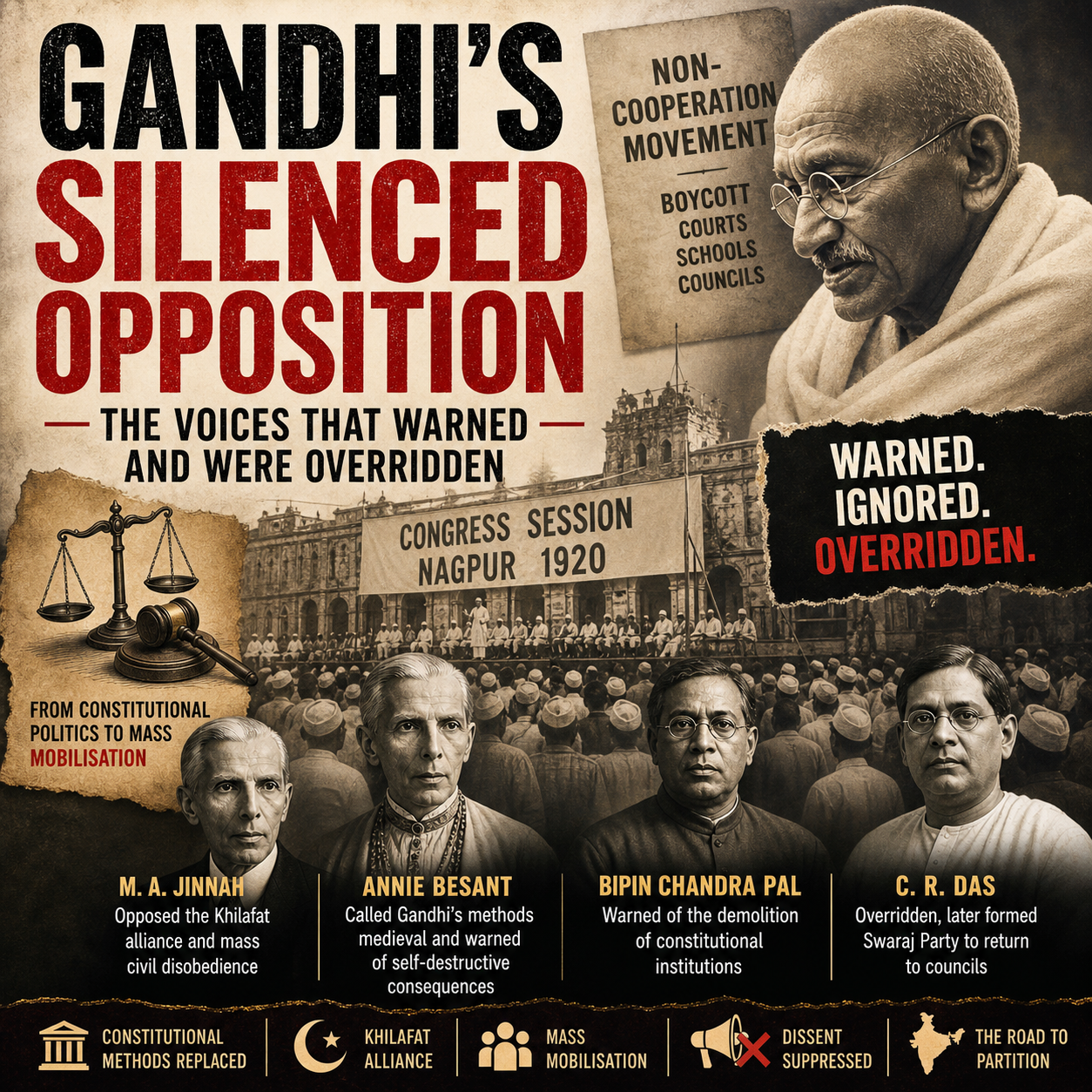
Gandhi’s Silenced Opposition: The Voices That Warned and Were Overridden (49)
भारत / GB
Part 49: Mahatma Gandhi’s Peace Efforts | Series Index
The Khilafat alliance was not adopted without opposition. Significant leaders — constitutional, experienced, and politically sophisticated — warned against it in specific and documented terms. This post records their warnings, what they said, how they were overridden, and what the overriding produced. The prosecution does not claim Gandhi was wrong and his opponents were right. It claims the opposition was silenced by methods that left no institutional space for the warnings to be heard — and that what followed confirmed what the silenced voices had said.
Thank you for reading this post, don't forget to subscribe!The Action Taken: Gandhi dismissed formal warnings from senior contemporaries that injecting theological zealotry into mass politics would lead to sectarian violence, having dissenters shouted down at Nagpur.
Who Paid the Price: Constitutional nationalists whose secular critique of religious mobilization was delegitimized.
The Alternative Bypassed: Heeding recorded constitutional warnings to separate religious grievances from the national self-governance charter.
Why This Matters: Proves that the long-term dangers of religious mobilization were not unforeseen; they were placed on the official record by senior peers and deliberately set aside.
The Congress Before Nagpur, 1920 — What Was Being Overridden
Gandhi’s Silenced Opposition begins with a precise description of what the Congress was before Gandhi transformed it at Nagpur in December 1920.
The Indian National Congress before 1920 was a constitutional organisation. Its stated objective — adopted at its founding and maintained for thirty-five years — was to attain self-government by constitutional and legal means. It operated through petitions, legislative engagement, and elite political negotiation. It had produced the Lucknow Pact of 1916 — the highest point of documented Hindu-Muslim civic cooperation — through exactly this method.
Gandhi’s programme at Nagpur changed the objective from constitutional means to any means including mass civil disobedience. It yoked the Congress to a pan-Islamic religious cause — the Khilafat — that had no connection to India’s constitutional future. And it restructured the Congress internally — reducing the membership fee to four annas, reorganising provincial committees on linguistic lines, fixing delegate numbers proportional to population — in ways that transformed it from an elite constitutional body into a mass mobilisation instrument.
Every significant constitutional voice in the Congress warned against this transformation. Gandhi overrode all of them.
Jinnah — Shouted Down at Nagpur
Muhammad Ali Jinnah had been called the Ambassador of Hindu-Muslim Unity by Sarojini Naidu. He had negotiated the Lucknow Pact of 1916 — the document that brought the Congress and the Muslim League together on a shared constitutional framework. He had spent fifteen years building the case that Hindus and Muslims could share a democratic, constitutional, self-governing India.
At the Nagpur session in December 1920, Jinnah was the only delegate who had the courage to openly oppose Gandhi to the end — among approximately fifty thousand surging delegates.
He had two principal objections.
- First: Gandhi’s satyagraha campaign was political anarchy — it rejected constitutional methods that had produced real gains in favour of mass civil disobedience that could not be controlled.
- Second: the entanglement of the secular independence movement with the religious Khilafat cause was a category error — it imported pan-Islamic religious energy into a civic nationalist framework that was not designed to manage it.
Both objections were documented. Both proved to be correct. Both were overridden.
The manner of the overriding is itself documented.
It was Motilal Nehru who had primed Jinnah to oppose Gandhi’s resolution — Motilal shared Jinnah’s constitutional reservations.
But when the vote came, Jawaharlal Nehru pressured his father under strong emotional strain to side with Gandhi. Motilal capitulated. A Muslim majority had been contrived at Nagpur — and it was that Muslim majority, energised by the Khilafat alliance, that shouted Jinnah down.
The man who had spent fifteen years building Hindu-Muslim unity was shouted down by a Muslim majority that Gandhi’s Khilafat alliance had activated. The irony is documented fact.
Jinnah resigned from the Congress. He said: “You are making a mistake. Gandhi is heading for disaster.”
Annie Besant — Medieval Methods
Annie Besant had founded the Home Rule League in 1916 and had served as Congress President in 1917 — the first woman to hold the position. She was a committed Indian nationalist who had given decades to the independence cause.
Besant called Gandhi’s methods medieval. She warned that Non-Cooperation would destroy the constitutional progress that thirty years of patient political work had built. She argued that boycotting courts, schools, and legislative councils — the infrastructure through which Indians could exercise institutional power — was self-destructive. It handed the British a victory by removing Indians from the very spaces where they were beginning to accumulate power.
Besant left the Congress. Her warnings were not engaged with. They were simply rendered irrelevant by Gandhi’s numerical majority.
Bipin Chandra Pal — The Constitutional Demolition
Bipin Chandra Pal — one of the Lal Bal Pal triumvirate that had defined the militant nationalist tradition before Gandhi arrived — opposed Non-Cooperation on specific constitutional grounds. His concern was that Gandhi’s programme would demolish the constitutional framework within which Indians had been systematically accumulating representative power since the Morley-Minto reforms of 1909.
Pal’s warning was structural: once you abandon constitutional institutions — courts, councils, schools — you cannot rebuild them on your own terms. You rebuild them on the terms available after the abandonment. Gandhi’s programme, if successful, would leave India with mass mobilisation and no institutional architecture for self-governance.
Pal left active politics. His warning was not refuted. It was bypassed.
C.R. Das and Motilal Nehru — Overridden Then Capitulated
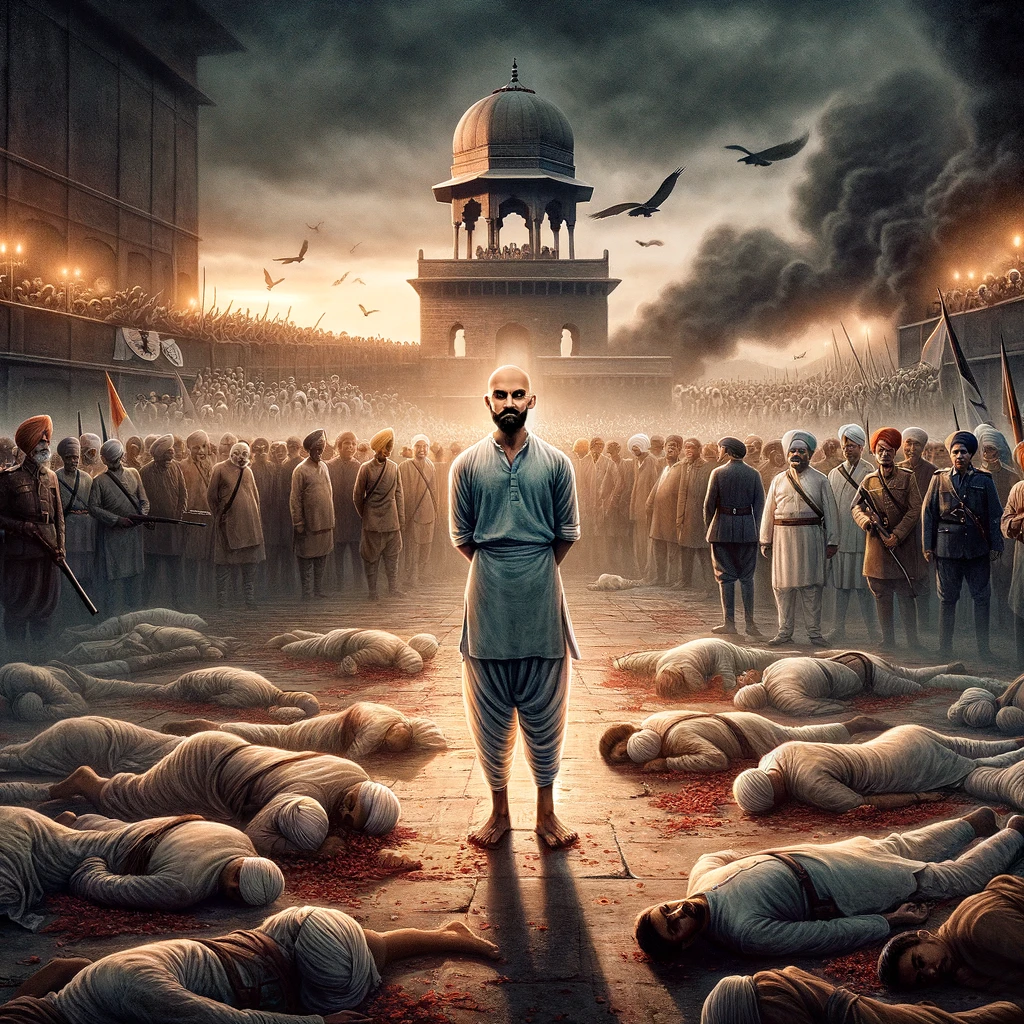
C.R. Das — the foremost lawyer-politician of Bengal, later the founder of the Swaraj Party — had opposed Gandhi’s programme at the Calcutta Special Session in September 1920. He was not opposed to Non-Cooperation in principle. He was opposed to the boycott of legislative councils — arguing that Indians should use the councils, not abandon them, and that boycotting them surrendered institutional power Gandhi would never recover.
Das was overridden at Calcutta. By Nagpur in December, he had capitulated to Congress discipline and moved the main Non-Cooperation resolution himself. The capitulation is documented — and it illustrates the method: Gandhi did not win arguments. He built numerical majorities that made argument irrelevant.
Motilal Nehru had primed Jinnah to oppose Gandhi at Nagpur — sharing Jinnah’s constitutional reservations. His son Jawaharlal emotionally blackmailed him to side with Gandhi when the vote came. Motilal voted for the programme he had privately opposed. Jinnah, who refused to capitulate, was shouted down and resigned.
The difference between Das and Motilal on one hand, and Jinnah on the other, was not political — it was personal. Das and Motilal chose Congress discipline over their convictions. Jinnah chose his convictions over Congress discipline.
Gandhi’s method rewarded the capitulators and expelled the principled. This is Gandhi’s Silenced Opposition in its most compressed form.
The Method of Silencing
Gandhi’s Silenced Opposition documents a consistent method across all four cases — Jinnah, Besant, Pal, Das — that goes beyond simple majority voting.
The method had four elements.
- First: restructure the Congress membership to produce a numerical majority before the vote. The four-anna membership and mass enrolment before Nagpur ensured that Gandhi’s supporters dominated the delegate count.
- Second: activate the Khilafat network to produce a Muslim bloc that voted as a unit. The Muslim majority that shouted Jinnah down at Nagpur was the Khilafat mobilisation operating within the Congress.
- Third: use emotional and social pressure — Jawaharlal’s emotional blackmail of Motilal is documented.
- Fourth: make the vote a test of loyalty to the freedom struggle itself — opposing Gandhi was made equivalent to opposing Indian independence.
This method produced unanimous majorities. It did not produce genuine agreement. The voices that warned were not persuaded. They were outvoted, outlasted, or pressured into public capitulation while privately maintaining their objections.
What the Silenced Voices Had Said
The prosecution does not claim the silenced voices were right about everything. It claims the documented record of what they warned — and what followed — deserves to be placed before the reader.
Jinnah warned: the entanglement of secular nationalism with religious Khilafat energy was a category error. What followed — as examined in earlier parts of this series — includes the Moplah violence, recurring communal mobilisation through the 1920s, the consolidation of Muslim political identity, and eventually Partition.
Besant warned: boycotting constitutional institutions was self-destructive. What followed: the Irwin Pact of 1931 abandoned eight of eleven demands — the constitutional gains that patient institutional work had never abandoned were surrendered in a negotiation Gandhi conducted from a position of deliberately weakened institutional standing.
Pal warned: once constitutional frameworks were abandoned they could not be rebuilt on Indian terms. What followed: the Congress spent the 1930s trying to re-enter the very councils it had boycotted, under terms less favourable than those available before the boycott.
But the most precise exhibits of Besant’s and Pal’s warnings were verified by Gandhi himself. Judge Broomfield on March 18, 1922. He did not contest the court’s jurisdiction and pleaded guilty to sedition under Section 124A of the Indian Penal Code, presenting a clear divergence between stated position and subsequent legal conduct. He told India not to use British courts. He used a British court to enter his own plea. He told India the British legal system had no legitimate authority over Indians. He submitted to that system’s authority to punish him. Besant had warned that abandoning constitutional institutions was self-destructive. Gandhi abandoned them publicly and submitted to them privately — in the same month.
Das warned: the council boycott surrendered institutional power. What followed: Das formed the Swaraj Party in 1922 specifically to re-enter the councils Gandhi had told India to abandon — proving within two years that the boycott had been a mistake.
Every warning was specific. Every warning was documented. Every warning proved accurate. Every warning was silenced before it could be heard.
Jinnah was the only delegate who opposed Gandhi to the end at Nagpur — among fifty thousand surging delegates. He was shouted down by a Muslim majority Gandhi’s Khilafat alliance had activated. He resigned. He said Gandhi was heading for disaster. He was right. The disaster was documented across the blogs that follow. Gandhi’s Silenced Opposition is not the record of men who were wrong. It is the record of men who were right — and were overridden before their warnings could protect the people who paid for the overriding.
Feature Image: Click here to view the image.
Videos
Glossary of Terms
- Khilafat Movement: A pan-Islamic political campaign (1919–1924) in India aimed at preserving the Ottoman Caliphate, later aligned with Congress under Gandhi.
- Non-Cooperation Movement: A mass political movement led by Mahatma Gandhi urging Indians to boycott British institutions including courts, schools, and councils.
- Nagpur Session (1920): The Indian National Congress session where Gandhi restructured the party into a mass organisation and adopted Non-Cooperation.
- Lucknow Pact (1916): An agreement between Congress and the Muslim League establishing a framework for Hindu-Muslim political cooperation.
- Satyagraha: Gandhi’s method of non-violent resistance, involving civil disobedience and moral pressure rather than constitutional negotiation.
- Four-Anna Membership: A structural reform reducing Congress membership fees to widen mass participation and expand numerical strength.
- Mass Mobilisation Instrument: A political structure designed to organise large-scale public participation rather than elite negotiation.
- Constitutional Politics: Political engagement through legal, legislative, and institutional mechanisms within an established governance framework.
- Council Boycott: The refusal to participate in British legislative councils as part of the Non-Cooperation strategy.
- Swaraj Party: A political group formed in 1922 by C.R. Das and Motilal Nehru to re-enter legislative councils after the boycott.
- Section 124A (IPC): A colonial-era sedition law under which criticism of the government could be prosecuted.
- Moplah Violence (1921): A violent uprising in Malabar involving agrarian, religious, and political dimensions during the Khilafat period.
- Silenced Opposition (Series Term): A concept used in this series describing leaders whose warnings were overridden through structural majority and political pressure.
- Category Error (Political Context): The misapplication of a religious mobilisation (Khilafat) within a secular nationalist framework.
- Institutional Vacuum: A condition where established political structures are abandoned without viable replacements, weakening governance capacity.
#Gandhi #Khilafat #Congress #Jinnah #NonCooperation #IndianHistory #FreedomStruggle #Partition #Politics #HinduinfoPedia
Gandhi’s Peace Efforts: The Questions Before the Mahatma (0)
Read The Prosecution Exhibits Through Links