
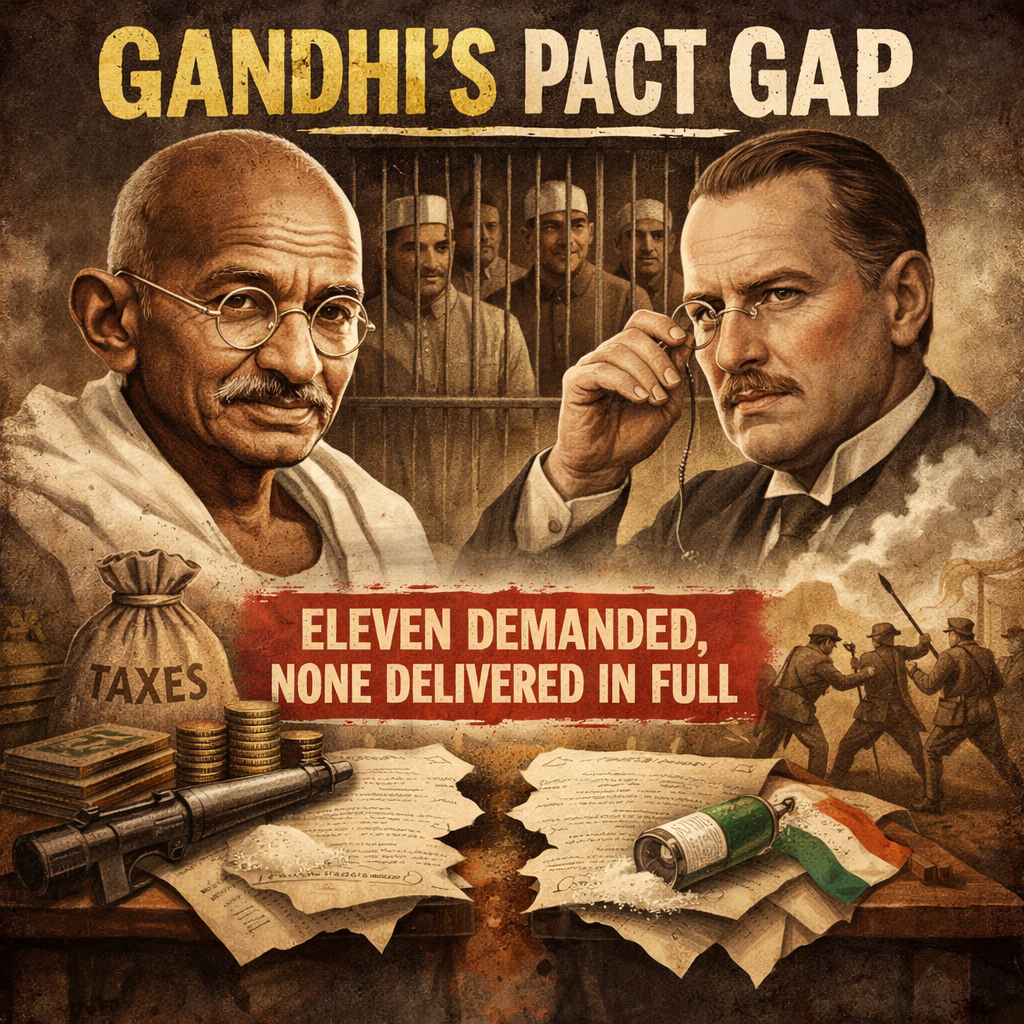
Gandhi’s Pact Gap: Eleven Demanded, None Delivered in Full (20)
भारत / GB
Part 20: Mahatma Gandhi’s Peace Efforts | Series Index
The Architecture of Extraction vs. The Diplomacy of Silence
This series has tracked the collision between an empire’s financial machinery and a Mahatma’s moral challenge. We began by documenting the Extraction Machine—the Council Bills, Home Charges, and salt monopolies that drained the subcontinent’s wealth. We then moved through the Incubation Year, where British administrators used twelve months of censorship and arrests to fortify their position before ever sitting at the table. In the previous chapters, we analyzed the specific clauses of the Gandhi-Irwin Pact, noting how legal qualifiers were used to hollow out nationalist victories. Now, we reach the arithmetic of the encounter. This post places Gandhi’s original Eleven Demands directly alongside the final text of the Pact to measure Gandhi’s Pact Gap. It is a side-by-side comparison of a movement’s mandate against its ultimate settlement—a ledger where silence speaks louder than the signatures.
Thank you for reading this post, don't forget to subscribe!The Action Taken: Gandhi signed the Delhi Pact, formally suspending civil disobedience while zero of the original eleven demands were met in full or to any enforceable extent.
Who Paid the Price: The 60,000 imprisoned satyagrahis whose sacrifices produced no structural constitutional progress, while the salt tax remained law until 1947.
The Alternative Bypassed: The Lahore Purna Swaraj mandate and AICC directives requiring self-governance concessions before ending non-cooperation.
Why This Matters: Confirmed to colonial administrators that mass civil movements under his command could be defused through personal negotiations without structural concessions.
The Comparison
Gandhi’s Pact Gap is not an argument. It is an arithmetic. Eleven demands were carried into eight meetings. What emerged from those meetings is documented in the pact text. This post places them side by side — demand by demand, clause by clause, silence by silence.
The Four Financial Demands
Demand 1 — Reduce land revenue by 50%, subject to legislative control.
Pact response: Not mentioned. Silence.
Land revenue — the largest single extraction line in the colonial budget, running for 190 years — was not addressed by a single clause in Gandhi’s Pact Gap. The farmers whose land had been seized during Gandhi’s Incubation Year received no reduction in the assessment that had produced the arrears for which their land was taken.
Demand 2 — Abolish the salt tax and the government monopoly on salt manufacture.
Pact response: Coastal residents may collect salt for personal domestic use.
The salt monopoly remained intact. The salt tax remained on the statute books until 1947. The Salt March was never about salt alone — salt was the entry point, the universally consumed necessity chosen to expose the deeper architecture of colonial extraction. What the pact returned was the symbolic act of picking up mud from a beach. What it preserved was every mechanism that had made that act criminal. The inland poor — who paid the salt tax most heavily as a proportion of income — received nothing from this concession.
Demand 3 — Change the rupee-sterling exchange rate to 1s 4d.
Pact response: Not mentioned. Silence.
The exchange rate mechanism — through which every government transaction, every official salary, every railway bond remittance transferred additional value from India to Britain — continued operating on March 6, 1931 exactly as it had on March 4.
Demand 4 — Reduce military expenditure by 50%.
Pact response: Not mentioned. Silence.
The Indian Army — consuming 40% of central revenue, deployed for British imperial operations across Egypt, China, and Mesopotamia — continued to be financed by Indian taxpayers without adjustment.
The Three Control Architecture Demands
Demand 5 — Abolish or place the CID under popular control.
Pact response: Not mentioned. Silence.
The surveillance apparatus that had monitored nationalists, infiltrated organisations, and maintained files on every political dissident continued operating. The CID that had helped the colonial administration identify, track, and arrest Congress leadership during Gandhi’s Incubation Year was untouched.
Demand 6 — Amend the Arms Act to permit licences for self-protection.
Pact response: Not mentioned. Silence.
The deliberate disarmament of three hundred million people — the 1878 policy that Gandhi had described as a spiritual degradation — remained in force.
Demand 7 — Release all political prisoners not convicted of murder.
Pact response: Release prisoners not convicted of violence. Provincial interpretation varies.
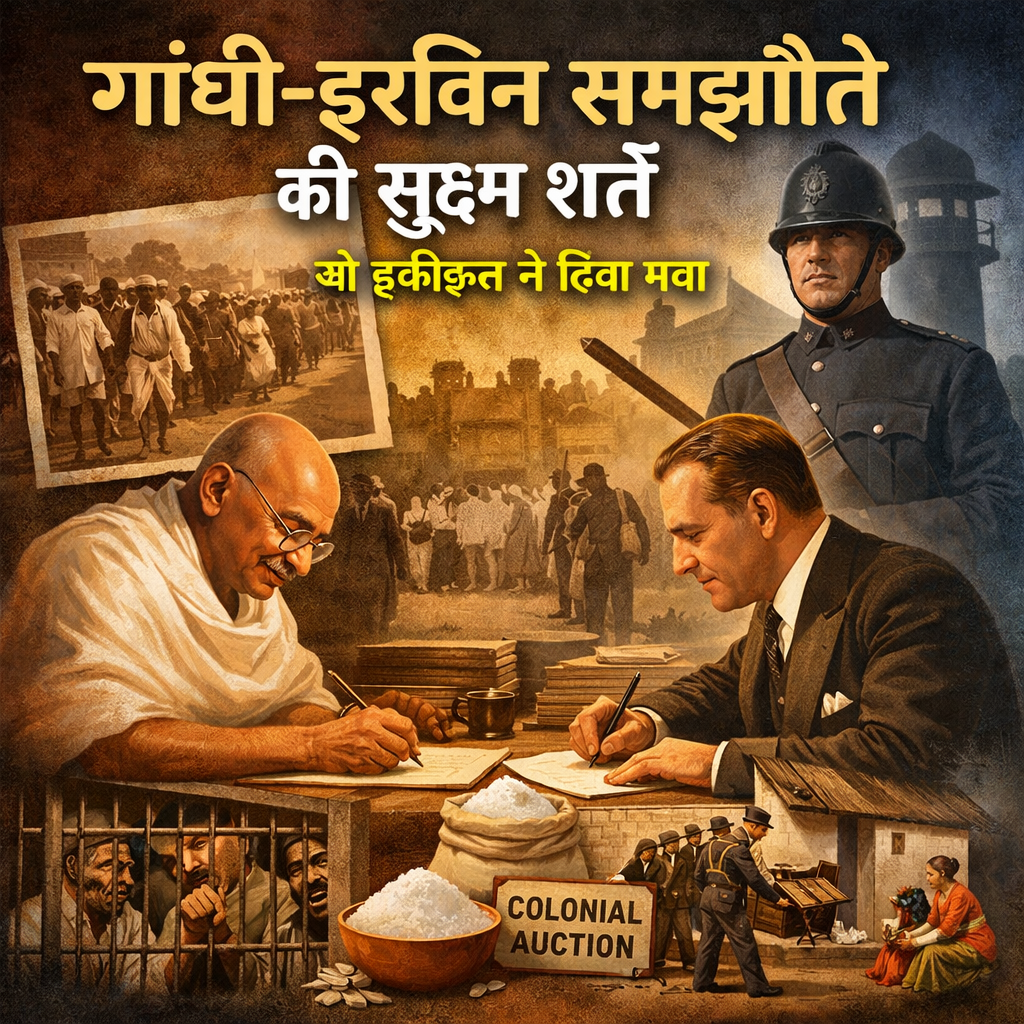
The operative word was “violence.” The people who had been shot at during Gandhi’s Incubation Year and had responded — who had defended themselves or their neighbours from police beatings, property seizures, and lethal force — were classified as violent offenders. They stayed in jail. Gandhi asked for all political prisoners not convicted of murder. The pact released those not convicted of violence. The distinction was precise and it was punitive. Provincial governments then debated the classification for months, delaying hundreds of releases in disputed categories.
But the clause did not stand alone. Its force lay in who defined “violence” and controlled the record on which that definition rested.
The Witness-less Boobytrap: The Arithmetic of the Administrative Lie
Across the Incubation Year, the Empire seized property, censored the press, and unleashed the lathi. When Gandhi sat down to negotiate the reopening, he accepted a filter that released only the “non-violent,” but this was a trap of documentation. In the mud of a lathi charge, there are no neutral observers. If a protester was beaten until they bled, the colonial police record—the only surviving evidence—naturally reflected that the protester had attacked the officer. Who was there to check the file? Who was the witness for the man in the hospital or the cage?
By agreeing to the “violence” exclusion while simultaneously accepting the refusal of an inquiry into police brutality, Gandhi surrendered the only tool that could have corrected those lies. He signed a deal that did not reopen the cells of the very people caught in the British crackdown his march had provoked. The man who had opened the sea left the most vulnerable victims of the conflict to the “mercy” of a police record written by their attackers.
The Three Commercial Sovereignty Demands
Demand 8 — Impose a protective tariff on foreign cloth.
Pact response: Not mentioned. Silence.
Lancashire’s captive Indian market continued intact. The Indian textile industry that had been destroyed over a century of unprotected British imports received no legislative relief.
Demand 9 — Reserve coastal shipping for Indian vessels.
Pact response: Not mentioned. Silence.
Indian goods moving between Indian ports on British ships at British rates — the commercial monopoly so embedded that most Indians had ceased to notice it — continued unchanged.
Demand 10 — Accept the Postal Reservation Bill.
Pact response: Not mentioned. Silence.
British control over India’s communications infrastructure continued without adjustment.
The Administrative Demand
Demand 11 — Total prohibition of intoxicants and alcohol.
Pact response: Indians permitted to peacefully picket liquor shops.
The colonial state’s second largest revenue source — the liquor and drug excise extracted almost entirely from the poor — remained intact. The pact permitted Indians to stand outside liquor shops and ask people not to enter. The shops remained open. The revenue continued flowing.
The Demand Gandhi Added at the Table
Gandhi had one additional request not in the original eleven. He asked for an independent inquiry into police brutality during the Civil Disobedience Movement — the lathi charges, the Dharasana beatings, the unreported violence across the interior of India during Gandhi’s Incubation Year.
Pact response: Refused.
Lord Irwin refused the inquiry. There was nothing to inquire into — at least nothing that had survived the twelve months of press censorship, administrative classification, and evidence management that Gandhi’s Incubation Year had produced.
The Semantic Trap: When “All” Meant “Filtered”
The phrase “release of all political prisoners” was the emotional heart of the movement’s expectations, yet in the cold light of the Pact’s text, “all” was reduced to a conditional variable. By inserting the qualifier “not convicted of violence,” the British administration didn’t just exclude those who pulled a trigger; they created a legal filter that caught anyone the Empire deemed “dangerous.”
The tragedy lay in the Provincial Interpretation. Local governors, particularly in restive regions like Bengal, utilized this loophole to keep activists behind bars by digging up prior records or classifying “incitement to protest” as a form of “mental violence.” Furthermore, the people who had defended their neighbors from police lathis during the Incubation Year found themselves trapped. Their acts of self-defense were categorized as violent offenses, ensuring that those who bore the brunt of colonial brutality were the very ones abandoned by the settlement.
Ultimately, the Pact released the symbolic Satyagrahis—those who had committed only technical breaches like making salt—but it firmly locked the gates on the revolutionary left and the defensive resisters. Gandhi walked away with a handshake; thousands of others remained in the silence of their cells, separated from freedom by a single, punitive word.
The Ledger
Eleven demands. One additional request.
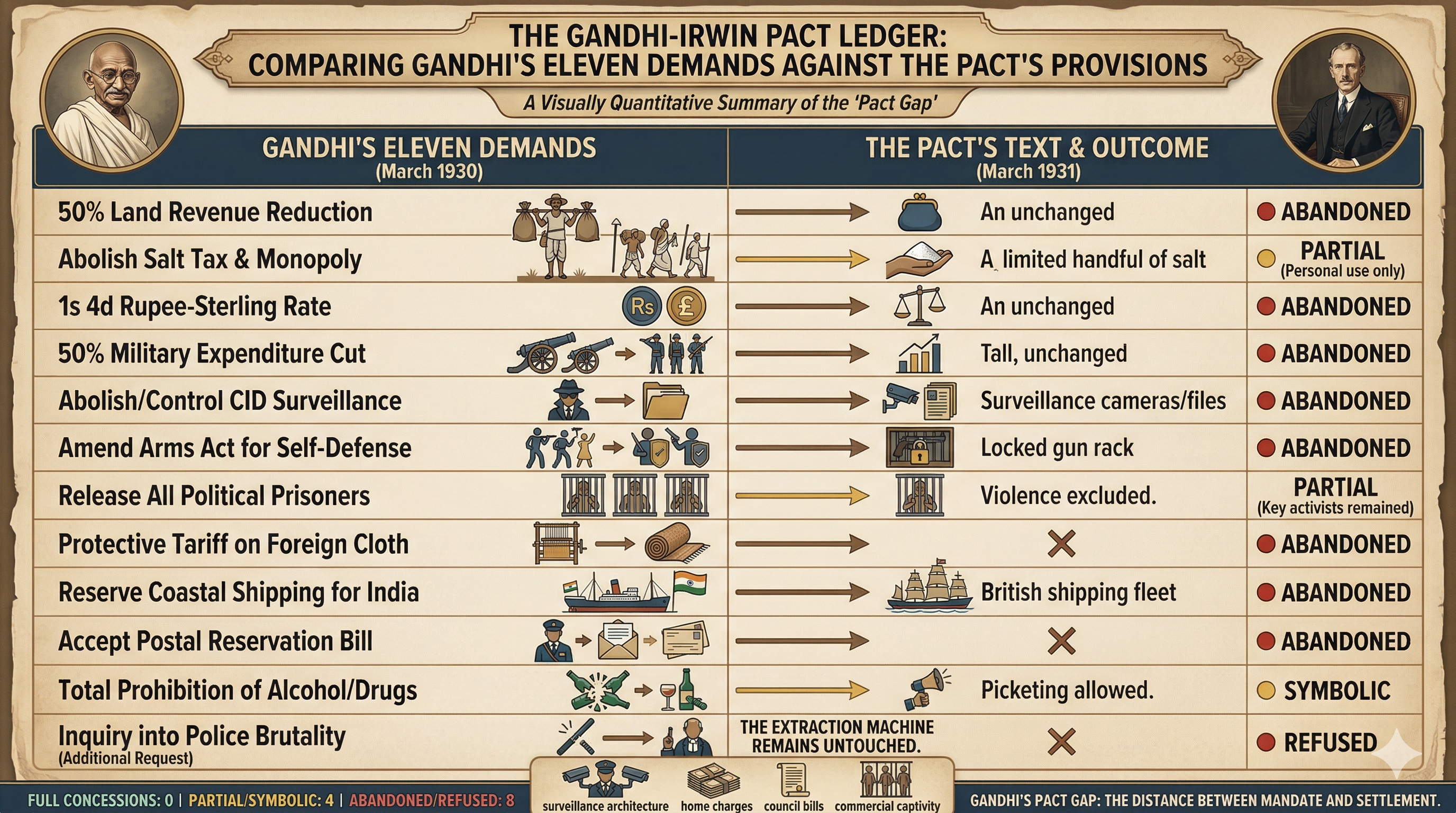
Fully delivered: zero.
Partially delivered with qualifying clauses: three — prisoner release (violence excluded), property return (not yet sold), salt (coastal personal use only).
Delivered in name only: one — ordinance withdrawal (communal carve-out retained), liquor shops (picketing permitted, revenue intact).
Not mentioned: seven — land revenue, exchange rate, military expenditure, CID, Arms Act, protective tariff, coastal shipping, postal reservation.
Additional request refused: one — police brutality inquiry.
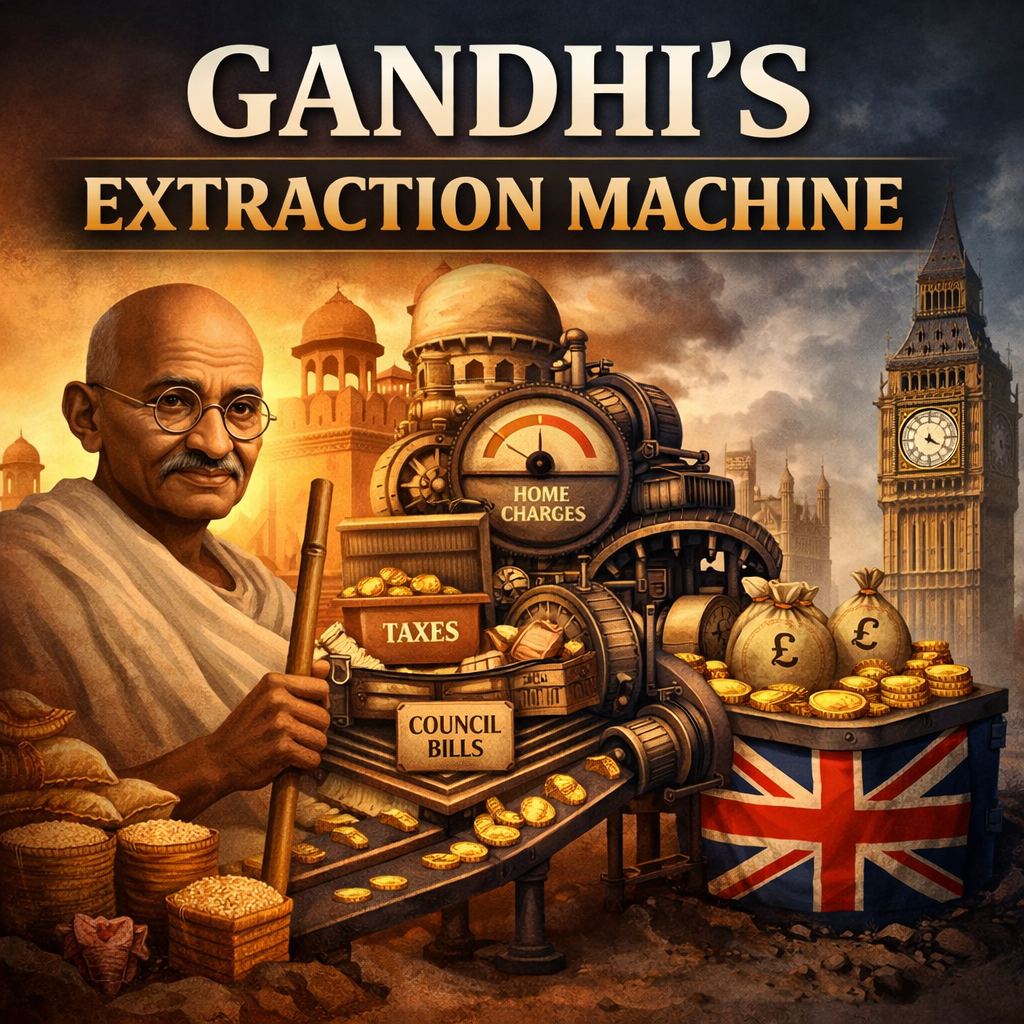
The extraction machine documented in Blogs 13 and 14 — the Council Bills, the Home Charges, the commercial captivity, the surveillance architecture — was not touched by a single operative clause in Gandhi’s Pact Gap.
The Comparison Ledger: Demands vs. Results
| Category | Gandhi’s Demand | Pact Response | Status |
| Financial | 50% Land Revenue reduction | Not mentioned. | Abandoned |
| Financial | Abolish Salt Tax & Monopoly | Coastal residents: personal use only. | Partial |
| Financial | Change Rupee-Sterling ratio | Not mentioned. | Abandoned |
| Financial | 50% Military expenditure cut | Not mentioned. | Abandoned |
| Sovereignty | Protective tariff on foreign cloth | Not mentioned. | Abandoned |
| Sovereignty | Reserve coastal shipping for India | Not mentioned. | Abandoned |
| Sovereignty | Accept Postal Reservation Bill | Not mentioned. | Abandoned |
| Control | Abolish/Control the CID | Not mentioned. | Abandoned |
| Control | Amend Arms Act (Self-defense) | Not mentioned. | Abandoned |
| Justice | Release all political prisoners | Only those “not convicted of violence.” | Partial |
| Social | Total prohibition of intoxicants | Peaceful picketing allowed; shops stay open. | Symbolic |
| Inquiry | Inquiry into police brutality | Explicitly refused by Lord Irwin. | Refused |
The Hormuz Parallel
In 2026, the United States launched strikes on Iranian positions. Iran responded by closing the Strait of Hormuz. The US then found itself fighting to reopen a waterway that its own action had closed — bearing the cost of the conflict its aggression had triggered, while the populations caught in the middle absorbed the violence of both sides.
The structure is not unfamiliar.
Gandhi fired the chemical bomb at Dandi. The British closed Hormuz of Indian freedom struggle — seizing properties, censoring press, beating protesters, jailing leadership across Gandhi’s Incubation Year. When Gandhi sat down to negotiate the reopening, he accepted terms that released the “non-violent” while leaving those who had been shot at or beaten to the mercy of police records, .allowing the aggressors to manufacture the facts and keep their victims imprisoned in the very cells his march had filled. The man set out to bomb the “Iran” of the British Raj. But when the Hormuz of the freedom struggle was blocked, he signed on the dotted line as per the dictat of the Raj—delivering to the regime of the British Raj what it wanted to have.
The question the Hormuz parallel asks — who bears the cost of the downstream consequences of their own action — is the same question Gandhi’s Pact Gap leaves open. The movement had generated the violence of the incubation year by its own existence. The pact’s violence exclusion meant the people who had borne that downstream violence remained imprisoned. The hero had shaken hands with the jailer. The people the jailer had beaten stayed inside.
The next post documents what those people discovered when the pact’s terms were finally implemented.
Eleven demanded. Three partially delivered. Eight abandoned. One refused. Gandhi’s Pact Gap is the distance between what a movement of sixty thousand earned and what its leader accepted in their name.
Series Index
Feature Image: Click here to view the image.
Videos
https://youtu.be/JKEqMlRcHRY
Glossary of Terms
Scan Through The Entire Series at
Gandhi’s Peace Efforts: The Questions Before the Mahatma (0)