
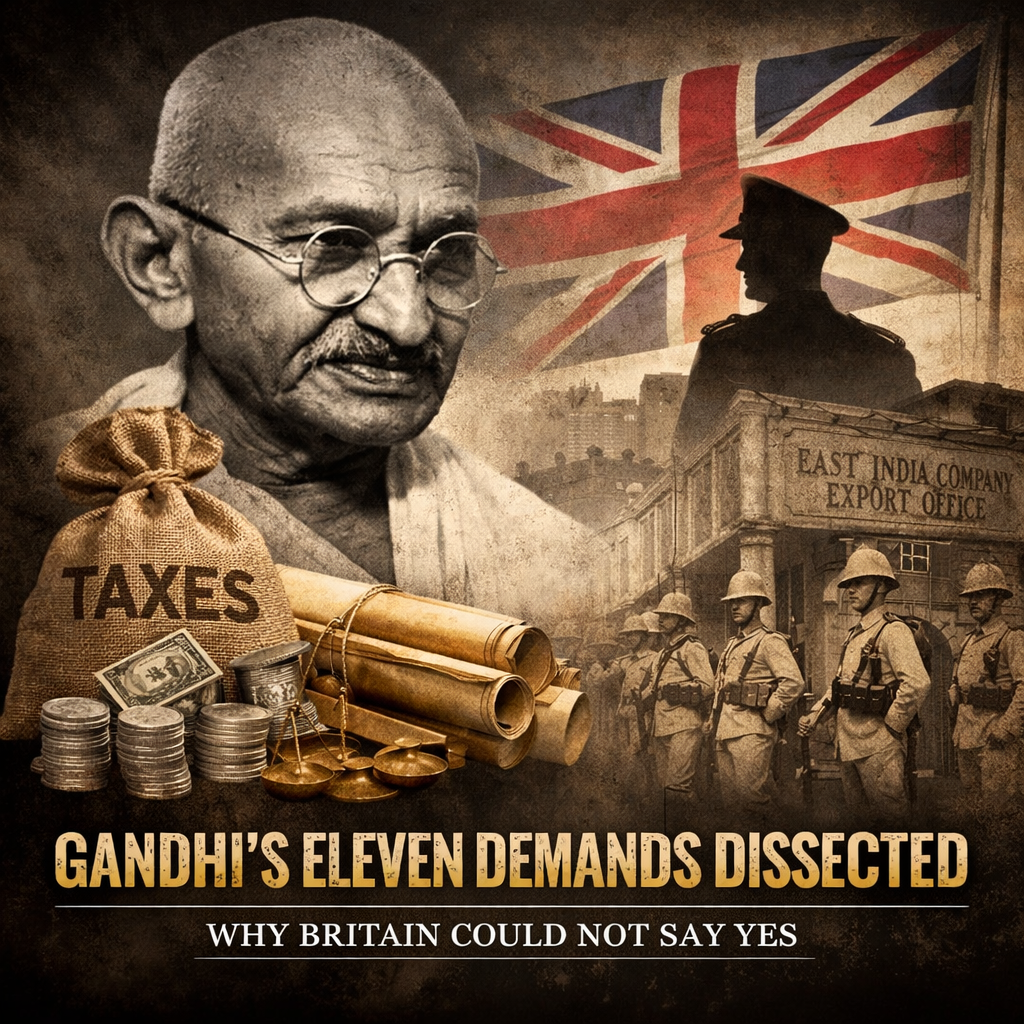
Gandhi’s Eleven Demands Dissected: Why Britain Could Not Say Yes (12)
भारत / GB
Part 12: Mahatma Gandhi’s Peace Efforts | Series Index
Eleven posts have traced the method from Inner Temple to Dandi, the ledger of four acts, and the charter Gandhi placed before Irwin. The previous post listed what was demanded. This post examines what each demand would have dismantled — and why Britain’s silence was not indifference but calculation.
Thank you for reading this post, don't forget to subscribe!The Action Taken: The 11-demand charter directly challenged the fiscal architecture of the colonial state, demanding a 50% cut in military spending and land revenue alongside salt tax abolition.
Who Paid the Price: Agrarian cultivators who continued to pay land revenue and salt levies during severe Great Depression price collapses.
The Alternative Bypassed: Formal colonial legislative budgeting assemblies, which could not concede these cuts without dismantling the imperial administration.
Why This Matters: Places before the reader why Britain could not grant the charter: granting it would have dismantled the colonial extraction machine, setting the baseline against which the eventual pact terms must be measured.
Not a List — A Demolition Plan
Gandhi’s Eleven Demands Dissected reveals something the standard historical account obscures — read individually, the eleven demands are grievances. Read together, they are a complete blueprint for dismantling the colonial extraction machine.
The British Raj did not survive by force alone. It survived through an interlocking system of financial extraction, information control, legal disarmament, and commercial monopoly. Every one of Gandhi’s eleven demands targeted a specific load-bearing wall of that system. Grant all eleven and there was no Raj left — only a British administrative presence in a country that had recovered its own economy, armed its own citizens, freed its own political class, and broken the financial pipeline to London.
This is why Irwin did not negotiate. He could not afford to.
The demands came six weeks after the Lahore Congress of December 1929 had declared Purna Swaraj — complete independence. Gandhi was not opening a negotiation. He was issuing a final warning before a movement already committed to independence.
The Financial Extraction Demands
The Rupee-Sterling Exchange Rate
The exchange rate of 1s 6d — which Gandhi demanded be reduced to 1s 4d — was not an accounting technicality. It was the mechanism through which India’s wealth was transferred to Britain every single day. Every government transaction, every railway remittance, every pension payment to a British official retired to England, every import invoice — all calculated at a rate that systematically overvalued sterling against the rupee. The drain theory that Dadabhai Naoroji had quantified decades earlier ran, in part, through this ratio. Granting this demand would have reduced the daily transfer of Indian wealth to British accounts by crores annually.
The British Treasury’s position in India was partly built on this rate. It could not be conceded.
Land Revenue — 50% Reduction
Land revenue was the oldest and largest single source of colonial income from India. It had been collected since Mughal times, but the British had calibrated it to maximum extractable levels regardless of agricultural conditions — payable in cash, in a good harvest or a failed one, at rates set by colonial administrators with no accountability to those paying them. A 50% reduction subject to legislative control would have cut the single largest revenue line in the Indian budget and placed future assessments under democratic oversight. No colonial administration that depended on this revenue for its functioning could accept it.
The Indian military budget at the time consumed roughly half of India’s total annual revenue — deployed not for Indian defence but for British imperial operations in Egypt, Mesopotamia, and China. A 50% cut was not a reform. It was the end of India as an imperial base.
Salt Tax and Monopoly Abolition
The salt tax was the most universal tax in India — falling on every person regardless of income, caste, religion, or region. Gandhi chose it for the march precisely because it was the most indefensible item on the list — a superpower taxing a peasant’s right to season his food. But the salt monopoly was not only about revenue. It was about control of a basic commodity that the British had made it illegal for Indians to produce or trade independently. Abolish the monopoly and you establish the principle that Indians have the right to produce what grows on their own soil. That principle, once conceded in salt, could not be contained.
Military and Civil Salary Cuts — 50%
These two demands together targeted the cost of occupation itself. India was paying for its own subjugation — financing a military establishment calibrated to British imperial needs and a civil service paid at rates that bore no relationship to Indian income levels. The Viceroy’s Rs. 700 per day against India’s average of less than two annas was not an anomaly. It was the design. A 50% cut in both would have made the occupation financially unsustainable — reducing it to a shell that could no longer attract the talent required to administer a subcontinent.

The Control Architecture Demands
Abolition of the CID
The Criminal Investigation Department was the nervous system of colonial political control — not a police force but an intelligence apparatus that monitored nationalists, infiltrated organisations, maintained files on dissidents, and fed the colonial administration the information it needed to suppress opposition before it became dangerous. The Rowlatt Act had been its legislative expression. Abolishing the CID or placing it under popular control would have blinded the colonial administration to the internal political landscape of India — removing its ability to identify, track, and pre-empt any future organised resistance. No occupying power dismantles its intelligence network voluntarily.
The Arms Act — Licences for Self-Defence
The Arms Act of 1878 was one of the most consequential laws the British ever passed in India. It disarmed a population of hundreds of millions. An Indian could not own a firearm without a licence that the colonial state controlled entirely — and had every incentive to deny to anyone with political standing. Gandhi described the result in his letter to Irwin as a spiritual degradation — a people rendered cowardly helpless by deliberate design. Granting the right to bear arms for self-protection would have reversed a fifty-year policy of enforced defencelessness. A disarmed population is manageable. An armed one is not.
Release of Political Prisoners
Thousands of Indians were in colonial jails not for violence but for political activity — for writing, speaking, organising, and dissenting. Their continued imprisonment served a purpose beyond punishment: it demonstrated to every other Indian that political activity carried a personal cost. Releasing them unconditionally would have been a concession that political dissent was legitimate — a concession that fundamentally altered the relationship between the colonial state and the people it governed.
The Commercial Sovereignty Demands
Protective Tariff on Foreign Cloth
Indian textile workers had been systematically destroyed by British mill goods imported without tariff protection since the nineteenth century. A protective tariff would have revived Indian industry — but more importantly it would have established the principle that India had the right to protect its own economy from British commercial predation. Lancashire’s mill interests had a direct line to the British Parliament. A tariff on foreign cloth was a tariff on Lancashire. Parliament could not permit it.
Coastal Shipping Reservation
Indian goods moving between Indian ports travelled on British ships at British rates — a commercial monopoly so embedded that most Indians had ceased to notice it. Reserving coastal trade for Indian vessels would have transferred a significant revenue stream to Indian enterprise and, more consequentially, built the shipping infrastructure for an independent India to trade on its own terms. It was a sovereignty demand dressed as a commercial one.
Total Prohibition
The liquor and drug excise was the colonial state’s second largest revenue source after land — and it was extracted almost entirely from the poor. The dyarchy reforms of 1919 had transferred this revenue to Indian ministers — making prohibition politically impossible because any minister who abolished it had to find the revenue elsewhere. It was a fiscal trap. Total prohibition would have removed a major source of colonial income and ended a deliberately maintained system of addiction that Gandhi argued was as much a tool of control as a source of revenue.

Why Salt Was Chosen for the March
Of the eleven demands, Gandhi chose the salt tax to dramatise. Gandhi’s Eleven Demands Dissected shows the choice was precise.
Every other demand on the list had a constituency that could be argued against — the exchange rate was complex, the military cuts were debatable, the CID abolition was a security question, the arms licences were contentious. The salt tax had no defensible constituency. It fell on every Indian without exception — the poorest most heavily, the richest lightly, but no one escaped it. And it taxed a mineral that occurred naturally on India’s own coastline, which Indians were forbidden by law from collecting for themselves.
Gandhi’s Eleven Demands Dissected reveals that the salt demand was chosen not because it was the most economically significant — land revenue was far larger — but because it was the most morally indefensible and the most universally felt. It could unite the Bihar tenant farmer, the Gujarati merchant, the Bengal student, and the Madras lawyer around a single act of defiance that required nothing more than walking to the sea.
The demand and the march were the same argument: that the most basic human necessity had been taxed by a foreign power, and that picking up what washed onto your own shore was an act of resistance.
The Eleven as a System
Remove the exchange rate manipulation — the financial drain slows. Remove the salt and land revenue — the rural extraction ends. Abolish the CID — the surveillance collapses. Restore the Arms Act — the enforced defencelessness ends. Free the political prisoners — dissent becomes legitimate. Tax foreign cloth — Indian industry revives. Reserve coastal shipping — commercial sovereignty begins. Cut military and civil salaries — the occupation becomes unaffordable.
No single demand was fatal to the Raj in isolation. All eleven together were. Gandhi’s Eleven Demands Dissected across these three categories — financial extraction, control architecture, commercial sovereignty — reveals not a reform agenda but a structural dismantling. This is what Gandhi placed on the table. Irwin read it. He understood it. He ignored it. The march began.
The next post opens the document signed on March 5, 1931 — and measures it, demand by demand, against every line of Gandhi’s Eleven Demands Dissected here.
The Demolition Plan at a Glance
A three-column table: Demand | What It Dismantled | Why Britain Could Not Grant It. Eleven rows. No prose — pure reference. Serves the reader who has read both blogs and wants the comparison ready for a future Blog.
Eleven demands. Each one a load-bearing wall of colonial extraction. Together, a demolition plan. What did the pact preserve?
Feature Image: Click here to view the image.
Video
Glossary of Terms
Scan Through The Entire Series at
Gandhi’s Peace Efforts: The Questions Before the Mahatma (0)
Refer to Various Arks Referred to in the Blog
- English YouTube: https://www.youtube.com/@Hinduofficialstation
- Hindi YouTube: https://www.youtube.com/@HinduinfopediaIn
- X: https://x.com/HinduInfopedia
- Instagram: https://www.instagram.com/hinduinfopedia/
- Facebook: https://www.facebook.com/Hinduinfopediaofficial
- Threads: https://www.threads.com/@hinduinfopedia