
Gandhi’s Class Ceiling: Elite Reassertion of Control Over Autonomous Mass Participation (142)
भारत / GB
Part 142: Mahatma Gandhi’s Peace Efforts | Series Index
Blog 141 placed the smoke before February 4, the ashes after February 4, and one question before the reader: was there fire? This post places a different documented exhibit before the reader — the internal class dynamic that historian Shahid Amin documents as the structural explanation for Gandhi’s suspension, distinct from the moral framework Gandhi himself placed on record.
Thank you for reading this post, don't forget to subscribe!The Action Taken: While traveling in third-class rail compartments for public symbolism, entire carriages were reserved, cleared, and cordoned off by railway staff and private attendants to ensure personal privacy.
Who Paid the Price: Ordinary third-class passengers, who were evicted or displaced from standard compartments to accommodate the leader’s private retinue.
The Alternative Bypassed: Traveling in ordinary unreserved carriages alongside common passengers without special state railway cordons.
Why This Matters: The curated aesthetic of poverty: third-class travel was organized through special reservations and police cordons, maintaining a public symbol of austerity underwritten by considerable private expense.
The Documented Finding
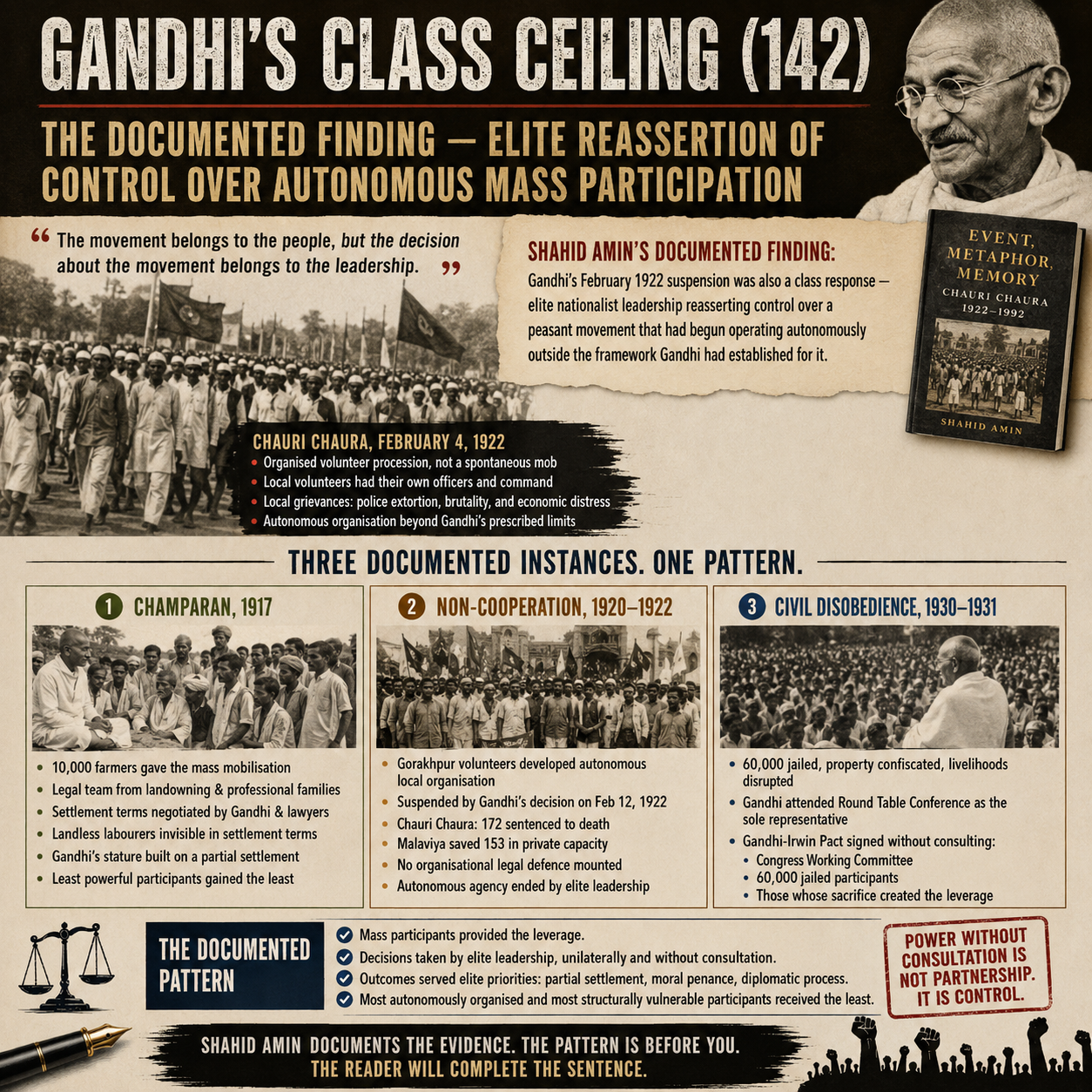
Gandhi’s Class Ceiling places Shahid Amin’s documented finding before the reader precisely. Amin’s Event, Metaphor, Memory: Chauri Chaura 1922-1992 (Oxford University Press, 1995) — the definitive historical reconstruction of the incident and its aftermath — documents a third reading of Gandhi’s February 1922 suspension alongside the standard accounts.
The first reading: Gandhi’s own documented moral framework — he suspended because crowd violence had demonstrated that the movement’s participants had not qualified themselves for non-violent discipline. Established in Blog 134 of this series from Gandhi’s own documented Young India writings.
The second reading: the Bose-Bipan Chandra strategic critique — the movement was at its documented peak, the suspension squandered the strategic initiative. Established in Blog 133 of this series from documented inner circle reactions.
Amin’s third documented reading: Gandhi’s suspension was also a class response — elite nationalist leadership reasserting control over a peasant movement that had begun operating autonomously outside the documented framework Gandhi had established for it.
Gandhi’s Class Ceiling places this documented third reading before the reader as a standalone exhibit — because it connects across three documented instances in this series, not only to Chauri Chaura.
The Documented Autonomy at Chauri Chaura
Gandhi’s Class Ceiling places what Amin documents about the February 4 procession before the reader. The Gorakhpur volunteer corps had by February 1922 developed a documented autonomous local organisation that went beyond Gandhi’s documented programme. In mid-January 1922 — three weeks before February 4 — the local volunteers had appointed their own “officers.” They were operating on documented local grievances: police extortion, the Daroga’s documented brutality, economic distress from collapsed sugar prices and spiked cloth prices.
The February 4 procession was not a spontaneous mob. It was a disciplined volunteer corps demonstration — documented by Amin from oral histories and colonial legal records. The participants were people Gandhi’s Non-Cooperation framework had mobilised, organised, and given documented authority to enforce boycotts and maintain temperance pickets. By February 1922 they were exercising that documented authority autonomously — beyond what Gandhi’s elite nationalist leadership had sanctioned or could control.
When Gandhi suspended the national movement on February 12 1922, the documented effect was not only moral penance — it was the reassertion of elite nationalist control over a mass participant base that had begun to operate independently.
Three Documented Instances Across the Series
Gandhi’s Class Ceiling places the documented class pattern before the reader across three instances already established in this series.
Champaran 1917 — as discussed in later blogs: Gandhi arrived with a documented legal team drawn predominantly from landowning and professional families. The 10,000 farmers provided the mass mobilisation. The documented settlement terms were negotiated by Gandhi and his lawyers — not by the farmers whose documented grievances the campaign was built upon. The landless agricultural labourers — the participants with no land to have exactions refunded upon, the most structurally vulnerable and most autonomously organised — were invisible in the settlement’s documented terms. Gandhi built his documented national stature on a partial settlement that the least powerful participants in the documented campaign did not share.
Non-Cooperation 1920-1922: The documented Gorakhpur volunteer corps exhibit established above. The participants who had developed autonomous local organisation — documented local command structures, documented local grievances, documented autonomous enforcement — were suspended by Gandhi’s unilateral decision on February 12 1922. Their documented autonomous agency was ended by the documented decision of the movement’s elite leadership. The Malaviya exhibit — established in Blog 131 — carries the documented consequence: 172 sentenced to death, Malaviya saving 153 in a private capacity, because no organisational legal defence was mounted by the movement that had mobilised them.
Civil Disobedience 1930-1931: 60,000 documented participants — jailed, property confiscated, economic livelihoods disrupted — whose documented sacrifice was traded for a conference seat Gandhi attended alone as Congress’s sole representative. The documented settlement — the Gandhi-Irwin Pact — was signed without consulting the Congress Working Committee, without consulting the 60,000 jailed participants, without the mandate of those whose documented suffering had built the leverage the Pact traded. Established in Blogs 17-20 and Blog 138 of this series.
The Documented Pattern
Gandhi’s Class Ceiling places the documented pattern across the three instances before the reader.
In each instance: the documented mass of participants provided the documented leverage. In each instance: the documented settlement or suspension was decided by Gandhi’s unilateral authority — without consultation with the participants whose documented sacrifice had assembled the leverage. In each instance: the documented outcome served the elite nationalist leadership’s documented priorities — partial settlement preserving structural framework, moral penance reasserting non-violent discipline, conference seat preserving diplomatic process — while the most autonomously organised and most structurally vulnerable participants received the least from the documented outcome.
The prosecution places one observation before the reader: Amin’s documented third reading is not a characterisation of Gandhi’s intent. It is a documented structural observation about who decided the movement’s documented outcomes and whose documented interests those outcomes served.
The Prosecution’s Position
Gandhi’s Class Ceiling places three questions before the reader.
- Does Shahid Amin’s documented finding — Gandhi’s February 1922 suspension was also a class response, elite nationalist leadership reasserting control over autonomous peasant agency — constitute a documented exhibit the reader places alongside Gandhi’s own documented moral framework for the suspension, established in Blog 134 of this series?
- Do the three documented instances — Champaran 1917, Non-Cooperation 1922, Civil Disobedience 1931 — each show the documented mass of autonomous participants providing the documented leverage while the documented settlement or suspension was decided unilaterally by elite nationalist leadership without the participants’ documented consultation or consent?
- Does the documented pattern — in each instance the most autonomously organised and most structurally vulnerable participants received the least from the documented outcome — constitute an exhibit the reader places alongside Gandhi’s documented unchallengeable authority over the movement’s documented decisions?
The series does not answer. Gandhi’s Class Ceiling places Amin’s documented finding and its documented three-instance pattern before the reader. The reader will examine what the class dimension of the documented suspensions established about the movement’s governing structure — and complete the sentence.
Invitation To Defence
The floor belongs to the defense. We now invite them to present their exhibits and challenge the narrative established by the prosecution.
Champaran: landless labourers invisible in settlement terms. Non-Cooperation: Gorakhpur volunteers with autonomous local organisation suspended by Gandhi’s unilateral decision. Chauri Chaura participants: 172 sentenced to death, no organisational defence mounted. Civil Disobedience: 60,000 jailed, traded for a conference seat Gandhi attended alone. Three documented instances. In each: autonomous mass participants provided the leverage. In each: elite leadership decided the outcome. Shahid Amin documents the pattern. The prosecution places it before the reader. The reader will complete the sentence.
Videos
Glossary of Terms
- Gandhi’s Class Ceiling: A phrase coined in this blog to describe the structural limit within Gandhi-led mass movements where autonomous popular participation generated political leverage, but decisive authority remained concentrated within elite nationalist leadership.
- Autonomous Mass Participation: Political participation by large groups of ordinary people who develop local organisation, leadership, grievances and methods of action that operate beyond direct central leadership control.
- Elite Nationalist Leadership: The educated, professional and politically influential leadership within the Indian nationalist movement that exercised disproportionate authority over negotiations, strategy and movement-level decisions.
- Chauri Chaura: The February 1922 incident in the Gorakhpur region in which a confrontation between protesters and police culminated in the burning of the police station, becoming the immediate context for the suspension of the Non-Cooperation Movement.
- Shahid Amin: Indian historian and author of Event, Metaphor, Memory: Chauri Chaura 1922–1992, whose reconstruction examines Chauri Chaura through the relationship between peasant politics, nationalist memory and colonial records.
- Volunteer Corps: Organised local groups of nationalist volunteers who participated in political mobilisation, boycott enforcement, picketing and other activities during the Non-Cooperation Movement.
- Non-Cooperation Movement: The nationwide movement launched under Gandhi’s leadership in 1920, involving boycotts of British institutions and mobilisation for non-violent resistance.
- Tinkathia System: The system in Champaran that compelled cultivators to grow indigo on a fixed portion of their land, forming the central grievance of the Champaran agrarian struggle.
- Champaran Settlement: The negotiated outcome of the Champaran struggle that included the abolition of the tinkathia system and the refund of 25 percent of illegal exactions collected from cultivators.
- Structural Interpretation: An analysis that examines how power, authority and social organisation shape outcomes, rather than focusing only on the personal intentions of individual leaders.
- Class Response: A structural interpretation in which a political decision is examined in relation to the social groups whose power, autonomy or authority it strengthens or restrains.
- Civil Disobedience Movement: The mass anti-colonial movement launched in 1930 involving deliberate violation of colonial laws, imprisonment, property confiscation and widespread political mobilisation.
- Gandhi-Irwin Pact: The March 1931 agreement between Gandhi and Viceroy Lord Irwin that ended the first phase of the Civil Disobedience Movement and enabled Congress participation in constitutional negotiations.
- Mass Leverage: The political pressure created when large numbers of people contribute participation, sacrifice, imprisonment, economic disruption or organised resistance to a movement.
- Reassertion of Control: The restoration or strengthening of central leadership authority when autonomous local or mass political activity begins operating beyond the limits established by that leadership.
#Gandhi #ChauriChaura #IndianHistory #FreedomMovement #Congress #Nationalism #History #HinduinfoPedia
Gandhi’s Peace Efforts: The Questions Before the Mahatma (0)
Refer to Various Arks Referred to in the Blog