
Gandhi’s Hijrat Accelerant: The Three-Tier 1920 Transmission Machine (215)
भारत / GB
Part 215: Mahatma Gandhi’s Peace Efforts | Series Index
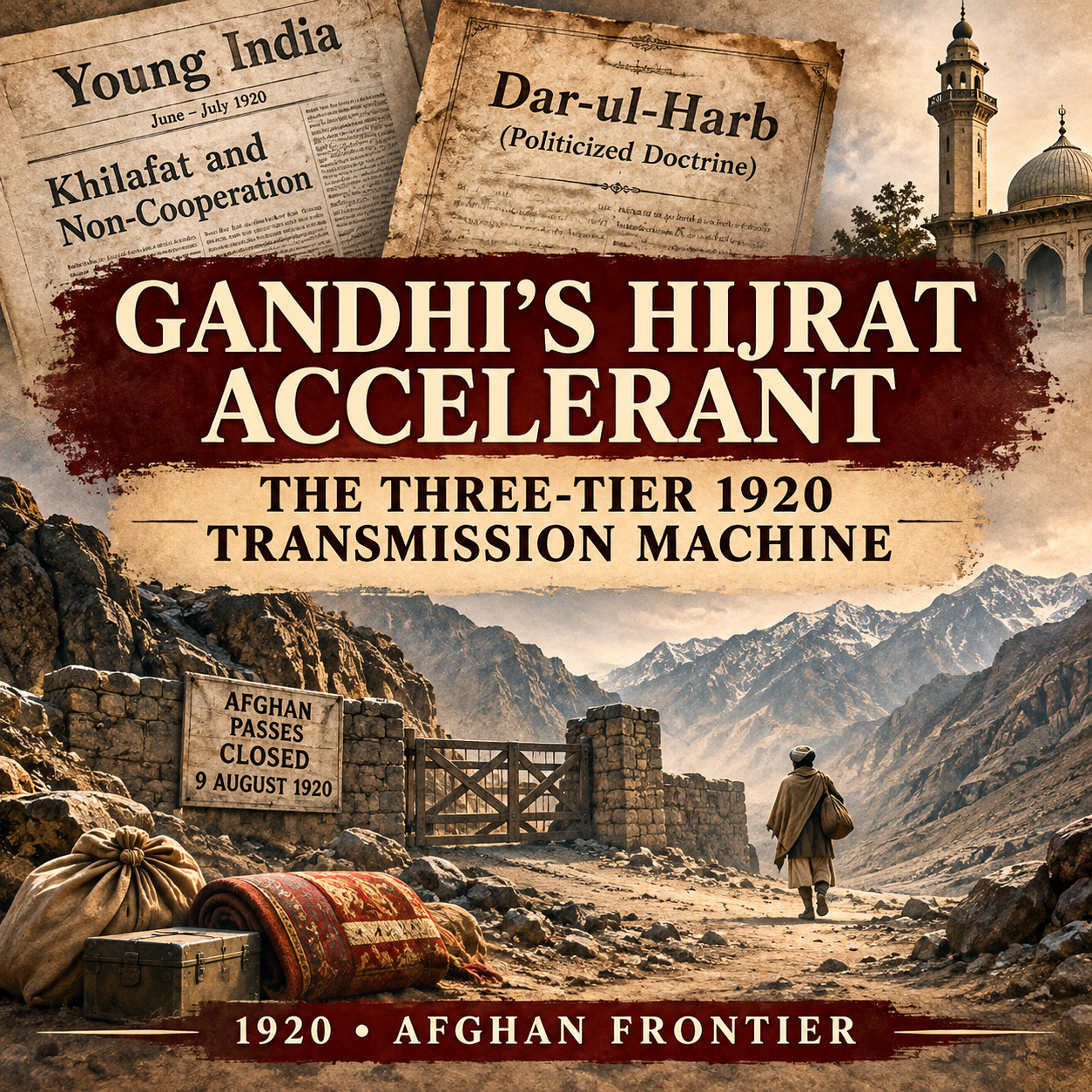
Blog 214 documented the six-month gap between Atatürk’s abolition of the Ottoman Caliphate (3 March 1924) and the Kohat expulsion (8–11 September 1924), establishing that the Khilafat apparatus survived its founding pretext because the clerical commitments sealed at Nagpur in December 1920 and amplified under Gandhi’s mandate were never tied to the Ottoman dynasty’s survival. This instalment documents how that apparatus was built in the first place: the three-tier transmission machine through which Gandhi’s summer 1920 endorsements in Young India passed through a politicized distortion of classical Dar-ul-Harb terminology — stripped of classical Hanafi safeguards — and were amplified at the December 1920 Nagpur Congress dais into the Hijrat migration disaster that displaced tens of thousands of Muslim families along the Afghan frontier.
THE THREE-TIER TRANSMISSION MACHINE: WHAT THE RECORD SHOWS
The Action Taken: Between June and December 1920, Gandhi’s endorsements of the Khilafat cause in Young India, his joint Sindh–Punjab tour with the Ali Brothers (July 1920), and the chanting of Quranic verse 9:5 from the official Congress dais at Nagpur (December 1920) combined to transmit a theologically loaded message through three successive tiers — Gandhi’s English-language press statements (Tier 1), a manipulated clerical doctrine that inverted classical Hanafi safeguards to endorse Dar-ul-Harb (Tier 2), and mosque-pulpit amplification of the resulting Hijrat call to Muslim populations along the Afghan frontier (Tier 3). By 9 August 1920, when Afghanistan sealed the Khyber and Kurram passes, tens of thousands of Muslim families who had sold homes and land at distress prices to trek to the border were stranded without shelter, food, or the means to return.
Who Paid the Price: The Muslim families of Sindh, Punjab, and the North-West Frontier who sold property at distress prices and trekked to the Afghan border on the theological assurance that British India was Dar-ul-Harb — an assurance the Nagpur transmission machine had framed as carrying Gandhi’s endorsement — only to find the Afghan passes sealed and their homes sold. The Hindu and Sikh communities whose subsequent neighbourhood relations with these returning, destitute, and embittered families were fractured by the experience documented in Blog 183.
Why This Matters: The three-tier structure is the documented mechanism by which Gandhi’s bilingual public position — English-language affirmations of Hindu–Muslim brotherhood read by Congress and British audiences alongside Urdu-language mosque-pulpit amplification read by frontier Muslim populations — created operational consequences Gandhi neither acknowledged nor reversed.
Tier One — Gandhi’s Young India Endorsements (June–July 1920)
Between June and August 1920 — immediately after assuring skeptical Moderate and Hindu leaders at the June 1920 Allahabad conference that he could keep the Khilafat agitation under strict control, an assurance he would later repeat to Viceroy Lord Reading during their private Simla meetings in May 1921 — Gandhi published a series of statements in Young India endorsing the Khilafat cause as a matter of honour binding on all Indians. In his June 1920 Young India writings (“The Khilafat: What May Be Done” and “The Mohammedan Decision”), Gandhi wrote that he considered it “the paramount duty of every non-Muslim Indian” to support the Khilafat demand and that he would himself fast unto death if the British government violated the religious sentiments of Indian Muslims over the Caliphate. His 16 June 1920 article on Non-Cooperation opened with the Khilafat wrong as the primary grievance before the Amritsar massacre. His 28 July 1920 article titled “To the Muslims” explicitly associated Hindu honour with the defence of the Caliphate. Notably, none of these 1920 Khilafat articles ever formed the basis of his later March 1922 sedition conviction, which rested solely on three anti-Crown essays published in late 1921 and February 1922.
Read in English by Congress members, Moderate politicians, and the British administration, these statements appeared to be an expression of Hindu–Muslim solidarity framed in the secular political idiom of colonial grievance. Read through the manipulated clerical doctrine simultaneously being amplified by Deobandi and Barelvi agitators across north and northwest India — a doctrine that had stripped classical Hanafi safeguards from the Dar-ul-Harb concept — they were something structurally different — the first tier of Gandhi’s Hijrat accelerant, statements by the most prominent non-Muslim political figure in India publicly confirming the legitimacy of the clerical Khilafat demand at the precise moment clerics were building the theological case for Hijrat migration.
The Joint Sindh–Punjab Tour with the Ali Brothers (July 1920)
In July 1920, Gandhi undertook a joint public tour of Sindh and Punjab alongside Maulana Muhammad Ali and Shaukat Ali — a tour whose platform combined Non-Cooperation with Khilafat agitation and whose audiences were drawn from precisely the frontier Muslim populations that Deobandi and Barelvi clerics were simultaneously addressing in Urdu and Persian with the Dar-ul-Harb framework. At joint gatherings in Karachi, Lahore, and intermediate stations, Gandhi and the Ali Brothers appeared on the same platform delivering what English-language press reported as Hindu–Muslim unity addresses.
The Urdu-language press and mosque networks reaching the same audiences in the same towns simultaneously framed those platforms as confirmation from Congress’s foremost Hindu leader that the Dar-ul-Harb campaign had Hindu political backing — completing the second operational component of Gandhi’s Hijrat accelerant at the ground level where Hijrat decisions were being made. What Gandhi said in English on joint platforms with the Ali Brothers, and what the Ali Brothers said in Urdu on the same platforms, were not identical messages reaching the same ears. They were two parallel transmissions, in two languages, to two differently informed audiences.
Tier Two — The Manipulated Dar-ul-Harb Doctrine and the Hijrat Injunction
Classical Hanafi jurisprudence — the dominant legal tradition of Deobandi and Barelvi clerics across north and northwest India — contained explicit safeguards against the mechanical application of Dar-ul-Harb (Abode of War) wherever religious freedom existed under a non-Muslim government; the classical concepts of Dar al-Aman (Abode of Security) and mu’amalat (commercial and civic relations) governed relations with non-Muslim authorities where Muslims could freely practise their faith. What the Jamiat Ulama-i-Hind issued in 1920 was not a faithful application of classical Hanafi jurisprudence: it was a deformed and politicized distortion of Hanafi terminology — stripping the Dar-ul-Harb concept of every classical legal safeguard and grafting pan-Islamic political agitation onto the Hijrat obligation — to serve a political campaign.
Senior Hanafi scholars opposed it at the time on exactly these grounds: Ahmed Raza Khan of Bareilly — the foremost Barelvi authority of the period — ruled that the classical conditions for Dar-ul-Harb were not met in British India, where Muslims freely performed the five pillars, administered their own waqf properties, and adjudicated personal law in Sharia courts, placing India unambiguously within Dar al-Aman; the 1920 fatwa, he held, was therefore invalid on its own classical terms and had been issued in service of a political campaign, not a jurisprudential determination. That ruling — made by the most authoritative counter-voice within the same Sunni tradition — was suppressed in the agitation’s public framing and never reached the frontier households being mobilised toward the Afghan passes.
Gandhi’s public endorsement of the Khilafat demand — issued in the same months this manipulated clerical doctrine circulated — was read by those agitating clerics as the Congress political endorsement that validated their position: a non-Muslim political leader of pan-Indian standing confirming the legitimacy of the grievance on which the Dar-ul-Harb declaration rested. This is the second tier of Gandhi’s Hijrat accelerant: not Gandhi’s intent, but the institutional mechanism by which his English-language political statements acquired an Urdu-language operational consequence he neither acknowledged in Young India nor addressed when the Hijrat disaster unfolded.
Tier Three — The Nagpur Congress Dais (December 1920)
At the December 1920 Nagpur Congress session — the session at which Gandhi’s Non-Cooperation programme was formally adopted — the official dais proceedings included the chanting of Quranic verse 9:5 (Ayat al-Sayf, the Verse of the Sword) and other Quranic verses by clerical participants alongside the standard Congress political resolutions. These chants were performed in the presence of Gandhi and the Congress leadership at the official session of the Indian National Congress, the most prominent institutional political platform in colonial India. It was under these exact circumstances — with clerical recitations applauded from the dais and constitutionalist objections shouted down — that Muhammad Ali Jinnah was heckled and chased out of the Congress.
The appearance of Ayat al-Sayf — a verse specifically governing the treatment of non-Muslim idolaters who had not entered into treaty relations with the Muslim community — from the official Congress dais, in Gandhi’s presence and without objection from the Congress leadership, was the third and amplifying tier of Gandhi’s Hijrat accelerant: the institutional imprimatur of Congress itself placed on the clerical framework that the Jamiat Dar-ul-Harb fatwa had issued and that the Ali Brothers’ mosque-circuit tours had carried to frontier Muslim populations throughout 1920.
Mosque-Pulpit Amplification Across the Frontier
Through the spring and summer of 1920, the Khilafat Committee’s network of mosque committees — operating across the North-West Frontier Province, Punjab, and Sindh — carried the combined message of the Jamiat Dar-ul-Harb fatwa, the Ali Brothers’ platform addresses, and Gandhi’s Young India endorsements into Friday sermons (khutbahs), madrasa instruction, and local clerical consultations. The specific message reaching frontier Muslim populations through this circuit was that British India was declared a war-zone under Islamic law, that migration to Afghanistan was an obligation for capable believers, and that the Khilafat demand — which Gandhi had publicly endorsed — was inseparable from that religious duty.
The mosque-pulpit amplification circuit is the final structural layer of Gandhi’s Hijrat accelerant: the institutional link between the English-language political statements of Young India and the Urdu-language theological decisions being made in frontier households. That circuit required no direct instruction from Gandhi, though it functioned as an unwritten licence from Gandhi, as reflected in Tier Three; it operated through the clerical chain of authority that the agitating Deobandi and Barelvi networks had built — using classical transmission forms while carrying a doctrine that had discarded classical restraints. Gandhi’s statements entered one end of this circuit in English. They exited the other end in Urdu, in Pashto, and in action.
August 1920: The Afghan Border Closes and the Hijrat Ruin
By the summer of 1920, tens of thousands of Muslim families from Sindh, Punjab, and the North-West Frontier had sold homes, agricultural land, and business premises at distress prices and joined Hijrat convoys trekking toward the Khyber and Kurram passes into Afghanistan — acting on the Dar-ul-Harb fatwa amplified through the three-tier machine that had been operating since June 1920. Contemporary estimates placed the number of Hijrat migrants at between eighteen thousand and twenty thousand; some accounts record higher figures for those who began the journey without completing it.
On 9 August 1920, the Afghan Amir Amanullah Khan sealed both passes, refusing entry to the mass migration — citing the impossibility of absorbing the numbers arriving and the absence of prior agreement with any Indian political body. The families stranded at the passes — who had already sold their property and had no homes to return to — were left without shelter, food, or transit arrangements in the August heat of the Frontier passes. Many died; survivors returned destitute to towns and neighbourhoods where their land and premises were now under new ownership, completing the full material consequence of Gandhi’s Hijrat accelerant and seeding the specific economic resentment and social fracture documented in Blog 183 across the Kurram–Parachinar belt that four years later fed directly into the September 1924 Kohat mobilisation.
Invitation To Defence
Gandhi’s Young India articles of June–August 1920 (CWMG Vols. 20–21), the Jamiat Ulama-i-Hind’s 1920 Dar-ul-Harb fatwa, the December 1920 Nagpur Congress session proceedings, Afghan government correspondence of August 1920 sealing the passes, and the British administrative reports on Hijrat migrant numbers and conditions are all established primary documents. The defence is invited to identify any Young India article between June and December 1920 in which Gandhi acknowledged the Hanafi theological meaning of the Dar-ul-Harb framework his endorsements were amplifying, or any Congress Working Committee statement warning Muslim populations that migration to Afghanistan carried no political or logistical guarantee.
Between June and December 1920, Gandhi’s endorsements in Young India, his joint Sindh–Punjab platform with the Ali Brothers, and the chanting of Quranic verse 9:5 from the Nagpur Congress dais transmitted a three-tier message whose English-language surface and Urdu-language operational consequence were structurally distinct. When Afghanistan sealed the passes on 9 August 1920, the families who had sold their homes and trekked to the frontier paid the full material price of Gandhi’s Hijrat accelerant — while Young India continued publishing addresses on Hindu–Muslim unity.
Feature Image: Click here to view the image.
Videos
Glossary of Terms
1. Hijrat: Migration undertaken for religious reasons. In the 1920 Indian context, it refers to the movement of Muslim families from British India toward Afghanistan following clerical declarations that India was Dar-ul-Harb.
2. Hijrat Accelerant: A distinctive phrase coined for this blog to describe the mechanism through which Gandhi’s public endorsements, politicized clerical doctrine, and mosque-pulpit amplification combined to accelerate the 1920 Hijrat migration.
3. Three-Tier Transmission Machine: The central analytical framework of this blog describing three successive stages of message transmission: Gandhi’s English-language press statements, the politicized Dar-ul-Harb doctrine, and mosque-pulpit amplification of the Hijrat call.
4. Dar-ul-Harb: An Islamic jurisprudential term meaning Abode of War. The blog examines its politicized application to British India in 1920 and the removal of traditional Hanafi safeguards from its interpretation.
5. Dar al-Aman: An Islamic jurisprudential concept meaning Abode of Security. It describes circumstances in which Muslims can practise their religion and conduct civic and commercial affairs under non-Muslim political authority.
6. Hanafi Jurisprudence: A major school of Sunni Islamic legal interpretation. Its classical legal conditions and safeguards concerning Dar-ul-Harb form an important part of the blog’s examination.
7. Jamiat Ulama-i-Hind: An organisation of Islamic scholars that issued the 1920 Dar-ul-Harb fatwa examined in this blog.
8. Deobandi and Barelvi: Two influential Sunni Islamic religious traditions in the Indian subcontinent. Their clerical networks and differing interpretations of the Dar-ul-Harb question feature in the blog.
9. Fatwa: A religious legal opinion issued by an Islamic scholar or religious authority in response to a question concerning Islamic law.
10. Mu’amalat: Islamic jurisprudential terminology referring to transactions, commercial dealings, and civil or social relations between individuals and communities.
11. Young India: Gandhi’s English-language periodical in which he published statements supporting the Khilafat cause and Non-Cooperation during 1920.
12. Ali Brothers: Maulana Muhammad Ali and Shaukat Ali, prominent leaders of the Khilafat Movement who undertook a joint public tour with Gandhi in Sindh and Punjab in July 1920.
13. Ayat al-Sayf: An Arabic expression meaning Verse of the Sword, commonly associated with Quranic verse 9:5. Its recitation at the December 1920 Nagpur Congress session is examined in the blog.
14. Hijrat Convoys: Groups of Muslim families who travelled toward Afghanistan after selling their homes, agricultural land, and business properties in response to the 1920 Hijrat mobilisation.
15. Khutbah: An Islamic religious sermon, particularly the Friday congregational sermon delivered at a mosque. The blog examines how mosque sermons transmitted the Hijrat message to frontier populations.
#Gandhi #Khilafat #Hijrat #Congress #Afghanistan #IndianHistory #History #NonCooperation #YoungIndia #HinduinfoPedia
Scan Through The Entire Series at