
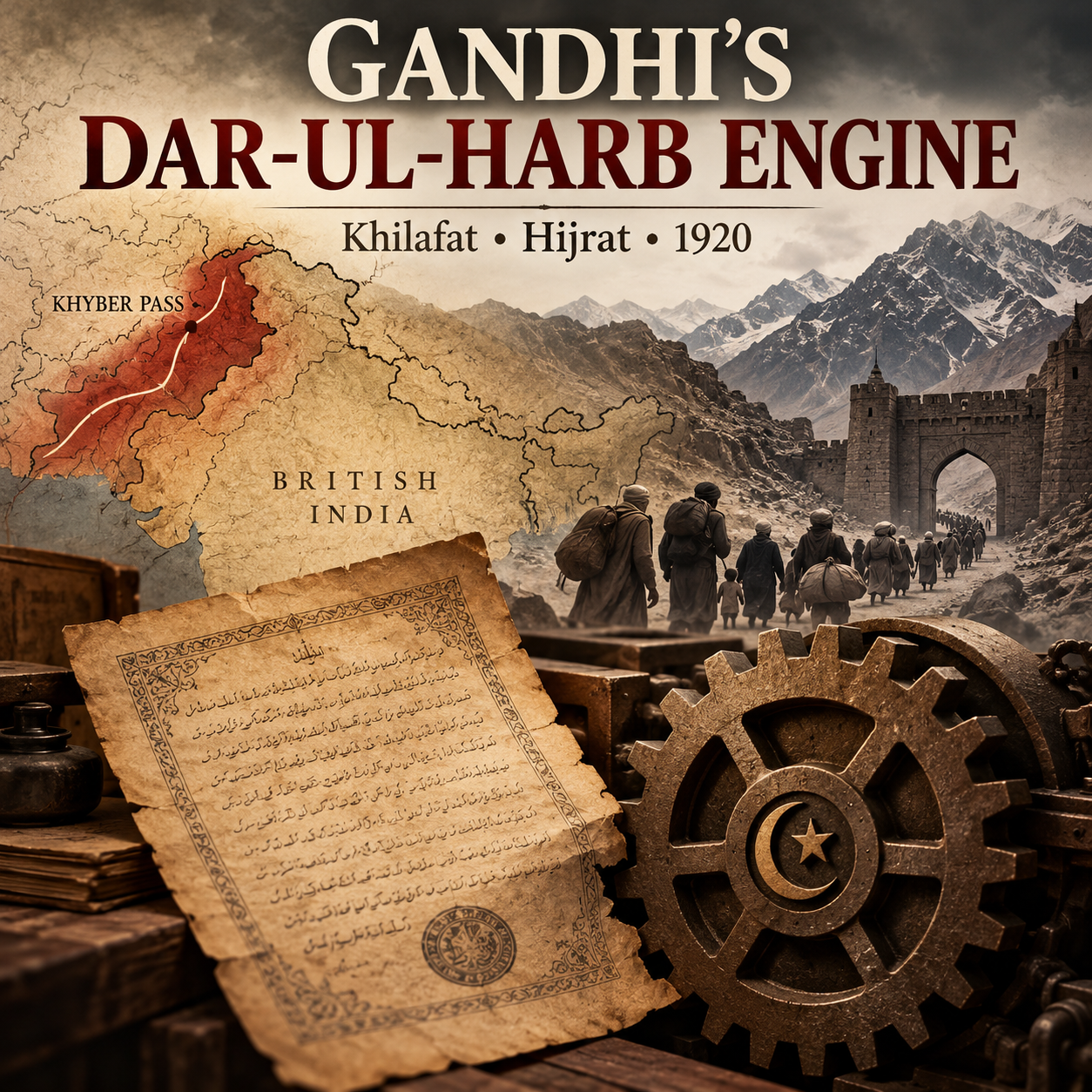
Gandhi’s Dar-ul-Harb Engine — Khilafat’s Pain to Muslims (182)
भारत / GB
Part 182: Mahatma Gandhi’s Peace Efforts | Series Index
The previous blog placed before the reader the selective capital — the documented pattern across four exhibits and thirteen years in which Gandhi’s political prestige, personal intervention, and public moral authority were deployed and withheld not by the principle of ahimsa but by the operational test of utility: the ally protected, the martyr abandoned. This blog asks what the machine ran on. Gandhi’s Dar-ul-Harb engine places before the reader the theological classification at the centre of the apparatus Gandhi harnessed, and the live operational proof of what that classification produced when the people Gandhi had placed before the Congress believed it.
Thank you for reading this post, don't forget to subscribe!THE HISTORICAL RECORD — GANDHI’S DAR-UL-HARB ENGINE
The Pattern: On 1 August 1920, Gandhi inaugurated the Non-Cooperation Movement. That same month, an estimated 40,000 to 60,000 Indian Muslim peasants were dying in the Khyber passes or staggering back across the Afghan border — having sold their ancestral lands to act on a formal religious decree that classified British India as Dar-ul-Harb, the Abode of War. The apparatus Gandhi was inaugurating had just demonstrated, at the cost of tens of thousands of livelihoods, what it produced when believed. Gandhi’s Dar-ul-Harb engine places that demonstration before the reader.
The Lethal Exhibit: The Mutafiqa Fatwa of 1920–21 — the Consensus Decree signed by hundreds of leading Sunni ulema under the Jamiat Ulema-e-Hind — issued three operative rulings: British India constituted Dar-ul-Harb; Muslim service in the army, police, and civil administration was haram; and Tark-e-Mawalat — the severing of all cooperative ties with the non-Muslim authority — was a Shariat obligation incumbent on every Muslim, not an elective political tactic. On the Congress floor, Gandhi translated Tark-e-Mawalat as Non-Cooperation. In the mosques, the ulema preached the identical programme as mandatory religious law. The engine did not run on satyagraha. It ran on religious obligation.
Why it matters: The standard defence holds that the Khilafat apparatus’s violence was unforeseeable — that Gandhi could not have anticipated what a theological mobilisation would produce in the field. The Hijrat closes that defence: one year before Malabar, on the same doctrinal foundation, the apparatus Gandhi had placed at the centre of the national programme demonstrated precisely what it produced when believed — and Gandhi inaugurated Non-Cooperation in August 1920 as it was demonstrating it.
The Doctrinal Foundation
Under Islamic jurisprudence, Dar-ul-Harb — the Abode of War — is territory governed by non-Muslim authority where Muslims live under a sovereignty structurally incompatible with Islamic religious obligation. The classification is juridically operative, not merely descriptive. It triggers Tark-e-Mawalat — the severance of all cooperative ties with the authority — and, where capacity exists, the duty of Jihad.
The Mutafiqa Fatwa of 1920–21 applied this classification formally to British India. Drafted under the authority of Maulana Abdul Bari of Firangi Mahal — the same cleric whose alliance with Gandhi in April 1919 had been the theological foundation of the Khilafat–Congress compact — and signed by hundreds of Sunni ulema under the Jamiat Ulema-e-Hind, the Fatwa’s operative rulings were unambiguous: British India was Dar-ul-Harb; Muslim military and civil service was haram; Tark-e-Mawalat was a Shariat obligation, not a political option.
Gandhi’s Dar-ul-Harb engine places the parallel before the reader. On the Congress floor: Non-Cooperation, a constitutional programme of institutional withdrawal. In every mosque and madrasa the Firangi Mahal network reached: the same programme as a mandatory religious decree carrying the authority of hundreds of signed Muslim scholars. Two languages. Two audiences. One machine.
What the Decree Meant at Street Level
The doctrine did not say: wage war against the British administration. It classified the territory as the Abode of War — which means every person, every household, every commercial relationship within it existed under a religious designation that made coexistence a theological compromise, not a natural condition. The Muslim weaver sharing a loom with a Hindu weaver in Malegaon. The merchant in Chandni Chowk who had elected a Muslim neighbour as his chaudhury. The Malkana Rajput family whose sons had observed both Eid and Diwali for three generations. Under Dar-ul-Harb, these were not relationships of fellowship. They were relationships of strategic tolerance — maintained only where Jihad was not yet possible.
The doctrine created a hierarchy. Where capacity for Jihad exists: war. Where it does not: Tark-e-Mawalat — the severing of cooperative ties. Where even that is premature: sabr — patience, as a tactical posture, not peace as a principle.
The neighbour was never neutral. The neighbour was the territory.
The Live Proof: Tehreek-e-Hijrat, 1920
A doctrine is tested by what it produces when believed.
When Jihad is constrained and Tark-e-Mawalat is insufficient, the jurisprudential hierarchy requires Hijrat — emigration from the Abode of War to Islamic territory. In early 1920, Maulana Abul Kalam Azad and Maulana Abdul Bari both declared Hijrat a religious obligation while the Dar-ul-Harb classification was operative.
The operational result is documented in British Intelligence Reports compiled by H.D. Craik and P.C. Bamford in the Home Political Files of 1920–21. Between May and August 1920, an estimated 40,000 to 60,000 Indian Muslim peasants — predominantly from Sindh and the North-West Frontier Province — responded as the religious instruction directed. They liquidated ancestral lands, livestock, and household goods at distress prices. They crossed the Khyber Pass on foot, heading for Afghanistan, which they had been given to understand would receive them as brethren. Amir Amanullah Khan, overwhelmed by the human flood and unable to absorb them, closed the border. They were turned back at gunpoint.
Thousands died of starvation, disease, and exposure in the mountain passes. The survivors returned to nothing — lands sold, social networks dissolved. They returned destitute, dispossessed, and structurally radicalised.
The prosecution places the Hijrat before the reader as forensic proof of the apparatus’s operational capacity — not as an indictment of its victims, but as the calibration of the weapon. In 1920, before Malabar, before Ali Musliyar had raised a Khilafat flag over a police station, the apparatus Gandhi had harnessed was already capable of destroying mass civilian populations on the authority of a theological classification. Gandhi’s Dar-ul-Harb engine places that capacity before the reader.
Gandhi’s Silence: 1 August 1920
On 1 August 1920, Gandhi inaugurated the Non-Cooperation Movement. The month of August 1920 was the peak of the Hijrat.
Gandhi did not address the Hijrat. He did not countermand the Dar-ul-Harb classification. He did not warn the peasants of Sindh and the Frontier that the ulema’s decree would produce catastrophe. He called the movement’s commanders “brave, God-fearing men.” He placed their cause before the cause of Swaraj. He continued.
The prosecution does not assert that Gandhi designed the Hijrat. It places the timeline before the reader: the Dar-ul-Harb classification was the theological foundation; the Hijrat was its operational proof; Gandhi inaugurated Non-Cooperation at its peak. The most generous reading available to the defence is naivety — that Gandhi did not understand what the classification meant when it left the mosque and reached the village. Gandhi’s Dar-ul-Harb engine places that naivety before the reader and asks what it cost.
The Prosecution’s Position
Two questions stand before the reader.
- Does the Mutafiqa Fatwa — hundreds of ulema formally classifying British India as Dar-ul-Harb and mandating Tark-e-Mawalat as a Shariat obligation, while Gandhi translated the identical programme as constitutional Non-Cooperation for secular audiences — constitute an exhibit the reader places alongside the claim that Non-Cooperation was born of Gandhian ethics rather than Islamic jurisprudence?
- Does the documented displacement of 40,000 to 60,000 peasants in 1920 — acting on the Dar-ul-Harb doctrine, dying in the Khyber passes, returning destitute and radicalised, one year before Malabar, on the same doctrinal foundation, as Gandhi inaugurated Non-Cooperation in silence — constitute an exhibit the reader places alongside the key phrase: Gandhi’s Dar-ul-Harb engine?
The series does not answer. This blog places the theological foundation and its operational proof before the reader. The next blog places before the reader the immediate consequence — the neighbourhood that existed before the doctrine arrived, and what remained of it after.
Invitation To Defence
The floor belongs to the defence. We now invite them to present their exhibits and challenge the narrative established by the prosecution.
The Mutafiqa Fatwa classified British India as Dar-ul-Harb and mandated Tark-e-Mawalat as a Shariat obligation — signed by hundreds of ulema. In August 1920, 40,000 to 60,000 peasants were dying in the Khyber passes having acted on that classification as the religious instruction it was delivered as. Gandhi did not countermand the Dar-ul-Harb decree. He did not address the Hijrat’s victims. He inaugurated Non-Cooperation at its peak and called the apparatus’s commanders brave, God-fearing men. Gandhi’s Dar-ul-Harb engine places the silence before the reader. The reader will name what it constitutes.
Feature Image: Click here to view the image.
Videos
Glossary of Terms
- Dar-ul-Harb: A term in Islamic jurisprudence referring to a territory classified as the Abode of War. The blog examines its application to British India during the Khilafat period.
- Mutafiqa Fatwa: The consensus decree discussed in the blog, attributed to hundreds of Sunni ulema associated with Jamiat Ulema-e-Hind, classifying British India as Dar-ul-Harb and setting out religious directives.
- Tark-e-Mawalat: The severing of cooperative ties with a non-Muslim authority, described in the blog as a Shariat obligation rather than an optional political tactic.
- Hijrat: Migration from territory classified as Dar-ul-Harb to territory regarded as Islamic. The blog examines the 1920 migration of Indian Muslim peasants toward Afghanistan.
- Tehreek-e-Hijrat: The Hijrat movement of 1920, in which Muslim peasants left British India for Afghanistan in response to religious guidance.
- Khilafat Movement: A political and religious movement in British India associated with the campaign to defend the Ottoman Caliphate and with Gandhi’s alliance between Khilafat leaders and the Congress.
- Non-Cooperation Movement: The movement inaugurated by Gandhi on 1 August 1920, encouraging withdrawal from cooperation with British institutions and authority.
- Islamic Jurisprudence: The interpretation and application of Islamic legal principles, referred to in the blog as the framework through which Dar-ul-Harb and related obligations were understood.
- Shariat: Islamic religious law, invoked in the blog in connection with the obligations attributed to the Mutafiqa Fatwa.
- Ulema: Muslim religious scholars who interpret Islamic teachings and legal traditions.
- Jamiat Ulema-e-Hind: An organisation of Muslim religious scholars associated with the fatwa discussed in the blog.
- Firangi Mahal: A scholarly and religious centre in Lucknow associated with Maulana Abdul Bari, whom the blog identifies as influential in the theological foundations of the Khilafat–Congress alliance.
- Jihad: A term with multiple meanings in Islamic traditions. In the doctrinal framework presented by this blog, it refers to the duty of armed struggle where the required capacity is considered to exist.
- Sabr: Patience or restraint. The blog describes it as a tactical posture within the doctrinal hierarchy it examines, rather than necessarily a commitment to peace as a principle.
- Gandhi’s Dar-ul-Harb Engine: A phrase coined for this blog to describe the alleged mechanism connecting the Dar-ul-Harb classification, religious directives, political mobilisation, and the consequences examined through the Hijrat movement.
- Operational Proof: The blog’s term for the practical consequences used to evaluate a doctrine or political-religious mechanism, particularly the migration and hardship associated with the Hijrat movement.
- Home Political Files: British government records cited in the blog as a documentary source for intelligence reports concerning the 1920–21 period.
- D. Craik and P.C. Bamford: British officials named in the blog in connection with the compilation of intelligence reports on the Hijrat movement.
- Swaraj: Self-rule or self-government, a central political objective of the Indian independence movement and a term used in the blog when discussing Gandhi’s priorities.
- Malabar Rebellion: The 1921 uprising in the Malabar region, invoked in the blog as a later event against which the timing and consequences of the 1920 Hijrat movement are compared.
- Forensic Archive: The title of a broader documentary collection associated with the series, intended to organise evidence and arguments concerning Gandhi’s political decisions and their historical consequences.
#Gandhi #Khilafat #Hijrat #IndianHistory #MahatmaGandhi #BritishIndia #History #IslamicHistory #NonCooperation #Afghanistan #HinduinfoPedia
Scan Through The Entire Series at
Refer to Various Arks Referred to in the Blog