
Mamata’s Manufactured Grievance Playbook: When the Same Strategy Reveals the Exit Door
भारत/GB
Mamata’s Manufactured Grievance Playbook Bare Display
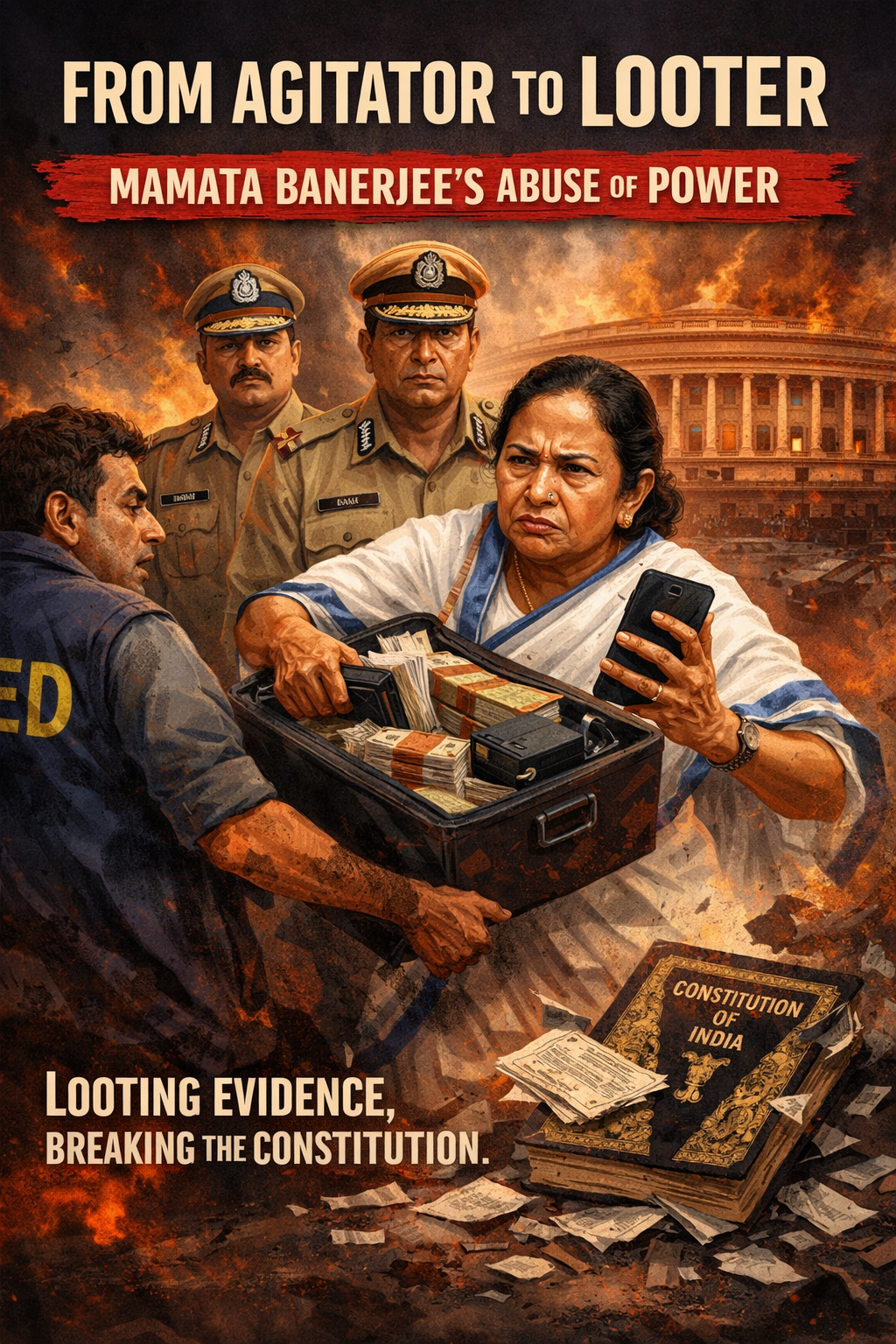
Trinamool Congress supremo Mamata Banerjee’s manufactured grievance playbook is once again being deployed across the towns and villages of West Bengal. The political strategy that delivered her 15 years in power is being replayed. But the playbook carries a structural flaw: manufactured grievance works from opposition, not from government. In 2025, a voter list became her weapon to escape corruption scandals. The template looks identical—claim injustice, create institutional paralysis, weaponize victimhood, declare victory. But there’s one critical difference. In Singur, she was the agitator on a 26-day hunger strike. In SIR, her agents protest while she orchestrates from the CM’s office. And on January 8, 2026, when she personally stormed an ED raid to steal evidence from investigating officers—including an officer’s mobile phone—the desperation became unmistakable. Mamata’s manufactured grievance playbook that opened the door to power may now be showing her the exit door.
Thank you for reading this post, don't forget to subscribe!The Evidence Theft That Reveals Everything
On January 8, 2026, the Enforcement Directorate conducted searches at the I-PAC (Indian Political Action Committee) office and director Pratik Jain’s residence in Kolkata as part of a coal smuggling money laundering investigation. What happened next wasn’t protest. It was state-sponsored obstruction.
What Mamata Did:
- Personally entered the raid location with senior TMC leaders
- Took away ED officer’s mobile phone from investigating personnel
- Confiscated laptops, hard disks, and documents from ED custody
- Used state police—DGP Rajeev Kumar and Police Commissioner Manoj Verma—to facilitate the seizure
- Claimed she was “protecting party documents” to prevent them going to BJP
Let us understand what happened. A raid was conducted at the premises of a private firm. The firm in question, I-PAC, is a political consultancy and was engaged as a consultant by a political party—Trinamool Congress. The president of Trinamool Congress, in the capacity of a private citizen, claimed that the firm possessed confidential party documents that needed protection. On this basis, she entered the I-PAC premises and forcibly took possession of sensitive documents from ED officials and left the premises. This action was carried out under the protection of the state machinery and in the presence of the West Bengal Director General of Police.
Solicitor General Tushar Mehta’s description to the Supreme Court was devastating: “This is pure theft. She took an ED officer’s phone as well. This will only encourage such acts and demoralize Central forces.” He characterized the incident as one where “mobocracy replaces democracy.”
On January 15, 2026, the Supreme Court delivered a stinging rebuke. Justice Prashant Kumar Mishra and Justice Vipul Pancholi called the obstruction “very serious” and warned it threatens “lawlessness across the country.” The Court:
- Stayed all three FIRs filed by West Bengal Police against ED officers
- Issued notices to Mamata Banerjee, DGP Rajeev Kumar, and Police Commissioner Manoj Verma
- Directed preservation of all CCTV footage and electronic storage devices
- Observed that the Calcutta High Court had been turned into “Jantar Mantar” after TMC WhatsApp messages mobilized party workers to pack the courtroom
This is not a confident leader awaiting vindication. This is a desperate politician using state machinery to obstruct justice.
The ED raid wasn’t random. It connects to I-PAC—the same political consultancy firm that has been managing Mamata’s SIR protest rallies. The timing matters. The raid came amid mounting evidence trails from the School Service Commission scandal, where the Supreme Court cancelled 26,000 illegally appointed teaching jobs after ₹21 crores in cash was recovered from the residence of arrested TMC Education Minister Partha Chatterjee’s associate.
When a Chief Minister physically steals evidence from federal investigators, it reveals one thing: she knows what that evidence contains.
The Global Playbook for Instability
The pattern of institutional obstruction in Bengal isn’t unique; it follows a documented manual for systemic disruption. These analyses reveal how domestic protests are often the final phase of a much larger strategy.
Explore the Doctrine:
Singur Template: Mamata’s Manufactured Grievance Playbook Delivered 15 Years of Power
Between 2006-2008, the West Bengal government acquired 997 acres in Singur for Tata Motors’ Nano factory. The project promised India’s cheapest car manufacturing hub, thousands of direct jobs, ancillary industrial development, enhanced compensation for displaced farmers, and vocational training for local youth. This investment push came after decades in which West Bengal had steadily lost its industrial primacy, with private capital and manufacturing shifting to other states amid an entrenched reputation for labour militancy, policy rigidity and an unfavourable investment climate during the long Left Front rule.
Mamata Banerjee led a sustained agitation claiming “forcible land acquisition” and “farmer injustice.” On December 4, 2006, she began what would become a legendary 26-day hunger strike. The protest drew intervention from President APJ Abdul Kalam, who appealed to her: “life is precious.”
The turning point came on December 18, 2006, when 16-year-old activist Tapasi Malik was murdered. This gave “the Singur agitation a razor-sharp edge,” winning support from civil society members, intellectuals, artistes, and political activists of all stripes. The supporter base included Booker Prize winner Arundhati Roy, Magsaysay Award winner Mahasweta Devi, environmental activists Medha Patkar and Anuradha Talwar, and film personalities Aparna Sen and Kaushik Sen, most of whom are labelled by some as anti-India and anti-development.
On October 3, 2008, Tata Motors withdrew from Bengal. Ratan Tata blamed “agitation by Banerjee and her supporters.” Then-Gujarat Chief Minister Narendra Modi sent a message: “Suswagatam” (Welcome). The Nano factory was built in Sanand, Gujarat in 14 months—half the 28 months planned for Singur. Sanand became an automobile manufacturing hub. Bengal lost the opportunity.
The Electoral Reward:
In the 2006 Assembly elections, TMC delivered a dismal performance. Post-Singur, the party began “pulling off one electoral coup after another.” In May 2011, Mamata Banerjee became Chief Minister, ending 34 years of Left Front rule. She has remained in power for 15 consecutive years (2011-2026).
Mamata herself acknowledged the movement’s unprecedented nature: “I have agitated in the past; I have seen huge gatherings on the Brigade Parade Ground. There would be a sea of people, but just on that one day. But never before have I seen a constant stream of people for so many days.”
The Legal Vindication?
This outcome was secured through a one-sided legal contest pursued by the post-2011 state government using public resources, after Tata Motors had exited and no stakeholder remained to defend the industrial project. The legal victory, therefore, came at the cost of permanent industrial loss to Singur, the farmers who lost fertile land and compensation, as well as the industrial development of the region and the state of West Bengal, which continued to project a hostile environment for industrial growth and reinforced the anti-business posture of the state administration. The state had already lost its prime status as an economic powerhouse of India, declining from a 27.5% economic contribution in 1947 to below 4% by the 2000s.
But here’s what the presumed victory narrative conceals.
Demographic Reality & Electoral Fraud
Why is the SIR verification meeting such fierce resistance? Understanding the strategic logic behind refugee status and the refusal of neighboring nations to accept their own reveals the high stakes of electoral roll integrity.
The Wall of Truth:
The Aftermath Reality: Economically Betrayed Farmers and Lost Opportunity
Bifal Bangal, a 67-year-old farmer, got his land back in 2016. But the land remains “uncultivable.” The factory was razed but concrete debris underground was never fully cleared. The foundations remain.
The regret is palpable. “Koley and other landowners in Singur now regret not accepting the enhanced compensation for their farmlands that was offered by the Tatas.” They lost:
- Jobs for children of land-losers
- Vocational training (many had already been trained)
- Ancillary industrial units
- The manufacturing hub that became Sanand
The assessment is harsh: “Several of Singur’s residents today feel politically used and economically betrayed.”
Bengal paid a massive price. The state developed a “mercurial and industry-unfriendly image.” Investors gave Bengal “a wide berth.” The lack of employment opportunities became chronic. The economic cost continues compounding.
But the political reality? “The farmers here are disenchanted with the TMC but it will not have much of an effect on turning the tide against the party.”
The playbook had worked. Manufactured grievance + sustained agitation + institutional paralysis = political consolidation. The Supreme Court vindication came after she’d already secured power for five years. The farmers’ economic betrayal didn’t matter. The template had delivered.
This established Mamata’s manufactured grievance playbook as a proven political weapon.
The Critical Reversal: From Agitator to Orchestrator
Here’s where the template breaks down.
Singur (2006-2011): Mamata as Direct Agitator
Her role:
- Personal 26-day hunger strike (December 4-29, 2006)
- Led street protests herself
- Faced police action directly
- WAS the movement—not just directing it
- Opposition leader with nothing to lose and everything to gain
When you’re on a hunger strike for 26 days, people believe you mean it. When you’re getting teargassed yourself, credibility comes automatically. When President Kalam intervenes worried about your health, the grievance appears genuine.
SIR (2025-2026): Mamata as Government Orchestrator
Her role now:
- Supporters and agents are protesting
- She’s directing from the CM’s office
- Using I-PAC (the political consultancy firm now under ED investigation) to manage rallies
- Writing letters to the Election Commission instead of dharnas
- Claims of “100 deaths due to anxiety” (unverified)
- Chief Minister trying to appear as Opposition fighter
The credibility problem is fundamental:
- She IS the state machinery now
- She’s defending institutional power, not challenging it
- The protests look orchestrated because they are—I-PAC is managing them
- She’s resisting verification, not land acquisition
Former MP Jawahar Sircar stated it plainly: “By ordering the hounding of poorer classes of Bengali migrant workers all over India, Amit Shah has given Mamata Banerjee an unprecedented opportunity to recoup her sinking popularity in West Bengal and leap into her sub-nationalist role.”
Note the key phrase:
“Recoup her sinking popularity.” The context he referred to? “TMC was on the back foot because of corruption and oppression allegations.”
This isn’t a leader riding genuine grievance to power. This is a government in crisis manufacturing a diversion.
Governance vs. Grievance
A “manufactured grievance” works only when it masks a failure of governance. From the economic betrayal of farmers in Singur to the current corruption scandals in the School Service Commission, see the evidence of the template in action.
Institutional Integrity:
SIR: Constitutional Exercise Reframed as Persecution
What is SIR?
The Special Intensive Revision (SIR) is a constitutional exercise under Article 324 and Section 21(3) of the Representation of the People Act, 1951. The Election Commission has explicit power to revise electoral rolls without permission from any authority.
This is the 14th such intensive revision since 1952. Previous revisions occurred in: 1952-56, 1957, 1961, 1965, 1966, 1983-84, 1987-89, 1992, 1993, 1995, 2002, 2003, and 2004. The last comprehensive revision was in 2002—a 23-year gap that makes this exercise overdue, not premature.
The 2025 Phase II SIR (launched November 4, 2025) covers 9 states and 3 union territories, affecting 51 crore electors across 321 districts and 1,843 Assembly constituencies. This is routine electoral hygiene across India, not targeted persecution of Bengal.
In West Bengal, 58 lakh names were dropped from draft rolls for documented reasons: deaths, migration, duplication, and untraceability. The exercise verifies 7.66 crore current voters against the 2002 baseline list.
Documents required include legacy documents like pre-1987 certificates, land records, and matriculation certificates. Critically, Aadhaar is explicitly NOT proof of citizenship—only identity. And fundamentally: “The ECI has no authority to decide citizenship.”
This is verification of electoral rolls, not citizenship determination.
Mamata’s Strategic Deployment
On November 4, 2025, Mamata led a massive I-PAC-managed rally with “all signature elements of a Mamata political rally.” Interfaith leaders marched at the front—Sikh turbans, Buddhist robes, Hindu saffron garments, Christian cassocks, Muslim clerical robes—in carefully staged symbolism.
She has written five letters to Chief Election Commissioner Gyanesh Kumar. Her latest letter concluded: “Though I know you won’t reply or clarify, but it is my duty to inform you (of) the details.”
Her claims include:
- “100 deaths due to anxiety” related to SIR (unverified escalation from earlier claims of 28 deaths)
- 90,000 voters in Malda district (minority-dominated) being deleted
- ECI targeting minorities, Matuas, Rajvansis, tribal communities
- “Even acclaimed persons like Amartya Sen and poet Joy Goswami” being scrutinized
She launched “Bhasha Andolan” (Language Movement) from Bolpur-Santiniketan (Rabindranath Tagore’s home), claiming Bengali-speaking migrants are being harassed in BJP-ruled states. The historical echo is deliberate—the original Bhasha Andolan was the language movement that ultimately led to Bangladesh’s independence.
Her grand declaration: “If a single eligible voter is removed from the electoral rolls in Bengal, we will ensure the fall of the BJP government.”
TMC branded SIR as “Bangla-birodhi” (anti-Bengali).
The Document Controversy That Reveals Orchestration
In a revealing incident, Mamata claimed she personally received the voter enumeration form from a Booth Level Officer (BLO). TMC-aligned outlets Jago Bangla and Sangbad Pratidin reported this.
She then denied it on social media: “This news is completely false, misleading, and motivated propaganda.”
Multiple Bengali publications quietly deleted their online reports. New headlines appeared quoting her: “Until every person in Bengal fills out the form – I myself have not filled out any form – I won’t either.”
This shows the manufactured nature of the campaign. Even her own party media gets the script wrong, then deletes and rewrites on her orders. This isn’t organic protest. This is orchestrated theater.
The Political Calculation Made Explicit
Political analyst Biswanath Chakraborty stated: “Bengal has entered a cycle where the election debate is about the vote itself, not about schemes.”
Mission accomplished. Governance forgotten. Grievance activated. Corruption scandals buried under identity politics.
The target constituencies are clear:
- Muslim voters: approximately 30% of state population
- Scheduled Caste voters: approximately 24% (particularly Matuas and Rajbanshis who have legitimate documentation anxieties as refugee communities)
- Border district populations where infiltration questions are most acute
But here’s the fundamental problem with Mamata’s manufactured grievance playbook this time: She’s not fighting against government power. She’s using government power to resist lawful verification.
At the same time, images and videos emerging from the India–Bangladesh border and from within West Bengal, including Kolkata, showed undocumented migrants attempting to exit Indian territory amid verification drives. These visuals directly contradicted claims of “persecution,” reinforcing that the resistance was not to injustice, but to scrutiny.
Dharma vs. Jurisprudence: The Judicial Failure
The Supreme Court’s eventual vindication of the Singur agitation mirrors a documented pattern where legal processes are delayed until political outcomes are secured. From the “mobocracy” in the Calcutta High Court to the handling of Shaheen Bagh, we analyze the framework of institutional decline.
Understand the Pattern:
The Ground Reality: Dual Voter Cards and Admission of Fraud
A Tehelka investigation in Haryana among Bengali-speaking migrant workers produced a startling admission.
Khadimul Islam, a Congress worker from South Dinajpur, revealed:
- 30 lakh Bangla-speaking migrant workers in Haryana (unofficial estimate)
- 7 lakh are Hindus among them
- “At least 10,000 people may have two voter cards”—one in Gurugram (Haryana), another in West Bengal
Among local residents of Gurugram, there are accounts and circulating messages claiming that a few months ago garbage collection services came to a halt, allegedly after the police took illegal Bangladeshi migrants into custody. Following this, other undocumented migrants reportedly disappeared from the service. It took several weeks before normal operations resumed.
This is the admission that validates the entire SIR exercise. When workers openly acknowledge dual voter card possession, the claim of “persecution” collapses. This isn’t harassment. This is correction of documented fraud.
The Tehelka report noted: “Since 2025, many had temporarily fled the city due to fears triggered by police verification drives to weed out illegal immigrants from Bangladesh, before gradually returning.”
This behavior pattern reveals consciousness of vulnerability. People who fled verification drives and then returned are demonstrating awareness that scrutiny might expose irregularities.
The Assam Precedent That Validates Verification
The 2019 Assam NRC excluded 1.9 million people from the citizenship register. Assam shares a 263 km border with Bangladesh. West Bengal shares 2,217 km—more than eight times longer.
If Assam’s shorter border justified excluding 1.9 million people after verification, West Bengal’s vastly longer border makes the case for scrutiny overwhelming, not oppressive.
The Assam NRC also revealed systematic exclusion of vulnerable groups: 200 sex workers in Silchar alone, 2,000 trans women statewide—people whose birth certificates don’t match their gender identity or current names. This documented reality shows verification exercises have real human costs for legitimate citizens.
But the solution isn’t abandoning verification. It’s ensuring verification processes account for vulnerable populations while still maintaining electoral roll integrity.
Why Bengal Needs Verification More, Not Less
The Sunali Khatun case became TMC’s symbolic grievance. She was a Bengali-speaking migrant rag picker in Delhi, picked up in June 2025 on suspicion of being an undocumented Bangladeshi. Eight months pregnant, she was pushed across the border. Her parents were in the 2002 voter list—verified Indian citizens. The Calcutta High Court ruled her deportation unlawful. Bangladesh ruled her as Indian. She remains in a Bangladeshi jail.
TMC projected this as “emblematic of profiling and institutional excess.”
But here’s what the case actually proves: The 2002 voter list baseline matters. Sunali Khatun’s claim to Indian citizenship rested on her parents being in that 2002 list. When verification uses that baseline, legitimate citizens can prove status. When verification is abandoned, everyone—including genuine citizens—becomes vulnerable to arbitrary deportation.
The case for SIR verification is strengthened, not weakened, by cases like Sunali Khatun’s.
The Logic of Enforcement vs. Manufactured Resistance
Risk-based verification is standard administrative practice across all enforcement domains:
- Tax audits concentrate on high-income brackets and industries with violation patterns
- Customs checks intensively monitor trade routes with smuggling history
- Welfare fraud verification focuses on high-claim patterns
- Airport security uses risk-based profiling mandated by international protocols
Unequal scrutiny ≠ unequal treatment when risk profiles differ.
West Bengal’s 2,217 km border with Bangladesh, combined with documented history of infiltration and the admission of dual voter card possession by migrant workers, creates a legitimate basis for intensive verification.
When enforcement deliberately avoids high-risk categories to appear “balanced,” it becomes performative theater, not fair administration. Real fairness means enforcement concentrates where violation probability is highest.
The Grievance is Resistance to Enforcement Itself
If a community has tolerated systematic misuse of electoral rolls, verification will cause inconvenience to that community. That inconvenience is consequence, not injustice.
When protests arise not from procedural irregularity but from verification itself, the grievance is manufactured. The claim isn’t “the process is unfair.” The claim is “don’t enforce verification where it’s most needed.”
Leader of Opposition Suvendu Adhikari stated it clearly: “A clean electoral roll is the foundation of democracy. Genuine voters have nothing to fear.“
This is the question that exposes manufactured grievance: If the voters are genuine, why resist verification?
The Wall of Truth: Global Refugee Tactics
Refugee resistance to verification in Bengal is not an isolated event. It follows a strategic logic seen across the globe, where maintaining perpetual refugee status serves a specific geopolitical purpose. Discover why 57 Muslim nations maintain these same barriers.
Explore the Series:
Why Mamata’s Manufactured Grievance Playbook Now Shows the Exit Door
1. The Position Reversal
Then (2006): Opposition leader on hunger strike challenging government land acquisition Now (2026): Chief Minister using state muscle to obstruct federal investigation and resist constitutional verification
When you go from 26-day fast to stealing an ED officer’s phone, the trajectory is visible. The credibility reversal is complete.
2. Legitimacy of the Process
Singur: Land acquisition had procedural questions the Supreme Court later validated (even if eight years late) SIR: Electoral verification is explicit Constitutional authority under Article 324
You can’t claim “injustice” when the Election Commission is following the Constitution. There’s no procedural irregularity alleged. The entire campaign opposes verification itself.
3. The Fraud Admission
The Tehelka investigation documented workers admitting 10,000 dual voter cards among 30 lakh migrant workers. This validates the need for verification. It undermines the entire “persecution” narrative.
When your own constituency admits the fraud you’re supposed to be protecting them from, the manufactured grievance collapses.
4. The Desperation Is Visible
The School Service Commission scandal: 26,000 cancelled teaching jobs after ₹21 crores in cash was recovered from the residence of arrested TMC Education Minister’s associate.
The ED raid: Physical theft of evidence including an investigative officer’s mobile phone.
The Supreme Court rebuke: Called the obstruction “very serious” and threatening “lawlessness across the country.”
Using SIR to escape corruption charges is transparently desperate, not strategically brilliant. Even sympathetic analysts like Jawahar Sircar openly call it an “unprecedented opportunity to recoup her sinking popularity.”
5. Supreme Court Timing Reversal
Singur: Supreme Court vindication came in 2016 (8 years after Tata withdrew, 5 years after she became CM)
She won power first. Governed for five years. Then got legal vindication. The sequence allowed her to consolidate despite economic damage to Bengal.
SIR: Any Supreme Court ruling on electoral verification would come BEFORE the 2026 elections.
She can’t win elections, govern for years, then get vindicated. The sequence is reversed. If the Court rules against her SIR resistance (as it likely will, given Constitutional clarity), the judgment comes before votes are cast.
6. The Manufacturing Is Too Obvious
Even the manufactured nature is visible:
- I-PAC (now under ED investigation for coal scam money laundering) managing her SIR protest rallies
- Interfaith symbolism that looks staged because it is
- TMC media outlets deleting and rewriting their own stories on her orders
- Claims escalating from “28 deaths” to “100 deaths” without verification
- The document controversy where she denied receiving what her own party media reported
Political analyst Biswanath Chakraborty’s assessment is damning: “Bengal has entered a cycle where the election debate is about the vote itself, not about schemes.”
When analysts openly state you’ve successfully diverted from governance to grievance, the tactical move is visible. Visible manipulation loses credibility.
7. Defending the Indefensible
Opposing land acquisition = debatable development policy where reasonable people disagree
Opposing electoral verification = appearing to protect electoral fraud
When protestors say “don’t check us,” they’re not claiming injustice. They’re demanding exemption. This is fundamentally indefensible in a democracy.
8. The 23-Year Gap Is Objectively Too Long
The last comprehensive electoral revision was in 2002. A 23-year gap in verification is objectively excessive. Even neutral observers accept this timeline makes intensive revision necessary, not oppressive.
India has conducted 13 intensive revisions since 1952. This is the 14th. It’s routine electoral hygiene, not targeted persecution.
9. Assam Precedent Validates Reality
The Assam NRC excluded 1.9 million people in 2019. This establishes that infiltration and documentation irregularities are real, not manufactured fears.
Assam’s 263 km border with Bangladesh yielded 1.9 million exclusions. West Bengal’s 2,217 km border—more than eight times longer—makes the case for verification overwhelming.
If anything, West Bengal needs more scrutiny than Assam, not less.
10. The Agent Problem
Singur: Mamata personally on 26-day hunger strike. She led protests herself. She was the movement.
SIR: Her supporters and agents protesting while she writes letters and orchestrates from the CM’s office.
This distance reveals orchestration, not organic leadership. When I-PAC is managing your rallies and the same I-PAC is under ED investigation for money laundering, the optics are devastating.
The January 8 ED raid showed the real Mamata: Not a hunger-striking Opposition leader challenging power, but a Chief Minister using state police to physically obstruct federal investigators and steal evidence.
That’s not leadership. That’s desperation.
The Exit Door: When Position Determines Outcome
Mamata’s manufactured grievance playbook worked in 2006 because every element aligned:
- She was in Opposition challenging government
- She had personal credibility from 26-day hunger strike
- The process had procedural questions (Supreme Court later found flaws)
- No admission of wrongdoing by her constituency
- Legal vindication came after political consolidation
- She appeared as David against Goliath, not Goliath against David
In 2025, every element is inverted:
- She IS the government resisting verification
- She has orchestrated protests managed by I-PAC instead of personal sacrifice
- The process has Constitutional authority (Article 324, no procedural flaw alleged)
- Workers admit dual voter cards exist (10,000 estimated)
- Legal judgment will come before elections, not after
- She appears as Goliath claiming victimhood, not David fighting oppression
The January 8, 2026 ED raid crystallized the inversion. When a Chief Minister physically storms a federal investigation to steal evidence—including an investigating officer’s mobile phone—and the Supreme Court calls it a threat to “lawlessness across the country,” the template has broken.
Former MP Jawahar Sircar’s assessment inadvertently revealed everything: This is an “unprecedented opportunity to recoup her sinking popularity” after being “on the back foot because of corruption and oppression allegations.”
This isn’t a leader riding genuine grievance to power. This is a government in crisis manufacturing a diversion.
The same playbook that delivered 15 years of power when deployed from Opposition may now reveal the exit door when deployed from government.
Position determines outcome. Mamata’s manufactured grievance playbook has met its expiration date. The question isn’t whether she’ll try to use it again—the question is whether voters will recognize the template this time.
When manufactured grievance becomes visible, it loses its power. And on January 8, 2026, when she personally stole evidence from ED officers, the manufacturing became unmistakable.
Feature Image: Click here to view the image.
Video
Glossary of Terms
- Manufactured Grievance Playbook: A political strategy where perceived injustice is deliberately constructed and amplified to mobilize support, paralyze institutions, and deflect accountability while in or out of power.
- Special Intensive Revision (SIR): A constitutional process under Article 324 of the Indian Constitution through which the Election Commission conducts a comprehensive verification and revision of electoral rolls.
- I-PAC (Indian Political Action Committee): A private political consultancy firm engaged in election strategy, messaging, and mobilization for political parties and leaders in India.
- Enforcement Directorate (ED): A central investigative agency responsible for enforcing economic laws, including money-laundering and foreign exchange violations.
- School Service Commission (SSC) Scam: A large recruitment scandal in West Bengal involving illegal appointments of teachers, later annulled by the Supreme Court.
- Singur Land Acquisition: The 2006–08 acquisition of farmland in Singur, West Bengal, for the Tata Nano factory, which became the focal point of mass political agitation.
- Tata Nano Project: An automobile manufacturing initiative by Tata Motors intended to produce the world’s cheapest car, later shifted from West Bengal to Gujarat.
- Article 324: A constitutional provision granting the Election Commission of India authority over the conduct of elections and electoral roll management.
- Representation of the People Act, 1951: Indian legislation governing elections, voter eligibility, and electoral procedures.
- Assam NRC: The National Register of Citizens exercise conducted in Assam to identify illegal immigrants, excluding approximately 1.9 million individuals in 2019.
- Dual Voter Cards: The illegal practice of possessing voter identity cards in more than one electoral jurisdiction.
- Institutional Obstruction: The deliberate interference by those in power with lawful investigative or constitutional processes.
- State Capture: A condition where political leadership uses state institutions and coercive power to protect partisan or private interests.
- Manufactured Persecution Narrative: A political narrative framing lawful administrative action as targeted oppression to mobilize identity-based support.
#MamataBanerjee #WestBengalPolitics #ElectoralRolls #IndianDemocracy #PoliticalCorruption #HinduinfoPedia
Related Reading:
- Regime Change Playbook: Understanding Color Revolution Mechanics
- Target India: Doctrine in Motion
- Demographic Reality: How Fertility Patterns Reshape Democracies
- Judicial Accountability Crisis: When Courts Fail Constitutional Duty
- Why 57 Muslim Nations Refuse Palestinian Refugees
- When Dictatorships Vote on Democracy: UN Legitimacy Crisis
Follow us:
- English YouTube: https://www.youtube.com/@Hinduofficialstation
- Hindi YouTube: https://www.youtube.com/@HinduinfopediaIn
- X: https://x.com/HinduInfopedia
- Instagram: https://www.instagram.com/hinduinfopedia/
- Facebook: https://www.facebook.com/Hinduinfopediaofficial
- Threads: https://www.threads.com/@hinduinfopedia