
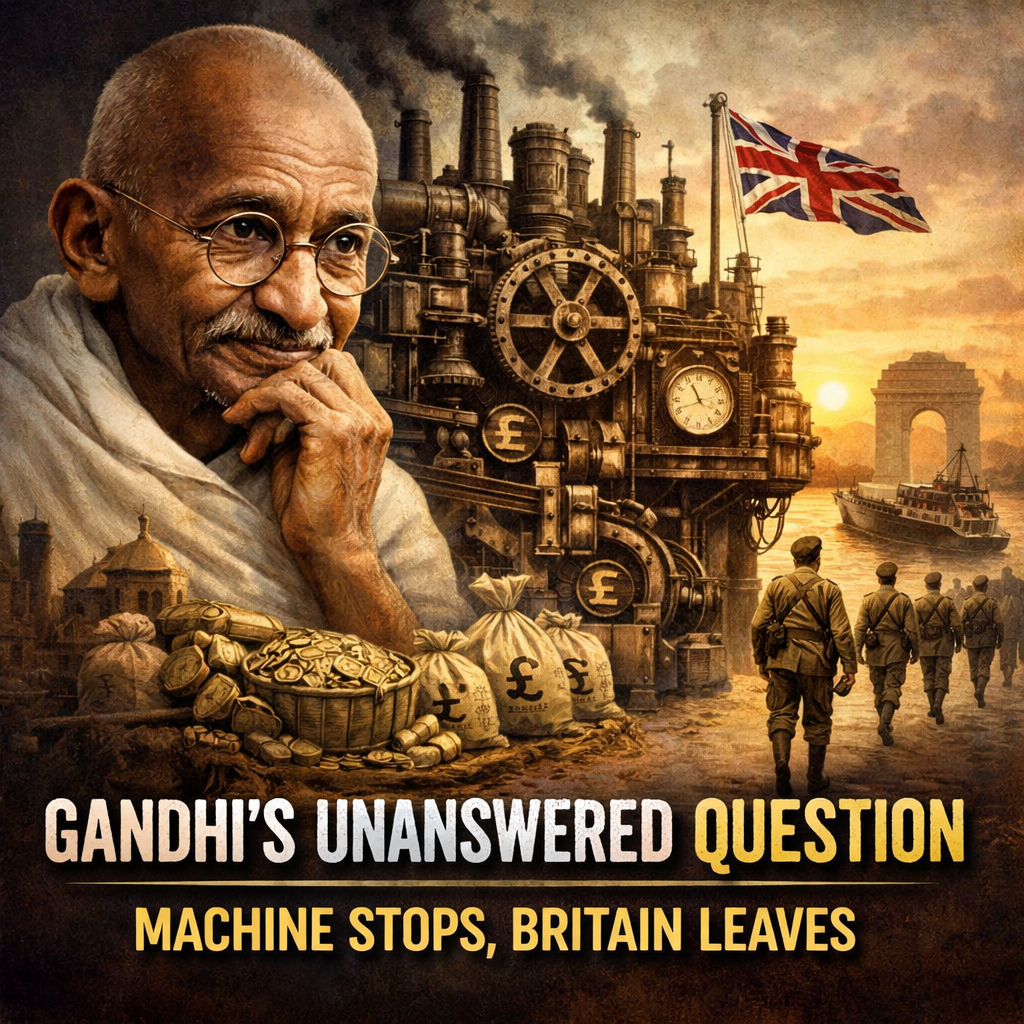
Gandhi’s Unanswered Question: Machine Stops, Britain Leaves (16)
भारत / GB
Part 16: Mahatma Gandhi’s Peace Efforts | Series Index
Irwin and Gandhi’s Unanswered Question
Following the investigation in Gandhi’s life as a student and his, hands-on training he had with what is now being called as “Satyagrah” we investigated how he utlised the learning in the three Satyagrahs in India. The last three blogs have built this moment: the extraction machine documented component by component, its cost priced at £9.2 trillion and a life expectancy of twenty-seven, and Gandhi’s eleven demands mapped, in structural terms, as a point-by-point shutdown notice served on every mechanism. Lord Irwin did not reply. Gandhi’s Unanswered Question is what that silence meant.
Thank you for reading this post, don't forget to subscribe!The Action Taken: Mass civil disobedience demonstrated that imperial administration was unsustainable if Indian non-cooperation severed the revenue extraction gears.
Who Paid the Price: The broader population, which remained under colonial rule for another 17 years when the economic blockade was suspended for talks.
The Alternative Bypassed: British administrative committees facing severe fiscal distress, which were relieved when civil disobedience was paused.
Why This Matters: Places before the reader the strategic question: whether imperial withdrawal was achievable in 1930 had the administrative blockade been sustained rather than traded for a bilateral truce.
The question Irwin understood and chose not to answer
Lord Irwin was not a careless man. His private correspondence, preserved in the India Office records and later examined by historians of the late colonial period, reveals a Viceroy who read the eleven demands carefully and understood their implications with precision. Whether articulated explicitly or embedded implicitly in the framing of the demands, the question operated at a structural level beyond its stated moral language. It was about whether the financial rationale for the British presence in India could survive the granting of what had been asked.
The internal colonial assessment, documented in the Viceroy’s correspondence, was not that the demands were extreme. (See Blog 13 for the documented breakdown of these mechanisms and their administrative evaluation.) The record, as reconstructed from administrative correspondence examined in Blog 13, indicates that they were structurally incompatible with the continuation of the Raj as a revenue-generating enterprise. Gandhi’s Unanswered Question had, at the level of colonial administration, already been answered. Irwin’s silence was the answer.

What the historians calculated, working backwards
The reparations debate that surfaced publicly between 2015 and 2018 produced, in effect, a retrospective answer to Gandhi’s Unanswered Question. Utsa Patnaik’s research, published through Columbia University Press in 2018, calculated the total drain at £9.2 trillion between 1765 and 1938, based on export surplus and colonial trade imbalance methodologies. Shashi Tharoor, in his Oxford Union address and the book that followed, placed a conservative figure of £3 trillion on what was extracted, reflecting a narrower valuation framework and offered the observation that Britain departed India in 1947 not from moral awakening but because the financial calculation had changed. External Minister S. Jaishankar, addressing the same framework in Washington, noted that the departure was strategic, not ethical.
What the historians established retrospectively, Gandhi’s eleven demands established prospectively — in January 1930, seventeen years before independence. The documentation indicates that the demands, if granted in full, would have materially altered that financial calculation not in 1947 but as early as 1930. Gandhi’s Unanswered Question was, structurally: if the extraction stops, on what basis does the occupation continue?
The Council Bills drain severed. The land revenue halved. The salt monopoly abolished. The military subsidy ended. The CID dismantled. The Lancashire captive market broken open. The record shows that these six mechanisms, operating together, were the financial architecture of the Raj. Blog 13 documented them. Blog 14 priced them. Blog 15 showed each demand as a shutdown instruction. Gandhi’s Unanswered Question asks what remains when the instructions are followed or the demands are met.
The departure that happened seventeen years later
Britain departed India in August 1947. The standard history attributes this to the cumulative pressure of the independence movement, the exhaustion of the Second World War, and the moral weight of democratic principle applied to colonial contradiction. The historians who have examined the financial record most carefully offer a less comfortable framework.
The departure of 1947 followed a specific sequence: the Royal Indian Navy mutiny of February 1946, which the colonial administration’s own internal assessments described as the moment the loyalty of the armed forces became uncertain; the Congress and League electoral results of 1945–46, which foreclosed the possibility of a negotiated collaborative administration; and the post-war British fiscal position, which made the maintenance of the Indian empire financially unsustainable for the first time. The extraction machine had, by 1947, begun to cost more to operate than it produced as most of the extractable wealth had been syphoned off in the last 190 years.
Gandhi’s Unanswered Question, read against this sequence, acquires a specific weight. The eleven demands of 1930 would have significantly undermined the profitability of the extraction machine seventeen years earlier. The Raj existed, on the evidence assembled across this arc, to extract. When the extraction became unsustainable to continue, the basis of the Raj’s continuation collapsed. Gandhi’s letter of 31 January 1930 identified every mechanism of that extraction and served notice on each one. Irwin, as reflected in administrative readings of the demands discussed earlier in this series, understood what had been served.

What comes next: now read the pact
Gandhi’s Unanswered Question was answered by Irwin’s silence in February 1930 and by British withdrawal in August 1947. The four-blog Economic Prosecution Arc — machine, price, termination notice, unanswered question — has established what was structurally at stake in the 1930 confrontation.
The Gandhi-Irwin Pact, signed in March 1931, is the document that follows. It will be read in Blog 17 against what this arc has now established: the eleven demands on the table, the extraction machine they were aimed at, the financial stakes Irwin’s administration understood clearly. The pact’s terms — what was agreed, what was not, what the salt tax status was the morning after the handshake — are now available to be examined with the full weight of what preceded them.
The historians have answered Gandhi’s Unanswered Question in retrospect. Blog 17 examines what Gandhi chose to accept instead.