
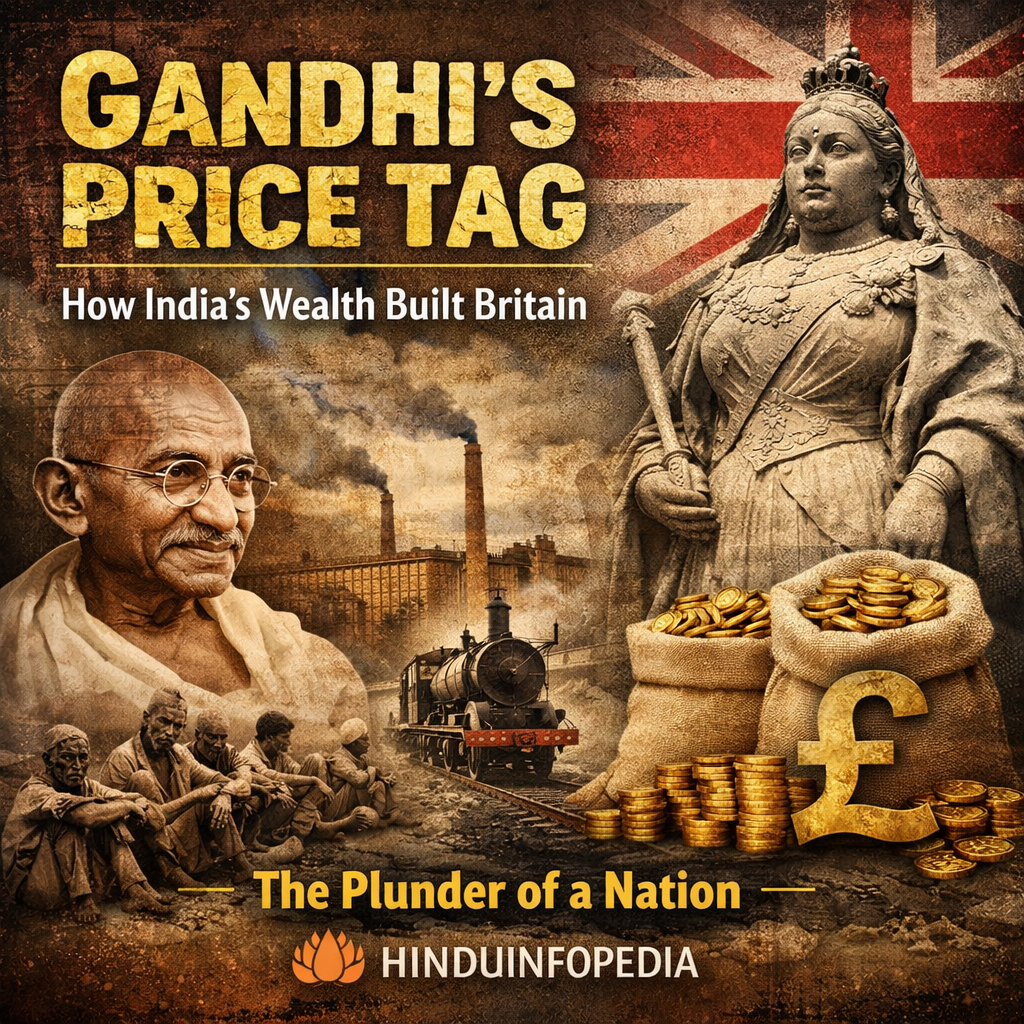
Gandhi’s Price Tag: £9.2 Trillion and a Life Expectancy of 27 (14)
भारत / GB
Part 14: Mahatma Gandhi’s Peace Efforts | Series Index
The previous post documented the machine — five interlocking components that transferred wealth from India to Britain continuously for 190 years. This post prices it. Not in pounds. In people.
The Question Nobody Asked at the Time
When the East India Company arrived in India in 1600, Gandhi’s Price Tag had not yet begun to accumulate. India accounted for approximately 23% of the world’s economy — as large as all of Europe combined. When Britain departed in 1947, that share had fallen to just over 3%.
Thank you for reading this post, don't forget to subscribe!Gandhi’s Price Tag asks the question that was not asked in the negotiating rooms of 1930 and 1931: what did 163 years of Gandhi’s Extraction Machine actually cost? Not in abstract economic terms. In human terms. In the numbers that a population carries in its body — how long it lives, whether it can read, whether it eats.
The answer exists. It has been calculated. And it is unrepayable.
The Action Taken: Colonial fiscal extractions prioritized imperial debt service and military charges over domestic public health, sanitation, and famine prevention.
Who Paid the Price: Four generations of Indian citizens who lived under conditions resulting in 16% literacy, chronic famine vulnerability, and a 27-year life expectancy.
The Alternative Bypassed: Statutory social infrastructure spending and famine insurance funds.
Why This Matters: Places before the reader the acute human stakes of the independence struggle, establishing why tactical suspensions and token truces came at immense human cost.
The Methodology — How the Number Was Arrived At
Professor Utsa Patnaik of Jawaharlal Nehru University — in research published by Columbia University Press in 2018 — spent five decades working toward a single figure. Her methodology used India’s merchandise export surplus as the measure of extraction, tracking it across four distinct periods from 1765 to 1938, and compounding the total at a conservative 5% interest rate from the midpoint of each period to 2016.
The figure she arrived at: £9,184 billion — approximately $45 trillion at 2018 exchange rates.
To place that number in context: it is 17 times the entire annual GDP of the United Kingdom today. It is more than the combined annual GDP of every country on earth. There is not enough money in Britain — there has never been enough money in Britain — to repay what Patnaik’s methodology documents was taken.
Shashi Tharoor, in An Era of Darkness (2017), cited an independent calculation by analyst Minhaz Merchant that arrived at a conservative figure of £3 trillion in today’s money — and noted that even this lower estimate exceeded Britain’s entire GDP in 2015. Tharoor’s own position was that financial reparation was impossible — not because the debt did not exist, but because no sum Britain could pay would be large enough to constitute it.
The methodology has critics. Tirthankar Roy of the London School of Economics argues that the drain was more modest — approximately 0.9 to 1.3% of Indian national income from 1868 to the 1930s by his estimate. The debate among economists is genuine. What is not in dispute is the direction of the flow, the mechanism through which it operated, and the human condition in which it left India.
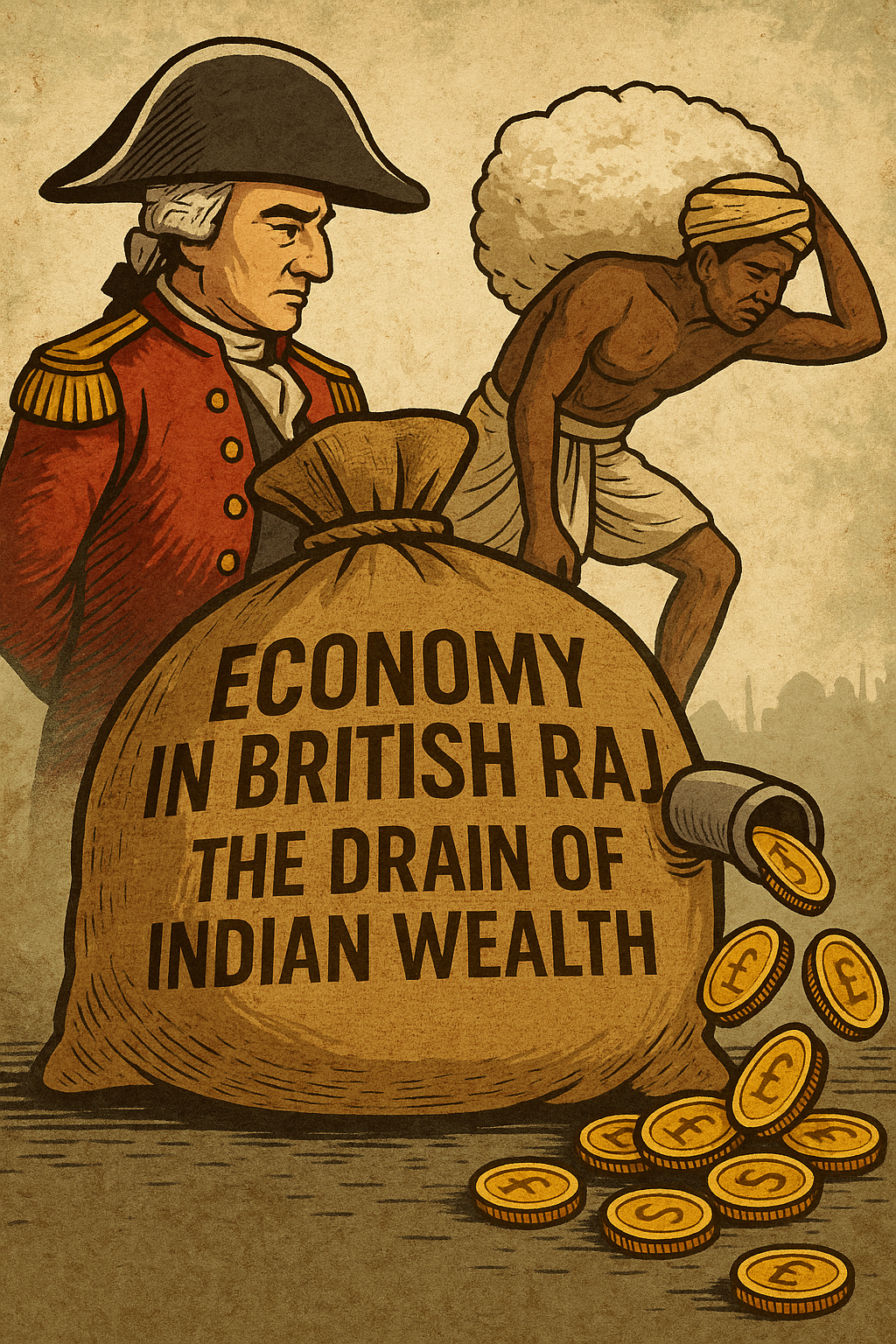
The Divergence — Two Economies, One Machine
Gandhi’s Price Tag is most clearly visible not in a single number but in a comparison. Between 1757 — the year the Battle of Plassey gave Britain control of Bengal — and 1900, two economies moved in opposite directions.
British per capita GDP grew by 347%.
Indian per capita GDP grew by 14%.
The following video illustrates how Indian resources were systematically extracted to fuel the growth of the East India Company, the British Raj, and ultimately the United Kingdom.
The video captures the process; the following analysis explains the mechanism behind it. This divergence was not the product of different natural endowments, different climates, or different levels of intelligence. Britain in 1700 had a smaller share of world GDP than India. Britain’s industrialisation — its mills, its railways, its financial system, its global trade network — was built during the same period that India’s manufacturing base was being systematically destroyed.
The East India Company chairman told the British Parliament in 1840 that the Company had succeeded in converting India from a manufacturing country into a country exporting raw produce. He said it as a statement of achievement. What he was describing was the deliberate destruction of the world’s most sophisticated textile industry — the industry that had given English the word muslin, from Mosul, and calico, from Calicut — to create a captive market for Lancashire’s mills.
India’s share of global industrial output: 25% in 1750. 2% in 1900. The mills of Lancashire rose as the looms of Dhaka fell.
The Human Cost — What the Numbers Meant in Bodies
Life Expectancy: 27 Years
When Britain departed India in 1947, the average Indian life expectancy at birth was 27 years. Tharoor documents this in An Era of Darkness as one of the defining measures of what 190 years of extraction had produced. A country that had been the world’s largest economy in 1700 had, by 1947, produced a population that died before it turned 30 on average.
In 1911 — the midpoint of Gandhi’s political career — Indian life expectancy at birth was 22 years. Professor Patnaik noted during her research interviews that people of India were dying like flies from malnutrition and disease while their wealth was being systematically transferred to Britain.
Literacy: 16%
Britain left India with a literacy rate of 16% — 8% for women. Tharoor describes this as “not exactly a stellar record” for a power that justified its presence partly on the grounds of civilisational uplift. The colonial administration had deliberately neglected primary education — channelling Indian tax revenue to Home Charges, military expenditure, and administrative salaries rather than schools. India had been the source of some of the world’s most advanced mathematics, astronomy, medicine, and philosophy. It left British rule with 84% of its population unable to read.
Poverty: 90%
At independence, 90% of India’s population lived below what would today be recognised as the international poverty line.
Per capita annual food consumption — a basic measure of subsistence — had fallen from 200 kilograms in 1900 to 137 kilograms by 1946.
This decline occurred during a period in which India was running a trade surplus with the rest of the world. India was exporting food while its own population was eating less of it each year. The export earnings from that food were going to London through the Council Bills system.
In the years 1891 to 1900 alone, 17 million Indians died of hunger. Colonial policies repeatedly turned scarcity into mass starvation. The Bengal Famine of 1943 killed approximately 4 million people — during which Winston Churchill, as Tharoor documents, deliberately ordered the diversion of food from starving Indian civilians to well-supplied British soldiers and European stockpiles, remarking that the suffering of “anyway underfed Bengalis” was less serious than that of “sturdy Greeks.”

What the Machine Produced for Britain
Gandhi’s Price Tag runs in both directions. What it cost India, it paid to Britain.
Britain’s Industrial Revolution — its cotton mills, its railways, its financial expansion, its global commercial network — was built during the same 190-year period in which India was being converted from the world’s largest manufacturer into a raw material supplier. Their war machine was fueled from Indian loot. Tharoor states the relationship directly: India was governed for the benefit of Britain. Britain’s rise for 200 years was financed by its depredations in India.
The connection is not rhetorical. It is structural. Lancashire’s mills required Indian cotton and Indian markets. British railways required Indian capital and Indian labour. British banks required Indian trade flows. The City of London’s financial supremacy in the nineteenth century was built, in significant part, on the management and investment of Indian revenues. The Council Bills system kept Indian foreign exchange earnings flowing through London rather than accruing to Indian producers — giving British financial institutions the capital they used to fund their own expansion.
India was not incidentally part of the British economic story. India was its foundation.
Gandhi’s 11 Points were designed to break the chases of the British Extraction Machine. He didn’t ask for schools in 1930 because you cannot teach a starving child, and you cannot fund education with an extracted economy.
The Taxation Burden — British Admission
Gandhi’s Price Tag is not constructed only from nationalist historians. The British acknowledged it themselves.
British colonial officials estimated that taxation in India was two to three times higher than it had ever been under any previous ruler — and higher than anywhere else in the world. The British economist George Wingate wrote in the 1830s: “The tribute paid to Great Britain is by far the most objectionable feature in our existing policy.” An Indian’s tax burden under colonial rule was, by Naoroji’s calculation, nearly twice that of an Englishman in England — for a fraction of the income and none of the political representation.
Gandhi’s letter to Irwin in 1930 made this viscerally specific — the Viceroy earning Rs. 700 per day against India’s average income of less than two annas. The most expensive civil administration in the world, financed by the world’s most heavily taxed population.
The Cost That Cannot Be Paid
£9.2 trillion. £3 trillion on the most conservative estimate. Either figure exceeds Britain’s capacity to repay. Tharoor acknowledged this explicitly — which is why he asked only for a symbolic £1 per year for 200 years and an apology. Not because the debt was small. Because no number that could be written on a cheque was large enough to constitute it.
The machine that produced this number was the apparatus Gandhi’s eleven demands were aimed at in January 1930. The next post maps each demand against the specific component it would have switched off.
Reflections and Conclusions
The divergence was not accidental. It was engineered—sustained by policy, enforced by power, and paid for by India in wealth, health, and knowledge. Mahatma Gandhi’s eleven demands targeted this machine at its core. But dismantling extraction was only the first step; rebuilding what it hollowed out was the unfinished task.
Call to Action
If this analysis changes how you see India’s economic past, share it.
Read the next part to see how each of Gandhi’s eleven demands mapped directly onto the mechanisms of extraction—and what they were meant to shut down.
£9.2 trillion extracted. 27-year life expectancy left behind. 16% literacy. 90% poverty. The machine ran for 190 years. Gandhi’s eleven demands were a switch — one demand per component. The next post turns on the lights.
Feature Image: Click here to view the image.
Video
Glossary of Terms
- East India Company: A British trading corporation established in sixteen hundred that gradually gained political and economic control over large parts of India.
- Battle of Plassey: A decisive military engagement in seventeen fifty seven that marked the beginning of British political dominance in India.
- Colonial Extraction: The systematic transfer of wealth and resources from India to Britain during colonial rule through trade, taxation, and financial mechanisms.
- Deindustrialisation of India: The deliberate decline of India’s traditional manufacturing sectors, especially textiles, under British policies.
- Utsa Patnaik: An Indian economist known for estimating the scale of wealth transferred from India to Britain during colonial rule.
- Drain of Wealth Theory: An economic concept explaining how India’s resources were continuously transferred to Britain without adequate returns.
- Shashi Tharoor: An Indian author and politician who has written extensively on the economic and human impact of British rule in India.
- Per Capita Income: The average income earned per person, used to compare economic performance across regions or periods.
- Industrial Revolution (Britain): A period of rapid industrial growth in Britain during the eighteenth and nineteenth centuries, fueled partly by colonial resources.
- Dhaka Muslin Industry: A highly advanced textile industry in Bengal that declined sharply under British economic policies.
- Bengal Famine of 1943: A major famine during British rule that led to the deaths of millions due to food shortages and policy failures.
- Council Bills System: A financial mechanism used by the British to transfer Indian export earnings to Britain without direct payment to Indian producers.
- Home Charges: Expenses charged by Britain to India for administrative and military costs, paid using Indian revenues.
- Life Expectancy: The average number of years a person is expected to live, used as a key indicator of public health conditions.
- Mahatma Gandhi’s Eleven Demands: A set of demands presented in nineteen thirty aimed at addressing key aspects of British economic and administrative control in India.
#Gandhi #BritishRaj #IndiaHistory #ColonialIndia #EconomicHistory #WealthDrain #BengalFamine #HinduinfoPedia
Visual Presentation of World Economic Trends
Scan Through The Entire Series at
Gandhi’s Peace Efforts: The Questions Before the Mahatma (0)
Refer to Various Arks Referred to in the Blog
Follow us:
- English YouTube: https://www.youtube.com/@Hinduofficialstation
- Hindi YouTube: https://www.youtube.com/@HinduinfopediaIn
- X: https://x.com/HinduInfopedia
- Instagram: https://www.instagram.com/hinduinfopedia/
- Facebook: https://www.facebook.com/Hinduinfopediaofficial
- Threads: https://www.threads.com/@hinduinfopedia