
Gandhi’s Misfortune: The Man Gandhi Lost and the Words Gandhi Used to Name It (98)
भारत / GB
Part 98: Mahatma Gandhi’s Peace Efforts | Series Index
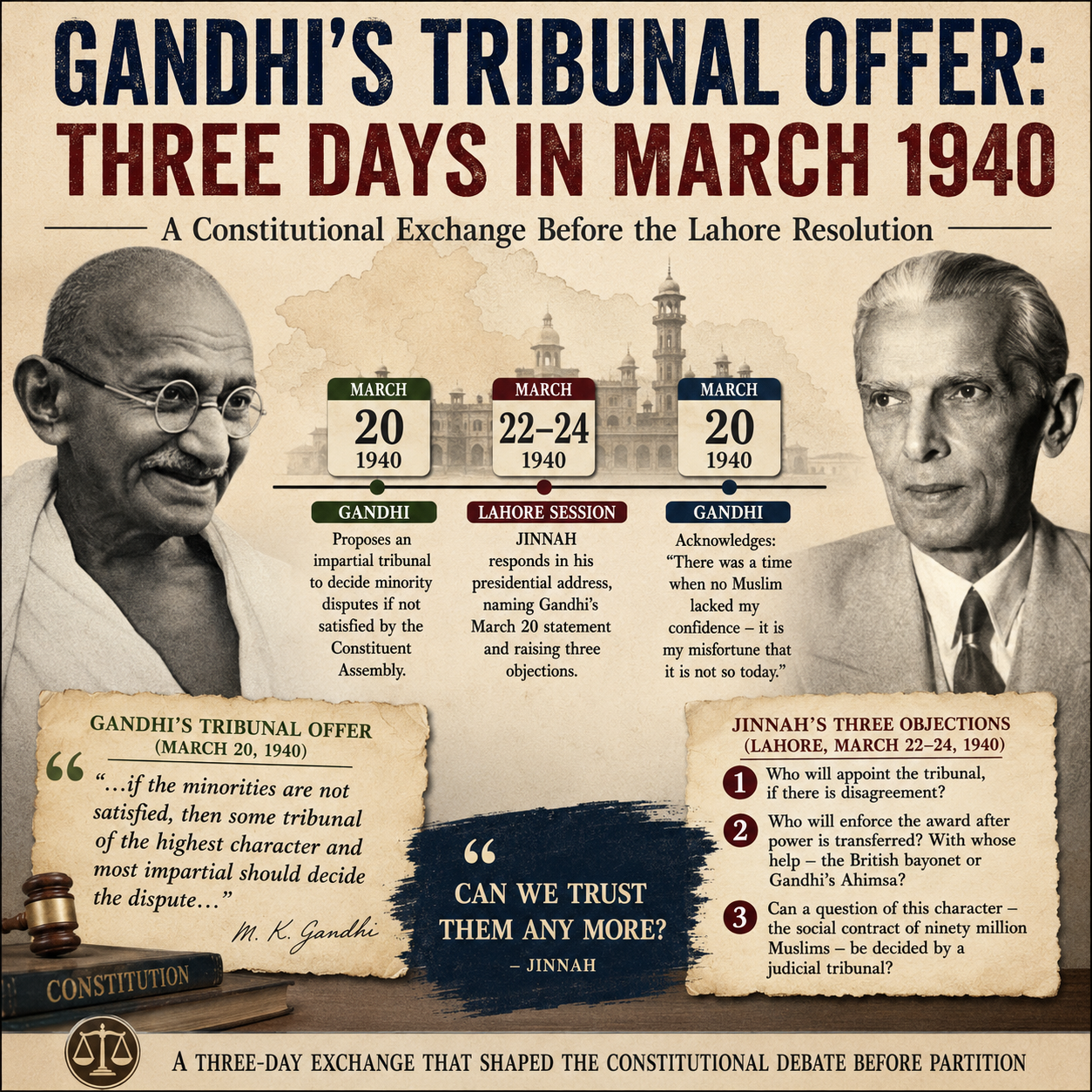
Blog 97 documented the three-day exchange between Gandhi’s March 20 1940 tribunal offer and Jinnah’s Lahore response. This post isolates Gandhi’s own self-assessment from that same March 20 statement and places it beside the documented profile of the man whose confidence Gandhi named as lost.
Thank you for reading this post, don't forget to subscribe!The Action Taken: Gandhi visited Jinnah’s residence in Bombay for fourteen consecutive days of private bilateral talks, addressing Jinnah as “Quaid-i-Azam” and negotiating directly on the basis of the C.R. formula.
Who Paid the Price: Nationalist non-League Muslims and secular leaders, whose political authority was undercut by the bilateral acknowledgment of Jinnah as sole spokesman.
The Alternative Bypassed: Engaging the broad spectrum of Muslim political formations (Unionist Party in Punjab, Khudai Khidmatgars, Jamiat Ulema-e-Hind) to prevent League hegemony.
Why This Matters: Bilateral legitimacy conferred: fourteen days of talks elevated Jinnah into an undisputed equal interlocutor, cementing the Muslim League’s monopoly over minority representation.
Gandhi’s Own Words — March 20 1940
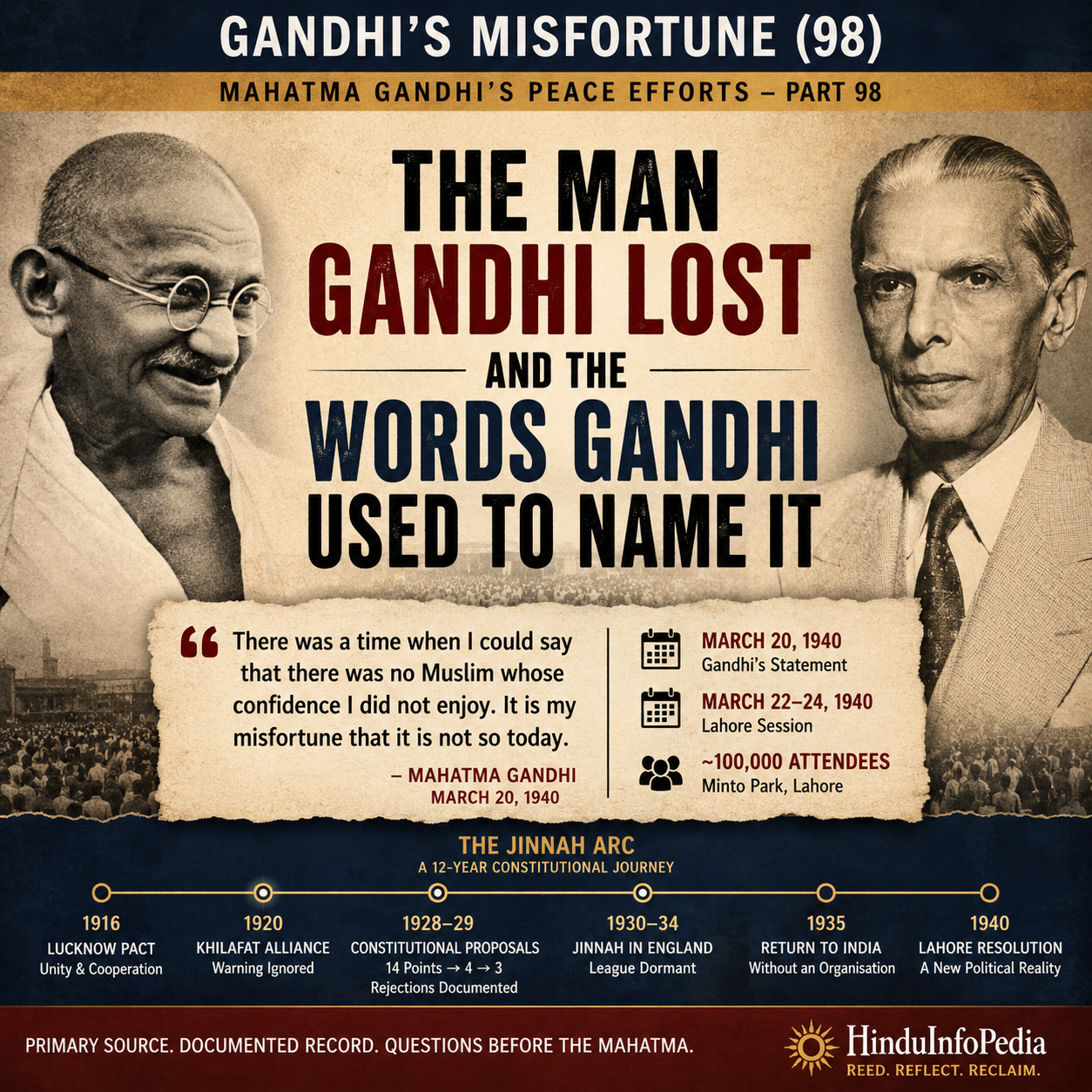
Gandhi’s Misfortune places the primary source before the reader at the outset. Gandhi’s March 20 1940 statement, quoted verbatim by Jinnah in his Lahore presidential address and preserved at franpritchett.com:
“There was a time when I could say that there was no Muslim whose confidence I did not enjoy. It is my misfortune that it is not so today.”
These are Gandhi’s own documented words, placed on record three days before the Lahore Resolution. The series does not paraphrase them. It places them before the reader as written.
The Documented Profile of the Man Gandhi Lost
Gandhi’s Misfortune places Jinnah’s documented profile before the reader alongside Gandhi’s words — not as characterisation, but as documented historical record.
Muhammad Ali Jinnah was primarily a barrister. His income and professional time through the 1920s were overwhelmingly in law, not politics. He was not a product of mass mobilisation or religious revivalism. Contemporary accounts describe him as a man who ate pork, drank wine, wore Western suits, and spoke better English than Urdu. His grip on Muslim political identity came not from religious credentials but from constitutional standing — he was the man who had built the Lucknow Pact of 1916, who had been called the Ambassador of Hindu-Muslim Unity by Sarojini Naidu, and who had sought to secure Muslim constitutional protections within a united India across three documented rounds of negotiation spanning twelve years. These are not contested characterisations — they are the documented profile of the man Gandhi named in his own March 20 1940 words.
In 1930, Jinnah left for England — partly to practise at the Privy Council, partly in documented disillusionment after the Calcutta rejection of 1928. The All-India Muslim League during his absence became dormant to the point where contemporaries wrote it off entirely. He returned in 1935 at the age of fifty-eight, without a mass organisation, without a provincial government, without rural roots, without a religious following. He had, in short, almost nothing. What he carried back was a documented position — that Muslim constitutional protections were necessary within any Indian framework — that had been rejected at Calcutta in 1928 and had produced, in his own documented words, the parting of the ways. The series’ documented record of what followed that return — Blogs 86 through 93 — is available to the reader.
By March 1940 — five years after returning with nothing — he had mobilised the Muslim premiers of Punjab, Bengal, Sindh, and Assam behind the Lahore Resolution. One hundred thousand people attended the Minto Park session on March 22-24 1940.
What the Documented Sequence Establishes
Gandhi’s Misfortune places the documented chain before the reader in full.
1920 — Jinnah told Gandhi at Nagpur that the Khilafat alliance was a mistake. Gandhi proceeded.
1928-1929 — Jinnah reduced his demands to fourteen points, then to four, then to three. Each reduction documented, each rejection documented, across Blogs 81 through 85.
1930-1934 — Jinnah in England. The League dormant.
1935 — Jinnah returned with nothing.
1937-1939 — Congress governed eight provinces. The documented coalition terms, Mass Contact Programme, and broken assurance followed — Blogs 86 through 93.
1940, March 20 — Gandhi’s own words: it is my misfortune.
Gandhi’s Misfortune places one question before the reader, drawn from this documented chain: this was the profile of the man whose confidence Gandhi acknowledged losing. Not a mass politician. Not a religious mobiliser. A constitutional lawyer who had tried every documented route within a united India, been rejected at each, and returned from four years of absence with no organisational base — and by 1940 stood at Lahore before one hundred thousand people. Gandhi’s own words named the outcome. The documented profile of the man names what that outcome required to produce.
The Prosecution’s Position
Gandhi’s Misfortune places three questions before the reader.
- Did Gandhi’s own documented words of March 20 1940 name the loss of Muslim confidence as his misfortune — placing it on the record as Gandhi’s own self-assessment, not the series’ characterisation?
- Does the documented profile of the man whose confidence was lost — a constitutional moderate, part-time in politics, absent from India 1930-1934, returning with nothing in 1935 — establish something about what it required to produce that documented outcome?
- Does the documented chain from 1920 through 1940 — placed across Blogs 80 through 97 — give the reader the specific documented context within which Gandhi’s own self-assessment can be weighed?
The series does not answer. Gandhi’s own words are the primary source — quoted verbatim by Jinnah in the primary source at franpritchett.com. The documented Jinnah profile is the historical record. The reader will place both beside the documented chain, assembled across Blogs 80 through 97, and complete the sentence.
Invitation To Defence
The floor belongs to the defense. We now invite them to present their exhibits and challenge the narrative established by the prosecution.
March 20 1940. Gandhi’s own words: there was a time when no Muslim lacked my confidence — it is my misfortune that it is not so today. The man whose confidence was lost: a constitutional lawyer, absent from India for four years, returning in 1935 with nothing, standing before one hundred thousand people at Lahore in 1940. The prosecution places Gandhi’s own self-assessment beside the documented profile of the man he named. The reader will complete the sentence.
Feature Image: Click here to view the image.
Videos
Glossary of Terms
- Gandhi’s Misfortune: A unique thematic phrase coined in this series to describe Mahatma Gandhi’s self-acknowledged loss of complete trust and political consensus among the Muslim community by 1940.
- Ambassador of Hindu-Muslim Unity: A historical title conferred upon Muhammad Ali Jinnah by Congress leader Sarojini Naidu following his pivotal role in orchestrating the Lucknow Pact of 1916.
- Lucknow Pact of 1916: A historic constitutional agreement between the Indian National Congress and the All-India Muslim League establishing joint electoral demands and separate electorates for Muslims.
- Calcutta Rejection of 1928: The definitive political turning point at the All-Parties Conference in Calcutta where the amendments proposed by Jinnah to the Nehru Report were flatly voted down by the Congress majority.
- Parting of the Ways: A historical phrase used by Jinnah after the 1928 Calcutta conference to denote the irreconcilable break between his constitutional efforts for a united India and the Congress leadership.
- Privy Council: The highest court of appeal for the British Empire, located in London, where Jinnah built a highly lucrative legal practice during his self-imposed political exile from India between 1930 and 1934.
- Lahore Resolution: A momentous political declaration adopted by the All-India Muslim League during its three-day session in March 1940, demanding independent sovereign states for Muslims in the northwestern and eastern zones of British India.
- Minto Park: The historical venue in Lahore, Punjab (now Greater Iqbal Park) where the All-India Muslim League held its landmark general session from March 22 to March 24, 1940.
- Khilafat Alliance: A political coalition formed in 1920 when Mahatma Gandhi linked the Indian non-cooperation movement with the pan-Islamic Khilafat agitation, a strategy Jinnah strongly warned against at the Nagpur Congress.
- Fourteen Points: A comprehensive series of constitutional reforms proposed by Jinnah in 1929 as a minimum baseline to safeguard Muslim rights within any future federal Indian constitution.
- Mass Contact Programme: An aggressive grassroots mobilization initiative launched by the Congress party between 1937 and 1939 aimed at appealing directly to Muslim voters over the heads of the Muslim League.
- Tribunal Offer: A specific compromise proposal made by Mahatma Gandhi on March 20, 1940, suggesting that an impartial international tribunal decide outstanding Hindu-Muslim constitutional disputes rather than relying on British arbitration.
- GB: An abbreviation used within this blog series to represent Great Britain, denoting the imperial constitutional framework within which pre-independence negotiations took place.
#Gandhi #Jinnah #LahoreResolution #History #MuslimLeague #Congress #India #HinduinfoPedia
Gandhi’s Peace Efforts: The Questions Before the Mahatma (0)