
Gandhi’s Calcutta Vote: Four Amendments, Four Rejections (84)
भारत / GB
Part 84: Mahatma Gandhi’s Peace Efforts | Series Index
Blog 83 documented the Nehru Report’s reversal of Madras 1927 agreements and its rejection of Muslim constitutional protections. This post examines the specific documented moment when Jinnah reduced his demands to four minimum provisions and put them to a formal vote at the All Parties Conference in Calcutta, December 1928.
Thank you for reading this post, don't forget to subscribe!The Action Taken: In direct response to the rejection at Calcutta, Jinnah drafted the Fourteen Points, crystallizing separate electorates, provincial autonomy, and minority vetoes into non-negotiable demands.
Who Paid the Price: The possibility of a unified, secular federal state, as minority politics hardened into institutional separatism.
The Alternative Bypassed: Joint electorates with weighted legislative reservations as proposed in earlier cross-party discussions.
Why This Matters: The structural foundation of Pakistan: the rejection of moderate compromise in 1928 institutionalized the constitutional blueprint that culminated in the 1940 partition resolution.
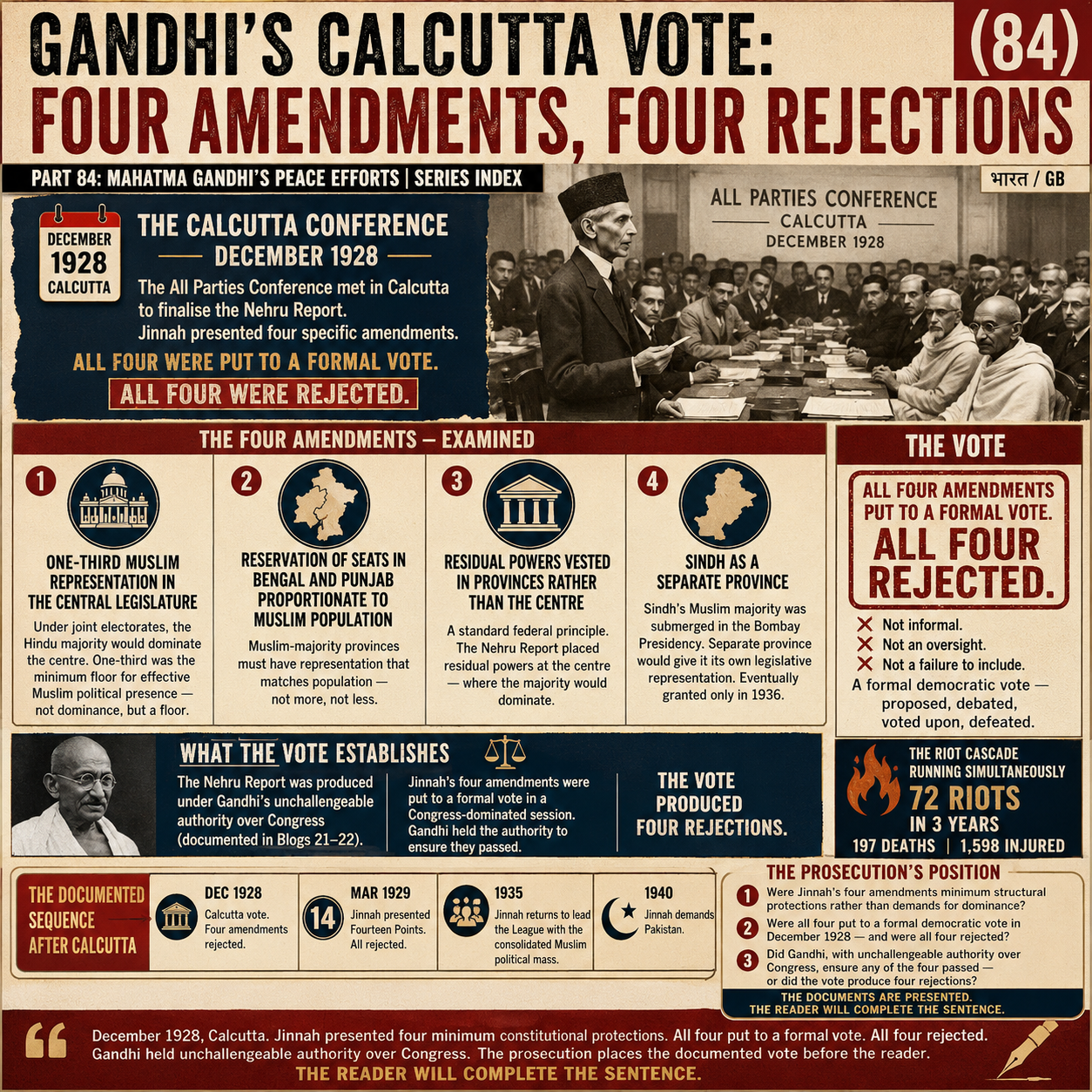
The Calcutta Conference — December 1928
The All Parties Conference convened in Calcutta in December 1928 to finalise the Nehru Report. Jinnah attended as the representative of the Muslim League. He presented four specific amendments to the report.
Gandhi’s Calcutta Vote places the four amendments before the reader precisely — not as broad demands but as the minimum constitutional floor Jinnah identified as necessary for Muslim political participation in a united independent India.
The Four Amendments — Examined
Amendment One — One-third Muslim representation in the central legislature:
The documented context: the central legislature under the Nehru Report’s joint electorate system would reflect the Hindu numerical majority. Jinnah’s one-third reservation was the minimum below which Muslim political presence at the national level would become symbolic rather than operational. It was not a demand for Muslim dominance — it was a floor.
Amendment Two — Reservation of seats in Bengal and Punjab proportionate to Muslim population:
Bengal and Punjab were Muslim-majority provinces. The Nehru Report’s framework, without population-proportionate reservation, risked producing legislative outcomes that did not reflect the demographic reality of these provinces. Jinnah asked that representation match population — not that it exceed it.
Amendment Three — Residual powers vested in provinces rather than the centre:
The Nehru Report placed residual constitutional powers at the centre — where the Hindu majority would dominate. Jinnah asked that powers not explicitly granted to the centre revert to the provinces. This is a standard federal constitutional arrangement. It was also the arrangement Congress had agreed to at Madras in 1927.
Amendment Four — Sindh as a separate province:
Sindh was administratively part of the Bombay Presidency. Its Muslim majority was submerged within a Hindu-majority administrative unit. A separate Sindh province would give the Muslim majority of Sindh its own legislative representation. Notably, Sindh was eventually made a separate province — but only in 1936, after the Government of India Act 1935, and after the constitutional framework Jinnah had sought to build within had already collapsed.
The Vote
All four amendments were put to a formal vote at the Calcutta session of the All Parties Conference in December 1928.
All four were rejected.
Gandhi’s Calcutta Vote places this documented fact before the reader with precision. The rejection was not informal, not a failure to include provisions in a draft, not an oversight. It was a formal democratic vote in a Congress-dominated session — amendments proposed, debated, voted upon, defeated. One procedural provision proposed by Jinnah was accepted. Zero substantive protection provisions passed.
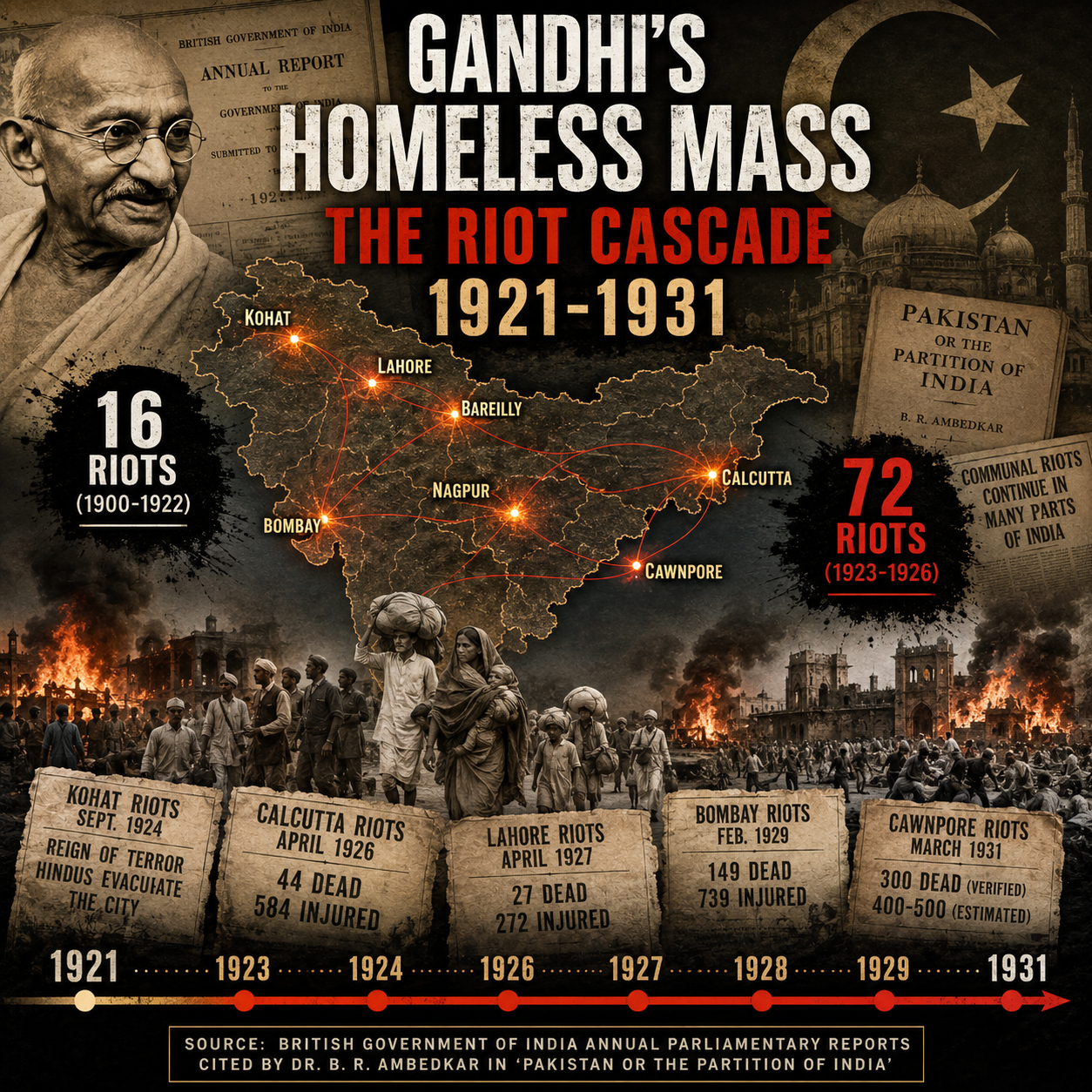
The riot cascade documented in Blog 80 was running at its peak simultaneously — 40 riots in the twelve months surrounding this vote, 197 deaths, 1,598 injuries. The consolidated Muslim political identity Gandhi had built through the Khilafat experiment was politically homeless. Jinnah asked for four minimum protections at Calcutta. The Congress-dominated session rejected all four.
The Lebanon parallel documented in Blog 83 is relevant here. Lebanon’s National Pact of 1943 crafted structural protections for minority communities in a divided society — and maintained peace for decades. The Calcutta vote rejected the Indian equivalent. The structural middle path was available. The documented vote shows it was not taken. The rejection was not informal. It was not a failure to include provisions in a draft. It was a formal democratic vote — amendments proposed, debated, voted upon, defeated.
What the Vote Establishes
Gandhi’s Calcutta Vote places one documented structural observation before the reader.
The Nehru Report was produced under Gandhi’s unchallengeable authority over Congress — documented across Blogs 21–22. The four amendments Jinnah presented at Calcutta were put to a formal vote in a Congress-dominated session. Gandhi held the authority to ensure those amendments passed. The vote produced four rejections.
The documented sequence following the Calcutta vote: Jinnah returned to the Shafi faction of the Muslim League and in March 1929 presented fourteen points — all rejected, as documented in Blog 81. In 1935 Jinnah returned to lead the League with the consolidated Muslim political mass Gandhi’s Khilafat experiment had built. In 1940 he demanded Pakistan. Gandhi’s Calcutta Vote places the December 1928 rejection at the centre of that documented sequence — the specific moment when four minimum protections were voted down.
The Prosecution’s Position
Gandhi’s Calcutta Vote places three questions before the reader — each answerable from the documented proceedings.
- Were Jinnah’s four amendments — one-third central representation, population-proportionate seats in Bengal and Punjab, residual powers in provinces, Sindh as separate province — minimum structural protections rather than aggressive demands for Muslim dominance?
- Were all four put to a formal democratic vote at the Calcutta All Parties Conference in December 1928 — and were all four rejected?
- Did Gandhi, who held documented unchallengeable authority over Congress, deploy that authority to ensure any of the four minimum protections passed — or did the vote produce four rejections under that authority?
Gandhi’s Calcutta Vote does not answer. The four amendments are documented. The vote is documented. Gandhi’s authority over Congress is documented across Blogs 21–22. The reader will examine all three and complete the sentence.
December 1928, Calcutta. Jinnah presented four minimum constitutional protections. One-third central representation. Population-proportionate seats in Bengal and Punjab. Residual powers in provinces. Sindh as separate province. All four put to a formal vote. All four rejected. Gandhi held unchallengeable authority over Congress. The prosecution places the documented vote before the reader. The reader will complete the sentence.
Feature Image: Click here to view the image.
Videos
Glossary of Terms
- All Parties Conference: A series of meetings involving major political organizations of British India, convened to discuss constitutional reforms and formulate a common political framework.
- Nehru Report: A constitutional proposal drafted in 1928 under the leadership of Motilal Nehru, outlining a framework for self-government in India and advocating joint electorates.
- Joint Electorate: An electoral system in which all voters participate in the same election regardless of religious or community affiliation.
- Central Legislature: The national law-making body proposed under constitutional reforms for British India.
- One-Third Representation: Jinnah’s proposal that Muslims should hold one-third of the seats in the central legislature as a minimum safeguard for political participation.
- Population-Proportionate Representation: A principle whereby legislative seats are allocated according to the demographic share of a community within a province.
- Residual Powers: Constitutional powers not specifically assigned to the central government or provinces, determining the balance of authority within a federal system.
- Federal Constitutional Arrangement: A system of governance in which powers are divided between a central authority and regional governments.
- Sindh Separation Proposal: The demand that Sindh be removed from the Bombay Presidency and constituted as a separate province to reflect its demographic composition.
- Bombay Presidency: A major administrative division of British India that included present-day Maharashtra, parts of Gujarat, and Sindh before 1936.
- Congress-Dominated Session: A political gathering in which the Indian National Congress exercised predominant influence over discussions and voting outcomes.
- Calcutta Vote: The formal December 1928 vote at the All Parties Conference in which Jinnah’s four constitutional amendments were debated and rejected.
- Four Amendments: The four constitutional proposals presented by Jinnah at Calcutta concerning central representation, provincial representation, residual powers, and Sindh’s provincial status.
- Fourteen Points: The constitutional demands presented by Jinnah in March 1929 following the rejection of the Calcutta amendments, outlining safeguards for Muslim political rights.
- Gandhi’s Calcutta Vote: The key phrase of this article, referring to the December 1928 conference vote conducted under the broader political influence of Gandhi and the Congress leadership.
#Gandhi #Jinnah #History #Congress #India #Politics #Partition #Constitution #Calcutta #HinduinfoPedia
Gandhi’s Peace Efforts: The Questions Before the Mahatma (0)
Refer to Various Arks Referred to in the Blog
Gandhi’s Calcutta Vote: Four Amendments, Four Rejections (84)