
Gandhi’s Ahmedabad Resolution: The Session That Diluted, Justified, and Blamed (70)
भारत / GB
Part 70: Mahatma Gandhi’s Peace Efforts | Series Index
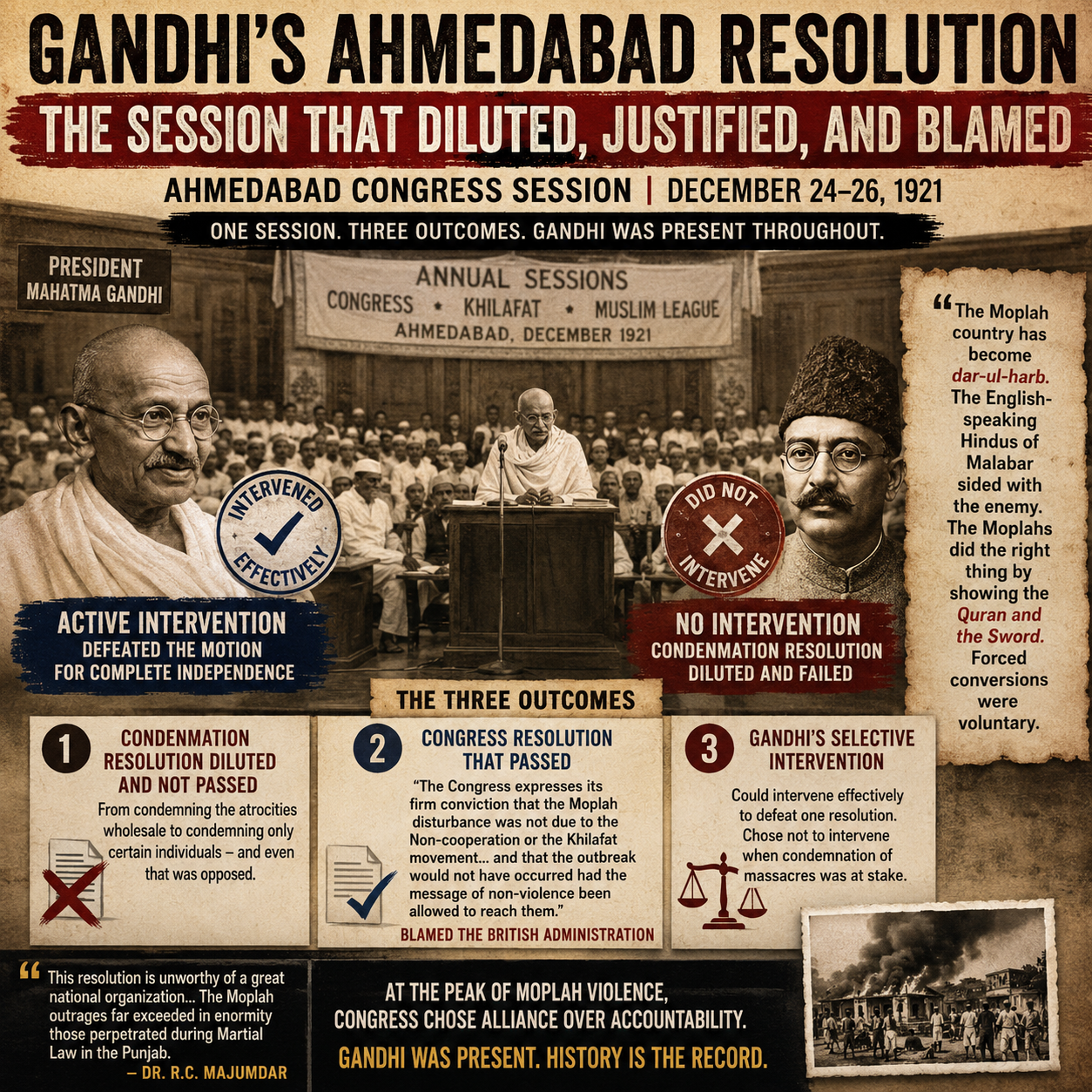
Blog 69 documented Gandhi’s removal of verbal condemnation as the test of Muslim friendship — and what the Khilafat leadership did instead. This post examines one documented session precisely: the Ahmedabad Congress December 1921, in the maddest or almost peak of Moplah riots against the Hindus, presiding authority and dictatorship of the session was held by Mahatma Gandhi, where three things occurred simultaneously — a condemnation resolution was diluted to nothing, Hasrat Mohani justified the massacre, and the Congress formally blamed the British. Gandhi was present throughout.
Thank you for reading this post, don't forget to subscribe!The Action Taken: The Republic of Turkey formally abolished the Ottoman Caliphate and expelled the Caliph, unilaterally terminating the theological institution around which Gandhi had organized Indian mass politics.
Who Paid the Price: Indian national cohesion, which was left with an entrenched clerical political infrastructure after the international objective had vanished.
The Alternative Bypassed: Anchoring mass political campaigns strictly in domestic constitutional self-determination rather than foreign theological structures.
Why This Matters: The collapse of the external premise: the Caliphate was dismantled by Turkish secular nationalists, exposing the folly of mortgaging Indian national unity to an empire that the Turks themselves rejected.
The Session — Documented Precisely
Gandhi’s Ahmedabad Resolution begins with what the documentary record establishes about the December 1921 Congress session — a session whose documented outcomes the series places before the reader without characterisation.
The session was held December 24-26, 1921. Gandhi was the acknowledged presiding authority and dictator of the session. The three major independence movements — Congress, Khilafat Conference, and Muslim League — all held their annual sessions in Ahmedabad simultaneously. Gandhi was the acknowledged presiding authority of the Congress session.
At this session, Gandhi actively opposed Hasrat Mohani’s resolution demanding complete independence — rising to argue against it with documented sobriety until it was defeated. Gandhi’s documented conduct at Ahmedabad: active participation, effective intervention, measurable result on the independence question.
The same session produced three documented outcomes on the Moplah question. The prosecution places all three before the reader.
Outcome One — The Condemnation Resolution Diluted
Hindu members moved a resolution at the Ahmedabad session on December 24, 1921 condemning the atrocities committed by the Moplahs on Hindus. What followed is documented in Swami Shraddhananda’s firsthand account, published in The Liberator on August 26, 1926 — and confirmed in multiple historical sources.
The original resolution condemned the Moplahs wholesale for the killing of Hindus, the burning of Hindu homes, and the forcible conversion to Islam. Hindu members themselves proposed amendments until it was reduced to condemning only certain individuals guilty of those crimes. Then Maulana Hasrat Mohani — described by Shraddhananda as an out-and-out Nationalist — opposed even this reduced resolution.
His documented position: the Moplah country had become dar-ul-harb. The English-speaking Hindus of Malabar had sided with the enemy.
Therefore, in his documented words, the Moplahs did the right thing by showing the Quran and the Sword to the Hindus. The forced conversions were, in his position, voluntary.
The condemnation resolution — already diluted from condemning the massacre wholesale to condemning certain individuals — was not passed.
Gandhi was present. Gandhi had demonstrated at the same session that he could intervene effectively to defeat a resolution he opposed — the Mohani independence resolution. He did not deploy that documented capacity on the Moplah condemnation question.
Outcome Two — The Congress Resolution That Passed
The resolution the Ahmedabad Congress did pass on the Moplah question is documented in its precise text. It read:
“The Congress expresses its firm conviction that the Moplah disturbance was not due to the Non-co-operation or the Khilafat movement… and that the outbreak would not have occurred had the message of non-violence been allowed to reach them.”
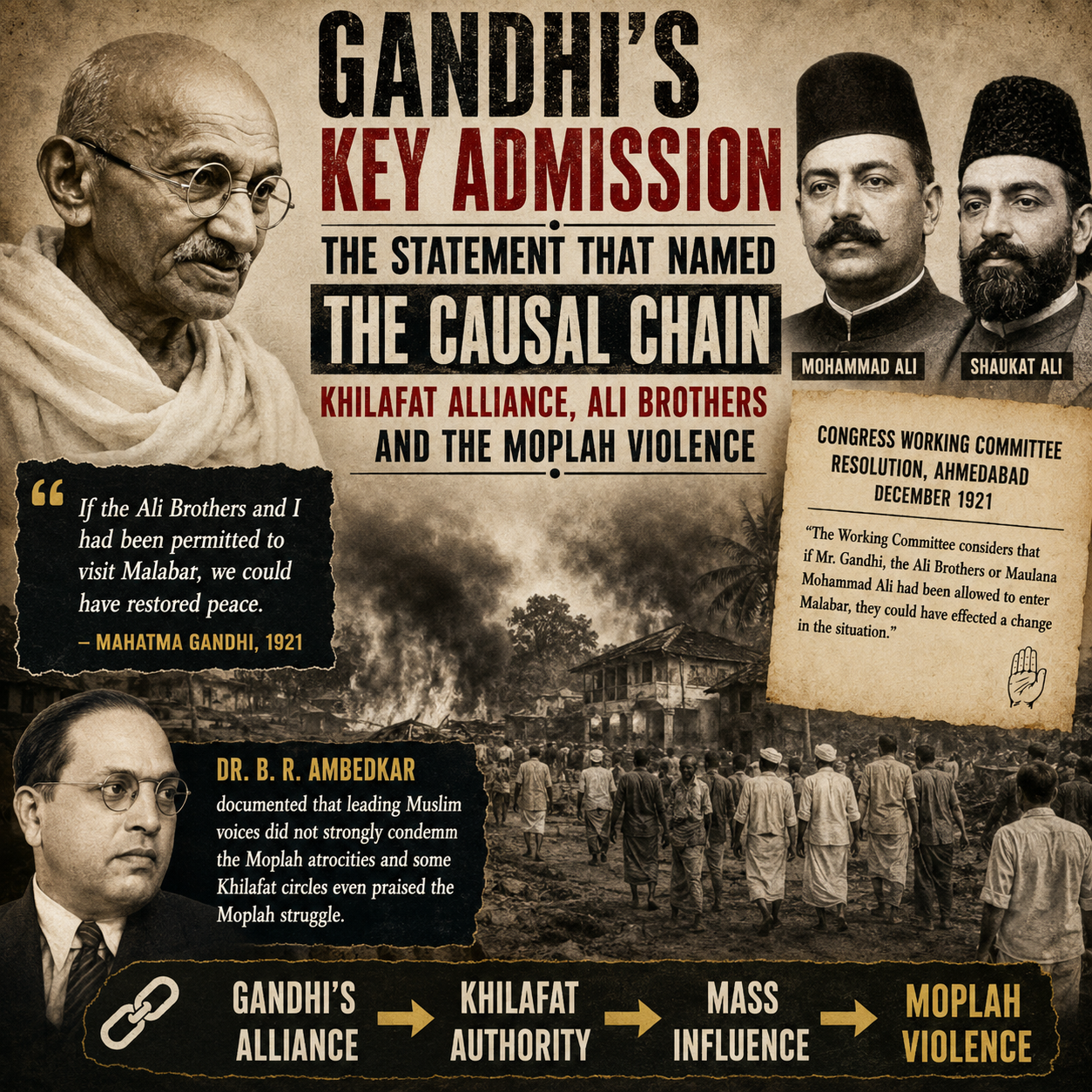
The resolution blamed the British administration for refusing to permit Non-Cooperation leaders to enter Malabar — the same position Gandhi had taken in his personal statements, documented in Blog 63 and Blog 64.
Dr. R.C. Majumdar, the historian, documented his assessment of this resolution: “This resolution is unworthy of a great national organization which launched the Non-co-operation movement as a protest against the Punjab atrocities. The Moplah outrages far exceeded in enormity those perpetrated during Martial Law in the Punjab.”
The resolution that passed at Ahmedabad did not condemn the massacre. It denied the alliance’s role in producing it. It blamed the colonial administration.
Outcome Three — Gandhi’s Selective Intervention
Gandhi’s Ahmedabad Resolution places the prosecution’s most precise single exhibit before the reader—the documented contrast between Gandhi’s two interventions at the same session, on the same day, under the same presiding authority.
1. On the Independence Resolution:
- Gandhi’s Action: Actively rose and argued against the resolution with documented sobriety.
- The Opposing Position: Defeated Maulana Hasrat Mohani’s demand for immediate, complete separation from the British.
- The Result: Resolution Defeated through Gandhi’s direct political intervention.
2. On the Moplah Condemnation Resolution:
- Gandhi’s Action: Present at the session, but remained silent throughout its progressive dilution.
- The Opposing Position: Allowed Maulana Hasrat Mohani’s floor-wide justification of the massacres to stand on the record unchallenged.
- The Result: Resolution Abandoned and never passed.
The prosecution does not assert what Gandhi thought or intended. It places the two documented interventions side by side—one active and effective, one absent—at the same session, on the same day, under the same chairman.
The documented record of the Ahmedabad session establishes one further fact. Gandhi had told Hindus in October 1921 that verbal disapproval from Muslims was not the test of Muslim friendship. At Ahmedabad in December 1921, the Congress under his chairmanship produced exactly that outcome—no verbal disapproval, no condemnation, a resolution that denied the massacre’s causes and blamed the British instead. What Gandhi had said was not the test, the Congress under his chairmanship did not provide. Gandhi’s Ahmedabad Resolution is the documentation of that precise outcome.
The Prosecution’s Position
Gandhi’s Ahmedabad Resolution does not claim Gandhi engineered the dilution of the condemnation resolution. It places the documented session record before the reader — three outcomes, two interventions, one presiding chairman. It places the documented session record before the reader and asks four questions.
- Did Gandhi demonstrate at the Ahmedabad session that he possessed the authority and capability to intervene effectively in Congress proceedings — specifically by defeating Mohani’s independence resolution?
- Did Gandhi deploy that documented authority to ensure the Moplah condemnation resolution was passed — or was his documented conduct at the session silent on that question?
- Did the resolution the Congress passed on the Moplah question deny the Khilafat-Non-Cooperation alliance’s role and blame the British — consistent with Gandhi’s own personal statements documented in Blogs 63 and 64?
- What does it mean that the same session which could not pass a condemnation of the Moplah massacre passed a resolution denying the alliance’s role and blaming the colonial administration?
The series does not answer. The session record is documented. Gandhi’s two interventions at that session are documented. The reader will examine both and complete the sentence.
December 24-26, 1921. Ahmedabad. Gandhi was the acknowledged presiding authority of the session. He rose to oppose Mohani’s independence resolution — and it was defeated. The condemnation resolution for 2,500 Hindu deaths was progressively diluted, Mohani justified the massacre, and it was not passed. The resolution that passed denied the alliance’s role and blamed the British. Gandhi was present throughout. Gandhi’s Ahmedabad Resolution is placed before the reader in its documented form. The reader will examine what the chairman’s selective intervention documents.
Feature Image: Click here to view the image.
Videos
Glossary of Terms
- Ahmedabad Congress Session: The December 24–26, 1921 annual Congress session held in Ahmedabad where debates on the Moplah violence, Khilafat politics, and independence resolutions occurred simultaneously.
- Moplah Massacre: The 1921 violence in Malabar during the Moplah Rebellion involving killings, forced conversions, and attacks on Hindu communities.
- Hasrat Mohani: A nationalist leader and Congress participant who opposed the diluted condemnation resolution on the Moplah atrocities during the Ahmedabad session.
- Dar-ul-Harb: An Islamic juridical term meaning “territory of war,” invoked by Hasrat Mohani during the Ahmedabad debates to justify Moplah actions.
- Non-Cooperation Movement: Mahatma Gandhi’s nationwide anti-British political movement launched in 1920 that aligned Congress with the Khilafat agitation.
- Khilafat Movement: A pan-Islamic political movement in British India seeking preservation of the Ottoman Caliphate after World War I.
- Selective Intervention: A key phrase in this blog series referring to Gandhi’s active intervention against the independence resolution while remaining inactive during the failed condemnation resolution debate.
- Condemnation Resolution: The proposed Congress resolution intended to condemn atrocities committed during the Moplah violence, later diluted and ultimately not passed.
- Congress Resolution on Moplahs: The officially passed Congress position claiming the Moplah disturbance was unrelated to the Non-Cooperation or Khilafat movements and blaming British administration failures.
- Alliance Politics: A recurring series concept describing Congress efforts to preserve Hindu-Muslim political unity during the Khilafat partnership despite communal tensions.
- R.C. Majumdar: Indian historian who criticized the Ahmedabad Congress resolution as morally inadequate compared to Congress reactions to Punjab atrocities.
- Punjab Atrocities: Repressive actions under British martial law in Punjab after the 1919 unrest, frequently referenced by Congress in anti-colonial mobilization.
- Institutional Silence: A series phrase describing situations where political organizations avoided explicit condemnation despite documented violence.
- Documented Session Record: A recurring evidentiary phrase in the series emphasizing reliance on recorded speeches, resolutions, and firsthand accounts rather than inferred motives.
- Moplah Condemnation Debate: The Congress discussion in Ahmedabad over whether and how to officially condemn the Moplah atrocities against Hindus
#Gandhi #Congress #Khilafat #Moplah #Ahmedabad #India #History #Freedom #Hindus #Islam #Colonialism #Politics #MahatmaGandhi #HinduinfoPedia
Gandhi’s Peace Efforts: The Questions Before the Mahatma (0)