
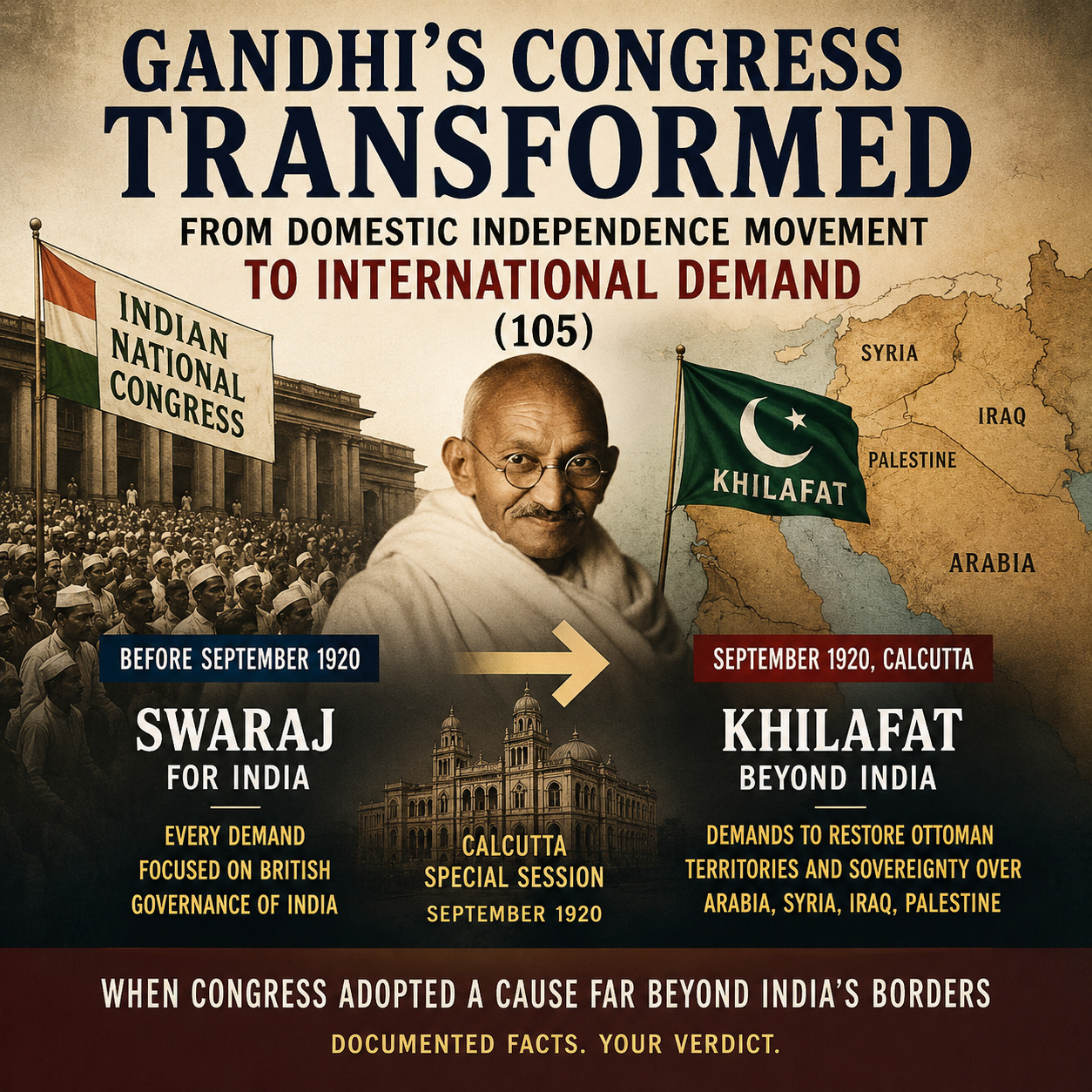
Gandhi’s Congress Transformed: From Domestic Independence Movement to International Demand (105)
भारत / GB
Part 105: Mahatma Gandhi’s Peace Efforts | Series Index
Blog 103 documented Gandhi’s own word for the Khilafat cause — “opportunity of a lifetime” — and what he overruled to pursue it. Blog 104 placed Gandhi’s own documented record on Islam before the reader in chronological sequence — 1909 through 1940. This post examines the structural consequence of the September 1920 decision: what Congress formally became when Gandhi merged its cause with the Khilafat Movement at the Calcutta session.
Thank you for reading this post, don't forget to subscribe!The Action Taken: In response to controversy over Mohamed Ali’s speeches regarding an Afghan invasion, Gandhi wrote in Young India: “I would rather see India perish than that she should not help the Amir of Afghanistan if he invaded to free the Caliph.”
Who Paid the Price: National territorial security, subordinated to an extra-territorial religious commitment to liberate the Ottoman Sultanate.
The Alternative Bypassed: An unequivocal declaration that any foreign military invasion of Indian territory would be resisted by the national movement.
Why This Matters: Recorded verbatim in the CWMG: the supreme leader of the independence movement explicitly stated a willingness to see India fall rather than refuse aid to a foreign invading monarch fighting for the Caliph.
What Congress Was Before September 1920
Gandhi’s Congress Transformed places the documented character of the Indian National Congress before the reader as the starting point.
The Indian National Congress was a domestic organisation pursuing independence efforts during the period. Its documented purpose was Indian self-rule — Swaraj — against British colonial authority exercised within India. Its demands, across its existence from 1885 through 1919, were directed at British governance of India: representative institutions, civil rights, economic policy, constitutional reforms. Every documented Congress demand prior to 1920 was a demand about what Britain did inside India.
The Muslim League, Congress’s rival for Muslim political representation, was similarly a domestic organisation — its documented demands, including Jinnah’s Fourteen Points examined in Blog 81, were framed within Indian constitutional arrangements. The entire documented constitutional debate of 1909 through 1919 was about the internal structure of governance of the Indian subcontinent.
What Congress Formally Adopted in September 1920
Gandhi’s Congress Transformed places the documented Khilafat demands before the reader alongside the Congress adoption.
The three documented Khilafat demands, established in Blog 102: the Khalifa must retain control over Muslim holy places; pre-war territories must be restored to the Khalifa; and the regions of Arabia, Syria, Iraq, and Palestine must remain under Muslim sovereignty. These were not Indian territories. Arabia, Syria, Iraq, and Palestine were former Ottoman territories, administered by Britain and France under post-war League of Nations mandates following the Treaty of Sèvres of August 10 1920.
At the September 1920 Calcutta special session, Gandhi convinced Congress to formally adopt these demands alongside Swaraj. By this documented intervention, Congress — India’s domestic independence organisation — formally adopted demands requiring Britain to reverse its entire post-war Middle Eastern settlement, restore the territorial sovereignty of a defeated foreign empire across territories thousands of miles from India, and return control of Arabia, Syria, Iraq, and Palestine to an Ottoman Sultan whose empire had fought alongside Germany in the First World War.
What the Transformation Meant Structurally
Gandhi’s Congress Transformed places the documented structural consequence before the reader.
A domestic independence movement fighting for Indian self-rule was one kind of political organisation. A movement that simultaneously demanded Britain reverse its post-war Middle Eastern foreign policy was a different kind. The Khilafat demands, adopted by Congress in September 1920, extended the organisation’s formal objectives from Indian governance to British imperial policy in the Arab world. The two causes — Swaraj and Khilafat — were not structurally compatible as a single movement’s objectives. Swaraj required Britain to transfer power within India. Khilafat required Britain to reverse its foreign policy across the Middle East. One was a demand about what Britain did at home; the other was a demand about what Britain did internationally. Gandhi’s Congress Transformed places this documented structural distinction before the reader: the September 1920 Calcutta session produced an organisation formally committed to both simultaneously, by Gandhi’s own documented intervention in both the Khilafat Conference and the Congress session.
The British documented their own assessment of this transformation. The Viceroy’s correspondence and British intelligence records from 1920-1921 treated the Khilafat-Non-Cooperation merger as qualitatively different from any previous Congress agitation — precisely because it carried a transnational, pan-Islamic dimension that domestic reform demands had never carried. A Congress demanding constitutional reforms was a manageable domestic political challenge. A Congress formally aligned with pan-Islamic territorial demands touching Britain’s Middle Eastern position was a different strategic problem entirely.
Gandhi’s Congress Transformed places one further documented fact before the reader: the Khilafat demands were not met. Britain did not reverse the Treaty of Sèvres. Arabia, Syria, Iraq, and Palestine did not revert to Ottoman sovereignty. The Caliphate was abolished by the Turks themselves in 1924. Congress had formally adopted demands that produced nothing for India, nothing for the Khalifa, and nothing for the Muslim populations whose cause Gandhi had adopted — while the documented domestic consequences of the alliance within India are examined in the blogs that follow.
The Prosecution’s Position
Gandhi’s Congress Transformed places three questions before the reader.
- Did Gandhi’s documented September 1920 intervention transform Congress from a domestic independence organisation into one that formally adopted demands requiring Britain to reverse its post-war Middle Eastern territorial settlement — demands that extended thousands of miles beyond India’s borders?
- Did the British themselves document a qualitatively different assessment of the Khilafat-Non-Cooperation merger — treating it as a transnational strategic challenge distinct from previous domestic Congress agitation?
- Did the documented outcome — Khilafat demands unmet, Caliphate abolished by the Turks, the alliance producing documented communal consequences inside India — belong before the reader alongside the documented transformation Gandhi’s intervention produced?
The series does not answer. Gandhi’s Congress Transformed places the documented pre-1920 character of Congress, the documented September 1920 adoption, and the documented structural consequence before the reader. The reader will examine what Congress became — and complete the sentence.
Invitation To Defence
The floor belongs to the defense. We now invite them to present their exhibits and challenge the narrative established by the prosecution.
Before September 1920: Congress — a domestic independence organisation, every demand directed at British governance of India. September 1920, Calcutta: Gandhi secures formal adoption of Khilafat demands alongside Swaraj — restore Ottoman territories, restore sovereignty over Arabia, Syria, Iraq, Palestine. Not Indian territories. Former Ottoman lands under British and French post-war mandates. A domestic independence movement formally adopted a foreign empire’s territorial restoration as its own cause. The prosecution places the documented transformation before the reader. The reader will complete the sentence.
Feature Image: Click here to view the image.
Videos
Glossary of Terms
- Indian National Congress: The political organization established in 1885 that led India’s constitutional and independence movement against British rule.
- Swaraj: The demand for self-rule and transfer of governing authority from British colonial administration to Indians.
- Khilafat Movement: A political campaign supporting the continuation of the Ottoman Caliphate after the First World War.
- Caliph (Khalifa): The traditional political and religious head of the Sunni Islamic world under the Ottoman Empire.
- Ottoman Empire: A multinational empire that ruled much of West Asia, North Africa, and southeastern Europe until its dissolution after the First World War.
- Treaty of Sèvres: The peace treaty signed on 10 August 1920 that dismantled the Ottoman Empire and redistributed much of its territory.
- League of Nations Mandates: Territories formerly controlled by defeated powers that were administered by Britain and France under international supervision after the First World War.
- Calcutta Special Session (1920): The September 1920 special session of the Indian National Congress where Gandhi secured adoption of Non-Cooperation and Khilafat objectives.
- Non-Cooperation Movement: Gandhi’s nationwide movement urging Indians to withdraw cooperation from British institutions through peaceful resistance.
- Pan-Islamic Movement: A political movement advocating solidarity among Muslims across national boundaries in support of common political or religious objectives.
- Structural Transformation: The fundamental change in an organization’s formal objectives, scope, or institutional character.
- Domestic Independence Movement: A political movement focused solely on achieving constitutional or political change within its own country’s boundaries.
- International Territorial Demand: A political objective seeking changes in sovereignty or administration beyond a nation’s own borders.
- British Imperial Policy: The strategic, diplomatic, and administrative policies adopted by Britain for governing and protecting its empire.
- Gandhi’s Congress Transformed: A key phrase in this series describing the documented change in Congress’s objectives after the adoption of the Khilafat demands in September 1920.
#Gandhi #Congress #Khilafat #Swaraj #India #History #Freedom #Calcutta #Ottoman #BritishRaj #Independence #Politics #HinduinfoPedia
Gandhi’s Peace Efforts: The Questions Before the Mahatma (0)